Whether a Bernedoodle Is Good With Strangers
A Bernedoodle may greet strangers with a wagging tail, hang back until it feels comfortable, or ignore new people altogether. That uncertainty can be stressful when visitors arrive or a friendly passerby reaches to pet your dog. This guide explains what stranger behavior can look like, how to build comfort safely, and when to get extra help.
How Bernedoodles May Act Around Strangers
There is no single Bernedoodle temperament
Bernedoodles are a cross between Bernese Mountain Dogs and Poodles, but that does not make every dog predictably outgoing. A puppy may inherit a sociable, people-focused nature, a more reserved tendency, or a mix that changes with the setting. Even dogs from the same litter can respond differently to unfamiliar people.
Some Bernedoodles greet visitors enthusiastically. Others watch from a few feet away before choosing whether to approach. A dog that stands quietly beside you rather than soliciting attention is not necessarily unhappy or unfriendly. It may simply prefer to observe first.
It helps to set a realistic goal: your dog does not need to love every stranger. Being able to stay relaxed, create space, and recover from a surprise is often more useful than expecting a greeting. The related guide Whether a Bernedoodle Is Naturally Reserved explores why a Bernedoodle may be cautious without being a problem dog.
Genetics, early experience, and the moment all matter
Temperament is shaped by more than breed. Inherited traits can influence a dog’s baseline confidence, but early handling, social experiences, health, and the particular situation can also affect its behavior. A Bernedoodle that is comfortable meeting a quiet neighbor in the yard may feel differently when surrounded by strangers in a busy shop.
The stranger’s behavior matters too. A person who turns sideways, speaks softly, and lets the dog approach at its own pace is easier for many dogs to handle than someone who leans over, reaches for the head, or crowds them in a doorway. Children can be especially difficult for a dog that has not had calm, positive exposure to their quick movements and unpredictable voices.
Watch the whole picture rather than relying on a wagging tail alone. Loose muscles, a soft face, and the ability to sniff and then disengage can suggest comfort. A stiff body, tucked tail, repeated lip licking, turning away, or trying to hide may mean your dog needs more space. Those signs are worth respecting, even if no growl or bark occurs.
Friendly does not have to mean eager to be petted
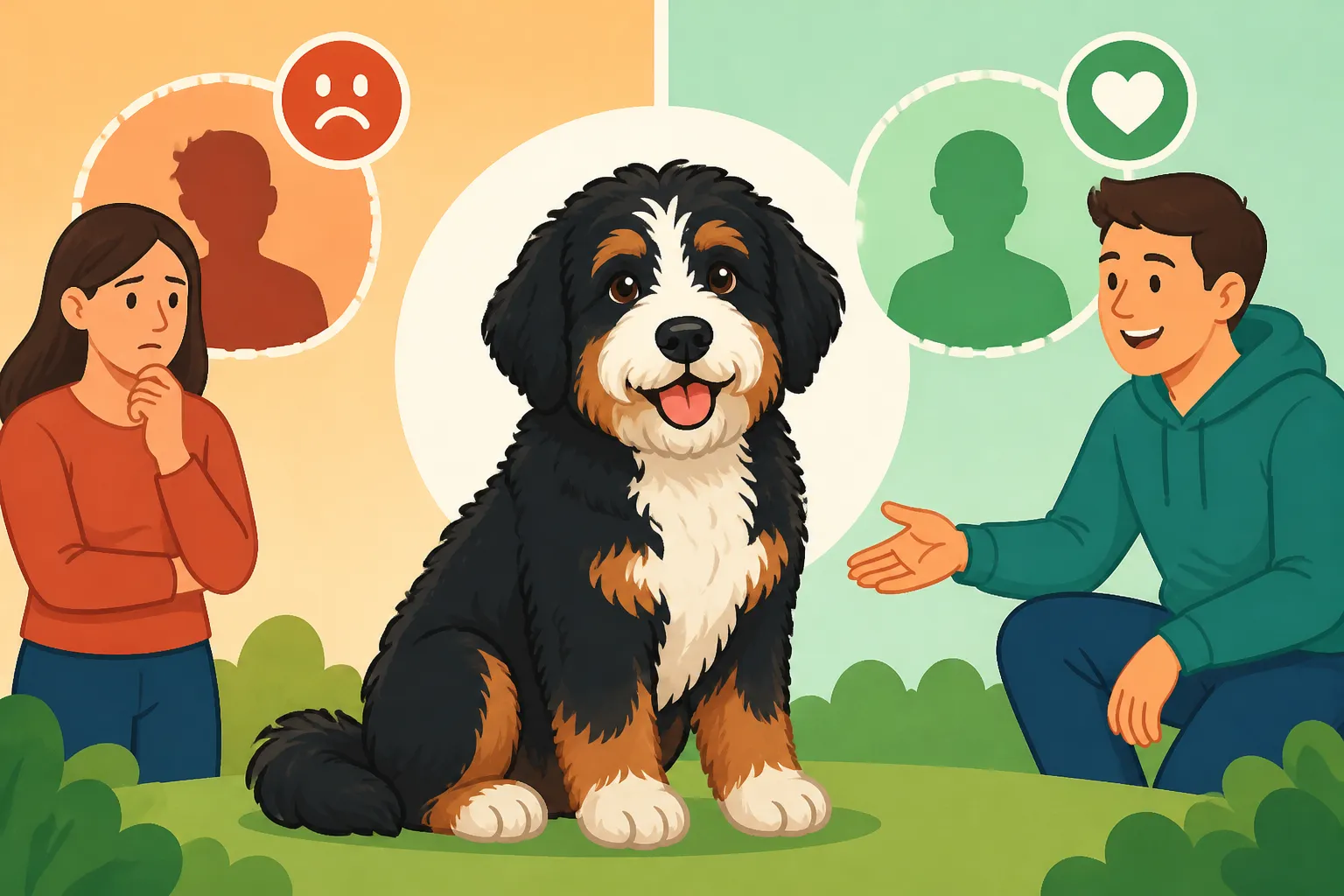
Owners sometimes feel awkward when a stranger asks to pet their “friendly” dog and the dog steps away. You are allowed to say no. Polite distance is a valid response, and preventing unwanted contact can help your Bernedoodle feel safer rather than forcing it to endure a greeting.
Try a simple, calm explanation: “We’re practicing giving people space,” or “Please let him approach you first.” If your dog does choose to approach, ask the person to keep their hands low and avoid leaning over the dog. A brief interaction followed by a pause gives your Bernedoodle an opportunity to move away.
For a broader look at sociability, see Whether a Bernedoodle Is Friendly With Strangers. The key is not to label every cautious moment as shyness or every excited greeting as good manners. The practical question is whether your dog can handle everyday encounters safely and recover without becoming overwhelmed.
How to Help a Bernedoodle Feel More Comfortable
Start with calm exposure, not forced greetings
Socialization is not a requirement to meet as many people as possible. It is the gradual experience of seeing different people and environments while feeling safe. For a puppy, that can mean watching a person walk past from a comfortable distance, hearing a visitor talk quietly, or seeing someone in a hat without being approached.
Let your Bernedoodle decide whether to move closer. If it notices a stranger and remains relaxed, calmly reward that choice with a small treat or gentle praise. If it turns away or retreats, do not lure it closer just to complete a greeting. Giving the dog room to choose can prevent a manageable concern from becoming a frightening encounter.
For a young puppy, thoughtful exposure during early development can be helpful, but it should be balanced with health precautions and your veterinarian’s guidance. The article Socializing a Bernedoodle Before Twelve Weeks discusses early experiences, while Socializing a Bernedoodle Before Full Vaccination focuses on balancing exposure with sensible safety choices.
Use distance as a training tool
When a Bernedoodle is worried, moving farther away is often more useful than asking it to “sit” while a stranger approaches. Distance reduces pressure and gives the dog a chance to notice the person without feeling trapped. If your dog can look at someone and then turn back toward you, you are likely at a more workable distance than if it is barking, freezing, or trying to escape.
A simple practice routine can look like this:
- Find a place where people pass at a distance your dog can manage.
- Let your Bernedoodle notice a person without pulling it toward them.
- Reward calm observation or a voluntary glance back at you.
- Leave or increase distance if your dog stiffens, hides, or becomes noisy.
- Repeat in short sessions and stop while your dog is still coping.
You can use treats your dog already enjoys. If you need a treat pouch or training supplies to make rewards easier to deliver, Chewy is one place owners may check for basic training gear. The equipment is secondary, though; the important part is pairing the sight of a stranger with a calm, manageable experience.
Make visitor routines predictable
Doorways are a common flashpoint. The doorbell rings, people enter, coats and bags move around, and a dog may feel crowded before anyone has even greeted it. A predictable routine can make these moments easier. Before opening the door, put your dog behind a gate, on a leash with space to move, or in a comfortable room with a chew or food toy.
Ask visitors to ignore your Bernedoodle at first. That means no staring, reaching, calling the dog over, or following it if it walks away. If the dog settles, you can invite a low-pressure interaction later, but the dog should remain free to retreat. For some dogs, calmly sharing a room without being touched is a successful visit.
If your Bernedoodle is more comfortable behind a barrier, that is not a failure. It may be the safest arrangement while it learns that guests do not have to approach. A food toy can help occupy the dog during arrivals; owners looking for one may find options through Chewy, but choose an item suited to your dog’s size and chewing habits and supervise its use.
Reading Caution, Fear, and Possible Aggression
A dog that backs away is communicating
A Bernedoodle that moves behind you, lowers its body, or avoids eye contact may be asking for space. It is tempting to reassure the dog by coaxing it toward a friendly visitor, especially when the visitor insists, “Dogs love me.” But allowing the retreat is often the more considerate choice.
Avoid punishing warning signals such as growling. A growl communicates discomfort; suppressing it does not necessarily remove the underlying fear. Instead, calmly create distance and prevent the person from continuing to approach. If the behavior is new or appears alongside signs of pain or illness, discuss the change with a veterinarian.
The article A Bernedoodle That Backs Away From Strangers looks more closely at this pattern. For a dog that seems unsure rather than simply selective, Building Confidence in a Timid Bernedoodle offers related guidance on supporting confidence gradually.
Distinguish reserve from distress
A reserved Bernedoodle may choose not to greet someone but remain loose, able to take treats, and comfortable staying nearby. A distressed dog may freeze, bark repeatedly, pull hard to escape, hide, or struggle to recover even after the person has gone. The difference is not always obvious in one moment, so notice how quickly your dog returns to normal and whether the reaction is becoming more intense or frequent.
Keep brief notes after difficult encounters: where you were, how close the stranger came, what the person did, and what your dog did next. A pattern may emerge. For example, your dog may be comfortable with people outdoors but anxious when strangers enter the home, or may react most strongly when someone reaches over its head.
| What you notice | What it may suggest | Helpful first response |
|---|---|---|
| Loose body, brief sniff, then moving away | Comfortable curiosity or a preference for distance | Let the dog disengage without calling it back |
| Turning away, tucked tail, hiding behind you | Uncertainty or fear | Increase space and ask people not to approach |
| Stiff posture, fixed attention, repeated barking | Rising stress or discomfort | Move away calmly and end the interaction |
| Growling, snapping, or lunging | A serious safety concern that needs management | Prevent access to strangers and seek qualified help |
These observations do not diagnose a behavior problem. They help you respond earlier and explain the situation clearly if you consult a professional. Avoid testing your dog by asking strangers to approach “to see what happens.”
Get help early if safety is becoming uncertain
If your Bernedoodle has snapped, bitten, lunged, or is difficult to control around strangers, prioritize management. Use secure barriers, a leash that you can safely handle, and enough distance to prevent people from reaching the dog. Tell visitors clearly not to approach or touch the dog. Do not rely on a “he’s usually sweet” warning after an incident.
A veterinarian can check for pain or other health changes that may affect behavior. For ongoing fear or aggression, ask about working with a qualified, reward-based trainer or veterinary behavior professional. A professional can help you develop a plan that fits your dog’s history and the risks in your household. The related topic Whether a Bernedoodle Is Ever Aggressive explains why breed labels alone cannot determine how an individual dog will respond.
Everyday Situations and Practical Expectations
Plan for greetings on walks and in public
You do not need to let every passerby greet your Bernedoodle. On a walk, step to the side, change direction, or use a parked car or other visual barrier if your dog needs room. A simple “We’re not greeting today” helps prevent well-meaning people from moving in before you can respond.
If your dog is comfortable watching people from a distance, reward calm attention and keep moving. If it becomes overwhelmed in a crowded setting, leave rather than waiting for it to “get used to it.” Repeated exposure at too close a distance can make the situation harder, not easier.
At a café patio, neighborhood gathering, or busy park, choose a spot where your dog can rest without strangers passing right beside it. Bring water and familiar rewards, and keep the first visits short. The aim is not to prove that your Bernedoodle can tolerate everything; it is to build a history of manageable experiences.
Help children and visitors interact safely
Children should not be expected to read subtle dog body language or manage a greeting on their own. An adult should supervise closely and prevent hugging, climbing, cornering, or chasing. Even a dog that has been gentle in the past may become uncomfortable when it cannot move away.
For visiting adults, explain the plan before they arrive. Ask them to leave the dog alone at first and avoid reaching into its bed, crate, or resting space. If your dog approaches, the visitor can offer a treat by tossing it onto the floor rather than using a hand to lure the dog closer. This lets the dog collect the reward and retreat if it wants to.
A dog’s comfort can change from day to day, particularly in a busy household or after a stressful event. Keep an eye on interactions rather than assuming that a successful greeting last week guarantees the same response today. The article Whether a Bernedoodle Is Aloof Rather Than Shy may help owners think through the difference between a dog that prefers less attention and one that seems genuinely worried.
A Bernedoodle can be sociable with strangers, but friendliness is not guaranteed by its name or appearance. Let the dog set the pace, reward calm choices, and make space when it asks for it. Those habits make encounters more predictable for your dog, your guests, and anyone you pass on the sidewalk.
Disclaimer
This article is for general informational purposes only and does not constitute professional advice. Laws, prices and regulations vary by location and change over time. Consult a qualified professional for guidance on your specific situation.