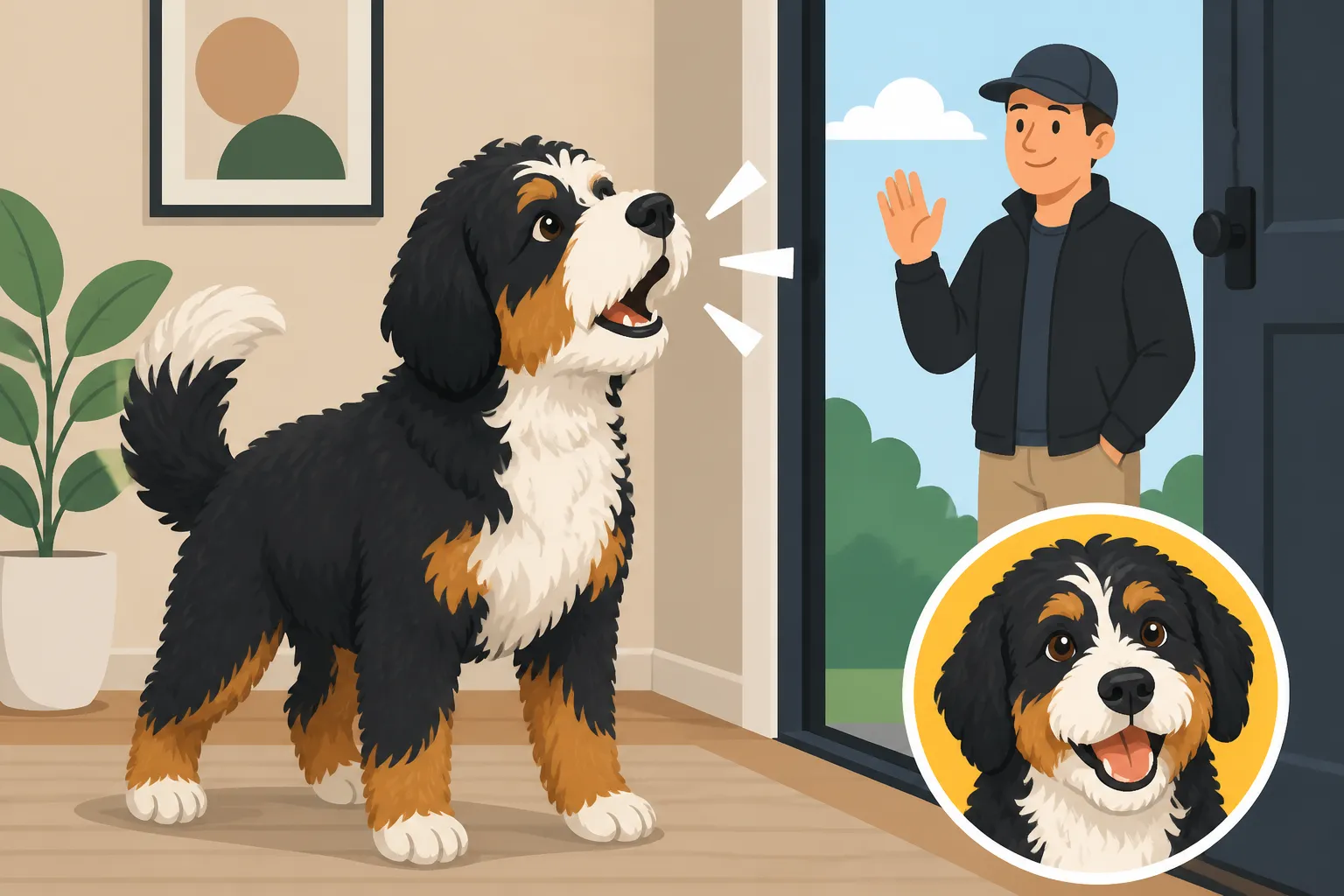
Whether a Bernedoodle Announces Visitors
It’s a common scenario: you hear the doorbell, and before you can even think about answering, your Bernedoodle has launched into a symphony of barks, sometimes accompanied by jumping, spinning, or a full-body wiggle. It's a sweet thought that they're just excited to see your guests, but the reality can be a bit… much. If you've ever wondered whether your Bernedoodle will announce visitors with polite alerts or a full-blown canine concert, you're in the right place. This guide will help you understand their natural tendencies and give you actionable steps to manage their greetings, ensuring a calmer, more enjoyable welcome for everyone.
Understanding Your Bernedoodle's "Welcome" Committee
When that doorbell rings or someone knocks, your Bernedoodle isn't just making noise for the sake of it. There's a whole lot of instinct and personality rolled into that furry package, influenced heavily by their parent breeds. It’s like having a little bit of the serene mountain guardian and the sharp-witted performer all in one, and how they combine dictates their initial reaction to someone new at the door.
The Bernese Mountain Dog Influence on Alertness
Let's talk about the Bernese Mountain Dog side first. These are magnificent, loyal dogs, originally bred for farm work in the Swiss Alps. Part of their job involved guarding the homestead and livestock, which means they have a natural inclination to be aware of their surroundings and to alert their family to anything unusual. This isn't usually an aggressive tendency, but rather a deep-seated desire to inform their people that something is up.
So, when a stranger approaches the house, that deep, resonant "woof" you hear? That's often the Bernese coming through. They're letting you know, very clearly, that someone is there. They might not be planning to chase the person off, but they certainly aren't going to let an unknown presence go unnoticed. It’s a trait that can be endearing when it's a polite "ding-dong, person here," but can become overwhelming if it escalates into prolonged, frantic barking. Their size also means their bark carries a good deal of authority, even if they're just trying to be your personal doorbell.
The Poodle's Contribution to Vigilance
Then there's the Poodle. Don't let their fancy haircuts fool you; Poodles are incredibly intelligent, sensitive, and often quite vigilant. They were originally water retrievers, which required keen observation and quick reactions. They are also known for being very attuned to their environment and their people, often picking up on subtle changes or new stimuli with remarkable speed.
A Poodle's bark can often be higher-pitched and more persistent than a Bernese's. They might use their vocalizations to express excitement, anxiety, or simply to draw attention to something. In the context of visitors, a Poodle's influence might mean your Bernedoodle is quicker to react to the sound of a car pulling up or a distant conversation, and their barking might have a more insistent, sharp quality. This sensitivity, combined with the Bernese's watchful nature, can create a dog that is incredibly effective at alerting you to anything new, whether it's a genuine threat or just the Amazon delivery driver.
The Blended Approach: What to Expect
So, what does this mix mean for your Bernedoodle? It means you're unlikely to have a truly silent greeter, at least not without some intentional training. Most Bernedoodles will fall somewhere on the spectrum of being an "announcer." Some might offer a couple of barks, wag their tail, and then settle down once they see you're okay with the visitor. Others might continue to bark, jump, and demand attention from the newcomer, especially if they haven't been taught how to manage their excitement.
It's also worth noting that every Bernedoodle is an individual. You might have one with a very strong Bernese protective streak, leading to more pronounced territorial barking. Another might lean heavily on the Poodle's sensitivity, reacting to every little sound with a rapid series of barks. The key is to recognize that alerting to visitors is a natural, ingrained behavior for many Bernedoodles. It's not necessarily "bad," but it's something that often needs guidance and management to ensure it doesn't become problematic or stressful for your household. Thinking about The Stubborn Streak Under a Bernedoodle's Poodle Brain can help you understand that while they are smart, consistency is crucial to overcome their strong instincts.
Why Your Bernedoodle Barks at the Door
It’s easy to get frustrated when your Bernedoodle erupts into a barking fit every time the doorbell rings. But understanding why they do it is the first step toward helping them adjust. It’s rarely out of malice; more often, it stems from a mix of instinct, emotion, and sometimes, even our own unintentional training cues.
A Matter of Territory and Protection
At their core, many dogs view their home and yard as their territory and their human family as their pack. When someone approaches that territory, especially an unknown entity, their instinct is to alert the pack. For a Bernedoodle, with its Bernese heritage, this territorial alertness can be quite strong. They aren't necessarily trying to be aggressive, but rather acting as a very enthusiastic, albeit loud, sentinel.
Imagine it from their perspective: a strange person is coming directly to your den. It’s their job, as far as their ancient instincts are concerned, to make noise and investigate. This kind of barking often has a deeper tone and might be accompanied by rushing to the door, standing tall, and watching intently. They are saying, "Hey! Who are you? And why are you here?" This primal urge to protect and alert can be quite powerful, even in the most laid-back Bernedoodle. They genuinely believe they are performing an important duty for you.
Excitement, Anxiety, or Under-Socialization
Beyond territoriality, barking at visitors can also stem from a few other places. One of the most common is sheer excitement. Bernedoodles are often goofy, friendly dogs who adore people. So, when someone new arrives, it's like a party in their mind! They bark because they're thrilled, eager to greet, and full of pent-up energy. This kind of barking is usually higher pitched, more frantic, and often accompanied by a wildly wagging tail and bouncy body language. They just want to say hello, but they haven't quite learned the polite way to do it.
On the flip side, some Bernedoodles bark out of anxiety or fear. If they haven't been properly socialized from a young age, meeting new people can be genuinely scary. A lack of positive exposure to various types of people, sounds, and environments during their crucial puppy development period can lead to shyness or even fear-based reactions. This kind of barking might be accompanied by backing away, tucked tail, flattened ears, or even a low growl. It’s their way of saying, "Stay away, I'm uncomfortable." It's critical to understand the nuances of this behavior, particularly if you notice A Bernedoodle That Backs Away From Strangers. Addressing this early with proper Socializing a Bernedoodle Before Twelve Weeks can make a huge difference in their adult demeanor.
Learned Behavior and Reinforcement
Sometimes, we inadvertently teach our Bernedoodles that barking at the door is a great idea. Think about it: when the doorbell rings and your dog barks, what do you do? Most of us immediately go to the door. From your dog's perspective, "I barked, and a human appeared at the door! Success!" This is positive reinforcement. Even if you're rushing to quiet them, the act of giving them attention, even negative attention like scolding, can still be seen as a reward by a dog craving interaction.
Every time they bark and you react – whether it's by talking to them, touching them, or rushing to the door – you're strengthening that behavior. It's not your fault; it's a natural human reaction. But recognizing this cycle is key to breaking it. They've learned that barking is the most effective way to communicate "doorbell!" and get a reaction from you. This learned behavior can become deeply ingrained, making it a challenge to unlearn without consistent effort and alternative training. This can be especially true if you are Raising a Bernedoodle Puppy That Will Outweigh You and their sheer size makes their barking even more impactful.
Strategies for a Quieter Welcome
Okay, so we know why they do it. Now, let’s talk about how to help your Bernedoodle become a more polite greeter. It’s not about stopping them from announcing visitors entirely—that’s often unrealistic—but about teaching them to alert you calmly and then settle, rather than continuing a frantic barking session. Consistency and patience are your best friends here.
Early Socialization and Exposure
This cannot be stressed enough: early, positive socialization is the foundation for a well-adjusted Bernedoodle. From the moment you bring your puppy home, expose them to a wide variety of people, sights, sounds, and experiences in a safe and controlled manner. Invite different kinds of people over – men, women, children, people in hats, people with glasses, people with walkers. Make every encounter a positive one with treats and praise.
The goal isn't just for them to see these things, but to associate them with good feelings. If your Bernedoodle learns that new people mean yummy treats and gentle praise, they're much less likely to react with fear or over-excitement later on. Even if you have an older Bernedoodle, you can still work on positive associations, though it might take a bit longer. For a truly timid Bernedoodle, working on Building Confidence in a Timid Bernedoodle will be paramount. Remember that a Bernedoodle's adolescence can be a challenging time, as discussed in The Age a Bernedoodle Stops Acting Like a Puppy, so keeping up with socialization even then is important.
Training "Quiet" and "Go to Mat"
One of the most effective ways to manage door barking is to teach two core commands: "Quiet" and "Go to Mat" (or "Place").
Teaching "Quiet":
- Provoke a Bark: Have someone knock or ring the doorbell (or use a recording). Let your Bernedoodle bark once or twice.
- Interrupt and Reward: The moment they stop barking, even if it's just to take a breath, say "Quiet!" in a calm, firm voice and immediately reward them with a high-value treat.
- Increase Duration: Gradually increase the time they need to be quiet before getting the treat. Start with just a second of silence, then two, then three, building up slowly.
- Repeat, Repeat, Repeat: Practice this many times throughout the day, in different scenarios, and with different sounds. The key is to reward the absence of barking.
Teaching "Go to Mat" (or "Place"):
- Designate a Spot: Choose a mat, bed, or crate that is specifically their "place."
- Lure to Spot: Lure your Bernedoodle onto the mat with a treat. As soon as they are on it, say "Place!" and reward them.
- Build Duration: Have them stay on the mat for increasing periods, always rewarding calm behavior.
- Add Distractions: Once they are solid on the mat, start adding distractions, like you walking away, or eventually, the doorbell ringing. The goal is for them to go to their mat and stay there calmly when visitors arrive.
The combination of these two commands allows you to actively manage their barking and redirect their excitement. Don't forget that finding What a Bernedoodle Will Work For (high-value treats!) will make this training much more effective.
Managing the Environment
While training is crucial, sometimes you need immediate management strategies, especially when unexpected guests arrive.
- Doorbell Desensitization: Record your doorbell or have a friend ring it randomly throughout the day, but don't open the door. When your Bernedoodle barks, practice your "Quiet" command. Over time, the sound of the doorbell will lose its power to trigger an immediate, frantic response.
- Physical Barriers: Use baby gates or a crate to keep your Bernedoodle away from the immediate entryway when you know guests are coming. This prevents them from rushing the door and creates a calmer entry. If you have a large standard Bernedoodle, consider a robust gate that can withstand their enthusiastic lean, as they love to put A Bernedoodle That Leans on Everyone. You can find various sizes and strengths on Amazon for different home layouts.
- Window Film or Blinds: If your Bernedoodle barks at people walking by outside, consider frosted window film or keeping blinds closed, especially in rooms facing the street. Out of sight, often means out of mind.
- Calming Aids: Some Bernedoodles benefit from calming aids like diffusers (e.g., Adaptil), calming chews, or thundershirts if their barking is rooted in anxiety. These aren't magic bullets but can help reduce overall stress levels, making training more effective.
- Leash Management: For dogs that are truly difficult at the door, having them on a leash when you anticipate guests can provide crucial control. This allows you to guide them to their mat or gently correct unwanted jumping or persistent barking. This is particularly important with Leash Manners on a Bernedoodle Heading for Ninety Pounds.
Professional Help and Online Resources
If you're struggling to make progress, don't hesitate to seek professional help. A certified professional dog trainer can assess your Bernedoodle's specific behavior and develop a tailored plan. They can offer hands-on guidance and troubleshoot challenges you might be facing. Group classes can also be excellent for continued socialization and working on polite greetings in a structured environment.
There are also fantastic online resources available. Platforms like BAXTER & Bella offer comprehensive puppy and dog training programs, including modules on door manners and polite greetings. These can be a great option if in-person training isn't feasible or if you prefer to work at your own pace from home. They often provide step-by-step videos and support to guide you through common behavior challenges. Sometimes, the issue isn't just about visitors, but also about general anxiety when left alone, as discussed in Whether a Bernedoodle Suffers Separation Anxiety, which a professional can also help address.
Beyond the Bark: Reading Your Bernedoodle's Cues
While barking is the most obvious way a Bernedoodle announces visitors, it's not the only way. Understanding their body language and the nuances of their vocalizations can give you a much clearer picture of what they're trying to communicate, helping you respond more effectively.
Body Language Speaks Volumes
Your Bernedoodle's body tells a whole story before, during, and after a visitor arrives. Learning to read these cues can help you understand if their barking is from excitement, fear, or pure territoriality, allowing you to choose the right management or training approach.
- Excitement: A loosely wagging tail (often wiggling their whole body), ears perked but not stiff, a play bow, or jumping up and down (which you'll want to train out with Teaching a Bernedoodle Not to Jump on Guests) usually indicate a dog that's thrilled to see someone. Their bark might be higher pitched and more erratic.
- Alertness/Territoriality: A stiff body, ears forward, tail held high (or sometimes still), a direct stare at the door, and a low, rumbling bark often signal a dog on alert. Their hackles might even be raised (the hair along their spine). This isn't necessarily aggression, but a declaration of "I see you!"
- Fear/Anxiety: A tucked tail, ears flattened back, backing away, licking their lips, yawning, or panting can all indicate fear or discomfort. Their bark might be whiny, high-pitched, or mixed with growling if they feel cornered. They might try to hide behind you or furniture. If this is the case, your focus should be on building confidence and positive associations, rather than just suppressing the bark. Sometimes, this can look like a Bernedoodle that hides behind its owner.
- Calm Curiosity: A relaxed posture, tail wagging slowly or held naturally, ears relaxed, and a sniff of the air without intense staring shows a dog that is curious but not overly aroused. This is the ideal state you're aiming for during greetings.
Observing these subtle (and not-so-subtle) cues helps you go beyond just "barking" and understand the emotional state driving the behavior.
Different Barks for Different Folks
Just like humans have different tones for different situations, your Bernedoodle's barks aren't all the same. They can vary in pitch, intensity, and duration depending on who or what is at the door.
For example, the sharp, rapid barks they unleash at the mail carrier, who they probably see every day but never interact with, are likely different from the excited yips they give when their favorite aunt pulls into the driveway. A deeper, more sustained bark might be reserved for an unfamiliar utility worker in their yard, signaling a stronger sense of territoriality.
Here's a quick guide to help you differentiate:
| Bark Type | Description | Common Context | Bernedoodle's Emotion (Likely) |
|---|---|---|---|
| Alarm Bark | Deep, loud, sustained, often accompanied by rushing to the door. | Mail carrier, unfamiliar person at door, unexpected noise outside. | Alertness, territoriality, vigilance. |
| Greeting Bark | Shorter, enthusiastic bursts, often higher-pitched, coupled with body wiggles and tail wagging. | Known visitor, family member, friend they haven't seen in a while. | Excitement, happiness, eagerness to play. |
| Attention Bark | Repetitive, insistent, sometimes whining, directed at you. | Wants to go out, wants to play, needs something, or wants you to notice the visitor. | Frustration, demand, seeking interaction. |
| Anxious Bark | Whining, low growl, backing away, ears back, perhaps trembling. | Unfamiliar person or situation they perceive as threatening or overwhelming. | Fear, discomfort, insecurity. |
By learning to interpret these different barks and body language signals, you can fine-tune your response. Instead of just reacting to the noise, you can address the underlying emotion or intent. This makes your training more targeted and ultimately more effective in cultivating a Bernedoodle who announces visitors with a controlled, calm, and happy demeanor, rather than a cacophony of sound.
Disclaimer
This article is for general informational purposes only and does not constitute professional advice. Laws, prices and regulations vary by location and change over time. Consult a qualified professional for guidance on your specific situation.