Whether a Bernedoodle Reacts to Other Dogs on Leash
Oh, the classic leash reactivity dance! If you’ve ever found yourself bracing for impact every time another dog comes into view on your walk, your Bernedoodle transforming from a fluffy, friendly companion into a barking, lunging behemoth, then you are absolutely not alone. This guide is designed to help you understand why your Bernedoodle might be reacting to other dogs on leash, what those reactions actually mean, and practical strategies to bring peace back to your daily strolls.
Understanding Leash Reactivity in Bernedoodles
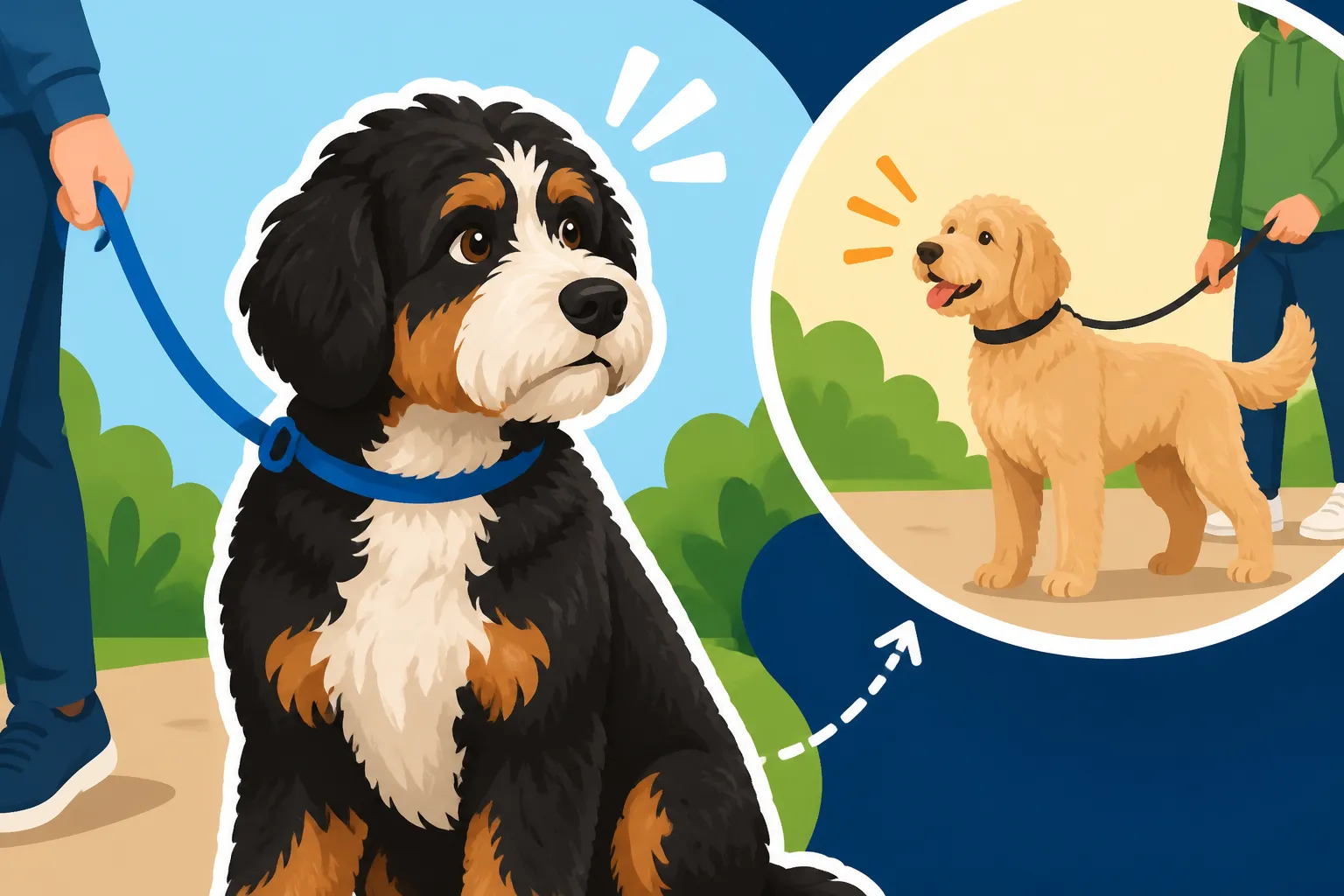
It’s easy to feel embarrassed or frustrated when your Bernedoodle acts out on leash, especially when they’re usually such sweet, goofy dogs. Many owners immediately jump to the conclusion that their dog is aggressive, but in most cases, leash reactivity isn’t about true aggression. It’s often a complex mix of emotions like fear, frustration, overexcitement, or even a lack of proper socialization.
Why Bernedoodles Exhibit Leash Reactivity
Bernedoodles inherit traits from both the Bernese Mountain Dog and the Poodle, and these can contribute to reactivity in different ways. Bernese Mountain Dogs, for instance, can be reserved with strangers and sometimes other dogs, preferring their familiar pack. This natural wariness can manifest as fear-based reactivity when confronted unexpectedly on a leash, especially if they feel trapped. On the other hand, Poodles are intelligent, alert, and can be quite sensitive. This sensitivity, coupled with high energy, can lead to over-arousal or frustration-based reactivity. When a Bernedoodle wants to greet another dog but is restrained by a leash, that pent-up energy and desire can quickly turn into a frustrated outburst.
It's crucial to remember that your dog isn't doing this to annoy you. They're genuinely struggling with an overwhelming situation. Think of it like a kid wanting a toy in a store – if they can't have it, they might throw a tantrum. For dogs, that "tantrum" can look like barking, lunging, and pulling. Understanding this can help shift your perspective from anger to empathy, which is the first step in helping your furry friend.
Common Triggers for Reactive Behavior
Leash reactivity isn’t usually a constant state; it's triggered by specific circumstances. Identifying these triggers is key to managing and ultimately resolving the behavior.
- Proximity and Sudden Appearance: A common trigger is the distance at which another dog appears. For some Bernedoodles, a dog across the street is fine, but one that pops out from behind a parked car is too much. The suddenness and closeness can be overwhelming.
- Specific Types of Dogs: Some Bernedoodles might react more intensely to certain breeds, sizes, or even colors of dogs. Perhaps they had a bad experience with a pushy small dog, or they find larger, more boisterous dogs intimidating.
- Location and Environment: A quiet walking trail might be perfectly calm, but a bustling city park with dogs, people, and children everywhere can be a minefield. High-stress environments amplify a dog's natural tendencies. Consider what your Bernedoodle’s threshold is for busy environments and try to avoid situations that consistently push them over that limit, especially when starting out with training.
- Handler Anxiety: Dogs are incredibly adept at reading our emotions. If you tense up, shorten the leash, and prepare for a reaction every time you see another dog, your Bernedoodle will pick up on that stress and anticipate a problem, often fulfilling that expectation.
The Impact of the Leash Itself
The leash, while essential for safety and control, can paradoxically exacerbate reactive behavior. This is often referred to as "leash frustration" or "barrier frustration." When a dog feels confined and unable to perform natural dog behaviors—like approaching another dog in a curved, polite way, or retreating if unsure—they can become frustrated. The leash acts as a barrier, preventing them from doing what their instincts tell them to do. This can turn a dog that might be perfectly fine with other dogs off-leash into a reactive mess when constrained.
Furthermore, the leash can become a "trigger" itself. If every time your Bernedoodle sees another dog on leash, they feel that sudden tension on their collar or harness, they start to associate the leash with the unpleasant feeling of being unable to move freely and the ensuing emotional outburst. It's a vicious cycle that we, as owners, inadvertently perpetuate without realizing it. Understanding Leash Manners on a Bernedoodle Heading for Ninety Pounds can provide a good foundation for preventing some of these issues.
Identifying the Signs of Leash Reactivity
Recognizing the early warning signs, both subtle and overt, is crucial. If you can catch your Bernedoodle's discomfort before they hit their "point of no return," you have a much better chance of redirecting their focus and managing the situation calmly.
Subtle Cues Before the Eruption
Long before the barking and lunging begins, your Bernedoodle will likely be giving off subtle signals that they're feeling uncomfortable or stressed. Learning to read these can be a game-changer.
- Stiffening or Freezing: Your dog might suddenly stop, or their body might become rigid as they spot another dog. This is often a precursor to a more overt reaction.
- Lip Licking or Yawning (Out of Context): If your Bernedoodle is lip licking or yawning when they haven't just eaten or woken up, it's often a sign of stress or anxiety.
- Whale Eye: This is when you can see the whites of your dog's eyes, usually around the outer edges, as they look sideways at something that makes them uncomfortable. It's a clear signal they're worried.
- Low Growl or Muffled Bark: Sometimes, before a full-blown bark, you might hear a low, rumbling growl, or a suppressed "woof" under their breath, almost as if they're trying to warn without fully committing.
- Ears Back or Tail Tucked: These are classic signs of fear or apprehension. While a happy dog might have a wagging tail or relaxed ears, a Bernedoodle with tucked tail or pinned-back ears is communicating distress.
By observing these subtle changes, you can intervene early – perhaps by changing direction, increasing distance, or engaging your dog with a fun game before they become too overwhelmed. This early intervention helps prevent the full reactive display and reinforces that you are there to help them feel safe. For some Bernedoodles, this behavior might stem from an underlying timidity, which is often seen in the Bernese side of their heritage. Learning how to identify The Shyness a Bernedoodle Gets From the Bernese can give you further insight.
The Overt Reactions You're Used To
These are the behaviors that typically cause embarrassment and stress for owners, but they are simply your Bernedoodle's way of communicating that they are past their coping threshold.
- Barking: Often loud, frantic, and persistent. It's usually an attempt to make the other dog go away.
- Lunging: A sudden, forceful forward motion towards the trigger, often straining against the leash. This can be intimidating and even dangerous if your Bernedoodle is Teaching a Bernedoodle Not to Pull at Eighty Pounds and you're caught off guard.
- Pulling: Intense, relentless pulling on the leash, making it difficult to control your dog or maintain your balance.
- Growling: A clear auditory warning, often accompanied by a hard stare or tensed body language.
- Hackles Raised: The hair standing up along your dog's spine, from their neck to their tail. This is an involuntary physiological response to arousal, whether from fear or excitement, and indicates a heightened state.
It’s important to understand that these aren’t necessarily signs of an "aggressive" dog, but rather a dog that is overwhelmed and trying to create distance or express intense frustration. Their communication might be rude by human standards, but it's their best attempt to handle a situation they find difficult.
Distinguishing Reactivity from True Aggression
This is a critical distinction for owners to make. While leash reactivity can look like aggression, especially to onlookers, it often isn't the same thing.
- Reactivity is often distance-increasing: A reactive dog typically wants the other dog to go away. Their barking and lunging are often attempts to scare the other dog off, rather than to engage in a physical fight. If given the space, many reactive dogs will actually try to avoid direct confrontation.
- Body language tells the story: A truly aggressive dog, one intending harm, might exhibit a more predatory stare, a low, stiff posture, and a direct approach with intent. A reactive dog, conversely, might show more signs of fear or conflict, such as averted gaze, tucked tail, or frantic, rather than calculated, movements.
- Frustration vs. Hostility: Many reactive Bernedoodles are simply frustrated that they can't greet (or get away from) the other dog, or they are over-stimulated. True aggression is about hostility.
Of course, any dog exhibiting these behaviors can bite if pushed too far, especially if they are consistently ignored or forced into situations they can't cope with. That's why addressing reactivity promptly is so important. By understanding your Bernedoodle’s communication, you can help them navigate a world that sometimes feels too big and too close. If you have a larger Bernedoodle, ensuring you have The Harness That Holds a Ninety Pound Bernedoodle can make managing these situations much safer for both of you.
Strategies for Managing and Improving Leash Reactivity
Addressing leash reactivity takes patience, consistency, and a multi-faceted approach. There's no magic bullet, but with the right strategies, you can significantly improve your Bernedoodle's comfort and your walking experience.
Management Techniques
Management is about preventing your Bernedoodle from practicing the reactive behavior. Every time your dog reacts, the behavior is reinforced, making it harder to extinguish. So, the first step is to avoid triggers as much as possible while you work on behavior modification.
- Avoiding Triggers: This means being hyper-aware of your surroundings. If you see another dog approaching, cross the street, duck behind a car, or turn around and walk the other way. It's not "giving in" to your dog; it's protecting them from a situation they can't handle and preventing them from practicing unwanted behavior.
- Changing Routes and Timing Walks: Explore quieter streets, empty fields, or visit parks during off-peak hours. If you know certain areas are always busy with dogs, simply avoid them for now. Early morning or late evening walks can be great for this.
- Using Appropriate Tools: A front-clip harness can be incredibly helpful for managing strong pullers. Unlike a traditional back-clip harness or a collar, a front-clip harness redirects your dog's momentum back towards you when they pull, making it much harder for them to lunge with full force. Many excellent options are available on Amazon that can provide better control without causing discomfort. Avoid tools like choke chains or prong collars, as these can increase anxiety and fear in a reactive dog, potentially worsening the problem.
| Technique | Description | Purpose |
|---|---|---|
| Avoidance | Changing routes, crossing streets, walking during off-peak hours. | Prevents reactive outbursts, reduces stress for dog and handler. |
| Redirection | Using treats or toys to focus dog away from trigger before a reaction. | Interrupts focus on trigger, creates positive association with handler. |
| Increase Distance | Moving further away from another dog when one is sighted. | Helps dog stay under threshold, allows for calmer training. |
| Use Equipment | Front-clip harnesses, head halters. | Provides better physical control, reduces pulling and lunging force. |
Behavior Modification: Counter-Conditioning and Desensitization
While management prevents the behavior, modification changes your Bernedoodle's emotional response to the trigger. This is where the real progress is made.
- Counter-Conditioning: This involves changing your dog's negative emotional association with other dogs into a positive one. The classic method is "Look at That" (LAT). The moment your Bernedoodle sees another dog before they react, mark the sighting (with a clicker or a verbal "yes!") and immediately give them a high-value treat. The goal is to make them think, "Oh, another dog! That means good things happen!" Start at a distance where your dog notices the other dog but doesn't react.
- Desensitization: This works hand-in-hand with counter-conditioning by gradually exposing your Bernedoodle to other dogs at increasing levels of intensity. You start at a distance where they are completely comfortable and slowly, over many sessions, reduce that distance while continuing with counter-conditioning. Think about Socializing a Bernedoodle Before Twelve Weeks to instill early positive experiences, but remember, for an older reactive dog, it's about re-socializing with careful, controlled exposure.
- Finding the "Sweet Spot": This is often called working "under threshold." It means finding the distance and intensity of the trigger where your Bernedoodle can notice the other dog without reacting negatively. This is where you do your training. If they react, you've gone too far, too fast, and need to increase the distance again.
Importance of Handler Calmness
Your demeanor is incredibly important. Dogs are masters of reading body language and emotional cues. If you're tense, anxious, or frustrated, your Bernedoodle will pick up on it and likely become more stressed themselves. This creates a feedback loop: you get tense, they get tense, they react, you get more tense.
Practice taking deep breaths when you see a potential trigger. Keep your voice calm and positive. If you approach every walk with dread, your dog will too. Try to reframe your walks as training opportunities, even if it means short, frequent outings to practice specific skills in low-stress environments. You are your Bernedoodle's anchor, and your calm can help them feel more secure. Building Confidence in a Timid Bernedoodle in various situations starts with your steady presence.
Training Resources and Tools
You don't have to tackle leash reactivity alone. There are many excellent resources available to help you on this journey.
- Online Courses: Platforms like BAXTER & Bella offer comprehensive online puppy and dog training programs that can be incredibly helpful for addressing behavioral issues like reactivity. They provide structured lessons and often have community support or even one-on-one coaching sessions to guide you.
- High-Value Treats: Forget the dry biscuits! For training a reactive dog, you need treats that are irresistible – cooked chicken, cheese, hot dogs cut into tiny pieces. These are essential for creating those strong positive associations during counter-conditioning.
- Long Line: A long line (15-30 feet) can be useful for practicing recall and distance work in a safe, open area without the pressure of a short leash. However, use it in appropriate, low-distraction environments only.
- Treat Pouch: Having treats readily accessible in a pouch (many found on Amazon) is crucial for timely reinforcement. Fumbling in your pockets means missed opportunities to reward good behavior.
Remember, consistency is key. Short, frequent training sessions are much more effective than long, infrequent ones. Celebrate small victories, and don't get discouraged by setbacks. Every quiet walk is a triumph, and every averted reaction is a step in the right direction. For general health, ensuring your Bernedoodle gets The Exercise a Standard Bernedoodle Needs Daily can also help reduce pent-up energy that might contribute to reactivity.
When to Seek Professional Help
There are times when even with the best intentions and consistent effort, you might find yourself struggling to make progress with your Bernedoodle's leash reactivity. It's perfectly normal, and recognizing when you need to call in the experts is a sign of responsible pet ownership, not failure.
Recognizing When You're Overwhelmed
Dealing with a reactive dog can be emotionally and physically draining. If you find that your walks have become a source of dread rather than joy, or if you're constantly feeling embarrassed, frustrated, or even fearful, it's a clear signal that you might need professional guidance.
Here are some indicators that it might be time to seek help:
- No Progress or Worsening Behavior: Despite consistent efforts with management and basic modification techniques, your Bernedoodle's reactivity isn't improving, or it seems to be getting worse.
- Safety Concerns: Your Bernedoodle's lunging and pulling are becoming a safety risk for you (pulling you over) or for others (potential for them to get loose or accidentally make contact).
- Increased Stress for You and Your Dog: You and your dog are both miserable on walks. This chronic stress can have long-term negative impacts on your dog's overall well-being.
- Feeling Stuck and Helpless: You've tried everything you can think of and feel like you're out of ideas.
- Living in a High-Density Area: If you live in a city or a very dog-dense neighborhood where avoiding triggers is nearly impossible, professional guidance can help you navigate these challenges. For a large dog, understanding Whether a Bernedoodle Copes in a Busy House and environment is essential for their overall happiness.
It’s important to remember that asking for help doesn't mean you've failed; it means you're committed to doing the best for your Bernedoodle.
Types of Professionals Who Can Help
Not all dog trainers are equipped to handle serious reactivity, so it’s important to find the right kind of professional.
- Certified Professional Dog Trainers (CPDT-KA, KPA CTP): These trainers have undergone rigorous certification processes focusing on positive reinforcement and science-based methods. They can teach you practical skills, help you implement counter-conditioning and desensitization protocols, and provide hands-on coaching. They'll work with you and your dog in real-world scenarios, which is invaluable.
- Veterinary Behaviorists (DACVB): These are veterinarians who have gone on to specialize in animal behavior, similar to how a human doctor might specialize in cardiology. They can diagnose underlying medical conditions that might contribute to reactivity (such as pain or neurological issues), prescribe medication if necessary (which can help lower a dog's anxiety threshold enough for training to be effective), and develop comprehensive behavior modification plans. This is often the best route for severe cases of reactivity, aggression, or when you suspect an underlying medical component.
- Certified Applied Animal Behaviorists (CAAB): These professionals typically have advanced degrees (Master's or PhD) in animal behavior. While they don't prescribe medication, they are experts in behavior modification and can offer similar in-depth analysis and training plans as a veterinary behaviorist.
When choosing a professional, always prioritize those who use positive reinforcement and fear-free methods. Avoid any trainer who suggests punitive tools like shock collars, prong collars, or forceful techniques, as these can actually worsen reactivity and damage your relationship with your Bernedoodle. Some Bernedoodles, with their sensitive Poodle heritage, may be particularly affected; Whether a Bernedoodle Is Too Sensitive for an E-Collar is a valid concern.
What a Professional Can Offer
A qualified professional offers more than just advice; they provide a structured pathway to improvement.
- Tailored Plans: They will assess your Bernedoodle's specific triggers, body language, and individual temperament to create a customized training plan that fits your dog's needs and your lifestyle.
- Hands-On Guidance: They can demonstrate techniques, help you practice in controlled environments, and provide immediate feedback, which is invaluable for refining your timing and execution.
- Ruling Out Medical Issues: A veterinary behaviorist can perform a thorough examination to rule out any pain, hormonal imbalances, or other health problems that might be contributing to your dog's reactivity. For example, a dog in pain might snap more easily.
- Support and Accountability: Having a professional to guide you provides moral support, helps you stay consistent, and gives you someone to troubleshoot with when challenges arise.
Investing in professional help is an investment in your Bernedoodle's quality of life and your own peace of mind. It’s about building a happier, calmer future for both of you.
Disclaimer
This article is for general informational purposes only and does not constitute professional advice. Laws, prices and regulations vary by location and change over time. Consult a qualified professional for guidance on your specific situation.