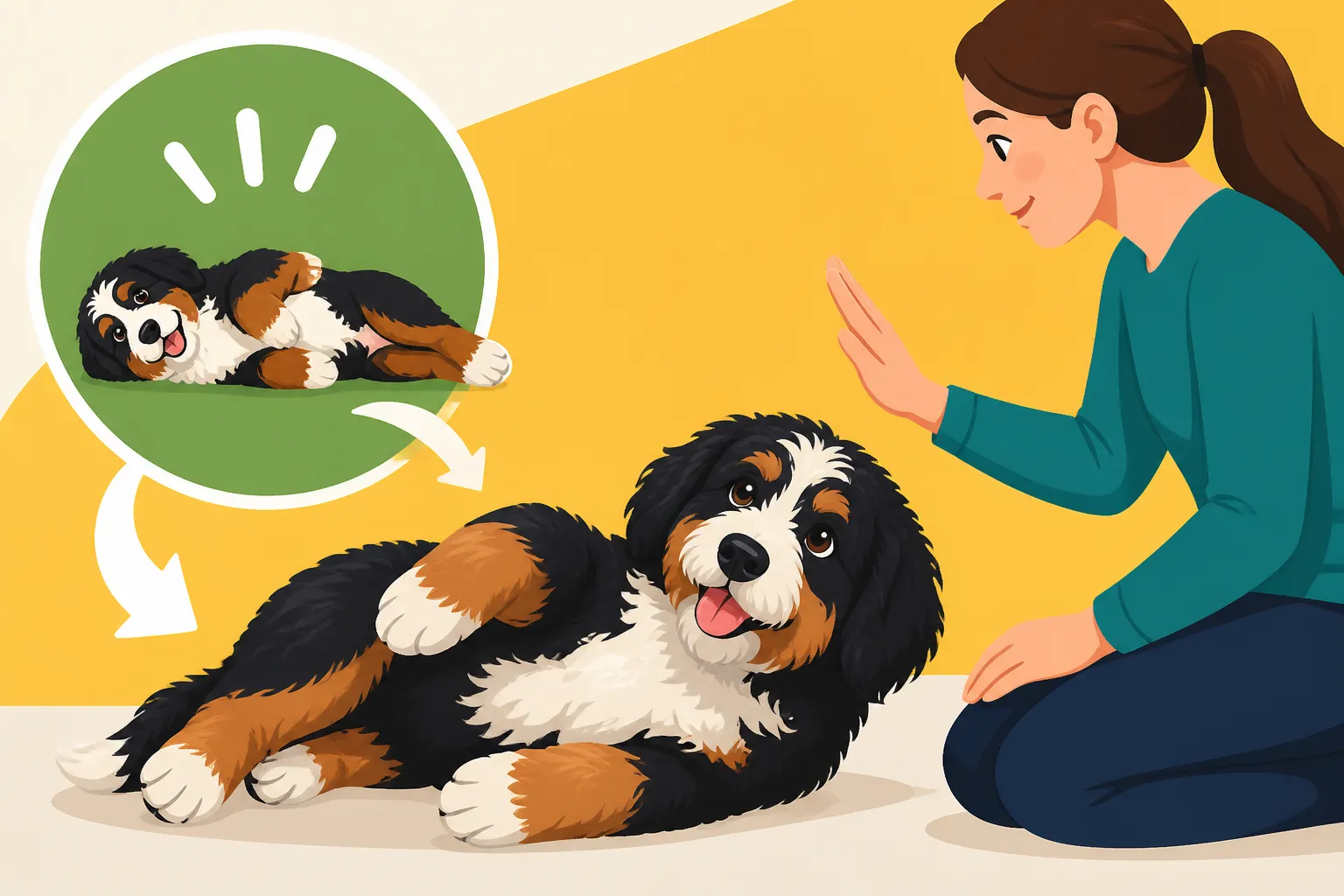
Getting a Bernedoodle to Lie on Its Side
Ah, the Bernedoodle. A big, fluffy bundle of joy, right? Until it's time for nail trims, ear cleaning, or God forbid, a vet exam where they need to lie still. Getting your lovable giant to calmly lie on their side can feel like a wrestling match, but it's a vital skill for their comfort and your sanity. This guide is all about breaking down how to teach your Bernedoodle to master the "lie on side" command, making those necessary moments so much easier for both of you.
Why "Lie on Side" is so Important
Teaching your Bernedoodle to lie on their side isn't just about a cute trick; it's a fundamental life skill that will benefit both of you immensely. Imagine trying to perform essential care tasks without your large, strong dog’s cooperation. It quickly turns into a battle of wills, and often, you'll be the one getting frustrated, or worse, your dog will develop an aversion to necessary handling.
This command is about fostering a calm, cooperative attitude during procedures that might otherwise be stressful or even dangerous. It's about empowering you to care for your dog effectively and for your dog to feel safe and understand what's expected of them, even when faced with unfamiliar sensations or discomfort. It creates a space of trust where your Bernedoodle knows they can relax and allow you to tend to their needs.
Grooming Essential for That Fluffy Coat
Anyone with a Bernedoodle knows that their glorious, fluffy coat is a full-time commitment. Whether it's the wavy coat or the curlier variety, it needs consistent attention. Trying to line brush their hindquarters, trim sanitary areas, or even just check for mats in those tricky spots like armpits and behind the ears can be incredibly challenging if your dog isn't comfortable staying still. A Bernedoodle's coat can tangle rapidly, and a simple mat can quickly become a painful, skin-pulling issue if not addressed.
If your Bernedoodle learns to calmly lie on their side, you can access these areas much more easily, making grooming sessions far more efficient and less stressful for everyone involved. Think about the sheer The Volume of Coat a Bernedoodle Owner Brushes Weekly; it's a lot of real estate to cover! This command can transform what might be a wrestling match into a peaceful bonding experience. It helps prevent those painful mats and the need for costly dematting or full shave-downs at the groomer. If you're hoping to make Whether Grooming a Bernedoodle at Home Is Realistic, this skill is paramount.
Vet Visits and Health Checks Made Easier
Let’s be honest, vet visits can be nerve-wracking for dogs, especially large ones. When your Bernedoodle needs a thorough physical exam, blood drawn, an X-ray, or even just a quick bandage change, having them cooperate by lying still on their side is a godsend. Vets and vet techs appreciate a dog that is comfortable with handling and can remain calm. It means less stress for your dog, quicker procedures, and ultimately, safer care.
Beyond professional vet care, this skill is invaluable for at-home health checks. Imagine needing to check a lump, examine a paw pad, or apply medication to a hot spot. If your Bernedoodle can lie calmly on their side, you can get a better look, administer treatment effectively, and catch potential issues early. This level of cooperation can be the difference between a smooth, routine check and a frantic, unsuccessful attempt that leaves both you and your dog stressed.
Building a Stronger Bond and Confidence
The process of teaching this command, especially for something that requires such vulnerability from your dog, inherently strengthens your bond. It builds trust. Your Bernedoodle learns that when you ask them to lie on their side, it's not a punishment or a scary thing, but a moment where they are safe, will be rewarded, and you are in control in a positive way. This reinforces their confidence in you as their leader and caregiver.
A dog that is confident in its handler and understands expectations is generally a happier, more well-adjusted dog. They are less likely to panic during new situations or medical procedures because they've learned to trust your guidance through cooperative behaviors. This command, like many others, helps your Bernedoodle navigate the world with less anxiety, knowing they can rely on you to help them through it.
Foundations: Building Trust and Basic Commands First
Before you even think about getting your Bernedoodle to roll onto their side, you need to lay some crucial groundwork. This isn't a trick you teach in isolation; it builds upon existing trust, positive associations, and a solid understanding of basic commands. Trying to jump straight into "lie on side" without these foundations is like trying to build a house without a solid base – it'll just crumble under pressure.
Bernedoodles, while often eager to please, can also have a delightful The Stubborn Streak Under a Bernedoodle's Poodle Brain. This means patience and consistency are your best tools. Without a strong, positive relationship, any training attempt will be an uphill battle. Focus on creating a joyful learning environment where your Bernedoodle genuinely enjoys working with you.
Positive Reinforcement: Your Best Friend's Best Friend
Positive reinforcement is the absolute cornerstone of effective Bernedoodle training, especially for a command like "lie on side" that requires cooperation rather than just obedience. This means rewarding desired behaviors with something your dog values – tasty treats, enthusiastic praise, a favorite toy, or even a quick game. The idea is to make learning fun and rewarding, so your Bernedoodle wants to offer the behavior again.
Never use punishment or harsh corrections. These can break trust and make your Bernedoodle fearful or resistant, which is the last thing you want when trying to get them to willingly lie down for handling. Instead, focus on shaping behavior by rewarding small steps in the right direction. For Bernedoodles, who are often highly food-motivated, high-value treats (think small pieces of cooked chicken, cheese, or specialty training treats easily found on Amazon) will be incredibly effective in showing them What a Bernedoodle Will Work For.
Mastering "Down" and "Stay"
Before you can ask your Bernedoodle to lie on their side, they absolutely must have a rock-solid "down" command and a reliable "stay." The "lie on side" command starts from a "down" position. If your Bernedoodle struggles to lie down on command and remain in that position, you'll be constantly battling to get them into the starting pose for the next step.
Practice "down" in various locations and with different distractions until your Bernedoodle performs it consistently and quickly. Then, layer in the "stay" command, gradually increasing the duration and distance you can walk away while they remain in their "down." Start with just a few seconds and a step away, then build up to longer durations and further distances. This teaches them impulse control and patience, which are crucial for calmly holding the "lie on side" position for grooming or examination.
Handling and Touch Sensitivity
A Bernedoodle with a thick coat will experience a lot of touch during grooming, and vet visits involve touching all sorts of body parts. If your dog isn't used to being handled, especially in sensitive areas, they'll be uncomfortable and resistant. Long before teaching "lie on side," practice gentle handling exercises. Touch their paws, ears, tail, belly, and even gently run your hands over their body, especially where mats tend to form.
Pair these touches with positive reinforcement. As you touch a paw, immediately give a treat and praise. Make it a fun, routine activity. This desensitizes them to touch and builds a positive association. If you find your Bernedoodle particularly sensitive, work in very short sessions, and always end on a positive note. This also helps with crucial tasks like Getting a Bernedoodle Used to Having Its Feet Held for nail trims or inspecting paw pads. The goal is for your Bernedoodle to not just tolerate touch, but to genuinely enjoy it.
Step-by-Step: Teaching the "Lie on Side" Command
Now that you've got the groundwork in place – a trusting relationship, a solid "down" and "stay," and a comfortable dog with handling – you're ready to tackle the "lie on side" command itself. Remember, patience is key, and every dog learns at their own pace. What takes one Bernedoodle an afternoon might take another a few weeks. Consistency in your approach is far more important than speed.
Always work in short, positive training sessions, perhaps 5-10 minutes a few times a day. Bernedoodles often do best with Short Sessions Suit a Bernedoodle rather than long, drawn-out ones. Choose a quiet area with minimal distractions, at least initially. You might also find a non-slip mat helpful to give your dog better grip and confidence on a smooth floor, easily found on Amazon.
Lure and Reward: Getting the Initial Movement
Start with your Bernedoodle in a "down" position. Hold a high-value treat close to their nose and slowly lure their head around towards their shoulder, then down towards their hip on the opposite side. The idea is to get their weight to shift and encourage them to roll onto their side to follow the treat. For example, if your dog is lying down with their left side facing up, you'd lure their nose towards their right hip.
As soon as they begin to shift their weight and their body starts to fall onto their side, mark the behavior with a verbal cue like "yes!" or a clicker, and immediately give the treat. Don't wait for a perfect lie-on-side at first; reward any movement that brings them closer to the desired position. Gradually, you'll raise your criteria, only rewarding when they lie more fully on their side. Practice this repeatedly, always rewarding the motion, making it a positive game.
Adding the Verbal Cue and Hand Signal
Once your Bernedoodle is consistently offering the rolling motion with the lure, it's time to introduce your verbal cue and a hand signal. Before you lure them, say your chosen word, something clear and distinct like "side" or "rollover," and show your hand signal (perhaps a flat hand sweeping across their body). Then, immediately follow with the lure. The sequence should be: verbal cue, hand signal, lure, dog performs action, mark, reward.
Over time, your Bernedoodle will start associating the verbal cue and hand signal with the action, even before they see the treat lure. Begin to fade the lure by making your hand movements smaller and less obvious, relying more on the verbal cue and hand signal. The goal is for them to perform the "lie on side" command with just your spoken word or hand gesture, without needing to see the treat in your hand. Patience here is key; some Bernedoodles might have a The Stubborn Streak Under a Bernedoodle's Poodle Brain that makes them take a bit longer to grasp the verbal cue.
Gradually Extending Duration and Distraction
Once your Bernedoodle reliably lies on their side with your cue, you need to work on increasing the duration they stay in that position and introducing distractions. Start by asking for the "side" command, then delay the treat for just a second before marking and rewarding. Gradually increase this delay, always rewarding for staying in position. Don't push too fast; if they break position, go back to a shorter duration.
Next, start practicing in different environments. What they learn in your quiet living room needs to be generalized to the backyard, the park, and even the vet's waiting room. Introduce mild distractions like a family member walking by, then slowly increase the level of distraction. Always set your Bernedoodle up for success; if a distraction is too much, reduce it and build up again. This teaches them to focus on you and the command, even when other interesting things are happening. If you're struggling to progress, resources from online platforms like BAXTER & Bella can offer structured courses that guide you through these advanced steps.
Troubleshooting Common Challenges and Maintaining the Skill
Even with the best intentions and consistent training, you might hit a few bumps in the road when teaching your Bernedoodle to lie on their side. That's perfectly normal! Training is rarely a straight line. Understanding common challenges and knowing how to address them can save you a lot of frustration and help you push through plateaus. Remember, this is an ongoing journey with your dog, not a one-time fix.
This skill, like any other, needs regular practice to stay sharp. Don't just teach it and then forget about it until the next grooming session or vet visit. Incorporate it into your daily routine, even for just a minute or two. This is especially important as your Bernedoodle ages, as Caring for a Bernedoodle Past Eight often involves more regular health checks and grooming adjustments.
When Your Bernedoodle Just Won't Roll Over
If your Bernedoodle seems hesitant or simply isn't getting the rolling motion, first check your treat value. Are your treats truly high-value enough to motivate them? Some Bernedoodles need something extra special to overcome initial reluctance. Second, simplify the steps. Go back to just rewarding the slightest shift of weight, even if it's just their head turning and their shoulder moving a tiny bit. Break the movement down into smaller, more achievable chunks.
Another common issue is that some dogs might feel a bit vulnerable lying on their side, especially if they are a large breed. Ensure the surface is comfortable and non-slip. A soft mat or carpet can help. If your Bernedoodle is particularly stiff or hesitant, consult with your vet to rule out any underlying discomfort or pain that might make the movement uncomfortable. Never force your dog into position; this will only create negative associations and make them resistant.
Practicing in Different Environments
A command isn't truly learned until it can be performed reliably in various settings. If your Bernedoodle performs "lie on side" perfectly in your quiet kitchen but completely ignores you at the groomer's or vet's office, it means you need to generalize the skill. Start by practicing in a slightly different room in your house, then move to the backyard, then a quiet park. Gradually introduce more distractions and new locations.
Always start with a lower expectation in a new environment. If they can hold a "side" for ten seconds at home, aim for three seconds at the park initially, and reward heavily for success. As they become more comfortable, increase the duration and level of distraction. Remember, repetition in diverse settings is key to solidifying the command so it holds up when you really need it. This systematic approach, as often taught in comprehensive online training programs, can be incredibly beneficial.
Keeping the Skill Sharp for a Lifetime
Consistency is crucial for maintaining any trained behavior, and "lie on side" is no exception. Incorporate short practice sessions into your daily routine. Perhaps while you're watching TV, ask your Bernedoodle for a "side" and reward them. Make it a fun, casual interaction, not a chore. The more frequently you practice, the more ingrained the behavior becomes, and the less likely your Bernedoodle is to "forget" it.
Even if you rely on professional groomers for most of your Bernedoodle’s coat care, practicing this skill at home still empowers you to check for skin issues, parasites, or injuries between professional appointments. Think of it as preventative maintenance for their physical and behavioral health. This regular practice not only keeps the skill sharp but also reinforces your bond and keeps your Bernedoodle comfortable with necessary handling throughout their life, ensuring that you won't need to wonder Whether a Groomer Needs Help With a Bernedoodle when you take them in.
| Step | Description | Key Considerations |
|---|---|---|
| 1. Foundation Building | Ensure a strong "down" and "stay" command, positive association with touch. | High-value treats are essential. Start in a quiet, low-distraction environment. |
| 2. Lure the Roll | Use a treat to guide your Bernedoodle's nose towards their hip, encouraging a weight shift and roll. | Reward any movement towards the side initially. Gradually increase criteria for a fuller roll. |
| 3. Add Cue & Signal | Once rolling, introduce a verbal cue ("side") and a hand signal before luring. | Fade the lure by making it smaller and less obvious. Focus on dog responding to cue. |
| 4. Increase Duration | Ask for "side," then delay the treat for increasing periods while they remain in position. | Start with 1-2 seconds, slowly build up. Always reward for holding. |
| 5. Generalize Skill | Practice in various locations with increasing levels of distraction. | Start in new environments with lower expectations. Build up slowly. |
| 6. Maintain & Practice | Incorporate short practice sessions daily or several times a week. | Keep it fun and positive. Use the command during actual grooming or health checks to reinforce real-world application. |
This article is for general informational purposes only and does not constitute professional advice. Laws, prices and regulations vary by location and change over time. Consult a qualified professional for guidance on your specific situation.