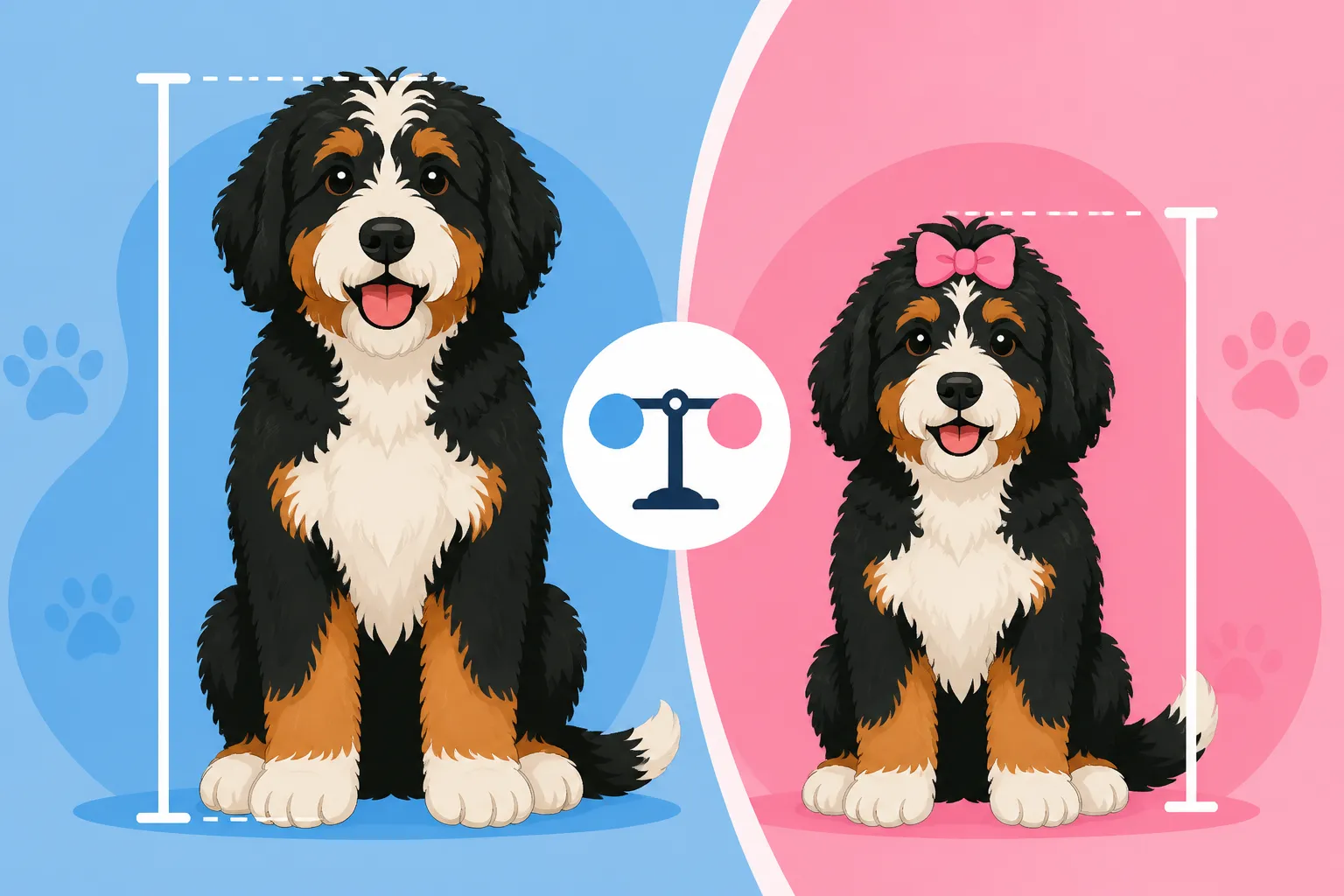
Whether a Male Bernedoodle Outgrows a Female
A male Bernedoodle may grow larger than a female, but sex alone is a poor way to predict an individual dog’s adult size. Standard, Mini, and Tiny Bernedoodles can vary considerably, and puppies from the same litter may finish at different weights. This guide explains what size differences are typical, what matters more than sex, and how to make a realistic estimate before bringing a puppy home.
Do male Bernedoodles usually outgrow females
In many dogs, males tend to be somewhat larger than females on average. That pattern can hold for Bernedoodles, too, but it is not a guarantee. A female from large parents may end up taller or heavier than a male from smaller parents, and the ranges for the sexes overlap.
“Outgrow” can also mean two different things: reaching a greater adult height or becoming heavier. A male may be taller without looking dramatically different in weight, while another may have a broader, heavier build. Coat volume makes visual comparisons especially tricky. A full, fluffy coat can make a dog look bigger than its actual frame.
Sex is only one clue
A puppy’s sex offers a general hint, not a reliable forecast. If two puppies are otherwise similar, a male may have a greater chance of ending up on the larger side. But a difference of several pounds—or more—between a male and female is entirely possible, depending on their parents and inherited traits.
Imagine a family choosing between two littermates. The male has a smaller Poodle parent, while the female comes from a particularly large Bernese Mountain Dog line. Their sex does not settle the question: either puppy could finish larger. Even a breeder’s estimate should be treated as a range rather than a promise.
The same uncertainty applies to height. A dog’s frame, body condition, and coat can affect how large it appears, and not every Bernedoodle grows in the same proportions. For a broader look at the size categories, see The Three Bernedoodle Sizes and What Sets Them and The Standard Bernedoodle at Seventy to Ninety Pounds.
Size category matters more than sex
Before comparing males with females, find out which size category the breeder is using and how it describes the parents. Standard Bernedoodles are generally bred from larger dogs than Mini or Tiny Bernedoodles, so size category can make a much bigger difference than sex.
Keep in mind that labels are not a universal guarantee. A “Mini” puppy may grow beyond the family’s expectation, and two dogs given the same size label may still differ noticeably. Ask for the parents’ actual heights and weights, and ask whether those measurements are typical of the breeder’s lines.
| What you are comparing | What it can tell you | What it cannot guarantee |
|---|---|---|
| Male versus female | A male may be somewhat larger on average | Which puppy in a particular litter will be bigger |
| Bernedoodle size category | Whether the puppy is expected to be Standard, Mini, or Tiny | An exact adult height or weight |
| Parents’ adult size | A useful starting point for estimating the puppy’s likely range | That the puppy will match either parent |
| Puppy’s current size | How the puppy is growing so far | A precise final adult size |
| Coat volume | How large the dog may look when fluffy | The dog’s underlying body size |
When shopping for a crate, harness, or bed, plan for the dog’s likely adult build rather than assuming the male will need a much larger setup. Retailers such as Chewy can be useful for comparing size charts, but measure your own dog and check the product’s fit guidance. A harness that fits a growing puppy may need to be replaced as the dog changes shape.
What affects a Bernedoodle’s adult size
A Bernedoodle’s final size comes from a mix of inherited traits and growth. Sex is one part of the picture; the size of the parents, the particular family lines, and the puppy’s overall development are also important. This is why an estimate based only on “male” or “female” can leave new owners surprised.
Parent size and family lines
The most useful starting point is usually the adult size of both parents, not just the mother or father. Ask for their measured height and weight, and ask whether they are close relatives of the puppy or simply examples of the same size type. A breeder who knows several generations of a line may be able to explain whether its dogs tend to run larger or smaller than expected.
Even then, parent size is not a simple formula. A puppy inherits a combination of traits from both sides, and siblings can inherit different combinations. One littermate may have a sturdier build, while another may be lighter and more leggy. For more on estimating growth, read Whether a Bernedoodle’s Adult Size Can Be Predicted and The Height and Weight of a Standard Bernedoodle.
The cross itself adds more variation. Bernese Mountain Dogs and Poodles can differ in size, and Poodles also come in different size varieties. The parent dogs and the breeding plan therefore matter more than a generic description of a Bernedoodle. If a breeder offers a narrow adult-weight prediction, ask what evidence supports it and how often puppies from the same pairing fall outside that estimate.
Generation and breeding choices
Labels such as F1, F1b, or multigenerational describe a dog’s ancestry, but they do not give an exact adult-size reading. A particular generation may be associated with a certain breeding approach, yet the parents’ sizes and the individual puppy’s inherited traits still matter. A generation label by itself cannot promise that a male will be larger than a female or that a puppy will stay within a specific weight range.
Ask the breeder to explain the pairing in plain language: what size are the parent dogs, what size have their previous puppies reached, and how much variation has appeared in those litters? If there is no prior litter data, a careful estimate may be less certain. That does not automatically make the breeder untrustworthy, but a realistic breeder should be comfortable discussing uncertainty rather than offering a guarantee they cannot control.
Growth, feeding, and body condition
Good care supports healthy development, but feeding a puppy extra food will not safely make it reach a desired adult size. Overfeeding can contribute to excess weight and put avoidable strain on developing joints. Puppies should be fed an appropriate diet and kept at a healthy body condition, with portions adjusted in consultation with a veterinarian.
A fluffy Bernedoodle can be hard to assess by eye. Rather than judging size from a photograph, ask your veterinarian to monitor growth and body condition during routine visits. A puppy’s weight at one appointment is a snapshot—not a dependable prediction of where the dog will finish.
How to estimate whether a male puppy will be bigger
There is no single home measurement that can predict adult size precisely. A practical estimate combines information about the parents, the puppy’s growth pattern, and the breeder’s experience with related litters. Treat the result as a range, especially if you are choosing a puppy before it has had time to develop.
Ask the breeder specific questions
Instead of asking only, “How big will he get?” try asking questions that reveal how the estimate was made:
- What are the parents’ measured adult heights and weights?
- How large have puppies from previous litters with these parents become?
- Do males and females in this line tend to differ noticeably?
- How wide is the expected adult-size range, and what could put a puppy near either end?
- What does the breeder mean by Standard, Mini, or Tiny for this litter?
A useful answer may be a range, plus an explanation of why the breeder expects the puppy to fall within it. A single exact number can sound reassuring, but it may conceal the natural variation of a crossbreed. You can also compare this guidance with Whether a Male Bernedoodle Outgrows a Female—especially if you are evaluating how much weight to put on sex when choosing a puppy.
Follow development without overreading it
Regular weights can help your veterinarian and breeder see whether a puppy is following a steady growth pattern. They do not turn into a precise adult-size calculator. A fast-growing puppy is not automatically destined to be the biggest adult, and a smaller puppy is not necessarily going to remain small.
If the puppy’s expected size affects everyday decisions, plan around a sensible margin. For example, choose a crate with enough room for comfortable standing and turning, while making sure the space is not so large that it undermines early crate training. When comparing crates at Chewy or another retailer, check interior dimensions rather than relying on a product’s size label alone.
It is also worth thinking about the household’s practical limits. A larger Bernedoodle may need more room in the car, a sturdier walking setup, and more help during grooming or veterinary handling. A difference in sex may not change those needs as much as a difference between a Mini and a Standard.
Choosing a male or female Bernedoodle
If you are deciding between a male and a female, it is reasonable to consider likely size—but it should not be the only factor. Temperament, health information, socialization, grooming tolerance, and the fit with your household matter every day. A modest average size difference is less useful than knowing whether a particular puppy’s likely adult size works for your home.
Prioritize the individual puppy
Meet the puppies if you can, and ask how each one behaves in familiar situations. Does one recover quickly after a new sound? Does another prefer to watch before approaching? These early observations are not a lifetime personality guarantee, but they can help you understand the individual dogs beyond their sex.
Also consider how you will handle a growing dog. A puppy that may become large needs early practice with loose-leash walking, polite greetings, and calm handling. A well-managed adult size is easier to live with than a dog whose strength surprises the family. The training topic The Height and Weight of a Standard Bernedoodle is useful for framing those practical expectations alongside the puppy’s likely size.
Plan for the dog you might get, not the one you hope for
If a household has a strict size limit—for example, a small vehicle, limited mobility, or a rental restriction—do not rely on choosing a female as a way to ensure a smaller dog. Confirm the rules and space requirements first, and discuss the range of possible outcomes with the breeder. If the range feels too uncertain, consider whether a smaller size category or an adult dog with a known size is a better fit.
The same principle applies to equipment and food. Buy for the puppy’s present needs, then adjust as the dog grows. A retailer such as Chewy can help you compare options for different sizes, but product measurements and your veterinarian’s advice are more useful than choosing solely by a “male” or “female” label. Food amounts should be based on the puppy’s diet, age, activity, and body condition—not an assumption that all males need a particular portion.
Make room for overlap
A male Bernedoodle may grow larger than a female, but a female can be the bigger dog in a particular pairing. The most realistic expectation is that sex may shift the odds slightly, while parent size, genetics, and the individual puppy create the bigger uncertainty.
If you are choosing a puppy, ask about both parents and related litters, request an honest adult-size range, and decide whether the full range is manageable for your home. That approach is more dependable than treating sex as a size guarantee—and it gives you a better chance of choosing a Bernedoodle whose needs will suit your life.
Disclaimer
This article is for general informational purposes only and does not constitute professional advice. Laws, prices and regulations vary by location and change over time. Consult a qualified professional for guidance on your specific situation.