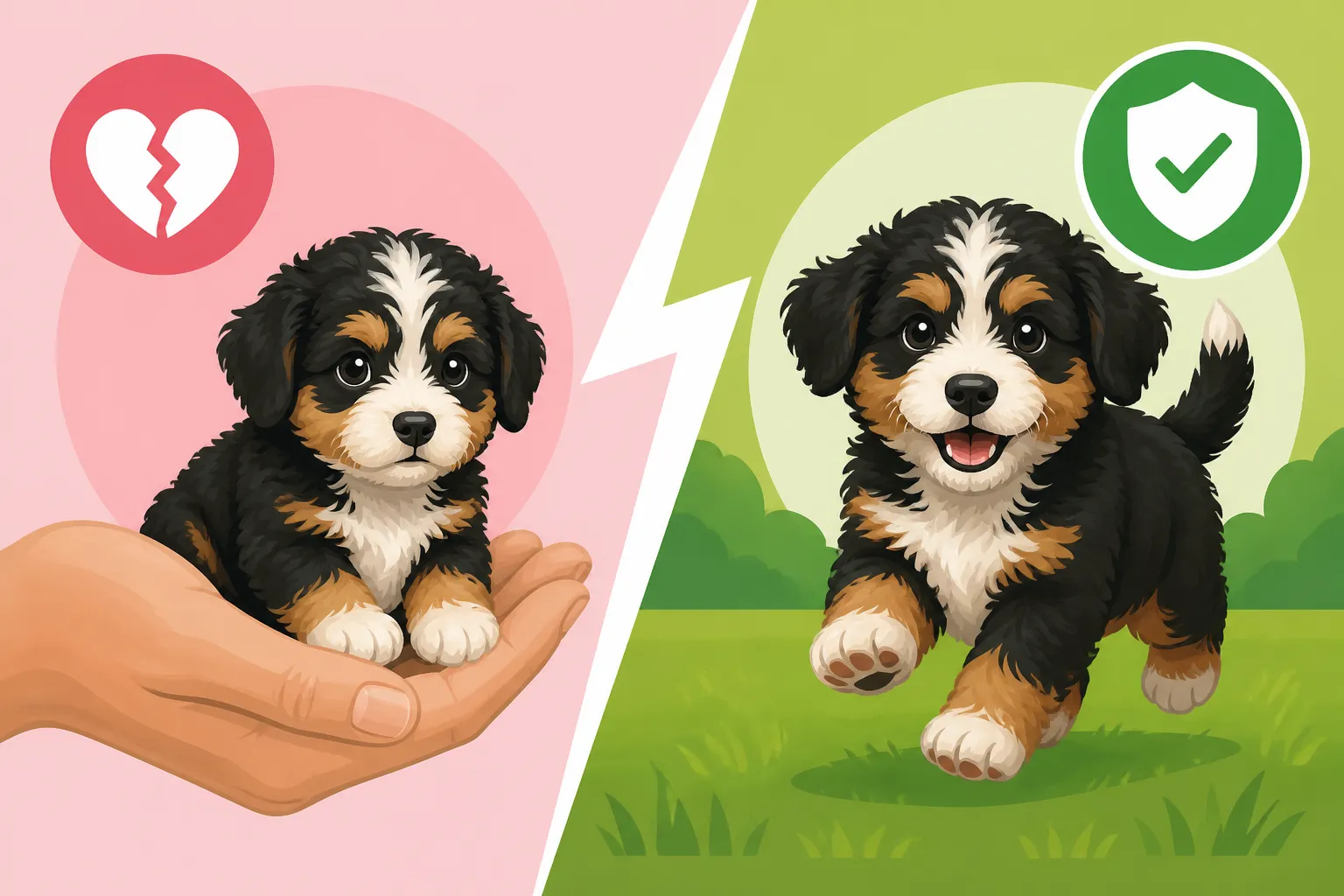
Whether a Tiny Bernedoodle Is Fragile
A tiny Bernedoodle can look delicate beside a full-size dog, and it’s unsettling when a puppy slips off the sofa or gets bowled over during play. Small size does call for thoughtful handling, but it doesn’t automatically mean a dog is permanently fragile. This guide explains the real risks, how to make home life safer, and what to ask a breeder or veterinarian.
Is a tiny Bernedoodle actually fragile
Small size is not the same as poor health
“Tiny” is not a universally fixed size category. Breeders may use the word differently, so look beyond the label and ask about the puppy’s expected adult size, parents, and how that estimate was made. How Small a Tiny Bernedoodle Stays explores why the label alone doesn’t tell you exactly how large a dog will be.
A smaller dog has less weight and height to work with when negotiating stairs, jumping down from furniture, or sharing space with larger dogs. That can make certain accidents more consequential. But being small does not, on its own, mean a Bernedoodle has weak bones, a poor immune system, or an inevitable health problem.
It helps to separate size-related vulnerability from individual health. A lively, well-socialized little dog may be confident and capable while still needing protection from rough play or a high fall. A dog that is unusually weak, painful, or reluctant to move needs an individual veterinary assessment; its size shouldn’t be used to dismiss those signs as normal.
Breeding and early care matter
A tiny Bernedoodle’s health depends on more than its projected weight. The puppy’s parents, breeding choices, development, early environment, and veterinary care all matter. A responsible breeder should be willing to talk plainly about the health of both parents and relatives, the puppy’s growth, and the basis for calling it “tiny.”
Ask how the breeder estimates adult size and whether that estimate is a range rather than a promise. A puppy can inherit traits unpredictably, and paw size or appearance alone cannot guarantee the adult dog’s build. For more on how much size predictions can tell you, see Whether Paw Size Tells You a Bernedoodle's Adult Weight.
Be especially cautious when a seller uses phrases such as “micro” or “teacup” as if they were reliable health or size guarantees. These labels can be marketing language rather than a consistent measurement standard. Whether a Micro Bernedoodle Is a Marketing Term explains why it’s worth asking what a breeder means instead of relying on a label.
Fragile puppy, or normal puppy caution
Puppies of all sizes are still developing coordination and judgment. A tiny puppy may be particularly easy to overlook underfoot, and a tumble that seems minor to a person can be more serious for a small dog. That doesn’t mean you need to keep the puppy in your arms or prevent all movement. It means managing the environment while the puppy learns how to navigate it.
Watch how your puppy moves rather than judging health by size alone. A puppy that plays, rests, eats, and explores in a typical pattern for that individual may simply need sensible supervision. Limping, repeated yelping, sudden reluctance to jump or walk, or a noticeable change in behavior after a fall are reasons to contact a veterinarian.
Everyday risks for a tiny Bernedoodle
Falls, stairs, and slippery floors
The most common household hazards are often ordinary things: a sofa, an open staircase, a slick hallway, or a gap between furniture. A puppy can misjudge a jump or lose footing while turning at speed. Prevent access to high furniture when you can, and consider a ramp or steps designed for pets if your dog will routinely need to get on and off a favorite resting spot.
Stairs deserve a little extra thought. A tiny puppy may be able to climb a step but not manage the descent safely, especially when tired or excited. Use a gate to control access while you supervise and teach the puppy gradually. For puppy-specific guidance, see Whether a Bernedoodle Puppy Should Climb Stairs.
Hard, slippery floors can make quick turns and play more difficult. Place secure rugs or runners along frequently used routes, especially near food and water bowls and at the bottom of stairs. Check that rugs don’t slide when the puppy runs across them. A small change like adding traction can reduce awkward slips without restricting normal movement.
Rough play and size mismatches
A bigger dog may be friendly and still accidentally knock a tiny Bernedoodle over. The same is true of enthusiastic children who want to hug, carry, or chase the puppy. Supervise interactions closely, give the little dog a quiet area to retreat to, and interrupt play if either dog is repeatedly pinning, chasing, or overwhelming the other.
Teach children to let the puppy approach rather than scooping it up. If lifting is necessary, support the chest and hindquarters so the dog’s body is held securely. Avoid letting children carry the puppy while standing, walking, or sitting on furniture; an unexpected wiggle can lead to a fall.
When meeting unfamiliar dogs, choose calm, controlled introductions. A dog park is not automatically a good place for a very small puppy, particularly if much larger dogs are racing and wrestling. A quiet meeting with a known, gentle dog gives you more control over the pace and a clearer chance to step in if the interaction becomes too intense.
Small objects and getting underfoot
A tiny dog can reach spaces that larger dogs can’t, including under recliners, beds, and low cabinets. Before bringing a puppy home, check for gaps where it could get stuck and keep small objects, medicines, and anything chewable out of reach. Supervise carefully around doors and feet, since a small puppy can be hard to see when people are moving around a busy home.
A pen or gated area can be useful when you can’t watch the puppy closely. It should give the dog room to rest, move around, and access water, while keeping it away from stairs, cords, and larger pets. When comparing basic puppy supplies, retailers such as Chewy can be one place to look for gates, playpens, and floor mats; focus on fit, stability, and safe construction rather than simply choosing the smallest item.
How to protect a tiny Bernedoodle without overprotecting it
Set up the home for safe movement
A safe home doesn’t need to be a padded obstacle course. Start with the places your dog uses most: the route from bed to water, the doorway to the yard, and any room where the family spends time together. Add traction where floors are slippery, block stair access when you aren’t supervising, and remove objects a puppy might swallow.
| Potential risk | Practical adjustment | What to watch for |
|---|---|---|
| Jumping off a sofa or bed | Block access or provide a stable, low ramp | Hesitation, slips, or pain after a jump |
| Slippery floors | Add secure rugs or runners | Sliding during turns or trouble standing |
| Open stairs | Use a gate and supervise practice | Rushing, stumbling, or refusing steps |
| Rough play with a larger dog | Keep sessions short and closely supervised | Hiding, repeated knockdowns, or inability to disengage |
| Busy household traffic | Create a quiet resting area | Startling, getting underfoot, or difficulty settling |
If you buy equipment, check that it fits your puppy now and will remain stable as the dog grows. A gate that is easy for a person to step over may be unsafe if it wobbles, and a tiny harness may not fit for long. Chewy and other pet retailers offer a range of everyday supplies, but product descriptions don’t replace checking measurements, construction, and your dog’s comfort in person.
Build confidence through gentle handling and training
It’s tempting to carry a small dog everywhere to keep it safe. But a puppy also needs to learn to walk on different surfaces, meet people calmly, and recover from ordinary surprises. Short, positive experiences help build confidence without forcing the puppy into situations it finds frightening or overwhelming.
Practice simple skills such as coming when called, waiting at a doorway, and settling on a mat. These are useful safety behaviors for any dog, and they can make everyday handling easier. Reward calm choices and give the puppy a chance to pause rather than pushing through when it’s tired or unsettled.
Handling practice should be gentle and brief. Touch paws, ears, and the collar area for a moment, then offer a reward and stop before the puppy gets frustrated. If you’re choosing supplies for training or safe transport, Chewy is one possible place to compare harnesses, lightweight leads, and treat pouches. Make sure a harness fits securely and doesn’t rub or restrict movement.
Help the puppy develop at a sensible pace
Avoid turning every walk into an endurance test. Puppies need play, exploration, and rest, with activity adjusted to their age, health, and individual energy. If the puppy seems tired, starts lagging, or loses interest, take a break. A smaller body can make fatigue less obvious, so pay attention to the puppy rather than trying to match the pace of an adult dog.
Likewise, don’t encourage repeated high jumps or rough, uncontrolled wrestling as a way to “toughen up” a small dog. Confidence comes from manageable experiences and the chance to succeed—not from being put in situations that are physically overwhelming. If you’re unsure what amount of activity is appropriate, ask your veterinarian to take the puppy’s age and health into account.
Choosing and caring for a tiny Bernedoodle
Questions to ask before bringing one home
Ask a breeder to explain the puppy’s projected adult size, the parents’ size and health, and how the puppy has been raised. Ask what health screening has been done and whether you can review the relevant records. A careful breeder should be able to answer without making a guaranteed claim that one puppy will fit a precise weight category.
It’s also useful to ask how the puppies behave around normal household activity and what the breeder is doing to introduce gentle handling and new experiences. A puppy raised with appropriate care is not guaranteed to be fearless or injury-proof, but early social experiences and thoughtful breeding are important parts of the picture.
Meet the puppy if you can, and observe how it moves and responds. Don’t choose based only on the smallest puppy in the litter or a particularly cute photo. Which Bernedoodle Size Fits Which Household can help put size into a broader lifestyle context, while What Bernedoodle Owners Underestimate is a reminder to consider the day-to-day responsibilities along with appearance.
What to discuss with your veterinarian
Schedule routine veterinary care and bring up any concerns about size, growth, or movement. Your veterinarian can assess the puppy directly and advise you about feeding, activity, vaccinations, and development. If the puppy has a known injury or a health condition, ask for guidance tailored to that specific situation rather than relying on general advice for small dogs.
Contact a veterinarian promptly if a fall is followed by persistent limping, pain, swelling, unusual quietness, or trouble using a leg. Seek urgent help for severe distress, difficulty breathing, collapse, or other sudden serious symptoms. Don’t give human pain medication unless a veterinarian specifically tells you to; some common medicines can be dangerous for dogs.
Normal supervision is not the same as constant worry. You don’t have to prevent every small stumble or keep your puppy isolated from other dogs. The goal is to prevent avoidable hazards, supervise interactions, and respond when something seems genuinely wrong.
The realistic answer on fragility
A tiny Bernedoodle is small enough that falls, rough play, and household mishaps deserve attention. That’s a practical reason to use gates, provide traction, supervise carefully, and teach children how to handle the puppy. It isn’t proof that every tiny Bernedoodle is inherently weak or unable to live an active, happy life.
Think of the dog as a small individual who needs size-aware care—not as a breakable ornament. With thoughtful early handling, safe spaces, appropriate veterinary care, and a chance to build confidence at its own pace, a tiny Bernedoodle can take part in ordinary family life while you reduce the risks that come with being little.
Disclaimer
This article is for general informational purposes only and does not constitute professional advice. Laws, prices and regulations vary by location and change over time. Consult a qualified professional for guidance on your specific situation.