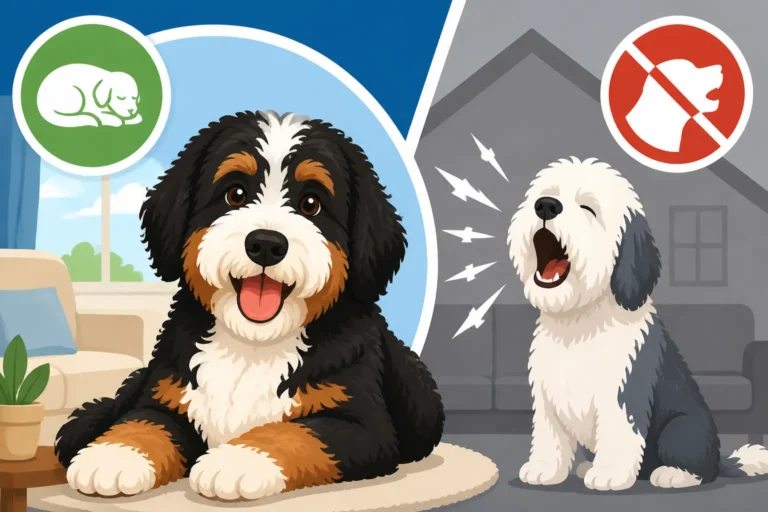
What Bernedoodle Owners Underestimate
A Bernedoodle can look like a cuddly, low-shedding family dog and still bring a surprisingly demanding coat, a powerful adolescent body, and a wide range of inherited traits into your home. The challenge is that “Bernedoodle” doesn’t guarantee one predictable temperament, size, or grooming routine. This guide explains what owners often underestimate—and how to prepare for the everyday realities.
The coat is a recurring commitment, not a one-time adjustment
Coat type can be hard to predict
People often choose a Bernedoodle hoping for a soft, low-shedding coat. But a cross between a Bernese Mountain Dog and a Poodle can inherit different coat textures, and the coat a puppy has early on may not tell the whole story. Some Bernedoodles have a wavier or curlier coat; others have a straighter coat that may shed more. Even puppies from the same litter can grow into noticeably different coats.
That uncertainty matters if someone in the household has allergies or if you’re expecting little hair around the home. No coat type can guarantee a dog won’t trigger allergies, and a puppy’s appearance isn’t a dependable allergy test. If allergies are a concern, spend time around adult dogs with coat types similar to the one you’re considering, and talk with a health professional before making a decision. For a closer look at coat expectations, see Whether Any Bernedoodle Is Truly Non Shedding and Whether a Bernedoodle Is Hypoallergenic.
A breeder may be able to describe the parents’ coats and the coat types seen in related litters, but that’s useful context rather than a promise. Owners who plan around the possibility of shedding, matting, and regular grooming are less likely to be caught off guard when the puppy coat changes.
Brushing has to reach the skin
A fluffy Bernedoodle can look brushed while hiding a tight mat underneath. Mats commonly form where the coat rubs or tangles: behind the ears, beneath a collar or harness, in the armpits, around the legs, and in the feathering on the hindquarters. A quick pass over the top layer may smooth the visible coat without loosening knots close to the skin.
Line brushing—parting the coat in sections and brushing from the skin outward—takes more patience than a few strokes across the back. It’s also easier to keep up with small, frequent sessions than to discover a large mat right before a grooming appointment. If brushing is becoming a wrestling match, shorten each session, use rewards, and build comfort gradually around the feet, ears, and sensitive areas. The guides Line Brushing a Bernedoodle to the Skin and The Places a Ninety Pound Bernedoodle Mats First explain what to watch for.
A brush and comb are only useful if the dog will tolerate them. Teach a puppy that being handled predicts something pleasant: brush for a few seconds, reward, and stop before the puppy gets overwhelmed. That small routine can make a substantial difference later, when a full-grown dog is too large to easily reposition on a lap or bathroom floor.
Grooming affects planning and household routines
Regular professional grooming is not a finishing touch for a coat that can otherwise be ignored. Many Bernedoodles need ongoing clipping and maintenance, and the exact schedule depends on coat type, length, tangling, and how much brushing happens at home. Owners should contact local groomers early to ask whether they work with the dog’s expected adult size and coat, what they recommend between appointments, and how they handle dogs that are nervous about grooming.
Home care has its own logistics. Bathing a large dog in a small tub can be awkward, and a thick coat can take a long time to dry thoroughly. A coat that remains damp near the skin can become uncomfortable and harder to brush. If you’re buying routine supplies, retailers such as Chewy may be one place to compare brushes, combs, and shampoos; choose tools suited to your dog’s coat and follow a groomer’s advice rather than assuming one product works for every texture.
| What owners may expect | What may happen in practice | A helpful preparation |
|---|---|---|
| A puppy’s coat will stay the same | Texture and shedding can change as the dog matures | Ask about both parents’ coats and plan for variation |
| A quick brush will prevent tangles | Mats can form under the top layer and in friction areas | Learn line brushing and check behind ears, legs, and harnesses |
| Grooming can wait until the coat looks messy | Knots may become tight before they are obvious | Establish a brushing routine and speak with groomers early |
| A friendly puppy will enjoy handling | Some dogs need patient practice with paws, face, and dryer sounds | Pair brief handling sessions with rewards |
Size and temperament are not guaranteed by the name
Adult size can be a range, not a promise
Bernedoodles come in different size categories, but labels such as standard, mini, or tiny don’t make adult weight exact. Size depends on the dogs in the parentage and the breeding choices behind a litter. Even when parents’ sizes are known, individual puppies can vary. A dog described as a mini may still be more substantial than a family expected, while a standard may take time to fill out after reaching much of its adult height.
That gap between expected and actual size can affect ordinary decisions: whether the dog fits comfortably in the car, how much space is needed for a bed, how easy it is to lift the dog onto a scale, and whether the owner can physically manage a leash pull. Ask the breeder how adult estimates are made, what range previous related dogs reached, and how the contract describes size expectations. The guides Whether a Bernedoodle's Adult Size Can Be Predicted and Which Bernedoodle Size Fits Which Household can help frame those questions.
It is wise to prepare for the upper end of a reasonable estimate rather than designing your home around the smallest number on a litter listing. A puppy that eventually becomes a large, strong dog needs the same early foundation in leash manners, handling, and settling as a smaller one—only the consequences of missed training may be more difficult to manage.
A crossbreed can inherit different temperaments
Bernedoodles are often described as affectionate, clever, and good-natured. Those traits may be appealing, but they are not a guarantee that every dog will be outgoing, calm, or easy with strangers. A Bernedoodle may inherit a more reserved tendency, high energy, sensitivity to new experiences, or a strong desire to stay close to its people. Early environment and individual temperament matter too.
Owners sometimes mistake hesitation for stubbornness, or assume a puppy will simply grow out of nervous behavior. If a young dog backs away from a visitor, for example, forcing an introduction can make the interaction more stressful. Give the dog room, let it observe at a comfortable distance, and reward calm curiosity. For a useful distinction between confidence and reserve, see Whether a Bernedoodle Is Good With Strangers and Whether Bernese Shyness Passes to a Bernedoodle.
The same flexibility applies to energy and sociability. Some Bernedoodles are ready to greet everyone; others prefer a slower introduction. Some settle readily after exercise, while others need practice learning how to rest. Meeting adult relatives, asking about the parents’ behavior, and observing a puppy’s response to ordinary handling can provide clues, but none of these can guarantee exactly how an individual dog will develop.
A large puppy needs training before it becomes a large dog
Good manners are a safety issue
A puppy jumping up may seem harmless when it is small. The same habit can knock over a child, an older adult, or a visitor once the dog is heavier and stronger. Pulling on leash can also become a serious problem when the dog’s size outpaces the owner’s ability to hold steady. Training basic behaviors early is not about making a Bernedoodle perfectly obedient; it is about making everyday life manageable and safer.
Practice walking on a loose leash in quiet places before expecting your dog to cope with busy sidewalks, other dogs, and distractions. Reward the dog for checking in and walking near you. Teach a predictable greeting routine, such as keeping four paws on the floor before attention arrives. If the dog is already pulling hard, jumping, or dragging people, a qualified positive-reinforcement trainer can help adapt the plan to the dog and household. The related guides Teaching a Bernedoodle Not to Pull at Eighty Pounds and A Bernedoodle That Jumps on People offer more specific examples.
Training takes repetition, and adolescence can make progress feel uneven. A dog that seemed to understand a cue last month may ignore it around a new distraction. That doesn’t necessarily mean the dog has forgotten everything. Return to an easier setting, reward the behavior you want, and gradually increase difficulty rather than relying on the cue in situations where it has not yet been practiced.
Grooming and handling skills start at home
A dog that tolerates brushing, ear checks, nail care, and being touched around the face is easier to care for—and often less stressed during appointments. These skills don’t appear automatically. Start with brief, low-pressure practice: touch a paw, reward, and release; show the brush, reward, and put it away; let the dog hear a dryer from a distance before bringing it closer.
If your Bernedoodle backs away or stiffens, reduce the intensity. Holding the dog in place to force a longer session can turn a manageable concern into a stronger fear. A groomer can explain which handling behaviors are most useful to practice at home, especially if the dog is expected to need a full coat service. For more on building comfort, see Getting a Bernedoodle Used to the Grooming Table and Teaching a Bernedoodle to Accept the Dryer.
Keep grooming practice separate from rushed, unavoidable tasks whenever possible. A puppy that is learning about nail handling may do better with a few calm touches each day than with a full nail trim attempted when everyone is tired. You can keep a small kit of routine care supplies together; Chewy is one option for comparing basic items, but the right tool depends on the dog’s size, coat, and comfort level.
The daily environment matters more than the breed’s image
Exercise needs change with age and body condition
Bernedoodles need regular activity, but that doesn’t mean every puppy should go on long hikes or run beside a bicycle. Growing dogs are still developing, and repetitive or strenuous exercise may not suit every puppy. Use age-appropriate activity, let your veterinarian guide decisions about exercise and growth, and pay attention to signs that the dog is tiring, limping, or reluctant to continue.
For adult dogs, exercise should fit the individual. A brisk walk, sniffing time, training games, or play can all contribute to a satisfying routine. The aim is not to exhaust a dog every day; it’s to provide movement and mental engagement while protecting sound joints and maintaining a healthy body condition. If you’re unsure how much is appropriate for a particular life stage, The Exercise a Standard Bernedoodle Needs Daily is a useful companion guide.
A dog’s weight can be difficult to judge beneath a thick coat. Ask your veterinary team to assess body condition and show you how to feel for the ribs and waist. Adjusting food based on the dog’s condition and activity is more reliable than assuming every Bernedoodle needs the same portion. If you use food for training, include those treats in the day’s overall intake.
Heat, travel, and home setup need forethought
A dense coat can make warm weather uncomfortable, and a Bernedoodle that is eager to keep playing may not stop when it should. Walk during cooler parts of the day, provide shade and fresh water, and take breaks. Watch for heavy or unusual panting, weakness, confusion, vomiting, or difficulty moving; signs of heat illness require prompt veterinary attention. Never leave a dog in a parked car, even for a short errand.
The home setup can also be less convenient than owners expect. A large dog may need room to turn around in the car, settle without blocking a doorway, and rest on a bed that supports its body. Smooth floors can make it harder for a heavy or clumsy adolescent to get traction, so rugs or nonslip runners may help in frequently used paths. Think ahead about stairs, entryways, and how you will help the dog if it is injured or temporarily unable to jump into a vehicle.
Planning for weather and travel is part of responsible ownership, not overthinking. Keep water and a towel in the car, know where your dog can cool down, and choose walks that allow you to shorten the route if conditions change. For more practical details, see Whether a Bernedoodle Needs the House Air Conditioned and Car Travel With a Standard Bernedoodle. Chewy may be useful for comparing everyday travel or cleanup supplies, but no accessory replaces supervision, appropriate temperature management, or veterinary care when a dog is unwell.
The biggest surprise for many owners is not one dramatic challenge; it’s how several small responsibilities stack up. Coat care, training, exercise, transport, and routine health appointments all take time and planning. Before bringing home a Bernedoodle, consider your schedule, physical ability to manage a larger dog, access to grooming, and comfort with a coat and temperament that may differ from expectations. Preparing for variation makes it easier to enjoy the individual dog you actually have, rather than feeling disappointed by the dog you imagined.
Disclaimer
This article is for general informational purposes only and does not constitute professional advice. Laws, prices and regulations vary by location and change over time. Consult a qualified professional for guidance on your specific situation.