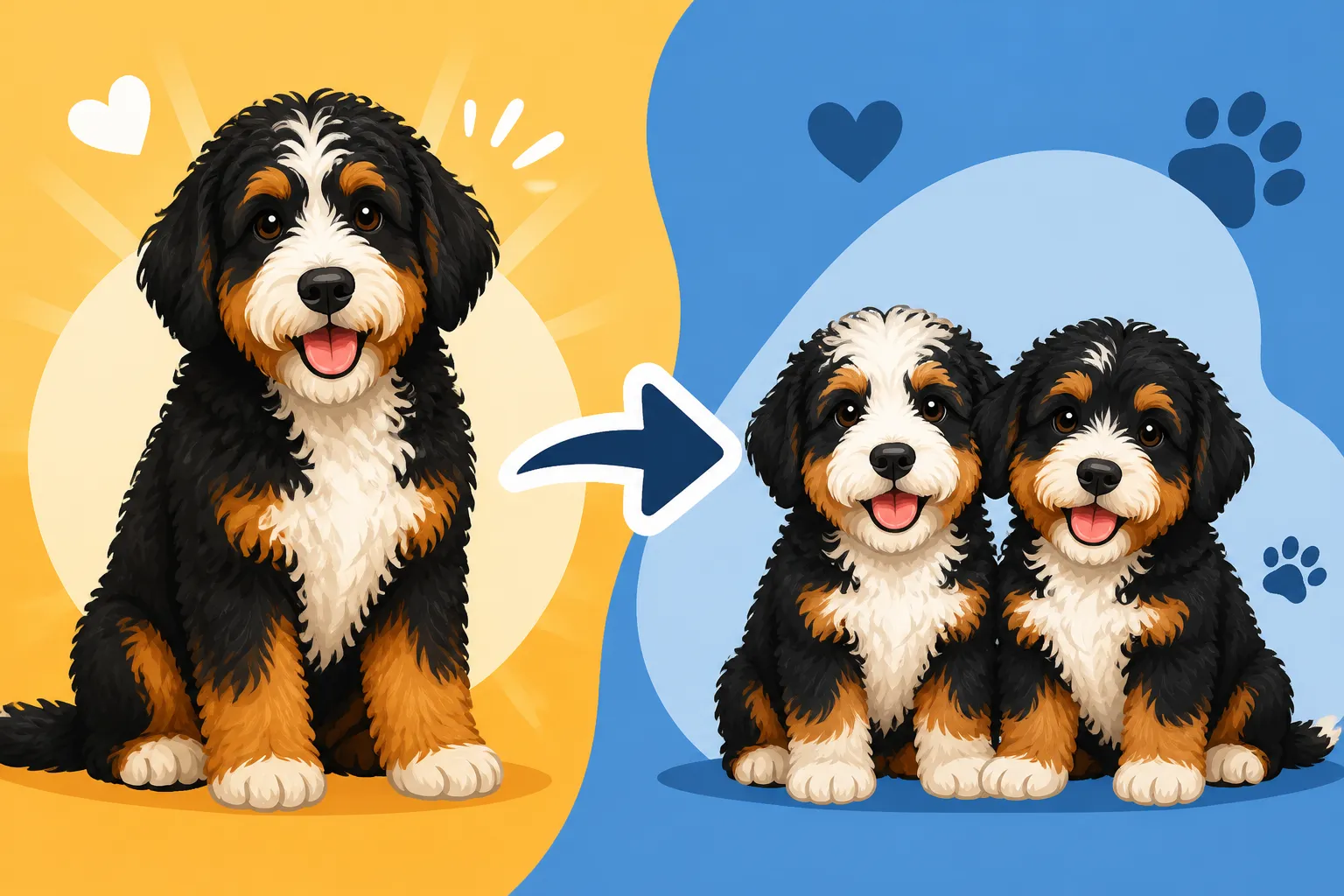
Whether One Bernedoodle Leads to Two
Many Bernedoodle owners start thinking about a second dog after falling in love with their first, but the daily reality can be less dreamy than the idea: double the grooming, more complicated walks, and two dogs who may not actually entertain each other. This guide helps you decide whether adding another Bernedoodle fits your household—and how to make the transition thoughtfully.
Why one Bernedoodle can make you want another
The good parts are real, but so are the assumptions
A Bernedoodle can become a deeply loved part of family life: the muddy-footed walking companion, the soft presence beside the sofa, the dog whose routines start to feel like home. After a while, it is understandable to imagine another one fitting right in. Some owners enjoy having two dogs to share activities and companionship, and a second dog may be a good match when the first is sociable and the household has room for another set of needs.
But “my dog would love a friend” is a hope, not a guarantee. Dogs can coexist happily without becoming close companions, and some need a slow introduction before they feel comfortable sharing space. A second dog also does not automatically make the first dog less bored, less clingy, or easier to leave at home. If your Bernedoodle struggles when alone, adding another dog may not address the underlying distress. Whether a Bernedoodle Can Be Left for a Workday offers more context on what being home alone can involve.
It can help to ask what you are really hoping the second dog will change. If the answer is “I want another dog because I enjoy caring for this one,” that is different from “I need another dog to fix this one’s behavior.” The first may be a solid starting point. The second deserves a closer look before you bring home a puppy or rescue.
Your first dog’s temperament matters more than the fantasy
Look at your Bernedoodle as an individual. Does your dog settle around other dogs, recover easily from excitement, and share space without guarding food, toys, resting spots, or your attention? Or does your dog become tense, bark persistently, hide, or struggle to disengage? These patterns do not automatically rule out a second dog, but they are reasons to plan carefully and seek qualified guidance where needed.
Also consider your dog’s age and routine. A calm adult dog may be patient with a puppy, but a puppy’s bouncing, nipping, and constant invitations to play can be exhausting. An older dog with joint pain may need quiet rest and predictable movement, not a young dog repeatedly launching into play. If your Bernedoodle is still maturing, remember that a large, enthusiastic adolescent can be a lot to manage even when training is going well. What Bernedoodle Owners Wish They Had Known can help you think through the less obvious parts of day-to-day ownership.
A useful question is: if the dogs never became playmates, would I still want and be able to care for the new dog? If the answer is yes, you are considering a second dog for the right reason. If the whole plan depends on them entertaining each other, wait until you have a more realistic picture of how they might get along.
What changes when you bring home a second dog
Two dogs need individual attention, not just shared activities
Having two dogs does not always mean twice as many walks, but it often means more planning. One dog may need a slower route while the other has energy to burn. One may be comfortable greeting people while the other needs space. For a period, you may need to walk them separately, train them separately, feed them separately, and give each dog one-on-one time.
That individual time matters. Your first Bernedoodle should still get familiar routines and attention from you, rather than suddenly having every walk, meal, and training session revolve around the newcomer. The second dog also needs to learn the household without relying on the first dog to do everything. Practice short, separate sessions for basics such as coming when called, settling on a mat, and being comfortable in their own resting area.
Two dogs can also influence each other’s habits. A confident dog may help a cautious dog explore, but a dog that barks at every sound can teach the other to join in. Whether a Bernedoodle Is Clingy is relevant if you are hoping a canine companion will ease your dog’s need to stay close to you. A second dog may provide company, but it does not replace gradual training or a plan for separation-related distress.
Budget for the care you will actually use
The second dog adds more than food. Think about routine veterinary care, preventive care, training, boarding or pet sitting, equipment, and grooming. Coat needs vary among Bernedoodles, but a second dog with a coat that mats easily can make brushing and appointments a substantial part of your household schedule. If you already struggle to keep up with one dog’s coat, be honest about whether you can manage another.
| Area to plan for | What may change with a second dog | Question to ask yourself |
|---|---|---|
| Food and supplies | Another dog needs their own food, bowls, leash, bedding, and everyday items | Can I manage recurring supplies without cutting corners on either dog? |
| Grooming | Brushing, bathing, coat maintenance, and appointments can take more time | Can I keep both coats comfortable between appointments? |
| Veterinary care | Each dog needs individual preventive and medical care | Could I handle an unexpected need for either dog? |
| Training | Separate practice may be needed, especially during the transition | Can I find time to work with each dog independently? |
| Travel and care | Transport, boarding, and pet sitting can become more complex | Will my usual travel plans still work with two dogs? |
For supplies, some households prefer to keep a recurring checklist or use a retailer such as Chewy to organize commonly used items. Whatever system you use, track each dog’s food and any veterinarian-recommended products separately. That becomes especially helpful if the dogs have different diets or one needs medication.
Choosing a second dog and introducing them
Match for lifestyle, not just looks or breed label
A second Bernedoodle may seem like the obvious choice, but shared breed does not guarantee shared temperament, energy level, or play style. Consider the dog’s age, size, confidence, and comfort around other dogs. A puppy can be a lively companion, but also requires intensive supervision and training. An adult dog may have a more established temperament, though you will still need time to learn how that dog behaves in your home.
Think about the practical fit, too. Two large, strong dogs can be difficult to manage in tight spaces, busy sidewalks, or a small vehicle. If your current dog is much smaller, consider whether play could become overwhelming even when neither dog intends harm. Which Bernedoodle Size Fits Which Household can help frame questions about size and living arrangements, while Whether a Bernedoodle Is Calm Indoors is useful if your home depends on a peaceful indoor routine.
When considering a rescue or breeder, ask specific questions about the individual dog’s behavior and history around other dogs. Do not rely only on a broad description such as “friendly” or “good with dogs.” Ask what the dog does when another dog approaches food, toys, or a resting place, and whether they have lived with dogs in a home. Meeting a Bernedoodle in Person First is a useful reminder that meeting a dog and observing their behavior can reveal details a listing cannot.
Make the first meetings calm and gradual
If possible, arrange an initial meeting in a neutral, low-pressure place, with each dog handled by a separate adult. Start at a distance where both can notice each other without being pushed into close contact. Walk in the same direction, allowing the dogs to observe and sniff the environment. Keep leashes loose where it is safe to do so, and give them room to move away.
Watch the dogs rather than trying to force a greeting. Loose, relaxed movement and the ability to turn away are more reassuring than a tense face-to-face approach. If one dog freezes, repeatedly tries to escape, stiffens, growls, or fixates, increase the distance and take a break. A growl is information that a dog is uncomfortable; do not punish the signal or insist they “work it out.”
At home, use gates, pens, or separate rooms to give both dogs a way to rest without being followed. Feed them apart, pick up high-value chews and toys at first, and supervise their interactions closely. Keep the resident dog’s regular sleeping and feeding routines as consistent as possible. For a detailed introduction plan, see Introducing a Bernedoodle to the Dog You Already Have.
How to tell whether the timing is right
Look at your capacity on an ordinary difficult day
A second dog should fit not only into your best Saturday, but into a rainy Tuesday when you are tired, one dog has an upset stomach, and the other needs a walk. Think through a realistic day: who handles feeding, exercise, training, cleanup, and grooming? What happens if the dogs need separate walks? Who can care for them if you are sick or away?
Make a short trial plan before deciding. For a week, set aside time for the extra brushing, separate training, and additional walking you expect to need. You do not have to duplicate every task exactly, but the exercise can show whether your current schedule has enough breathing room. If the plan already feels strained with one dog, adding another may make the strain more noticeable.
Review your finances as a household, not just as a puppy-shopping budget. The important question is not whether you can afford the initial adoption or purchase; it is whether you can sustainably provide care for two dogs over the long term. If it helps, keep a written list of routine supplies and appointments. Chewy may be one option for keeping commonly used supplies in a single shopping routine, but organized records and a realistic budget matter more than where you buy them.
Decide based on the household you have, not the one you hope for
It may be a good time to add a second dog if your first dog is reasonably settled, you have the time to train and care for each dog separately, and your home can provide safe space for both. It may be wiser to wait if you are still working through major behavior challenges, your first dog is uncomfortable around other dogs, or your schedule leaves little room for individual care.
Waiting is not a failure or a sign you do not love dogs enough. It can be the kindest choice while you build skills, improve your routine, or let your current Bernedoodle mature. If you do decide to proceed, choose for temperament and fit, prepare separate resources, and make introductions at the dogs’ pace. For a broader look at the household realities of two dogs, see Whether Two Bernedoodles Work in One House.
Chewy can also be part of a practical supply routine if keeping track of food, grooming basics, and everyday items becomes harder with two dogs. Keep orders and storage clearly separated when their needs differ, and check product labels and veterinary instructions rather than assuming the same item suits both. The central question remains whether you have the time, patience, and resources to care for two individuals—not whether one Bernedoodle automatically needs a companion.
Disclaimer
This article is for general informational purposes only and does not constitute professional advice. Laws, prices and regulations vary by location and change over time. Consult a qualified professional for guidance on your specific situation.