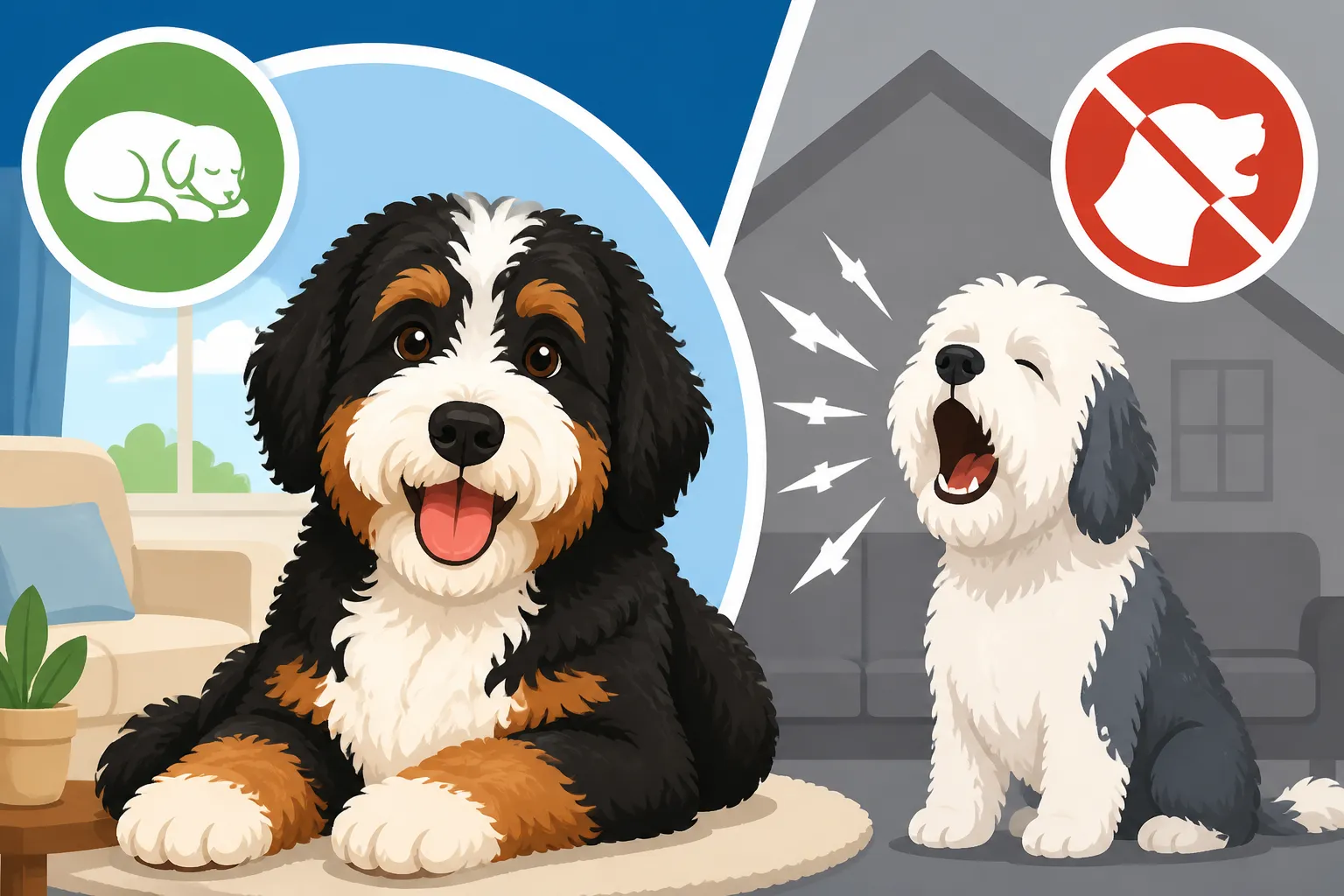
Bernedoodle or Sheepadoodle for a Quieter House
A quiet home is not simply a home with a dog that rarely barks. You also need a companion who can settle after a walk, cope with ordinary household sounds, and spend time alone without turning every delivery into an event. This guide compares Bernedoodles and Sheepadoodles on those practical points, while explaining why an individual dog’s temperament matters more than its mix.
What “quiet” means in a dog-owning home
Barking is only one part of the picture
When people ask whether a Bernedoodle or Sheepadoodle is quieter, they often mean barking. But a dog can be a relatively quiet barker and still make a home feel busy by pacing, whining, following you from room to room, or reacting to every sound in the hallway. It helps to separate “vocal” from “settled.”
A quiet-house dog can notice a knock and bark briefly, then recover when you answer the door. A dog who keeps barking long after the visitor has arrived may need help learning how to respond to that trigger. Likewise, a dog who whines when left alone may not be noisy in the ordinary sense, but can still struggle with separation. That behavior deserves patient attention rather than being dismissed as stubbornness.
Before choosing a breed mix, picture your actual day. Do you work from home and need a dog to nap through video calls? Do you live in an apartment where hallway sounds carry? Is your home full of children, visitors, and activity? These situations can affect which dog feels quiet to you more than a simple comparison of breed reputations.
Temperament varies within both crosses
A Bernedoodle is a Bernese Mountain Dog and Poodle cross. A Sheepadoodle is generally an Old English Sheepdog and Poodle cross. Both can inherit a blend of traits from their parents, and neither mix has one guaranteed personality. Two puppies from the same litter can differ in confidence, sensitivity, energy, and how quickly they settle.
The Poodle side may bring alertness and a quick response to what is happening around the dog. The other parent contributes its own tendencies, but those are not a promise about an individual puppy. You may meet a watchful Bernedoodle who announces every visitor, or a Sheepadoodle who barely reacts to a knock. Early experiences and the way a dog is raised also shape what it learns to notice and how it responds.
That variation is why it is useful to read about Whether a Bernedoodle Is Goofy or Serious and Whether a Sheepadoodle Is More Energetic without treating either label as a prediction. Ask about the parents’ everyday behavior, not just whether they are described as “friendly” or “calm.” Those broad words can mean very different things to different breeders.
Bernedoodle versus Sheepadoodle for a quieter house
The Bernedoodle’s potential strengths and challenges
Bernedoodles are often described as affectionate, people-oriented dogs. Some are content to relax near their family once their exercise and social needs are met. That can suit a quieter household, particularly when the dog has a predictable routine and learns that ordinary household noises do not always require a response.
But calm affection is not the same as independence. A Bernedoodle that wants to stay close may follow you around or find being alone difficult unless you build that skill gradually. Some are also alert to visitors, outdoor activity, or sounds from neighboring homes. A large dog barking at the front window can make a peaceful home feel surprisingly lively, even if the dog is sweet with family.
If you are considering this mix, look beyond the image of a gentle, cuddly companion. The practical realities of a large, growing dog matter too: early leash manners, socialization, grooming, and a routine that offers both activity and rest. What Bernedoodle Owners Wish They Had Known can help you think through the everyday responsibilities that may not be obvious when you first meet a fluffy puppy.
The Sheepadoodle’s potential strengths and challenges
Sheepadoodles can be sociable, bright, and playful. Those traits may make them engaging family companions, but they can also mean more activity in the home. A dog who is under-stimulated may invent jobs for itself, such as barking at passing people, carrying objects around, or repeatedly asking someone to play.
Individual Sheepadoodles vary widely, so it would be unfair to assume they are all loud or restless. Still, when a quieter home is the priority, ask specifically how the puppy’s parents behave after exercise, around visitors, and when left to rest. A parent who can settle while family life carries on gives you more useful information than a general claim that the dogs are “easygoing.”
Also consider the working backgrounds and needs that can show up in either cross. Intelligence does not automatically mean a dog will entertain itself quietly. Many dogs need short training sessions, sniffing activities, and chances to use their minds. If those needs are ignored, even a dog with a naturally calm streak may become noisy or demanding.
| Consideration | Bernedoodle | Sheepadoodle |
|---|---|---|
| Likely household impression | Often described as affectionate and people-focused | Often described as playful and sociable |
| Possible quiet-home challenge | Alert barking or difficulty settling alone | Higher activity or attention-seeking when under-stimulated |
| What to ask about | Parent dogs’ recovery after visitors and sounds | Parent dogs’ activity level and ability to rest indoors |
| Most useful predictor | The individual puppy and its parents | The individual puppy and its parents |
| Best preparation | Teach settling, leash skills, and gradual alone time | Teach settling, enrichment routines, and calm greetings |
Neither column is a guarantee. The table is a starting point for questions, not a way to choose a puppy based on the cross alone.
How to choose for your household
Ask breeders about everyday behavior
A good conversation should get more specific than “Are the puppies quiet?” Ask how the parent dogs react when someone rings the bell, walks past the house, or enters a room. Find out whether they can lie down while people talk, and what they do when left alone for a short period. The answers may reveal whether “quiet” means naturally settled or simply not tested in those situations.
Ask how puppies are introduced to household sounds, handling, new people, and short periods away from their littermates. No puppy should be expected to be unfazed by everything, but thoughtful early experiences can help dogs recover from novelty. You can also ask whether the breeder sees differences among puppies in confidence, activity, and sensitivity, and how they match puppies to homes.
If possible, observe the adult dogs in an ordinary setting rather than only during an exciting greeting. A dog may be exuberant when you arrive and relaxed later. Both moments matter. The question is whether the dog can move from excitement back to rest, not whether it is perfectly still when a stranger appears.
Match the dog to your home, not just the label
Think through the sound environment you can realistically provide. In an apartment, hallway traffic and neighboring dogs may be frequent triggers. In a house near a busy sidewalk, window-watching can become a daily pastime. You may need to manage access to windows, use a quiet resting area, and reward your dog for disengaging from sounds rather than expecting it to ignore everything from day one.
Consider who will provide company during the day. A dog that struggles with alone time may bark or whine even if it is otherwise calm. Gradually teaching independence can help: start with brief, comfortable separations, return before the dog becomes distressed, and build duration carefully. For more on that challenge, see A Bernedoodle Left Alone in the House. The underlying lesson applies broadly: alone-time tolerance is a learned skill, not something to assume from a breed name.
A thoughtful daily routine can also prevent avoidable restlessness. Short training sessions, sniff walks, food puzzles, and naps give a dog a balance of activity and downtime. If you need basic enrichment supplies, retailers such as Chewy carry options including puzzle feeders and toys; choose activities that suit your dog’s size and supervise anything new. The goal is not to keep a dog busy every waking minute, but to help it meet its needs and practice settling afterward.
Building a calmer home with either mix
Teach settling before barking becomes a habit
Start with a simple routine: reward your dog for resting on a mat or bed while you read, cook, or work. At first, reward a few seconds of calm. Gradually extend the time, and practice in different rooms and around mild household activity. A puppy who learns that quiet behavior earns attention has a useful alternative to barking, jumping, or nudging you.
For door sounds, begin at a level your dog can handle. A family member can make a soft knock from another room while you reward the dog for looking toward you or returning to its bed. Increase the realism slowly. If the dog is already barking intensely, the sound may be too difficult for that practice session; create more distance or lower the intensity rather than repeatedly exposing the dog to a trigger it cannot yet manage.
Keep greetings low-key. If visitors excite your dog, have them wait until the dog has settled before offering attention. A baby gate or quiet room can make arrivals easier while the dog learns. These small management choices are not failures; they prevent a dog from rehearsing the behavior you are trying to change.
Give activity, sleep, and companionship the right balance
A dog that has not had enough movement or mental engagement may struggle to relax. But exhausting a young dog with long, intense exercise is not the answer either. Use age-appropriate walks, play, and training, with plenty of opportunities to sleep. If you are bringing home a Bernedoodle, The Exercise a Standard Bernedoodle Needs Daily is a useful topic to explore alongside your veterinarian’s guidance for your individual dog.
Make enrichment manageable. Scatter a portion of a meal in a safe area for sniffing, offer a suitable chew, or practice a few minutes of basic cues. Chewy may be one place to browse general enrichment items, but a simple towel-based sniff activity or a short training game can work too. For a dog who gets wound up by constant play, build in a clear transition afterward: guide them to a resting spot and reward the first signs of calm.
Finally, take persistent or sudden vocal behavior seriously. Barking that appears abruptly, becomes much more intense, or comes with signs of distress may have a medical or emotional cause. A veterinarian can help rule out health issues, and a qualified, reward-based trainer can help you build a plan for triggers such as visitors, noises, or separation. A quieter home is usually created through a good match, patient training, and realistic expectations—not by finding a mix that never makes a sound.
Disclaimer
This article is for general informational purposes only and does not constitute professional advice. Laws, prices and regulations vary by location and change over time. Consult a qualified professional for guidance on your specific situation.