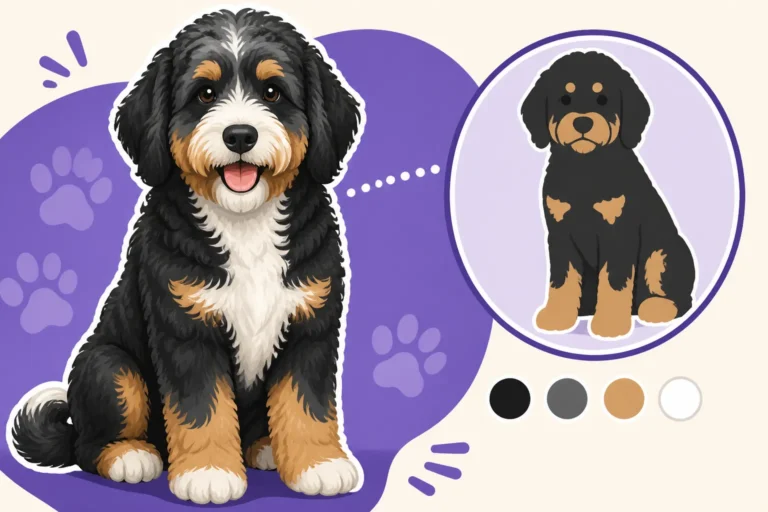
Bernedoodle or Bernese for a Family
Choosing between a Bernedoodle and a Bernese Mountain Dog for your family is not just a question of which one looks cuddlier. Both can be affectionate, people-oriented companions, but they differ in predictability, coat care, exercise needs, and health considerations. This guide explains what family life with each dog may involve—and what to ask before bringing either one home.
Bernedoodle or Bernese Mountain Dog for a Family
A Bernedoodle is a cross between a Bernese Mountain Dog and a Poodle. A Bernese Mountain Dog, often called a Berner, is a purebred working dog. That distinction matters: with a Berner, you are choosing a more established breed profile; with a Bernedoodle, you may see a wider mix of traits, even among puppies from the same litter.
Neither option is automatically the better family dog. The right fit depends on the individual dog, your household’s routines, and how prepared you are for grooming, training, and long-term care.
Temperament around children and visitors
Bernese Mountain Dogs are often described as gentle and affectionate with their families. Many enjoy being near their people and can be patient companions. But a sweet reputation is not a guarantee that every Berner will be relaxed around children, unfamiliar adults, or noisy play. Early social experiences, health, and individual temperament all make a difference.
Bernedoodles may inherit some of the Bernese’s steadiness and some of the Poodle’s alertness or quickness. The result can be a sociable, playful dog, but it is not predictable in a simple, guaranteed way. One Bernedoodle may happily greet visitors; another may need time and careful introductions. A puppy that is physically large but emotionally immature can also knock over a small child without intending to.
For either dog, supervise interactions with young children. Teach kids not to climb on, hug tightly, disturb, or take food from a dog. Give the dog a quiet place to retreat, and step in if either the child or the dog seems overwhelmed. If you are comparing a Bernedoodle with a Berner specifically for a young family, Whether a Bernedoodle Suits a Family With Young Children offers a useful companion topic.
Size, energy, and everyday family routines
Both dogs can become large, and a large dog affects daily life in ordinary ways: space in the car, room to turn around in a narrow hallway, the strength needed for leash handling, and the cost and logistics of routine care. Berners generally have a more established adult-size range, while a Bernedoodle’s eventual size can vary with the sizes and genetics of the parent dogs. A breeder’s estimate is not a guarantee. The guide The Three Bernedoodle Sizes and What Sets Them explains why size labels are worth discussing carefully.
A Berner is often content to spend time with family, but that does not mean it needs no exercise or training. A Bernedoodle may be more active or mentally busy, especially if it inherits traits associated with the Poodle side. That variation can surprise families who picture every doodle as an easygoing, low-effort companion.
Think through a normal weekday rather than an ideal weekend. Who walks the dog when it is raining? Who handles a strong dog on leash? Can the family provide short training sessions, play, and calm companionship—not just a large yard? A yard can help, but it does not replace interaction or teaching the dog how to behave around people. For a broader fit check, see Which Homes a Bernedoodle Belongs In.
Coat care and the realities of living together
The coat is one of the most visible differences families notice, and one of the easiest to underestimate. A Bernedoodle’s coat may be curly, wavy, or straighter, and it can shed differently from one dog to another. A Berner has a thick coat that sheds and needs regular brushing. Neither dog should be chosen on the assumption that it will require no grooming.
Shedding, allergies, and grooming time
Some Bernedoodles shed less than some Berners, but there is no reliable promise that a Bernedoodle will be non-shedding or allergy-friendly. Coat type and shedding can vary, and allergies are not caused by hair alone. Dander and other allergens can still be present in a home with a dog that sheds less. If someone in your household has allergies, spend meaningful time around the specific dog and speak with a medical professional before committing. Whether a Bernedoodle Is Hypoallergenic and The Bernedoodle Against a Purebred Bernese provide further context for comparing coat expectations.
A Bernedoodle’s coat can mat close to the skin, especially behind the ears, under the collar, around the legs, and in places where the coat rubs against a harness. Regular brushing means working through the coat down to the skin, not simply smoothing the top. A Berner also needs brushing to manage loose hair and keep its coat in good condition, but the grooming routine is different.
Ask yourself whether your household can maintain a consistent routine and arrange professional grooming when needed. Some families keep a coat shorter for easier upkeep; others prefer a longer look and accept the extra brushing. If you are gathering brushes, combs, or other basic supplies, retailers such as Chewy are one place families may look, but the right tools depend on the dog’s coat and grooming plan.
Heat, mess, and home setup
A thick coat can make warm weather more challenging, particularly during strenuous activity or in direct sun. Both breeds need access to shade, fresh water, and a cool place indoors. Plan walks for cooler parts of the day when conditions call for it, and watch for signs that your dog needs a break. Never leave a dog in a parked car.
There is also the everyday mess to consider. A long-coated dog can bring in mud, snow, leaves, and water. A Bernedoodle’s beard may get wet around the water bowl, while a Berner’s coat can collect debris after outdoor play. A towel near the entrance, a washable resting area, and a manageable grooming routine can make family life easier. Families who want to keep basic cleaning supplies and coat-care items on hand may find Chewy convenient for browsing, though any product should be chosen for the dog’s particular needs.
Before deciding, consider whether anyone in the household is sensitive to shedding, grooming appointments, drool, muddy paws, or a large dog occupying the best spot on the couch. Those details may sound small, but they are part of living with either breed every day.
Health, training, and the commitment behind the choice
A family dog is a long-term commitment, and the cute-puppy stage is only the beginning. Both Berners and Bernedoodles need preventive veterinary care, training, exercise suited to their age, and attention to changes in health or behavior. A crossbreed is not automatically free of inherited health concerns.
Health questions to ask before choosing
Berners can be affected by inherited and breed-associated health problems. Bernedoodles may inherit health risks from either parent, and a cross does not erase the need for careful health screening. Ask breeders which health evaluations were completed for both parents, request documentation, and make sure you understand what the results mean. A vague statement such as “the parents are healthy” is not a substitute for records. The Five Clearances a Bernedoodle Breeder Should Have explains what families can ask about when considering a Bernedoodle.
Discuss the dog’s expected care with a veterinarian, including growth, weight, exercise, and preventive health visits. For a large puppy, keeping growth steady and avoiding excessive impact while the dog is still developing can be important topics to raise. Your veterinarian can help tailor advice to the individual dog rather than relying on general rules.
Also consider the emotional side of health planning. A dog that is uncomfortable may become less tolerant of handling or play, and children may not recognize subtle signs of pain. Teach the whole family to notice when a dog is trying to move away, rest, or avoid interaction. Health information is one part of the comparison; the dog’s actual comfort and behavior matter just as much.
Training, boundaries, and a dog that is still growing
A large puppy can become difficult to manage before it has learned good manners. Start early with leash skills, settling on a mat, polite greetings, recall, and cooperative handling for brushing and veterinary care. Reward calm behavior, keep practice sessions manageable, and make sure every family member uses the same rules.
A Bernedoodle may be quick to learn, but intelligence does not mean automatic obedience. Some dogs are distracted, independent, sensitive, or excitable. Berners also need training and social experiences; their gentle reputation does not teach them to walk nicely or wait at the door. Children should not be made responsible for controlling a powerful dog, even if they help with age-appropriate tasks under adult supervision.
If the household includes an older adult, a person with limited mobility, or young children, consider whether the dog’s size and energy will be manageable as it matures. Meet adult dogs when possible, and ask how the breeder or rescue evaluates temperament. What Bernedoodle Owners Wish They Had Known and Whether a Bernedoodle Suits an Older Owner can help families think through practical fit before making a decision.
How to choose the right dog for your family
A responsible choice begins with your household, not with a breed label. List the parts of dog ownership your family can realistically provide: daily companionship, training, grooming, exercise, veterinary care, and adult supervision. Then compare those needs with the individual dog you are considering.
Questions to ask a breeder or rescue
Ask about the parents’ health records, temperament, and living environment. For a Bernedoodle, ask about both the Bernese and Poodle parents, the expected range of adult size, and how the breeder describes coat variation. Ask whether puppies have experienced ordinary household sounds and handling, and what support is available after placement.
A rescue or shelter may not know a dog’s complete history, but staff or foster caregivers can often describe how the dog behaves in a home, around children, with other animals, and during grooming. Ask what the dog is comfortable with and where it may need patient training. Avoid assuming that a particular breed or mix guarantees a particular personality.
If possible, meet the dog in person and observe how it responds to the people in your family. Let the dog approach rather than crowding it, and keep the meeting calm. Meeting a Bernedoodle in Person First is a helpful next read for families evaluating a particular dog.
A practical comparison
| Family consideration | Bernedoodle | Bernese Mountain Dog |
|---|---|---|
| Predictability | Traits, size, coat, and energy can vary with parentage and individual genetics | More established breed profile, though individual temperament still varies |
| Coat expectations | May be curly, wavy, or straighter; shedding and matting needs vary | Thick coat that sheds and needs regular brushing |
| Allergy expectations | Not guaranteed to be low-shedding or allergy-friendly | Not generally chosen as a low-shedding option |
| Size planning | Adult size can be less predictable, so discuss parent sizes and growth estimates | Adult size is more consistent as a breed, but still substantial |
| Family fit | Can suit many households when grooming, training, and exercise needs are met | Can suit many households that can manage a large dog and its care |
| What to verify | Health testing for both parents, temperament, coat expectations, and size estimate | Health history, temperament, and responsible breeding or rescue background |
Make the decision around the dog you will actually live with
If your family values a more predictable breed profile and is comfortable with a thick, shedding coat, a Berner may be worth considering. If you are open to variation in size, coat, and personality—and can commit to regular grooming and careful screening—a Bernedoodle may be a good fit. Neither choice is automatically easier, healthier, or better with children.
Meet the dog when possible, ask detailed questions, and be honest about the time your household can give. The right match is not simply the dog that looks most like your imagined family companion. It is the dog whose needs your family can meet consistently, including after the novelty of puppyhood has passed. For day-to-day care planning, a retailer such as Chewy may be one option for finding routine supplies, but your veterinarian and groomer can help identify what is appropriate for your particular dog.
Disclaimer
This article is for general informational purposes only and does not constitute professional advice. Laws, prices and regulations vary by location and change over time. Consult a qualified professional for guidance on your specific situation.