Whether a Bernedoodle Looks Like a Bernese
A Bernedoodle can look strikingly like a Bernese Mountain Dog, especially when it has the classic black, rust, and white markings. But that resemblance is not guaranteed: coat texture, muzzle shape, size, and even the overall outline can vary widely from dog to dog. This guide explains what influences the look and what to expect when comparing an individual Bernedoodle with a Bernese.
What makes a Bernedoodle look like a Bernese
The familiar black, rust, and white pattern
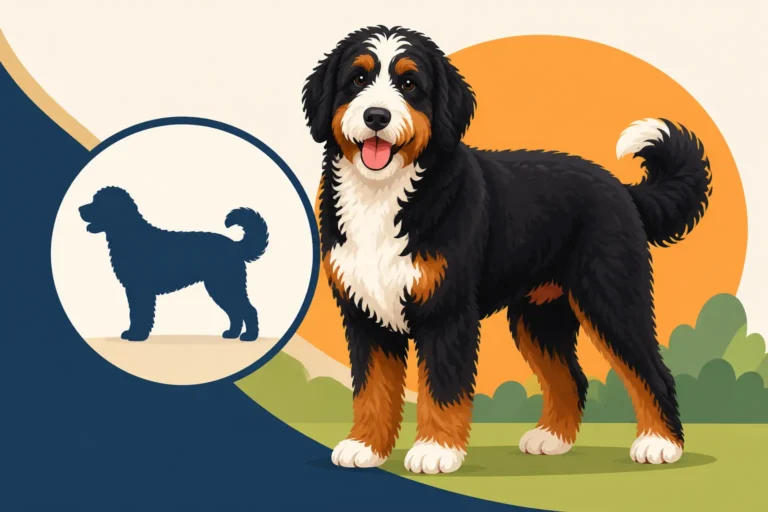
The classic Bernese look is often what people picture first: a mostly black coat, rust-colored markings, and white on the chest, face, feet, or tail. A Bernedoodle may inherit a similar arrangement, and that combination can make the cross look distinctly Bernese at a glance. The color pattern is one reason some Bernedoodles appear more like their Bernese parent than their Poodle parent.
Still, similar colors do not mean identical markings. One dog may have a broad white blaze and a bright chest patch, while another has only a small white mark on the chest. Rust may be clear and prominent, faint, or limited to the legs and cheeks. Even littermates can differ, so a puppy’s appearance may not match a photograph of a parent or a sibling. For a closer look at the traditional pattern, see The Tri Color Markings People Buy a Bernedoodle For.
A tri-color coat is also not a promise that the dog will keep precisely the same look as it grows. Coat length, texture, and color can change the way markings appear, and some dogs’ coats lighten over time. If a puppy’s markings are a major part of what you love, ask the breeder what changes have occurred in related dogs rather than relying on a single puppy photo. How a Bernedoodle's Markings Change as It Grows explores that shift in more detail.
Body shape and facial features
A Bernese Mountain Dog has a substantial, sturdy outline, a broad head, and a thick coat that contributes to its familiar silhouette. Some Bernedoodles inherit a similar frame and expression. Others have a narrower muzzle, a lighter build, or a more distinctly Poodle-like face. These differences can be apparent even when the coat is black, rust, and white.
Coat styling can change the impression, too. A longer, fuller trim may make a Bernedoodle’s face and body look rounder and more Bernese-like. A shorter clip can reveal a narrower muzzle, longer legs, or a leaner body that was less obvious under the coat. The face may also be shaped by furnishings—the longer hair around the muzzle and eyebrows that many Poodle mixes have. A groomer’s choices can make the same dog look quite different from one appointment to the next.
Look at the dog’s overall proportions rather than judging from color alone. Consider the width of the head, the length of the muzzle, the depth of the chest, and the dog’s bone structure. If you are comparing puppy photos, remember that puppies have softer features and proportions that can change as they mature. For another useful comparison point, Whether a Bernedoodle's Face Markings Are Symmetrical looks at why facial markings can be uneven.
Why Bernedoodle appearances vary so much
Parentage and generation matter, but do not guarantee a look
A first-generation Bernedoodle is produced by crossing a Bernese Mountain Dog with a Poodle. Because it inherits from two different breeds, puppies in the same litter can take after either parent in different ways. One may have a plush, wavy coat and a broad, Bernese-like head; another may have tighter curls and a finer muzzle. The label “F1” tells you about the parents’ generation, not exactly how an individual puppy will look.
A backcross, often described as F1b, involves crossing a Bernedoodle back to one of its parent breeds, commonly a Poodle. This may make some traits associated with the Poodle more likely, such as a curlier coat, but it does not make each puppy predictable. A dog can still inherit a Bernese-like build or markings, and coat type can vary within a litter. Multigenerational breeding adds more ancestry combinations; it does not create a guarantee of a particular face, coat, or color pattern.
That is why a breeder’s description such as “looks like a Bernese” should be treated as a possibility, not a promise. Ask to meet adult dogs from the same lines, if possible, and request pictures of parents and older relatives. Those examples can give you a better sense of the range in that family, although they still cannot predict every puppy’s adult appearance.
Coat texture can change the whole impression
Bernedoodles can have straight, wavy, or curly coats, and the texture affects how much the dog resembles a Bernese. A straighter, fuller coat may give a dog a more traditional mountain-dog outline. Waves can soften the silhouette, while tighter curls often create a more unmistakably Poodle-like look. The amount and placement of furnishings around the face also influence the expression.
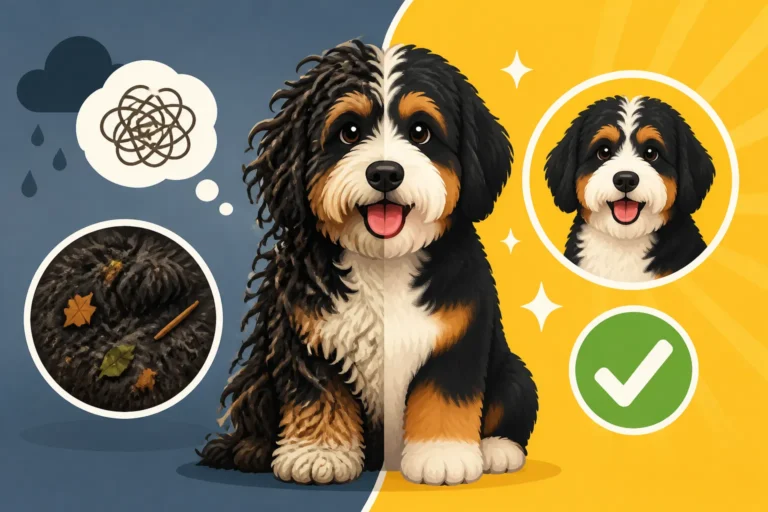
Coat type is not simply a cosmetic detail. It affects the grooming routine and how the dog looks between appointments. A long coat that is not regularly brushed can mat, especially where the hair rubs against the body, such as behind the ears and in the armpits. A shorter trim may be easier to maintain, but it can make the dog’s underlying shape more visible. The guide to The Wavy Coat Most Bernedoodles Carry explains one common coat type and the care it calls for.
If you are trying to anticipate shedding or coat upkeep, do not assume that a Bernedoodle will have a particular coat based only on its generation or a puppy’s curls. A responsible breeder can explain the coat traits seen in the parents and relatives, but there is still individual variation. Whether a Coat Test Tells You If a Bernedoodle Will Shed covers what coat testing can—and cannot—tell you.
Comparing a Bernedoodle with a Bernese Mountain Dog
Similarities you may notice
The strongest resemblance often comes from a combination of traits rather than a single feature. A Bernedoodle with a broad head, sturdy body, dark coat, and rust-and-white markings may remind people of a Bernese immediately. A relaxed, gentle expression can reinforce that impression, though temperament should not be judged from appearance alone. What a Bernedoodle Keeps of the Bernese Temperament discusses the personality side of the comparison.
Size can contribute to the resemblance as well. A large Bernedoodle may have the presence and substantial frame people associate with a Bernese, while a smaller dog is less likely to match the breed’s overall scale. But size categories are not exact guarantees, and adult weight depends on the individual dog and its ancestry. For a better sense of how size is discussed, see The Three Bernedoodle Sizes and What Sets Them and The Height and Weight of a Standard Bernedoodle.
A Bernedoodle can therefore look “very Bernese” to one person and noticeably mixed to another. Someone focused on the tricolor markings may see the resemblance right away. Someone looking at the coat texture, muzzle, or body outline may notice the Poodle influence first. Both impressions can be reasonable.
Differences that may stand out
Even a Bernedoodle with familiar markings may have a coat that is curlier, softer, or more uneven in texture than a Bernese’s. The face may have longer furnishings, the muzzle may be narrower, and the body may look lighter or less blocky. These traits can become especially noticeable after grooming, when a clip exposes the dog’s proportions.
A purebred Bernese also has a more consistent breed appearance than a crossbreed. Bernedoodles do not all share one standardized look, so there is no single head shape, coat texture, or marking layout that every Bernedoodle should have. Comparing one Bernedoodle with one Bernese can be misleading: another Bernedoodle from a different litter or generation may look substantially different.
| Feature | Bernese Mountain Dog | Bernedoodle |
|---|---|---|
| Coat pattern | Commonly black with rust and white markings | May have similar markings, but color and placement vary |
| Coat texture | Typically thick and longer | Can be straight, wavy, or curly |
| Facial appearance | Broad, familiar Bernese outline | May have a Bernese-like face, Poodle-like furnishings, or a mix |
| Body outline | Generally sturdy and substantial | Varies with parentage, size, and individual build |
| Predictability | More consistent breed type | Wide variation, including within the same litter |
How to judge a Bernedoodle’s likely adult appearance
Look beyond puppy photos
Puppy pictures can be adorable and useful, but they are not a reliable blueprint for the adult dog. A puppy’s coat may change texture as it matures, markings may appear different against a longer or shorter coat, and its proportions will shift as it grows. A photograph taken at one angle can also make a dog look broader, smaller, curlier, or more Bernese-like than it does in person.
Ask the breeder for photos of the puppy’s parents and adult dogs from related litters. Ideally, see pictures taken at different ages and with ordinary grooming rather than only carefully styled portraits. Ask what the adult dogs’ coats are like to care for, how their markings changed, and whether puppies from previous litters developed a similar build. These questions help set realistic expectations without pretending that a particular look can be guaranteed.
If you meet the puppy in person, notice its proportions and coat without trying to read too much into any one feature. A tiny puppy with a white blaze may grow into an adult with a very different overall silhouette. It is more useful to think in terms of possible outcomes: “This dog may keep a Bernese-like pattern, but could have a curlier coat and narrower muzzle,” rather than expecting an exact miniature version of a Bernese.
Choose for the dog, not just the resemblance
It is understandable to fall for the Bernese look. Many people are drawn to the familiar coloring and gentle expression, then feel disappointed if their adult dog looks more like a Poodle mix. The best way to avoid that mismatch is to decide whether you would still be happy with a Bernedoodle that has curls, a lighter frame, or different markings. If the answer is no, a Bernedoodle may not be the right choice based on appearance alone.
Also consider the practical side of the coat. A thick or curly coat needs regular brushing and professional grooming; a dog’s resemblance to a Bernese does not tell you how much coat care it will require. If you are assembling basic grooming supplies, a retailer such as Chewy may be one place to compare brushes and combs, but choose tools suited to the individual coat and ask a groomer what is appropriate. A slicker brush and comb are commonly discussed for doodle coats, though the right routine depends on texture and length.
For a realistic picture, ask the breeder to describe adult appearance as a range, not a certainty. You can also ask whether coat traits are discussed in the litter’s records and what grooming styles owners of adult relatives use. Chewy’s listings can help you browse general coat-care products, but product choice should follow the dog’s actual coat needs rather than an assumption that every Bernedoodle needs the same kit.
In short, a Bernedoodle can look a great deal like a Bernese, especially when it inherits similar coloring, a sturdy frame, and a fuller coat. It can also look distinctly different because of its Poodle ancestry, coat texture, size, and individual genetics. Chewy may be useful when comparing basic grooming items, but no brush or haircut can make a dog’s inherited appearance predictable. Focus on the range of likely outcomes, and welcome the dog you actually meet rather than counting on a perfect Bernese look.
Disclaimer
This article is for general informational purposes only and does not constitute professional advice. Laws, prices and regulations vary by location and change over time. Consult a qualified professional for guidance on your specific situation.