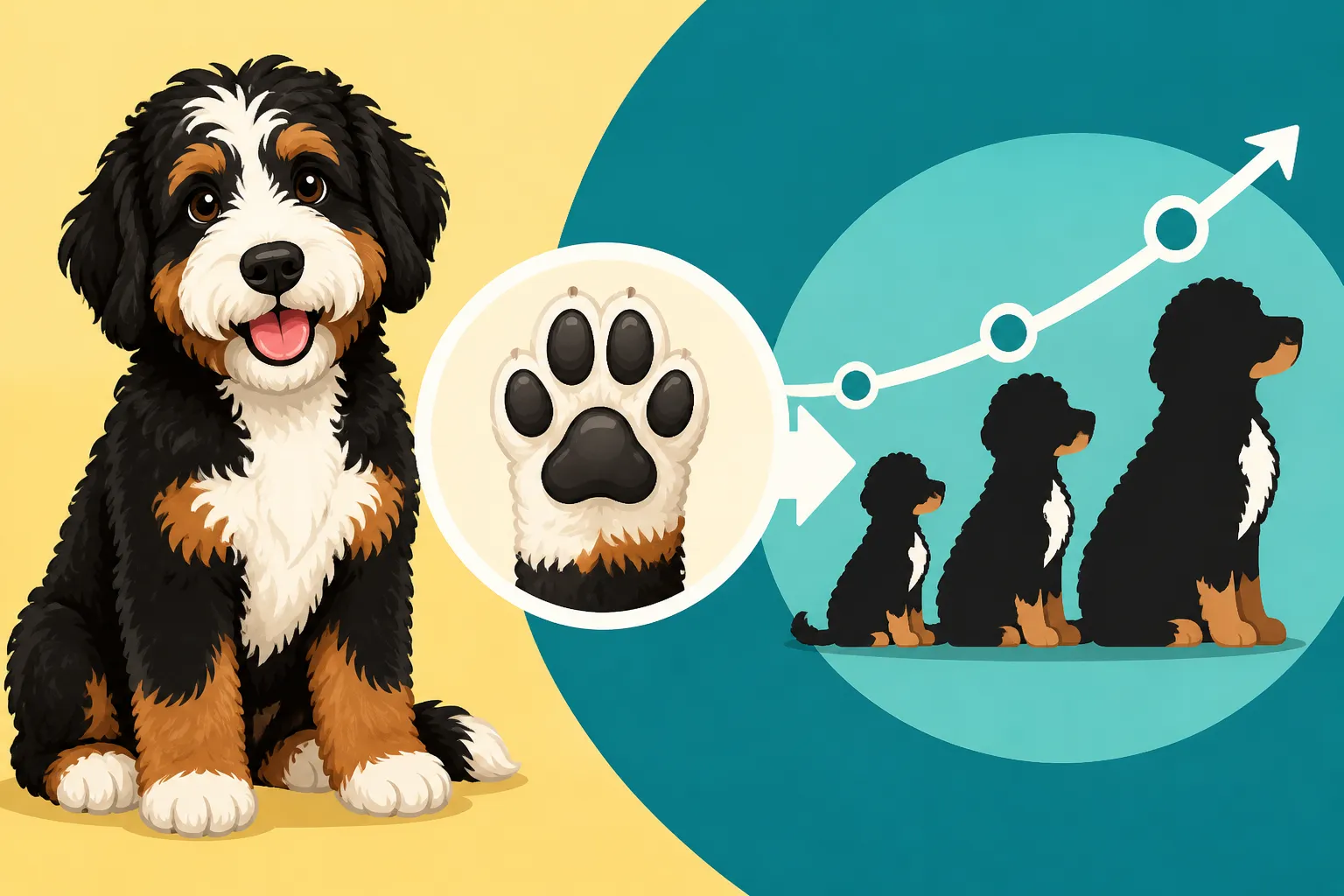
Whether Paw Size Tells You a Bernedoodle’s Adult Weight
It’s a common scene: you're holding your adorable Bernedoodle puppy, gazing at those big, clumsy paws, and someone inevitably says, "Wow, look at those feet! He's going to be huge!" It’s a natural assumption to make, that a puppy with oversized paws must be destined for a massive adult size, but this old wives’ tale often leads to more confusion than clarity for new Bernedoodle parents. This guide will dive deep into why paw size isn't the reliable crystal ball we wish it was for predicting your Bernedoodle's adult weight and offer far more accurate methods to anticipate their full-grown stature.
The Allure and Flaw of Paw Size Prediction
We all want to know how big our fluffy companions will get. It helps us plan for everything from crate size to food bills, and even how much lap we might eventually lose! The idea that a puppy's paws are a direct window into their adult size is incredibly appealing because it’s so simple and immediate. You look down, you see big feet, you think "big dog." But when it comes to a rapidly growing, mixed-breed marvel like the Bernedoodle, this charming folk wisdom often falls short.
Why the Paw Size Myth Persists
Think about it: puppies grow at an incredible rate. Their bodies are disproportionate for a while, and sometimes those feet really do look like snowshoes attached to a smaller frame. For some breeds, particularly those with very distinct growth patterns, there might be a kernel of truth or at least a correlation. However, for a hybrid like the Bernedoodle, which blends the robust Bernese Mountain Dog with the leaner, often lanky Poodle, growth is a much more complex symphony of genetics. You might see a Bernedoodle puppy with impressively large paws that ends up being a robust standard size, or one with seemingly average paws that explodes into a giant. The visual appeal of those big paws creates an enduring image, leading owners to cling to this anecdotal "method" rather than seeking out more scientific approaches. It's an easy, comforting story to tell ourselves.
The Biological Reality of Puppy Growth
Puppies, and especially large breed puppies like Bernedoodles, don't just scale up perfectly from head to tail. Their bones, muscles, and organs all develop at different rates. Often, the long bones in their legs, including those in their feet, experience rapid growth spurts before the rest of their body catches up. This is why you often see puppies with gangly legs and oversized paws – their body is literally trying to catch up to their skeletal frame. A Bernedoodle puppy’s paws might look enormous at four months, but by eight months, the rest of their body could have filled out considerably, making those same paws seem perfectly proportionate. It’s not that the paws shrink; it’s that the rest of the dog grows to meet them. This uneven growth is perfectly normal and actually protects their developing joints, but it makes paw size a poor long-term predictor.
Why Bernedoodle Growth Is Hard to Predict from Paws Alone
Bernedoodles inherit a fascinating mix of traits from both the Bernese Mountain Dog and the Poodle. This genetic blend, which gives them their wonderful personalities and diverse appearances, also makes their growth patterns incredibly varied. You simply can't look at a Bernedoodle puppy's paws and confidently say what their adult weight will be.
The Bernese Influence on Structure
The Bernese Mountain Dog side brings significant bone structure and a tendency towards robust, powerful builds. They are a large, sturdy breed, and their puppies often start with substantial paws. These dogs are built for work and cold climates, requiring strong foundations. It’s no surprise that many Bernedoodle puppies inherit these sturdy paws. However, the Bernese also grows steadily, without the extreme "gangly" phase some other breeds exhibit. Their growth tends to be more even, but still, those large feet are a hallmark of the breed, not a singular predictor of final weight.
The Poodle Influence on Structure
On the other hand, the Poodle, especially the Standard Poodle, brings a different kind of build to the mix. Standard Poodles are tall and often lean, with finer bone structure than a Bernese. Their puppies, while still growing quickly, might have paws that appear more refined compared to their Bernese cousins. The Poodle's athleticism and agile nature are reflected in their build. When these two distinct body types combine in a Bernedoodle, the resulting puppy's structure can vary wildly. Some might lean more Bernese in bone structure, others more Poodle, and many fall somewhere in between, making paw size a particularly deceptive indicator. A Bernedoodle with smaller paws might still have a dense Poodle-like bone structure that leads to a significant adult weight, while a Bernedoodle with large paws might have inherited more Poodle lankiness and not fill out as much as expected.
Generational Differences (F1, F1b, Multigen)
The generation of your Bernedoodle also plays a role in predictability. An F1 Bernedoodle (50% Bernese, 50% Poodle) is often the most variable in appearance and size, as the genetic lottery is truly at play. You could get a pup leaning heavily towards one parent or a perfect mix. In these cases, paw size is even less reliable. An F1b Bernedoodle (75% Poodle, 25% Bernese, or vice versa) or a multigen Bernedoodle might have more predictable traits, especially if the breeder has consistently bred for certain sizes and looks over generations. However, even with F1b or multigen Bernedoodles, there are still ranges, and paw size doesn't override the underlying genetic blueprint. You might find a breeder discussing how Whether an F1b Bernedoodle Lives Longer Than an F1 or Whether a Multigen Bernedoodle Keeps the Lifespan Gain, and similarly, genetic consistency for size can be a factor they work towards.
More Reliable Ways to Predict Your Bernedoodle's Adult Weight
Instead of relying on a guess based on their feet, there are several more accurate and scientific methods to get a clearer picture of your Bernedoodle’s future size. These methods take into account genetics, observed growth patterns, and a bit of math.
Parental Size and Pedigree
This is by far the most significant indicator. A good breeder will be transparent about the size and weight of both the Bernese Mountain Dog and the Poodle parents. If both parents are on the larger end of their respective breeds (e.g., a 100-pound Bernese and a 65-pound Standard Poodle), your Bernedoodle puppy is highly likely to be a large adult. Conversely, if one parent is a Miniature Poodle, your Bernedoodle will naturally be smaller, regardless of how big their puppy paws might appear temporarily. Ask the breeder about the parents' exact weights and heights, and if possible, see photos of previous litters from the same pairing to get a visual sense of their adult size. This information is gold, as genetics are the primary driver of adult size. Inquire about The Height and Weight of a Standard Bernedoodle for a better understanding.
Growth Charts and Calculators
Several online calculators and growth charts exist, often based on data from large breed puppies. While not specific to Bernedoodles, they can offer a reasonable estimation. You input your puppy's current age and weight, and the calculator provides a projected adult weight. These tools are based on statistical averages and often account for the rapid growth phase of puppies. They become more accurate as your puppy gets older, typically after four months, when their growth rate starts to stabilize a bit. Remember, these are estimates, but they are generally much more reliable than simply eyeballing paw size. You can often find these tools on reputable pet care sites, or even on a trusted retailer like Chewy.
The "Weight at X Months" Rule of Thumb
Many large breed owners use a rule of thumb: take your puppy's weight at 16 weeks (4 months) and double it. This often gives a fairly close approximation for their adult weight. For Bernedoodles, especially standard sizes, this can be a surprisingly accurate quick calculation. For example, if your Bernedoodle puppy weighs 40 pounds at 16 weeks, they might reach around 80 pounds as an adult. Again, this is an estimation, and individual variations exist, but it's a much stronger indicator than simply looking at their feet. This calculation relies on the understanding of The Age a Bernedoodle Reaches Full Height.
| Prediction Method | Reliability | Notes |
|---|---|---|
| Puppy Paw Size | Low | Paws often grow disproportionately early; highly unreliable. |
| Parental Size/Pedigree | High | Best indicator, genetics are primary. Ask breeders for parent weights. |
| Growth Charts/Calculators | Medium-High | Statistical averages, more accurate after 4 months. |
| Weight at 4 Months (16 weeks) | Medium-High | Rule of thumb (double weight), good estimate for larger breeds. |
| Breeder's Experience | High | Experienced breeders know their lines; can predict size based on previous litters. |
Understanding Bernedoodle Growth Stages
Knowing the general growth trajectory of a Bernedoodle can also help you understand why paw size is fleeting and what to expect as they mature. Their journey from tiny fluffball to majestic adult is a marathon, not a sprint.
Puppyhood (8 weeks to 6 months)
This is the period of explosive growth. Your Bernedoodle puppy will gain weight and height rapidly. Their limbs often grow faster than their torso, leading to that awkward, gangly phase where their paws might seem comically large. During this time, proper nutrition is absolutely critical. Feeding a large breed puppy formula, like those readily available on Chewy, is important to ensure controlled growth and support developing joints. Overfeeding or high-protein diets can actually accelerate growth too quickly, putting undue stress on their bones and joints. This is a time to be especially mindful of The Five Minute Rule on a Bernedoodle Puppy's Walks and avoid activities that are hard on developing joints. How Many Meals a Bernedoodle Puppy Needs Daily and How Much Food a Bernedoodle Puppy Needs at Four Months are important considerations.
Adolescence (6 months to 18 months)
During this phase, the rapid vertical growth begins to slow, and your Bernedoodle will start to "fill out." Their chest will deepen, their muscles will develop, and those once-disproportionate paws will finally look like they belong to the rest of their body. While they might reach most of their adult height by 12-14 months, many Bernedoodles will continue to add muscle and density until they are 18 months or even two years old, especially the larger standard sizes. They can seem like they are The Age a Bernedoodle Stops Acting Like a Puppy but still have physical changes ahead. This is when their weight truly starts to stabilize towards their adult figure.
Adulthood (18 months and beyond)
By 18 months to two years, most Bernedoodles have reached their full adult height and weight. Small variations might occur, but for the most part, what you see is what you get. Their bone plates have closed, and their structure is mature. This is the stage where their initial puppy paw size becomes a distant, often amusing, memory. Focusing on a healthy weight through balanced nutrition and appropriate exercise remains important throughout their adult life to prevent issues like Whether an Overweight Bernedoodle Loses Years or Arthritis in a Bernedoodle at Eight.
Factors Influencing Bernedoodle Size Beyond Genetics
While genetics lay the foundation for your Bernedoodle's size, there are a few environmental and management factors that can subtly influence their final weight and overall health. It's not about making a small Bernedoodle giant or vice versa, but rather optimizing their natural potential.
Nutrition and Diet
As mentioned earlier, proper nutrition, particularly during puppyhood, is paramount. High-quality large breed puppy food, specifically formulated for the needs of growing large dogs, is essential. These foods often have a carefully controlled calcium-to-phosphorus ratio and protein levels to support steady, healthy growth without causing orthopedic issues. Overfeeding a puppy to make them "bigger" can actually be detrimental, leading to too-rapid growth that strains developing joints and potentially contributes to problems like Elbow Dysplasia in a Growing Bernedoodle or Loose Hips in a Growing Standard Bernedoodle. You want slow, steady growth, not a sprint. Quality food from brands available at Chewy can make a real difference here.
Spay/Neuter Timing
The timing of spaying or neutering can have an impact on a Bernedoodle's skeletal development, and by extension, their final height and weight. Sex hormones play a role in the closing of growth plates in bones. When puppies are spayed or neutered early, before these growth plates have naturally closed, they can sometimes grow slightly taller or larger than they would have otherwise because the growth plates remain open for longer. This doesn't necessarily mean a "bigger" dog in terms of mass, but potentially a lankier one. Many veterinarians now recommend waiting until a large breed dog is fully mature (often 12-18 months) before spaying or neutering, to allow their skeletal system to develop completely. This is a conversation to have with your vet, considering the pros and cons for your individual dog, as early spaying can also influence Whether Spaying Early Raises Bernedoodle Cancer Risk.
Exercise and Activity Levels
Appropriate exercise is crucial for healthy development, but over-exercising a growing Bernedoodle puppy can be harmful. Intense, high-impact activities like long runs, jumping, or excessive stair climbing should be limited during their puppy and adolescent stages to protect their still-forming joints. While a Bernedoodle needs daily exercise, it should be controlled and age-appropriate to support muscle development without stressing their skeletal system. A Bernedoodle will continue to grow for a while, and understanding The Age a Bernedoodle Reaches Full Height is important for managing their activity levels. Once they are fully mature, around 18 months to two years, they can safely engage in more strenuous activities. Ensuring you provide the right balance of exercise contributes to their overall health and can influence how well their musculature develops, which in turn contributes to their final weight.
Ultimately, while the image of a puppy with massive paws hinting at a giant future is endearing, it’s not the most accurate gauge. By understanding Bernedoodle genetics, observing parental size, utilizing growth charts, and paying attention to responsible rearing practices, you'll have a much better idea of the magnificent adult dog your furry friend is destined to become.
Disclaimer
This article is for general informational purposes only and does not constitute professional advice. Laws, prices and regulations vary by location and change over time. Consult a qualified professional for guidance on your specific situation.