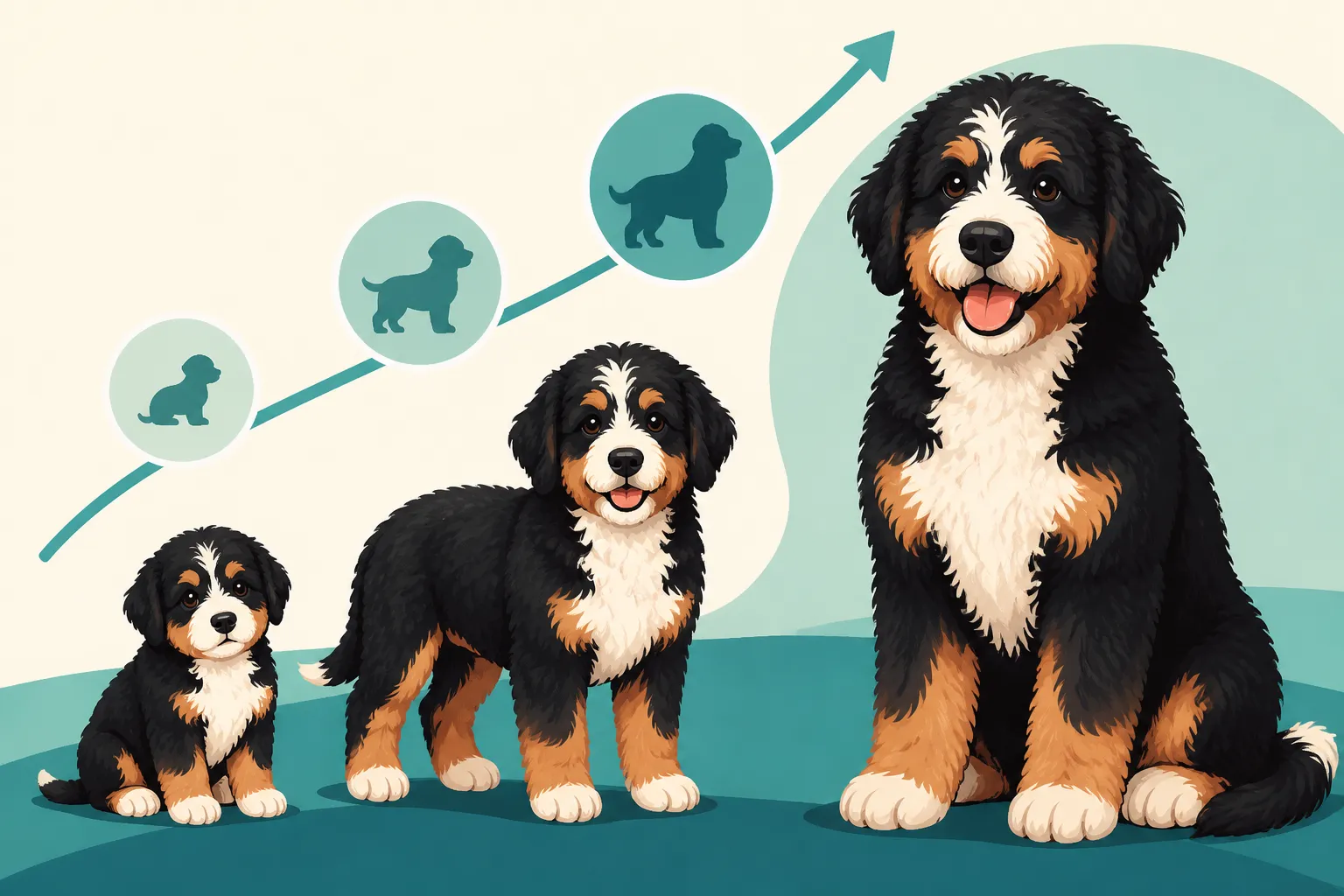
The Age a Bernedoodle Reaches Full Size
A Bernedoodle can look nearly grown while still gaining height, muscle, and weight, which makes it hard to know when puppy food, exercise, or expectations should change. Most reach close to their adult height before they finish filling out, and their size category matters: a Tiny may mature much earlier than a Standard. This guide explains what to expect and how to track growth sensibly.
When Bernedoodles usually reach full size
“Full size” can mean two different things: reaching adult height, or finishing the slower process of gaining muscle and filling out. Those milestones don’t always happen at the same time. A Bernedoodle may stop getting noticeably taller but still look lanky or puppyish for months afterward.
The estimates below are general patterns, not deadlines. Individual growth depends on inherited size, parent dogs, health, nutrition, and other factors. For an overview of how the size categories differ, see The Three Bernedoodle Sizes and What Sets Them.
| Bernedoodle size | Often close to adult height | May continue filling out |
|---|---|---|
| Tiny | Around 8 to 12 months | Into the first year or a little beyond |
| Mini | Around 10 to 14 months | Through roughly the first year to 18 months |
| Standard | Around 12 to 18 months | Often into the second year |
These are useful guideposts, not guarantees. A smaller dog can mature later than expected, and a larger dog may reach most of its height earlier while continuing to develop physically.
Tiny Bernedoodles tend to mature first
A Tiny Bernedoodle generally reaches its adult height earlier than a Standard because smaller dogs tend to complete their growth sooner. Many are close to their final height before their first birthday. Even then, a young dog may continue gaining a little weight and muscle as its body proportions settle.
Don’t assume that every puppy described as Tiny will mature on the same schedule. Breeder labels aren’t always used consistently, and adult size can be difficult to predict, particularly when the puppy’s parents vary in size. A Tiny Bernedoodle may also be more delicate during adolescence than its fluffy appearance suggests, so avoid treating “small” as a reason to push it into strenuous activity before it is ready.
If you’re comparing expected adult size with your puppy’s progress, The Tiny Bernedoodle Under Twenty Five Pounds provides useful context about the category. Keep in mind that a size label is an estimate, not a promise about an individual dog.
Mini Bernedoodles usually grow through their first year
Many Mini Bernedoodles approach adult height sometime around the end of their first year, but some continue to develop for several more months. They may look long-legged or narrow through the chest while their frame is still changing. That adolescent, slightly awkward look is common and does not necessarily mean something is wrong.
A Mini can also inherit a range of traits from its parents, so two dogs with the same label may mature differently. The label alone doesn’t tell you exactly when growth will stop, nor does it guarantee a precise adult weight. For a closer look at the size range and what it can mean in practice, see The Mini Bernedoodle at Twenty Five to Fifty Pounds.
Standard Bernedoodles often take the longest
A Standard Bernedoodle may keep growing taller into the second year, particularly if it is expected to become a large adult. Some reach most of their height before that point, then continue filling out. This can leave owners wondering why a dog that seemed to stop growing suddenly looks broader or heavier later on.
That later change isn’t automatically a sign of unhealthy weight gain. Compare the dog’s body condition and veterinary growth records rather than judging by its coat or by a single number on the scale. A thick, curly coat can make it difficult to see the waist and ribs, so use your hands as well as your eyes when checking body condition.
For a sense of the adult range commonly associated with the Standard category, see The Standard Bernedoodle at Seventy to Ninety Pounds. Individual dogs can fall outside a typical range, so use the parents’ size and your veterinarian’s assessment as additional context.
Why one Bernedoodle grows faster than another
Size category offers a starting point, but it can’t account for every puppy. Growth is influenced by genetics, sex, nutrition, health, and the timing of natural development. Two littermates can grow at different rates and still end up healthy adults.
It’s also easy to mistake a sudden visual change for a growth spurt. A coat becoming fuller, a puppy losing its round baby shape, or a change in grooming length can make a dog seem bigger or smaller without a dramatic difference in its actual frame.
Parent size and inherited traits matter
A puppy’s parents are among the most useful clues for estimating adult size, but they cannot provide an exact answer. A puppy may inherit a combination of traits that doesn’t match a simple midpoint between the parents. Even within one litter, puppies can differ in bone structure and growth pattern.
Generation can add another layer of uncertainty. Bernedoodle labels describe parentage, but they don’t make every puppy’s size predictable. A responsible breeder may share the parents’ adult sizes and explain the range they have seen in related litters, while still being honest that an estimate can be wrong. For more on the limits of forecasting, see Whether a Bernedoodle's Adult Size Can Be Predicted.
The puppy’s paws can be a tempting clue, but they aren’t a reliable measuring tool on their own. A puppy with big paws may still mature into a moderate-sized dog, and a puppy with neat feet may surprise you by growing larger than expected. Use family history and a pattern of growth over time rather than trying to make a precise prediction from one feature.
Growth isn’t a smooth, perfectly steady line
Puppies don’t gain height and weight in a neat, predictable way every week. You might notice a period when your Bernedoodle seems to shoot up, followed by a stretch when its size changes very little. That can be normal, particularly if the puppy is otherwise active, eating appropriately, and developing as expected.
A single weigh-in tells you little about the overall pattern. Weighing on the same scale and recording the result every few weeks can be more informative. If the number changes sharply, check that the weighing conditions were similar and discuss the trend with your veterinarian rather than making a sudden diet change based on one reading.
If your puppy appears much smaller or larger than the estimate you were given, avoid assuming the breeder deliberately misled you or that the dog has a health problem. Estimates are imperfect, and weight can be affected by body condition as well as frame size. Whether a Bernedoodle Ends Up Bigger Than Promised explores why the final adult size may not match an early prediction.
How to track your Bernedoodle’s growth
You don’t need elaborate equipment to keep an eye on development. A simple record of weight, appetite, activity, and veterinary observations gives you more useful information than repeatedly comparing your puppy with other dogs online. Photos can help too, especially if you take them from the same angle every few weeks.
Growth tracking shouldn’t become a contest. Puppies vary, and a dog that grows more slowly than a neighbor’s puppy isn’t necessarily behind. What matters is whether your individual puppy is following a healthy pattern for its build and age.
Record weight and body condition together
If possible, weigh your puppy on a consistent scale and make a note of the date. Your veterinary clinic can help if your home scale is too small or gives inconsistent readings. Also note changes such as appetite, energy, stool quality, and whether the puppy seems comfortable moving around.
Weight alone can be misleading. A fluffy Bernedoodle may look round even when its frame is lean, while a dog with a shorter coat may appear more slender. Ask your veterinarian to show you how to feel for the ribs and assess the waist. This is especially helpful as puppy proportions change and the coat becomes fuller.
A growth estimate can provide a rough reference point, but it isn’t a definitive forecast. Predicting What a Bernedoodle Puppy Will Weigh discusses what estimates can and can’t tell you. Treat any formula as a starting point for a conversation, not as a promise about adult weight.
Ask your veterinarian about an unexpected pattern
Bring up growth concerns at routine veterinary visits, or contact the clinic sooner if your puppy’s development changes abruptly or comes with other symptoms. Examples worth discussing include a noticeable loss of appetite, persistent digestive problems, unusual tiredness, pain, or difficulty walking. Those signs need attention in their own right; they aren’t simply a question of whether the puppy is reaching full size on schedule.
Your veterinarian can assess body condition, review the puppy’s diet, and consider whether further examination is needed. A chart from a general website cannot account for your dog’s breed mix, health history, or frame. Don’t try to speed up growth with extra food or supplements unless your veterinarian recommends a specific change.
Supporting healthy growth without rushing it
It’s natural to want a puppy to grow into its big, fluffy adult self. Still, faster growth isn’t a goal. Especially for a Standard Bernedoodle, steady development and a healthy body condition are more useful than trying to reach a particular weight by a particular age.
That means keeping food portions sensible, choosing an appropriate diet with veterinary guidance, and adjusting activity as the puppy matures. A puppy’s energy can make it seem ready for long hikes or repeated jumps before its body is ready for that level of strain.
Feed for development, not maximum size
Use feeding directions as a starting point and adjust with your veterinarian based on the puppy’s age, body condition, and rate of growth. Avoid adding extra food to make a Bernedoodle grow larger or feeding to a projected adult weight without professional guidance. A puppy’s nutritional needs are not the same as an adult dog’s, and growth diets should be chosen with care.
If you’re shopping online, Chewy is one place owners may compare puppy-food options, but a product listing can’t determine the best diet for your particular dog. Ask your veterinarian what nutritional profile is suitable, especially if your Bernedoodle is expected to grow large. If you use Chewy or another retailer, compare the product information against that guidance rather than choosing a food simply because it claims to support fast growth.
Chewy may also be convenient for reordering a food your veterinarian has already recommended. The important part is consistency: avoid switching foods repeatedly just because a puppy’s growth seems slower than expected. If your dog has a medical or digestive issue, ask the veterinary team before changing its diet.
For a deeper look at feeding considerations for a larger puppy, see Large Breed Puppy Food for a Standard Bernedoodle. Slow, appropriate growth is especially important for developing joints; Why Slow Growth Protects a Bernedoodle's Elbows explains why “bigger faster” is not a healthy target.
Match activity to the puppy, not its apparent size
A Bernedoodle can look like a substantial dog before it has finished maturing. Don’t assume that a tall adolescent is ready for the same repetitive exercise as a fully developed adult. Choose age-appropriate play, allow rest, and build activity gradually rather than expecting the puppy to keep up with a human hiking schedule.
Pay attention to how your puppy moves during and after activity. If it seems stiff, reluctant to continue, or unusually tired, shorten the session and discuss the pattern with your veterinarian. The aim isn’t to keep a young dog still; it’s to avoid turning exercise into a test of endurance while its body is developing.
Everyday habits matter too. Keep jumps from heights and repeated high-impact games from becoming the default, and use controlled walks and play suited to the puppy’s age and condition. For more on growth-related activity and joints, see Whether Overfeeding a Bernedoodle Puppy Damages Its Joints.
Know when the puppy stage is truly over
Reaching adult height doesn’t mean a Bernedoodle suddenly becomes emotionally mature. A dog may have a nearly adult frame and still behave like an adolescent, with bursts of energy, distractibility, or inconsistent responses to familiar cues. Physical growth and behavioral maturity follow different timelines.
Continue training and daily routines after your dog looks grown. Keep reinforcing calm behavior, leash skills, recall, and cooperative handling. A large adolescent that hasn’t learned to walk politely or settle around guests can be difficult to manage, even if it has stopped gaining height.
If your Bernedoodle is still lanky after its first birthday, that alone doesn’t mean it is underweight or growing abnormally. If its body condition, appetite, movement, or growth pattern worries you, ask your veterinarian to assess the whole picture. That’s a better guide than waiting for a specific birthday to declare your dog “full size.”
Disclaimer
This article is for general informational purposes only and does not constitute professional advice. Laws, prices and regulations vary by location and change over time. Consult a qualified professional for guidance on your specific situation.