Whether a Mini Bernedoodle Takes More Generations to Breed
It’s a natural question for anyone dreaming of bringing a Mini Bernedoodle into their home: just how many generations does it take for a breeder to consistently produce those adorable, smaller-sized pups? You might hear different answers, and it can certainly be confusing to navigate the alphabet soup of F1, F1b, and multigen. This guide will cut through the jargon and explain the reality of breeding Mini Bernedoodles, so you can understand what to expect.
Understanding Bernedoodle Generations F1, F1b, Multigen
When you dive into the world of Bernedoodles, you'll quickly encounter terms like F1, F1b, F2, and so on. These aren't just fancy labels; they actually tell you a lot about the dog's parentage and, by extension, give some clues about traits like size, coat, and even temperament. For Mini Bernedoodles, understanding these generations is crucial because it sheds light on how breeders aim for specific outcomes, especially when trying to reduce the size from the large Bernese Mountain Dog parent.
The Foundation: F1 Bernedoodles
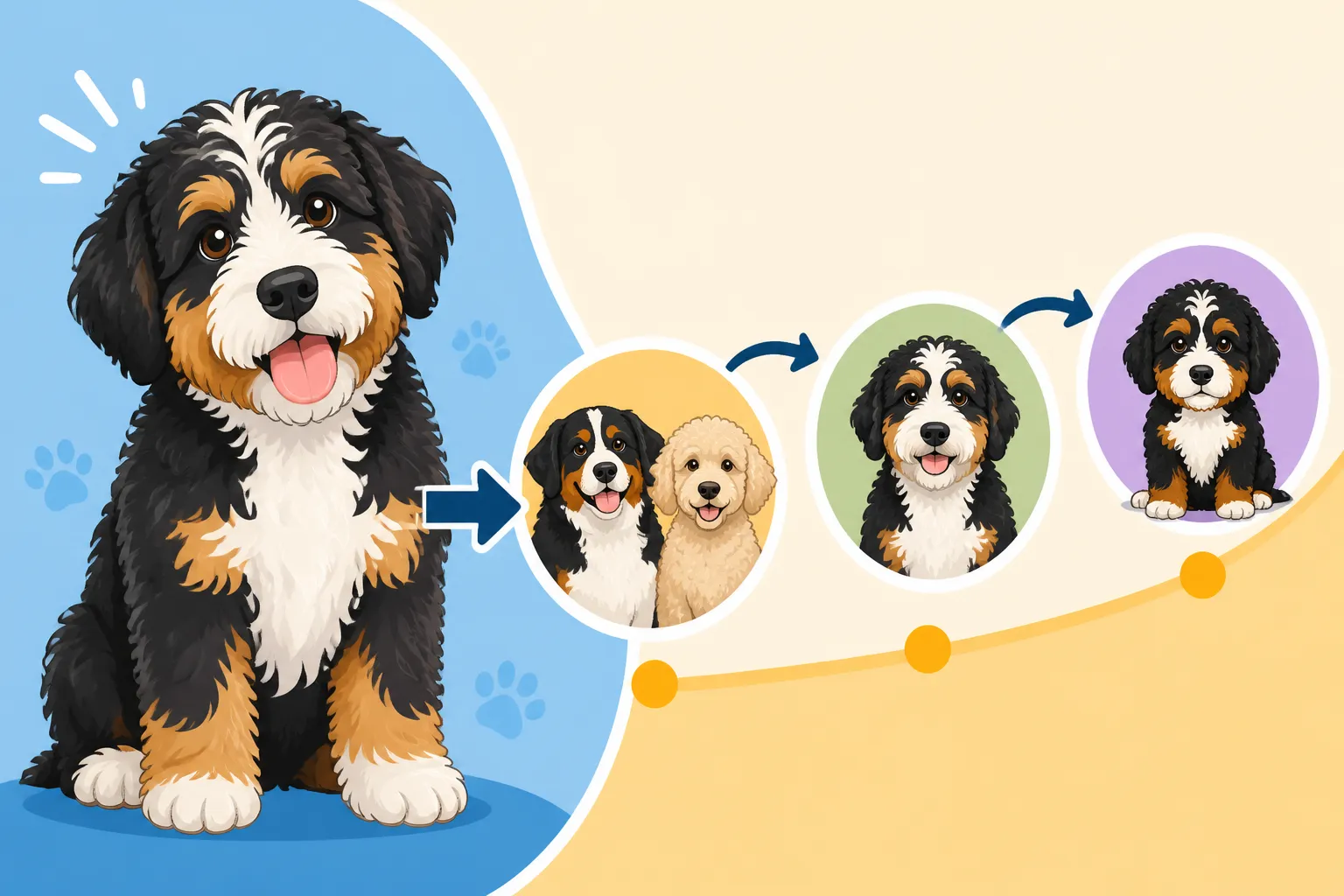
An F1 Bernedoodle is what we call a first-generation cross. This means one parent is a purebred Bernese Mountain Dog, and the other is a purebred Poodle. Simple, right? The "F" stands for filial, meaning offspring. So, F1 is the first filial generation. With an F1, you're looking at a 50/50 genetic split between the Bernese and the Poodle.
Now, for a Mini Bernedoodle, the size of the Poodle parent is absolutely critical here. If a breeder wants to produce smaller F1 Bernedoodles, they will typically use a Miniature Poodle (or sometimes even a Toy Poodle) as the Poodle parent, rather than a Standard Poodle. The idea is to introduce those smaller Poodle genetics right from the start. However, even with a Miniature Poodle, the Bernese Mountain Dog is a big dog, and genetics are a bit like a lottery. You can still end up with a fairly wide range of sizes in an F1 litter, with some puppies leaning more towards the Bernese side in stature, even if they're smaller than a full Standard Bernedoodle would be. So, while an F1 can be a Mini Bernedoodle, achieving consistent mini sizing in this generation can be a bit of a roll of the dice in terms of individual puppy size. If you're looking for a specific size, asking a breeder about predicting what a Bernedoodle puppy will weigh is a smart move.
The Backcross: F1b Bernedoodles
This is where things often start to get more consistent for those seeking a specific size or coat type. An F1b Bernedoodle is a "backcross." This means an F1 Bernedoodle (that 50/50 mix) is bred back to one of the original parent breeds, almost always a Poodle. So, an F1b Bernedoodle typically comes from an F1 Bernedoodle crossed with a purebred Poodle.
Why do breeders do this? Often, it's to increase the Poodle's influence. For a Mini Bernedoodle, this means taking an F1 Bernedoodle (hopefully one that is already leaning towards the smaller side) and breeding it with a Miniature Poodle. This cross aims to achieve a Bernedoodle that is roughly 75% Poodle and 25% Bernese. By adding more Poodle genetics, breeders can often achieve a more reliable reduction in size, and also increase the likelihood of a non-shedding, curly coat, which is highly desired by many people with allergies. So, while an F1 might give you a Mini Bernedoodle, the F1b generation is often the first intentional step where breeders start to see more predictable and consistent "mini" sizing within their litters. The greater Poodle influence also usually means a more consistent coat, which can be a relief for those worried about shedding.
Multigenerational Bernedoodles
Beyond F1b, you enter the realm of multigen Bernedoodles. This refers to any Bernedoodle that is an F2 generation or later. An F2 Bernedoodle, for example, is the result of breeding two F1 Bernedoodles together. An F3 is two F2s, and so on. Multigen breeding allows breeders even more control and predictability over traits like size, temperament, and coat.
With multigen Bernedoodles, breeders are essentially trying to "fix" or stabilize certain desired characteristics. If a breeder has consistently produced excellent Mini Bernedoodles through F1b crosses, they might then breed two of these F1b Bernedoodles together (creating an F2b, though terms vary) or breed an F1b with another Bernedoodle that also carries strong mini traits. This isn't about simply reducing size in more generations, but about refining and making that desired mini size (and other characteristics like coat type or specific temperaments) more consistent and less variable across litters. It allows for a greater degree of selection, helping breeders to hone in on their ideal Mini Bernedoodle. This is also where you might see specialized lines develop, with breeders working towards very specific size ranges, such as what the Tiny Bernedoodle size class costs.
The Role of Poodle Size in Mini Bernedoodle Breeding
It might seem obvious, but the size of the Poodle parent is the most direct and impactful factor in determining the potential size of a Bernedoodle. You can't get a Mini Bernedoodle by breeding a Bernese Mountain Dog with a Standard Poodle, at least not consistently or predictably. The Poodle side of the equation is actively manipulated by breeders to achieve the desired size range.
Standard vs. Miniature vs. Toy Poodles
Poodles come in three main size varieties: Standard, Miniature, and Toy.
- Standard Poodles are large dogs, typically over 15 inches at the shoulder. When bred with a Bernese, they produce Standard Bernedoodles, which are often 70 pounds or more. These are substantial dogs, perfect for those who want a truly big companion.
- Miniature Poodles are smaller, usually 10 to 15 inches at the shoulder. This is the variety most commonly used to create Mini Bernedoodles. By pairing a Bernese with a Miniature Poodle, breeders aim for that mid-range size that so many people adore – smaller than a Standard, but still sturdy. This cross is the primary route to getting what breeders call a "Mini Bernedoodle," typically weighing between 25 and 50 pounds. For many, this is the perfect balance, as you can see when comparing what a mini Bernedoodle sells for versus what a standard Bernedoodle sells for.
- Toy Poodles are the smallest, usually under 10 inches at the shoulder. When a Toy Poodle is used in a cross, often with an F1 Mini Bernedoodle or a smaller Bernese, the goal is to produce Tiny Bernedoodles, which can be under 25 pounds. These are the smallest of the Bernedoodles and require careful breeding to ensure health and proper conformation.
The Poodle parent essentially dictates the "starting point" for size reduction. Without a Miniature or Toy Poodle in the lineage, achieving a true Mini Bernedoodle is extremely unlikely.
Predicting Size in a Crossbreed
Despite a breeder's best efforts and careful selection of Poodle parents, predicting the exact adult size of a Bernedoodle puppy, especially in earlier generations, can still be a bit of a genetic lottery. This is one of the inherent challenges of hybrid breeding. Even if you breed a Bernese with a Mini Poodle, you can still have puppies in the litter that vary quite a bit in size. Some might take more after the Bernese parent in terms of build and mature size, while others will clearly follow the Poodle genetics more closely.
Think of it like this: each parent contributes a vast array of genes. While a Mini Poodle introduces "smallness" genes, the Bernese still brings "largeness" genes to the table. In an F1 litter, these genes combine in unpredictable ways for each individual puppy. This is precisely why breeders often move to F1b or multigen crosses. By consistently reintroducing more Poodle genetics (or selecting for smaller Bernedoodles to breed together), they increase the statistical probability of producing a more uniform litter of Mini Bernedoodles. This drive for predictability is a major reason why breeders sometimes lean towards later generations to establish a more consistent "mini" line. If a breeder is confident in their lines, they might even offer some guarantees, but even then, a Bernedoodle that outgrows its size class can happen.
Why "More Generations" Can Lead to More Predictable Mini Sizes
It's not necessarily about needing many generations, but rather strategically using specific generations to achieve desired outcomes. While a Mini Bernedoodle can certainly be born in an F1 litter, the journey through F1b and into multigen lines is often about increasing predictability and consistency, rather than simply taking longer to get to a "mini" size.
Achieving Consistency in Size and Traits
The primary reason breeders often pursue F1b and multigen crosses when aiming for Mini Bernedoodles isn't just to make them small, but to make them consistently small, and to combine that smallness with other desirable traits. In an F1 litter, where you have a 50/50 genetic split, you get a significant amount of genetic variability. This means that while some puppies might be perfectly "mini," others could be larger or have a less desirable coat type for allergy sufferers.
By moving to an F1b generation (F1 Bernedoodle x Poodle), breeders are taking a deliberate step to push the genetic balance towards the Poodle side. This not only increases the likelihood of smaller size but also improves the chances of a non-shedding coat and other Poodle-like qualities. When you then breed two F1b Bernedoodles together, or an F1b with a suitable multigen Bernedoodle, you're further refining these traits. It's about taking the best examples from previous generations and breeding them to reinforce the desired characteristics – making the "mini" size, the coat type, and the temperament more standard across the litters. This is often why you might find that why the smallest Bernedoodles cost the most; the effort in breeding for consistency adds value.
The Breeder's Strategy: Refining the Mini Bernedoodle
Ethical breeders are essentially artists, using genetics as their medium to create the healthiest, happiest, and most consistent puppies possible. Their strategy for Mini Bernedoodles involves careful selection and, yes, sometimes breeding beyond the F1 stage to achieve their goals. This isn't just about mating two dogs; it's about studying pedigrees, understanding genetic probabilities, and constantly evaluating their breeding stock.
A good breeder will perform health testing on both parent dogs for conditions common to Bernese Mountain Dogs and Poodles, such as hip and elbow dysplasia, eye conditions, and certain genetic diseases. This ensures that even as they refine for size, they are not compromising the long-term health of their puppies. Providers like Healthy Paws offer pet insurance that can help cover unexpected health issues, which is always a good idea for any dog owner.
They might begin with an F1 cross using a smaller Poodle, hoping for smaller F1 Bernedoodles. From that litter, they'd select the healthiest puppies with the desired size, coat, and temperament to become future breeding stock. These chosen F1 Bernedoodles might then be bred back to a Mini Poodle (creating F1b pups) to further solidify the smaller size and coat type. As they progress through generations, they continue this careful selection process, aiming to produce litters where all puppies reliably fall within the desired Mini Bernedoodle size range and exhibit other characteristic Bernedoodle traits. This deliberate, multi-generational approach isn't about simply adding generations, but about strategic breeding to achieve highly specific and predictable outcomes for the breed. Many reputable breeders will openly discuss the five clearances a Bernedoodle breeder should have for their breeding dogs.
| Generation | Parentage | Approximate Poodle/Bernese Split | Typical Size Predictability | Coat Consistency | Primary Goal |
|---|---|---|---|---|---|
| F1 | Bernese Mountain Dog x Poodle (Mini) | 50% Poodle / 50% Bernese | Variable (can range widely) | Variable | Initial cross, introduce Poodle traits & size reduction |
| F1b | F1 Bernedoodle x Poodle (Mini/Toy) | ~75% Poodle / ~25% Bernese | Improved (more consistent mini) | Improved (less shedding) | Refine size, reduce shedding, increase Poodle traits |
| Multigen | Bernedoodle x Bernedoodle (F2, F2b, F3, etc.) | Varies, usually Poodle dominant | High (very consistent mini) | High (stabilized coat) | Stabilize all desired traits (size, coat, temperament) |
Common Misconceptions and Realities of Mini Bernedoodle Breeding
The world of designer dogs, while wonderful, can also be a breeding ground for misunderstandings. When it comes to Mini Bernedoodles, there are a few common myths that need to be cleared up to help prospective owners make informed decisions. It's easy to get caught up in simplified explanations, but the reality is often more nuanced.
The "F1 = Standard, F1b = Mini" Myth
One of the most pervasive myths is that F1 Bernedoodles are always standard-sized, and you must have an F1b to get a Mini. This simply isn't true. As we discussed, an F1 Bernedoodle is the result of breeding a purebred Bernese Mountain Dog with a purebred Poodle. If that Poodle is a Miniature Poodle (or even a Toy Poodle), the resulting F1 litter will contain puppies that are considered Mini Bernedoodles.
The difference lies in predictability and consistency. While an F1 litter using a Miniature Poodle can and will produce Mini Bernedoodles, there's often a wider range of sizes within that litter. You might have some puppies that are on the smaller side of "mini" and others that are closer to the larger end, sometimes even pushing into what might be considered a smaller standard. The F1b generation, by reintroducing more Poodle genetics, tends to make the "mini" size more consistent across the litter, but it doesn't mean that F1s can't be mini. It's important to look at the specific parentage and the expected size range provided by the breeder, rather than relying solely on the generational label to indicate size.
Size Variation Within Litters
Even with the most meticulous breeding programs and later generations, it's important to remember that genetics are complex. You can still see significant size variation within a single litter of Mini Bernedoodles, regardless of generation. It's not uncommon for a litter to have a "runt" that is considerably smaller, or a "jumbo" puppy that seems to have inherited more of the Bernese's larger genes.
This is why reputable breeders emphasize that size predictions are just that: predictions. While they can give you a very good estimate based on the parents and previous litters, there's never a 100% guarantee that a puppy will reach an exact weight. Factors like nutrition, exercise, and individual growth rates also play a role. When selecting your puppy, it's wise to discuss growth expectations with your breeder and understand that there might be some natural variance. Stores like Chewy offer a wide range of large breed puppy food specifically formulated to support healthy, steady growth in these larger breeds, whether they are destined to be standard or mini. For those who prefer a more curated approach, services like Ollie provide fresh dog food options that can be tailored to a puppy's specific needs as they grow.
The Health Aspect of Size Reduction
While the desire for a smaller Bernedoodle is understandable, it's crucial to ensure that size reduction is being pursued ethically and responsibly. A good breeder prioritizes the health and well-being of their dogs above all else. This means not just breeding for smaller size, but for good health, sound temperament, and proper conformation within that smaller size.
Responsible breeders will screen their parent dogs for genetic health conditions common to both Bernese Mountain Dogs and Poodles, such as Hip and Elbow Dysplasia, Von Willebrand's Disease, and certain eye conditions. This careful health testing is vital at every generational stage, whether you're looking at an F1, F1b, or multigen Bernedoodle. Never hesitate to ask a breeder about the health clearances of their breeding stock. A breeder focused solely on achieving a tiny size without regard for genetic health could inadvertently propagate health issues. The goal should always be a healthy, well-adjusted Mini Bernedoodle, not just a small one.
Disclaimer
This article is for general informational purposes only and does not constitute professional advice. Laws, prices and regulations vary by location and change over time. Consult a qualified professional for guidance on your specific situation.