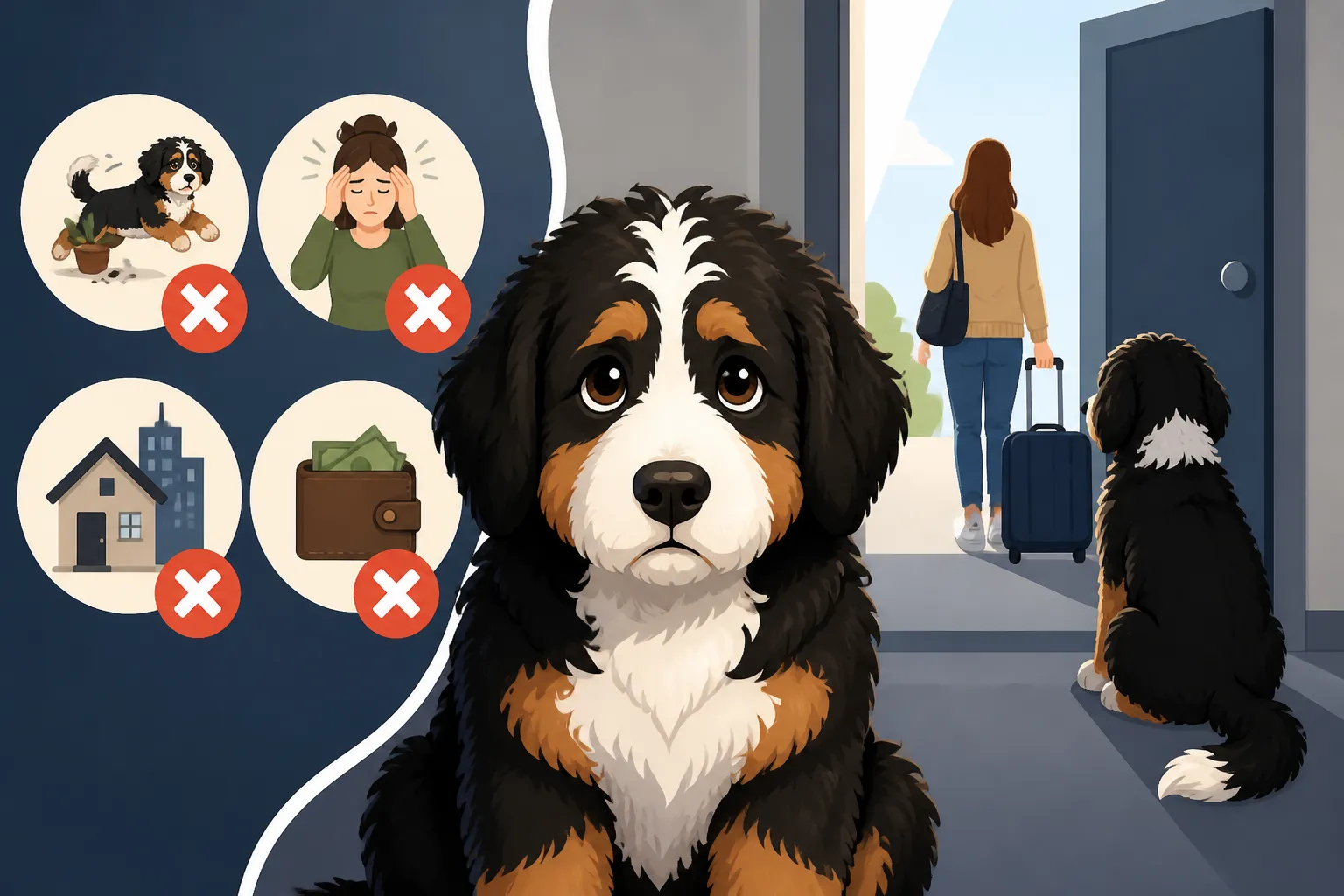
Why Bernedoodles Are Surrendered
It's truly heartbreaking to hear about any dog ending up in a shelter or rescue, and even more so when it's a breed like the Bernedoodle, often purchased with so much hope and excitement. When a beloved family companion suddenly needs rehoming, it's rarely due to a lack of love, but rather a perfect storm of unforeseen challenges that can overwhelm even the most dedicated owner. This guide will explore the often-hidden reasons why Bernedoodles, despite their popularity, sometimes find themselves without a home, and what prospective owners can do to prevent such a devastating outcome.
Underestimating the Grooming Demands
One of the biggest eye-openers for new Bernedoodle owners, and a common reason for surrenders, is the sheer intensity of their grooming needs. Many people are drawn to the idea of a "non-shedding" or "low-shedding" dog, often advertised as a major benefit of the Poodle cross, but the reality of that dense, curly, or wavy coat can be a rude awakening.
The Reality of the "Non-Shedding" Coat
While it's true that many Bernedoodles shed significantly less than their Bernese Mountain Dog parent, "non-shedding" doesn't mean "no maintenance." In fact, it often means more maintenance. The Poodle's coat, instead of falling out, gets caught in the surrounding hair, leading to matting if not meticulously brushed out. This is especially true for the F1 Bernedoodle, which is a 50/50 cross, and even more so for those with the thick, wavy "fleece" coat that many people adore. This isn't just a cosmetic issue; severe matting can be incredibly painful for a dog, pulling at their skin, restricting movement, and leading to skin infections. Owners often don't realize that the soft puppy fluff will transition into a much denser adult coat, which typically begins to mat intensely around 6-12 months of age. You might be surprised to learn that a Bernedoodle's coat gets thicker with age, not thinner, which only compounds the problem.
Imagine trying to run your fingers through a tangled mess after a long day – now imagine that all over your body, pulling at your skin with every movement. That's what matting feels like for a Bernedoodle. Many owners, picturing a dog that just needs an occasional brush, are completely overwhelmed by the daily or every-other-day commitment required to keep these coats healthy. They might not realize that even a quick five-minute brush isn't enough; you really need to learn how to line brush a Bernedoodle to the skin to prevent those hidden mats from forming close to the body, where they can cause the most discomfort. This effort needs to be consistent, day in and day out, regardless of how busy life gets.
The Cost and Time Commitment of Professional Grooming
When home grooming proves too challenging or time-consuming, professional grooming becomes essential. However, many owners vastly underestimate the cost and frequency of these appointments. A Bernedoodle, especially a Standard Bernedoodle, needs to be professionally groomed every 6-8 weeks, sometimes even more frequently if their coat is particularly prone to matting or if the owner prefers a longer style. A basic groom involves bathing, drying, brushing, nail trims, and a full haircut, which for a large Bernedoodle can easily take three hours or more due to the coat's density and length.
These appointments are not cheap. The Seventy to Hundred Fifty Dollar Bernedoodle Groom is a common starting point, and that's often for a dog whose coat is already in good condition. If the dog arrives matted, the cost skyrockets, sometimes incurring dematting fees or requiring the dog to be shaved down completely to alleviate pain and irritation. This can be a huge shock, and facing Six Hundred to Twelve Hundred a Year Grooming a Bernedoodle, or more, can quickly become a significant financial burden that was never factored into the initial budget. When owners can no longer afford regular grooming, the dog's coat quickly deteriorates, leading to discomfort, pain, and eventually, the difficult decision to surrender. This is why many rescues receive Bernedoodles that arrive matted, and their first order of business is often a full shave to provide immediate relief.
Size and Strength Beyond Expectations
Bernedoodles are generally large dogs, especially the Standard variety, and their impressive size, combined with their sometimes exuberant personalities, can be another common trigger for surrenders. What seems adorable in a puppy can become unmanageable in an eighty-pound adult.
Overwhelmed by a Large, Adolescent Dog
Many prospective Bernedoodle owners fall in love with the cute, fluffy puppy in pictures or during a brief visit. They might overlook the fact that these puppies grow into dogs that can easily weigh 70-90 pounds, or even more for males. While a Bernedoodle puppy is delightful, their adolescent phase can be a whirlwind of boundless energy, clumsy movements, and testing boundaries. It's a phase where a Bernedoodle is still a puppy at two, mentally, even though they've reached their full physical size. An owner who might have envisioned a calm, cuddly companion might instead find themselves with a boisterous, strong, and occasionally destructive teenager.
Imagine a rambunctious 80-pound dog trying to play like a small puppy, bouncing off furniture, enthusiastically greeting guests by jumping up, or accidentally knocking over a small child or an elderly family member. This isn't malice; it's often a lack of understanding of their own size and strength, combined with unspent energy and a need for consistent training. For families with very young children, or older individuals, managing a dog of this magnitude can become physically challenging, leading to frustration and, ultimately, a feeling of being overwhelmed. The sheer presence of a large, untrained dog can turn a peaceful home into a chaotic environment, which no one wants.
Managing a Strong Leash Puller
Another aspect of their size that often catches owners off guard is their incredible strength on a leash. While Poodles are often agile and easy on the leash, the Bernese Mountain Dog side contributes a solid, powerful build. A Bernedoodle heading for ninety pounds can easily pull an adult off their feet if they haven't been properly trained in leash manners. This means walks, which should be an enjoyable bonding experience, become a dreaded chore or even a safety hazard.
Owners might try various collars and harnesses, but without consistent training, a strong-willed Bernedoodle can make any walk a battle of wills. This becomes particularly problematic for people who live in areas with limited off-leash opportunities, or for those who simply don't have the physical strength to manage a determined large dog. The dream of strolling through the park with a well-behaved companion quickly evaporates, replaced by dread every time the leash comes out. This can severely limit a dog's exercise, which in turn leads to more pent-up energy and behavioral issues, creating a vicious cycle that contributes to the decision to surrender.
Financial Strain and Unexpected Costs
The initial purchase price of a Bernedoodle is significant, but many new owners fail to grasp that this is just the tip of the iceberg. The ongoing financial commitment for a large, long-lived dog can be truly staggering, and unforeseen expenses can quickly lead to financial strain.
The High Purchase Price Is Just the Beginning
Prospective Bernedoodle owners are usually aware that these designer dogs come with a premium price tag. What a Standard Bernedoodle Costs From a Tested Breeder can be several thousand dollars, a substantial initial investment. However, this figure often overshadows the multitude of costs that follow. Beyond the purchase price, there are immediate expenses like crates, beds, collars, leashes, toys, and initial vet visits for vaccinations and deworming. Then there are puppy classes, which are crucial for socialization and basic training, but add another layer of expense.
Many owners budget for the purchase but not adequately for the first year of ownership, which is often the most expensive. This includes not just supplies but also ensuring proper care to grow a standard Bernedoodle slowly on purpose, which involves quality large-breed puppy food and potentially joint supplements. The cumulative effect of these initial costs, combined with recurring expenses, can quickly deplete savings and leave owners unprepared for the long haul.
Unforeseen Health Issues and Veterinary Bills
Despite efforts by responsible breeders to health test their parent dogs, Bernedoodles can still inherit or develop health issues. Both Bernese Mountain Dogs and Poodles are predisposed to certain conditions, and while hybrid vigor can sometimes reduce the incidence of some diseases, it doesn't eliminate the risk entirely. Conditions like hip and elbow dysplasia, various cancers (including lymphoma in a middle aged Bernedoodle), bloat, and eye conditions are concerns that can lead to incredibly expensive veterinary care.
Imagine your beloved Bernedoodle suddenly developing a lameness requiring X-rays, medication, and possibly even surgery for elbow dysplasia in a growing Bernedoodle. Or, tragically, receiving a cancer diagnosis. What Cancer Treatment Costs a Bernedoodle Owner can run into many thousands of dollars, an amount that most families are simply not prepared for. While pet insurance, such as Healthy Paws, can certainly help mitigate these costs, many owners don't purchase it early enough or understand its limitations. Without insurance or a substantial emergency fund, these unexpected medical emergencies can create an impossible financial burden, leaving owners heartbroken and feeling they have no choice but to surrender their dog to ensure it receives the care they can no longer afford.
Daily Expenses Add Up Quickly
Beyond the big, scary vet bills, the day-to-day expenses of a Bernedoodle are considerably higher than for a smaller dog. A large dog eats a lot more food. What Feeding a Ninety Pound Bernedoodle Costs can be a significant monthly expenditure, especially if you opt for high-quality kibble or fresh food options like Ollie. Think about the volume of dog food a brand like Chewy ships for a large breed; it's substantial.
Then there are treats, toys that can withstand a powerful chewer (which often means more expensive, durable toys), and regular preventative medications like flea, tick, and heartworm treatments. Add to that the ongoing grooming expenses discussed earlier, and the costs quickly compound. Many owners don't account for these cumulative daily and monthly expenses over the expected 10-12 year lifespan of a Bernedoodle, leading to a slow but steady drain on finances that eventually becomes unsustainable.
Temperament and Training Challenges
Bernedoodles are often lauded for their intelligent, friendly, and goofy personalities. However, like any dog, they require consistent training and socialization. When these needs aren't met, or when their individual temperament presents unexpected challenges, owners can become overwhelmed.
Managing Puppy Energy and Adolescence
Bernedoodle puppies are notoriously energetic and playful. While this is endearing, it requires significant time and effort to channel properly. Many people get a puppy without fully understanding the commitment required for early socialization, puppy classes, and consistent training during this critical developmental period. The "puppy brain" often persists longer in larger breeds; Whether a Bernedoodle Is Still a Puppy at Two is a valid question many owners ask as their large dog continues to act with puppy-like exuberance.
During adolescence, which can last until two or even three years of age, Bernedoodles will test boundaries, experience bursts of energy, and sometimes "forget" previously learned commands. This period requires immense patience and consistency from owners. If an owner isn't prepared for this prolonged period of training and management, frustration can build. A Bernedoodle that isn't sufficiently exercised or mentally stimulated can become destructive, chewing furniture, digging, or barking excessively. These behaviors, while often a cry for attention or an outlet for energy, can push an owner to their breaking point.
Dealing with Separation Anxiety and Destructive Behaviors
Bernedoodles are known for being very social and forming strong bonds with their families. This can be a wonderful trait, leading to a loyal and affectionate companion. However, it can also predispose them to separation anxiety, especially if they are left alone for long periods without proper training and gradual acclimatization. Whether a Bernedoodle Suffers Separation Anxiety is a common concern, and indeed, many do.
A dog suffering from separation anxiety might engage in destructive chewing, incessant barking, house soiling, or frantic attempts to escape when left alone. Imagine coming home every day to a destroyed couch, chewed doorframes, or a constant barrage of complaints from neighbors about barking. These behaviors are distressing for both the dog and the owner. Addressing separation anxiety requires time, professional guidance, and often significant changes to routines, which not all owners are able to provide. The stress and damage can become unbearable, leading to the difficult decision to rehome.
The Stubborn Streak and Training Consistency
While Bernedoodles are intelligent, thanks to their Poodle lineage, they can also inherit a stubborn streak from their Bernese Mountain Dog side. This combination means they are smart enough to understand what you want but might choose not to do it if they don't see the immediate benefit. This is not malice, but a strong independent will that requires an owner who is patient, consistent, and creative with training methods. The Stubborn Streak Under a Bernedoodle's Poodle Brain can be challenging for inexperienced owners.
Many owners expect a dog to "just know" things or to respond to a few commands. They might get frustrated when their Bernedoodle seems to ignore them or perform well in class but not at home. This often comes down to a lack of consistency in training, or not finding the right motivators for the individual dog. Without clear boundaries and consistent reinforcement, a large, intelligent, and stubborn dog can quickly become the one running the household, creating a chaotic and stressful environment that is difficult to manage.
Lifestyle Changes and Lack of Preparedness
Life is unpredictable, and what might have been a perfect home for a Bernedoodle at one point can change dramatically, leaving owners scrambling to find a new solution for their beloved pet.
Major Life Events and Inadequate Planning
Major life events are perhaps the most common reason for surrenders across all breeds, and Bernedoodles are no exception. A new baby, a divorce, a job loss, a relocation (especially cross-country or international), or a sudden illness in the family can completely upend an owner's ability to care for their dog. What was once manageable suddenly becomes impossible. A new baby, for instance, drastically changes the amount of time and attention an owner has to dedicate to a large dog, and some families struggle with the integration of a powerful, energetic Bernedoodle with a fragile infant or toddler.
Similarly, a job loss can make the financial burden of a Bernedoodle—from food to grooming to vet care—untenable. Moving to a new home that doesn't allow large dogs, or a city apartment with no yard after living in a house with ample space, can mean the dog's exercise and space needs simply cannot be met. While these situations are often unavoidable, inadequate planning for such contingencies, or a lack of understanding of a Bernedoodle's needs in various living situations, can lead to heartbreaking choices.
Apartment Living and Exercise Needs
Bernedoodles, especially standard sizes, are substantial dogs. While some can adapt to apartment living if their exercise needs are rigorously met, many owners underestimate just how much physical and mental stimulation these dogs require. A standard Bernedoodle needs daily walks, playtime, and often mental enrichment activities to keep them happy and well-behaved. Simply letting them out in a small backyard isn't enough; they need engagement.
For an owner living in an apartment or a home with limited outdoor space, providing adequate exercise means a significant time commitment, often 60-90 minutes of active exercise daily, broken into multiple outings. If work schedules or personal commitments make this impossible, the dog can become bored, destructive, or develop behavioral issues. A frustrated Bernedoodle, cooped up with unspent energy, is not a happy dog, and an owner struggling to provide for its needs is not a happy owner. This mismatch between the dog's requirements and the owner's lifestyle often leads to the difficult decision of surrender.
Misconceptions About the "Hypoallergenic" Aspect
The perception that all "doodles" are hypoallergenic or non-shedding is one of the most persistent myths in the dog world, and it sadly contributes to Bernedoodles ending up in rescues when families realize it's not always true.
Shedding and Allergy Triggers
The Poodle is known for its non-shedding coat, which is why it's often crossed with other breeds to create "hypoallergenic" mixes. However, genetics are complex, and a Bernedoodle is a hybrid. This means that while many Bernedoodles do inherit the Poodle's low-shedding coat, some can take more after their Bernese Mountain Dog parent, resulting in a coat that sheds. Whether an F1 Bernedoodle Sheds More Than an F1b is a common question, and generally, F1b (75% Poodle) Bernedoodles are more likely to be lower shedding than F1 (50% Poodle) Bernedoodles, but there are no guarantees.
People often bring a Bernedoodle puppy home, hopeful that it will solve their allergy problems, only to find themselves, or a family member, still reacting. It can be devastating to realize that the new family member, chosen specifically for its supposed hypoallergenic qualities, is triggering allergies. This is often because allergies are not just to hair but also to dander (skin flakes), saliva, and urine. While a low-shedding coat might reduce the amount of dander circulating, it doesn't eliminate it entirely. This heartbreaking realization can leave families with no choice but to rehome the dog, a situation that could have been avoided with a more realistic understanding of coat genetics and allergy triggers.
The Bernese Coat Contribution
The Bernese Mountain Dog is a double-coated breed, known for its thick, beautiful coat that sheds considerably. When this gene is passed down, even partially, it can result in a Bernedoodle with a "flat coat" or a less curly, wavier coat that sheds. Some owners are told that if a Bernedoodle is hypoallergenic, it must be the case for all of them. But in truth, the Bernese half can ruin the allergy claim for a certain percentage of these dogs.
The density of the Bernese undercoat can also contribute to matting issues in the Bernedoodle, even if it's not shedding visibly. This means even if allergies aren't a concern, the coat can still be a massive grooming challenge. Unfortunately, many families only discover these realities after bringing their Bernedoodle home, leading to disappointment and distress. It's a prime example of how crucial it is for prospective owners to research thoroughly, speak with responsible breeders about coat genetics, and ideally spend time with adult Bernedoodles of various generations to assess potential shedding and allergy responses before committing.
Table: Common Reasons for Bernedoodle Surrender and Prevention
| Reason for Surrender | Description | Prevention / Mitigation for Prospective Owners |
|---|---|---|
| Grooming Demands | Underestimation of matting, frequency, time, and cost of grooming for dense, Poodle-like coats. | Research coat types thoroughly; commit to daily home grooming (line brushing); budget for professional grooming every 6-8 weeks (consider that a year of grooming bills on a Standard Bernedoodle can be over $1000); speak to experienced groomers about expectations. |
| Size & Strength | Puppy grows into a large, powerful adolescent/adult dog that is hard to manage physically. | Understand adult size (e.g., The Weight a Mini Bernedoodle Settles At vs. Standard); commit to early and ongoing positive reinforcement training; invest in proper equipment (harnesses, training tools); consider your physical capabilities to manage a strong, large dog. |
| Financial Strain | High initial cost, unexpected vet bills (e.g., from cancer or orthopedic issues), and daily expenses. | Create a detailed budget including purchase price, initial supplies, training, recurring food (consider brands like Chewy or Ollie), grooming, and pet insurance (e.g., Healthy Paws) from day one. Set aside an emergency fund for unexpected medical costs. Research potential health issues like "The Cancers That Take Bernedoodles Most Often" and "Hips on a Ninety Pound Bernedoodle". |
| Temperament & Training | Exuberant adolescence, stubbornness, separation anxiety, destructive behaviors due to lack of training/stimulation. | Commit to puppy classes and consistent training throughout adolescence; provide ample physical exercise and mental stimulation daily; learn about common Bernedoodle behaviors like "The Shyness a Bernedoodle Gets From the Bernese" and "The Stubborn Streak Under a Bernedoodle's Poodle Brain"; be prepared for the emotional demands of a highly bonded, sometimes anxious dog. |
| Lifestyle Changes | Relocation, new baby, job loss, illness makes dog ownership unfeasible. | Honestly assess current and future lifestyle; plan for potential changes (e.g., pet-friendly housing, childcare options that include the dog); have a contingency plan for emergency care or temporary rehoming. |
| Allergy Misconceptions | Belief that all Bernedoodles are 100% hypoallergenic, leading to allergic reactions in the family. | Spend time with adult Bernedoodles of the same generation before committing; understand that "hypoallergenic" is not guaranteed; research "Whether a Bernedoodle Is Hypoallergenic" and "Whether the Bernese Half Ruins the Allergy Claim". |
Disclaimer
This article is for general informational purposes only and does not constitute professional advice. Laws, prices and regulations vary by location and change over time. Consult a qualified professional for guidance on your specific situation.