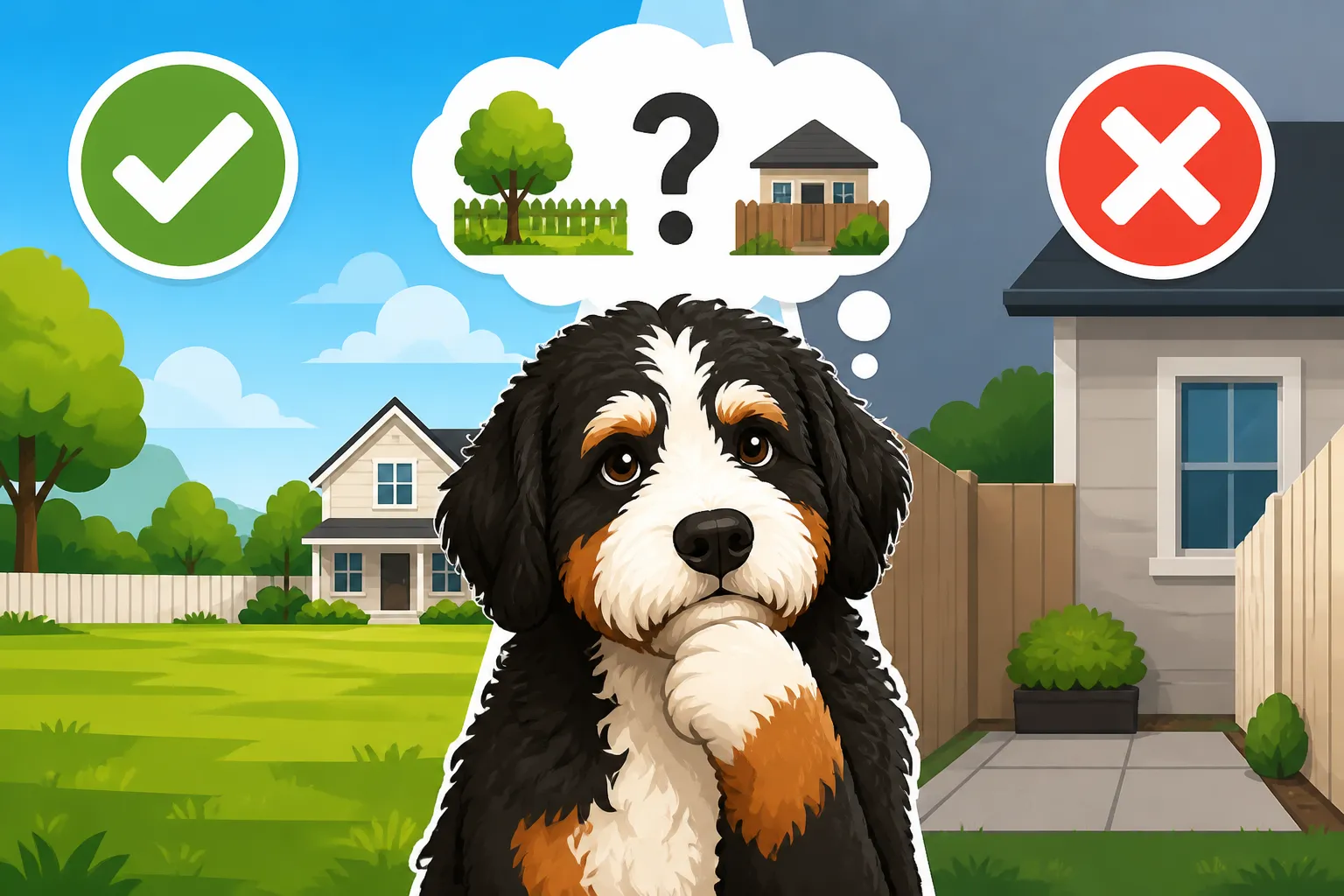
Whether a Standard Bernedoodle Needs a Big Yard
A standard Bernedoodle does not need a big yard simply because it is large. What matters more is whether you can provide regular walks, training, companionship, and safe chances to sniff and play. This guide explains how to decide if your home and routine can meet those needs, whether you have a small patio, a shared green space, or no yard at all.
Does a standard Bernedoodle need a big yard
A yard is convenient, but it is not a daily exercise plan
A secure yard can make life easier. It gives a dog a place to take a quick bathroom break, sniff around between walks, or play a short game of fetch. But a yard does not automatically provide the exercise, variety, and interaction a Bernedoodle needs. Many dogs with large gardens still need walks and time with their people; left outside alone, they may simply wait by the door or find something else to do, such as digging or barking.
A standard Bernedoodle’s size can make outdoor play feel like an obvious solution, but a large dog is not necessarily content to entertain itself. A walk gives your dog opportunities to explore new smells, encounter the world calmly, and practice leash manners. Indoor training and play also offer mental activity that a fenced patch of grass cannot provide on its own. For a sense of what regular activity can involve, see The Exercise a Standard Bernedoodle Needs Daily.
Think about a yard as a helpful extra, not a substitute for your routine. If you are home, have time for outings, and can give your dog safe opportunities to move and explore, a modest yard—or no private yard—can still work. If you are counting on a yard to make up for long periods without attention or exercise, its size is unlikely to solve the underlying problem.
The time and access matter more than the acreage
A small fenced area that is easy to reach may be more useful than a sprawling property that is inconvenient to supervise. For example, someone with a compact city garden and a reliable morning-and-evening walking routine may have an easier setup than someone with several acres but little time to interact with the dog. How often you go outside, what your dog does there, and whether the space is safe are more important than the yard’s square footage.
A Bernedoodle in a home without a yard can use a regular neighborhood route, nearby park, or other suitable public space for walks and sniffing. You will need to plan bathroom breaks rather than opening a back door, which can be tiring during bad weather, late at night, or when your dog is a puppy. A nearby green space helps, but it does not replace leash training or your responsibility to follow local rules.
If you are comparing living arrangements, consider the dog’s size alongside your daily schedule and the home’s layout. Which Bernedoodle Size Suits Which Household can help frame that decision. A standard Bernedoodle may take up more room indoors and be more challenging to manage on stairs or in a crowded entryway than a smaller dog, regardless of whether you have a yard.
What life with a standard Bernedoodle looks like without a big yard
A predictable walking routine does most of the heavy lifting
Without private outdoor space, it helps to build the dog’s day around dependable outings. A practical routine might include a morning walk, a shorter bathroom break later, and another walk or play-and-training session in the evening. The right plan depends on the individual dog’s age, health, energy, and experience. It should also be flexible: a young puppy, a recovering dog, and a healthy adult will not all need the same schedule.
Walks do not have to be strenuous to be worthwhile. A slower route with time to sniff can be more enriching than marching quickly around the same block. You can vary the route, practice calm greetings from a comfortable distance, or add a few simple cues during the walk. On days when the weather or your schedule makes a longer outing difficult, brief training sessions and indoor games can help fill the gap, though they should not be treated as a complete substitute for outdoor activity.
Be realistic about the less appealing parts of a no-yard routine, too. You may need to put on a coat and leash for a late-night bathroom trip, wait while your dog finishes sniffing in the rain, or clean muddy paws before coming back inside. If that sounds manageable as part of everyday life, a large yard may not be necessary. If it already feels like a major burden, consider whether a dog walker, a trusted neighbor, or a home with easier outdoor access is part of your plan.
Indoor enrichment helps, but it needs to suit your dog
A home can offer useful outlets for a dog’s brain, even if the indoor space is not enormous. Try short reward-based training sessions, hiding a few pieces of food for your dog to find, or using a food puzzle. Rotate toys rather than leaving every option out all the time, and supervise new items so you can see whether your dog chews them safely. Chewy is one place owners may browse for puzzle feeders and enrichment toys; check the item’s size and construction against your dog’s chewing habits.
Enrichment can also be simple and free. Ask your dog to wait while you place a toy in an easy-to-find spot, practice settling on a mat, or work on a handful of familiar cues. These activities are particularly handy on a rainy afternoon, but they should fit into a broader routine that includes walks and social contact. A dog who is restless may need more outdoor activity, a different kind of training, or help learning how to settle—not just another toy.
Space and flooring matter indoors, especially for a large, lively dog. Slippery floors can make sudden turns and play less comfortable, so rugs or runners may help create better footing. Keep play controlled in tight rooms, move breakable objects out of the way, and provide a resting place where the dog can be left undisturbed. For more on living with a dog that needs space to move, see Whether a Bernedoodle Is Calm Indoors.
What a yard can and cannot provide
A safe, usable yard is more valuable than a large, neglected one
If you do have a yard, check that it is secure and appropriate for a dog before relying on it. Look for gaps under fences, loose gates, sharp or hazardous objects, and plants or materials your dog might chew. A dog may squeeze through a space you thought was too small, particularly if something outside catches its attention. Supervise outdoor time until you understand how your dog behaves in the space.
A yard is also not automatically safe just because it is fenced. Dogs can overheat, get into garden products, or become distressed by noises and activity beyond the fence. Provide access to shade and fresh water, and bring your dog indoors when conditions are uncomfortable. Make sure outdoor time includes interaction rather than leaving the dog alone for long stretches.
The best yard is one you can use safely and consistently. A compact fenced patio may be handy for bathroom breaks, while a larger open area might make supervised play easier. If a fence is not practical, a leash or long line may allow safe sniffing where local rules permit. A yard’s usefulness depends on its boundaries, layout, and supervision—not just its size.
A private yard does not replace walks or social experiences
Dogs benefit from going beyond the same patch of ground. Neighborhood walks and suitable outings expose them to different surfaces, smells, sounds, and everyday situations. A dog who spends most of its outdoor time alone in a backyard may have fewer chances to practice moving calmly around bicycles, visitors, other dogs, or traffic. Those experiences should be introduced thoughtfully and at a pace the dog can handle.
This is especially important when a dog is still learning. A puppy may need frequent bathroom trips, but that does not mean it should be pushed into long or strenuous exercise. Keep outings appropriate for the puppy’s development and ask your veterinarian about concerns specific to your dog. The Exercise a Bernedoodle Puppy Should Not Do offers more context on keeping activity suitable while a puppy grows.
A secure yard is therefore best seen as one useful part of a dog’s environment. It can make bathroom breaks and brief play easier, but it does not provide the same variety as walks, training, and supervised time with people. If your dog has a yard and still seems bored, noisy, or hard to settle, look at the whole daily routine rather than assuming the outdoor area is too small.
How to decide whether your home is a good fit
Match the dog’s needs to your actual week
Before bringing home a standard Bernedoodle, picture an ordinary weekday, not just a sunny weekend. Who handles the first bathroom break? What happens when you have an early meeting, a long commute, or heavy rain? Where will the dog rest while you work? Who can help if you are sick or delayed? These details often matter more than whether the property has a large lawn.
Consider the route from your door to a safe place to walk, too. In an apartment, that might mean elevators, hallways, and several minutes to reach a suitable patch of grass. In a townhouse, stairs may be part of every bathroom trip. In a house without a fence, you may need to leash your dog every time. None of these arrangements makes a home automatically unsuitable, but each adds work that should be part of your decision.
A simple comparison can help you see where the real trade-offs lie:
| Home setup | Potential advantages | Everyday challenges |
|---|---|---|
| Large, fenced yard | Easy supervised bathroom breaks and room for brief play | Still requires walks, training, supervision, and maintenance |
| Small fenced yard or patio | Convenient outdoor access in a compact space | Limited room for play and no replacement for outings |
| Apartment near walkable green space | No yard upkeep and regular chances to explore outdoors | Bathroom trips require planning in all weather |
| Home without a nearby outdoor area | May still work with a consistent schedule and support | Longer travel to suitable walking areas and fewer quick breaks |
If you work away from home for long stretches, think about support before deciding that a yard will solve the problem. A midday visit from a trusted person may help with bathroom breaks and companionship. A dog walker or daycare may be another possibility, depending on the dog’s temperament and the quality of the care. The important question is how the dog will spend the day, not whether it can be let outside alone.
Plan for the dog you will have, not only the puppy you picture
A puppy can be carried or managed more easily than a full-grown standard dog, so think ahead to the adult version of your routine. Consider whether you can safely handle the dog on a leash, fit it comfortably in your car, and provide enough room for a bed and resting area. A fenced yard does not remove the need to teach basic skills such as walking politely, coming when called in safe settings, and settling indoors.
Your routine may also change as your dog ages. A senior dog with stiff joints may appreciate a nearby, easy-to-reach bathroom area, while long walks may need to become shorter or slower. That is one reason to choose a home setup that works for your life over time, rather than only for the energetic puppy stage. Whether a Bernedoodle Needs a Fenced Yard explores the separate question of fencing and safe outdoor access.
For many households, the deciding factor is not “big yard or no dog.” It is whether the people in the home can make a consistent plan for exercise, bathroom breaks, training, and companionship. If you are gathering everyday supplies for walks and cleanup, Chewy is one retailer to browse for items such as waste bags or portable bowls; choose equipment that suits your dog and your actual routine. You can also ask a local trainer or veterinarian for advice if your neighborhood setup presents a specific safety or behavior concern.
Use a realistic trial run before committing
Try following the schedule you expect to have with a dog for several days. Take a walk before work, plan a second outing later, and include a bathroom break when the weather is unpleasant. This will not fully reproduce life with a puppy or adult Bernedoodle, but it can reveal whether the timing and travel involved feel manageable. If you rely on a nearby park, walk the route at the time of day you would actually use it.
If possible, spend time with adult standard Bernedoodles in more than one kind of home. Notice the practical details: how much room the dog needs to turn around indoors, how it behaves when guests arrive, and how long it takes to get from the door to a suitable walking area. A breeder, rescue, or experienced owner may be able to explain what their particular dogs need, while remembering that individual temperaments and energy levels vary.
It can also help to write down a backup plan. Identify who could help during a busy week, where the dog can go for a safe walk, and what you would do if your usual outdoor route were temporarily unavailable. If the plan only works when everything goes perfectly, adjust it before bringing a dog home. A yard can make that plan more convenient, but it cannot do the planning for you.
Disclaimer
This article is for general informational purposes only and does not constitute professional advice. Laws, prices and regulations vary by location and change over time. Consult a qualified professional for guidance on your specific situation.