The Exercise a Bernedoodle Puppy Should Not Do
Bringing home a Bernedoodle puppy is an absolute joy, full of cuddles and playful antics, but it also comes with a big responsibility, especially when it comes to their growing bodies. Many new Bernedoodle parents are understandably eager to bond with their energetic furballs through play and walks, only to find themselves worried they might be doing too much or the wrong kind of exercise. This guide will walk you through the types of activities your Bernedoodle puppy absolutely needs to avoid to protect their delicate developing joints and ensure a healthy, happy future.
Understanding the Bernedoodle Puppy's Unique Needs
It’s easy to look at a fluffy Bernedoodle puppy and see a robust, resilient dog in the making. They grow so fast, often gaining several pounds a week, which can be deceptive. While they may look sturdy, their skeletal system is still very much a work in progress, making them vulnerable to injuries from inappropriate exercise. Understanding this critical developmental stage is key to nurturing a healthy adult dog.
The Rapid Growth Phase and Delicate Joints
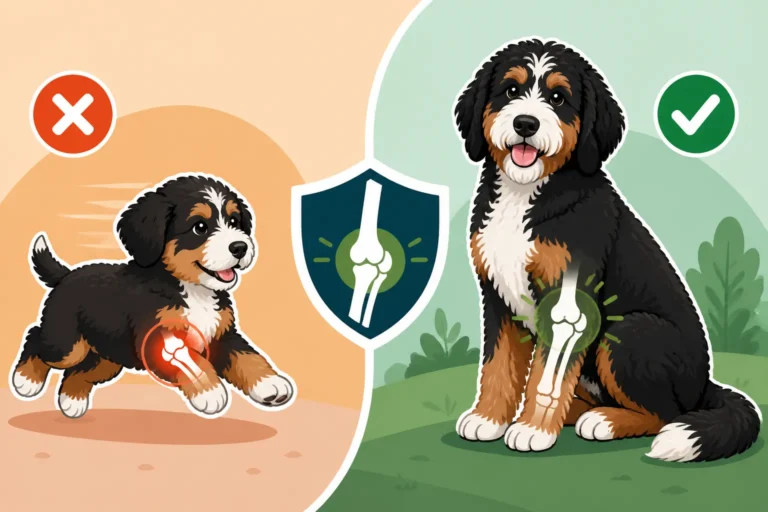
Bernedoodles, particularly the standard size, are considered large to giant breed dogs. This means they experience an incredibly rapid growth phase, often reaching their full height and a significant portion of their adult weight long before their growth plates have fully closed. Growth plates are areas of cartilage at the ends of long bones in puppies and young dogs, which produce new bone cells as the dog grows. These plates remain soft and vulnerable until they gradually harden and close, typically between 12 and 24 months of age, depending on the breed and individual dog.
During this period, any undue stress, impact, or twisting forces on these soft growth plates can cause damage. This damage can lead to irregular bone growth, pain, and potentially debilitating conditions like arthritis later in life. Imagine building a house on a foundation that hasn't fully set; any major stress could compromise its structural integrity. Your Bernedoodle puppy's skeleton is very much like that setting foundation.
Inherited Predispositions from Bernese and Poodle Lines
Adding another layer of complexity, Bernedoodles inherit genetic predispositions from both their Bernese Mountain Dog and Poodle parents. Both breeds, especially large Poodles and Bernese, can be prone to orthopedic issues such as hip and elbow dysplasia. These conditions are often polygenic, meaning multiple genes contribute to them, but environmental factors, particularly exercise during puppyhood, can significantly influence their expression. If a puppy with a genetic predisposition is subjected to excessive or incorrect exercise, the likelihood and severity of these joint problems can increase dramatically.
For instance, a puppy genetically inclined to Loose Hips in a Growing Standard Bernedoodle might develop more severe symptoms if allowed to jump frequently from high places. Similarly, a predisposition to Elbow Dysplasia in a Growing Bernedoodle can be exacerbated by activities that put repetitive stress on their front limbs. Responsible breeders screen their breeding dogs for these conditions, but even with clear parents, careful management of a puppy's environment and exercise is crucial.
The Temptation of a "Goofy" Puppy with Endless Energy
Bernedoodle puppies are often described as intelligent, playful, and wonderfully goofy. They have boundless energy, seemingly able to run and play for hours without tiring. This can be incredibly tempting for owners, who might feel like they're depriving their pup if they don't let them "burn off steam." However, a puppy's energy levels don't always align with what their growing bodies can safely handle. They don't self-regulate their activity in the same way an adult dog might; they'll often push themselves beyond their limits until they're physically exhausted, not because they've reached a sensible stopping point.
It’s your role as their guardian to regulate their activity, even when they’re begging for more playtime. This means setting boundaries, knowing when to end a play session, and understanding that mental stimulation can be just as tiring, if not more so, than physical exertion. Resisting the urge to let them play until they drop is one of the kindest things you can do for their long-term health.
High-Impact Activities to Avoid
When we talk about protecting a Bernedoodle puppy's joints, the first things that often come to mind are activities that involve jarring impacts or sudden stops and starts. These high-impact exercises can put immense strain on immature bones and joints, risking damage to those vulnerable growth plates and cartilage. It’s not about preventing play, but about structuring it safely.
Jumping from Heights: Furniture, Beds, and Vehicles
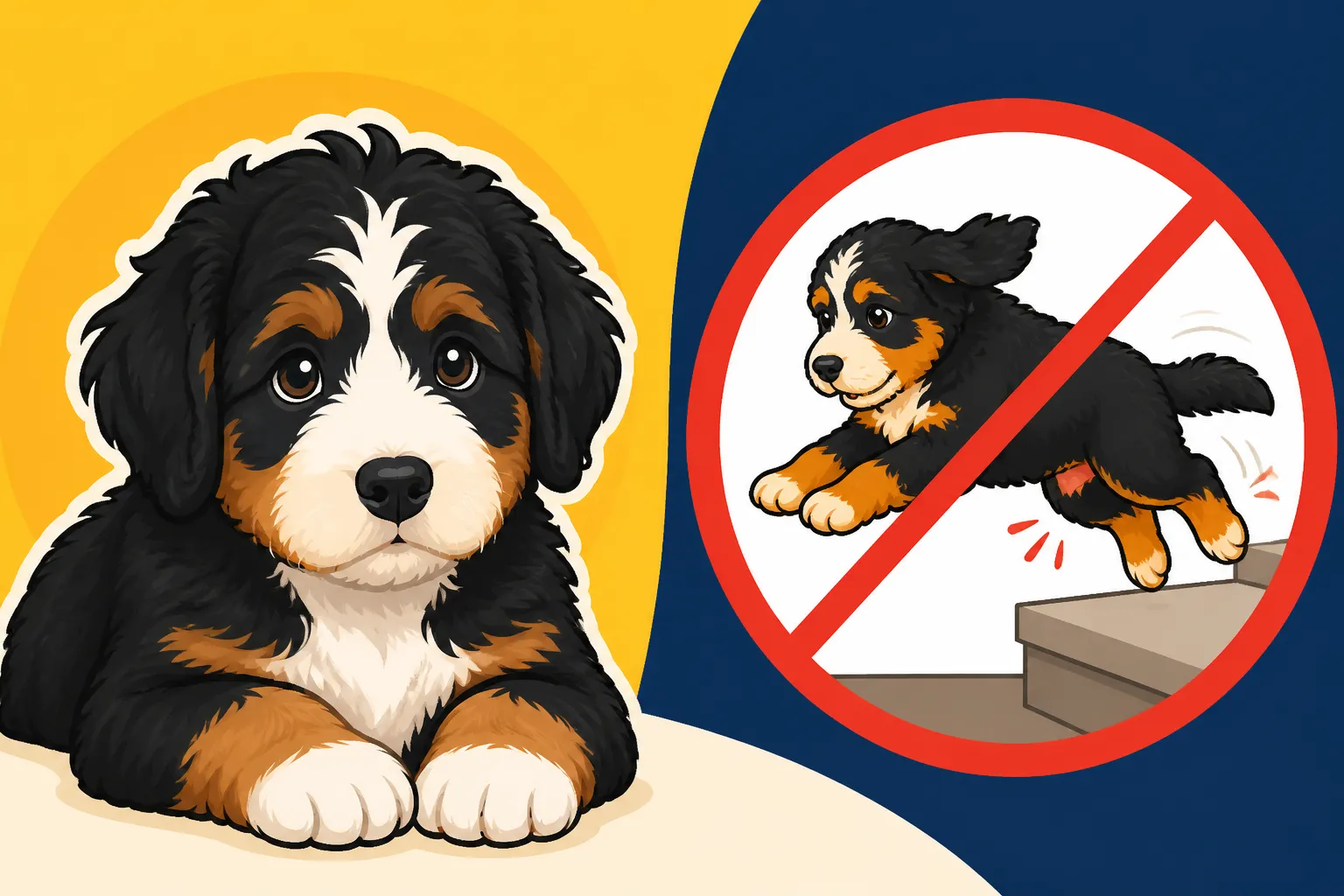
One of the most common and often overlooked dangers for a growing Bernedoodle puppy is jumping down from elevated surfaces. This includes furniture like couches and beds, and especially jumping out of cars or SUVs. When a puppy jumps down, the force of impact on their front legs and spine can be significant, potentially causing micro-fractures in growth plates, straining ligaments, or damaging cartilage. It’s a bit like a human child repeatedly jumping off a tall wall; even though they seem resilient, the cumulative effect can be detrimental.
Even if they don't show immediate pain, repeated stress can contribute to long-term issues like hip and elbow dysplasia. Teach your puppy from day one that jumping off furniture is a no-go. Use ramps or steps for access to beds or couches if you want them on the furniture, and always lift them in and out of vehicles until their growth plates are fully closed, usually around 18-24 months for a large breed. This simple habit can save them a lifetime of discomfort. For more on this, check out Whether Jumping Off Furniture Hurts a Bernedoodle.
Forced Runs and Long Distances
While a Bernedoodle puppy might have bursts of speed and seem like they could run forever, forcing them on long runs, especially on hard surfaces like pavement, is a definite no-no. Their cardiovascular system might be up to the task, but their skeletal system is not. Sustained running puts continuous, repetitive stress on every joint in their body, from their shoulders and elbows to their hips and knees. This kind of impact is precisely what can disrupt the delicate development of growth plates.
Think about the difference between a spontaneous burst of zoomies in the grass and a sustained jog alongside you. The former allows for natural breaks and varied movement, engaging different muscles without prolonged, monotonous impact. The latter is controlled by your pace, not theirs, and it can push them past their body's safe limits. Instead of forced runs, focus on free play in a secure, soft environment. The general rule of thumb for puppies is the "five-minute rule": five minutes of structured exercise per month of age, twice a day. So, a four-month-old puppy would get two 20-minute walks per day. This is a great guideline to protect those developing joints.
Intense, Uncontrolled Play with Adult Dogs
Introducing your Bernedoodle puppy to friendly, well-socialized adult dogs is crucial for their social development. However, supervising these interactions closely is paramount. Intense, rough-and-tumble play with much larger or overly boisterous adult dogs can lead to injuries for a smaller, less coordinated puppy. An adult dog, even one with the best intentions, might accidentally knock over, step on, or collide with a puppy during play, causing sprains, strains, or even fractures.
Furthermore, an adult dog might not understand the subtle cues that a puppy needs a break, or the puppy might be too excited to disengage. Look for play that is balanced, where both dogs take turns chasing and being chased, and where there are natural pauses. If the play becomes too one-sided, too fast, or too rough, step in and redirect the dogs. It’s better to err on the side of caution and end a play session early than to risk injury.
Repetitive Motions and Overuse Injuries
Beyond acute, high-impact incidents, puppies are also susceptible to injuries from repetitive motions. Their bodies are designed for varied movement and exploration, not for the same stress applied over and over. Overuse can lead to inflammation, micro-traumas, and long-term degenerative conditions, even if no single event seems particularly damaging.
Excessive Stair Climbing: Uphill and Downhill
Stairs might seem innocuous, but for a Bernedoodle puppy, they can be a significant source of stress on developing joints. Climbing stairs, especially going up, puts strain on the rear legs, hips, and lower back. Descending stairs, on the other hand, puts immense pressure and jarring impact on the front legs, shoulders, and elbows as the puppy tries to control its descent. The larger the puppy, the greater the gravitational force working against them, and the higher the potential for damage.
Until your Bernedoodle puppy is at least six months old, and ideally closer to 10-12 months for standard sizes, you should minimize or completely avoid stair climbing. If you live in a multi-story home, carry your puppy up and down the stairs. If that becomes impractical as they grow, consider baby gates to restrict access to stairways. Gradual introduction to stairs under supervision after their growth plates have started to close is much safer. For more detailed advice, read Whether Stairs Hurt a Standard Bernedoodle Puppy.
Slipping and Sliding on Hardwood Floors
Many modern homes feature beautiful hardwood, tile, or laminate flooring. While aesthetically pleasing, these slick surfaces can be treacherous for a growing Bernedoodle puppy. Their developing muscles and coordination are still catching up to their rapid growth, and they often struggle to gain purchase on smooth floors. Constant slipping, sliding, and sprawling can put abnormal stress on their joints, especially their hips and knees, as their legs splay out from under them.
Repeated slipping can contribute to subluxation (partial dislocation) or exacerbate genetic predispositions to hip and elbow issues. Consider laying down rugs, runners, or carpet squares in high-traffic areas where your puppy spends most of its time. This provides better traction and cushioning, allowing them to move more naturally and confidently without the risk of an accidental slip leading to injury. Mats available on Amazon or Chewy can be a lifesaver for slippery spots.
Prolonged Ball Chasing and Agility Training Too Early
Ball chasing might seem like the quintessential dog activity, but for a Bernedoodle puppy, prolonged sessions can be problematic. The sudden starts, stops, turns, and jumps involved in chasing a ball can put immense torque and impact on their joints, especially their knees and ankles. While a few throws here and there are fine, hour-long fetch sessions are definitely out for a young pup. This kind of repetitive, high-intensity activity can contribute to conditions like cruciate ligament tears or patellar luxation, which are devastating for a young dog.
Similarly, formal agility training, with its jumps, weaves, and tunnels, is fantastic for adult dogs but completely inappropriate for puppies. Agility obstacles are designed for dogs with fully developed musculature and closed growth plates. Introducing such strenuous activities too early is a recipe for serious injury. Wait until your Bernedoodle is at least 12-18 months old, or even older for the more challenging obstacles, before embarking on agility. Focus on foundational obedience and body awareness exercises instead.
Recognizing Signs of Overexertion and Pain
Even with the best intentions, sometimes puppies push themselves too hard, or we might inadvertently allow an activity that causes discomfort. Being able to recognize the subtle (and not-so-subtle) signs of overexertion or pain is crucial for immediate intervention and preventing further harm. Your Bernedoodle can't tell you in words that they hurt, so it's up to you to be their advocate.
Limping, Stiffness, and Reluctance to Move
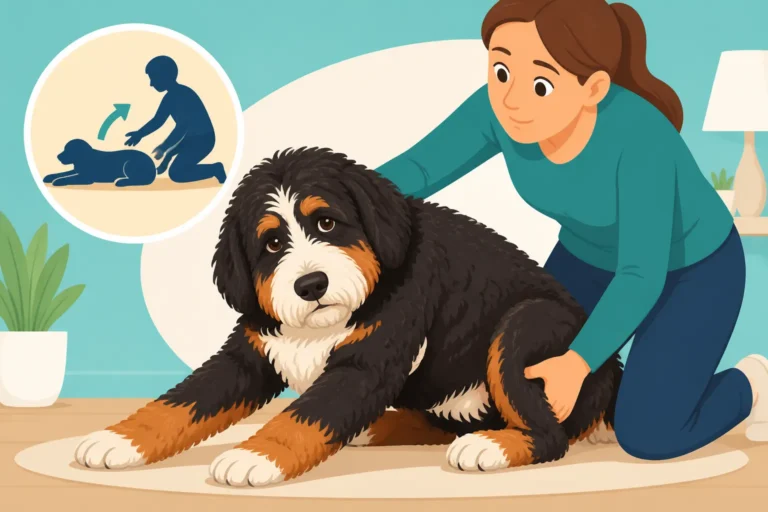
The most obvious sign of pain or injury in a puppy is limping. This might be a slight favoring of one leg, a head bob when they walk, or a complete refusal to bear weight. Sometimes, the limping might only be noticeable after a period of rest, such as first thing in the morning or after a nap, appearing as stiffness. This "post-rest stiffness" is a classic indicator of joint inflammation or discomfort.
Observe your puppy's gait and willingness to move. Are they hesitating before jumping (even if it's a small jump onto a chair) or showing reluctance to go up or down stairs they usually tackle with gusto? Do they seem less enthusiastic about playtime? Any change in their normal movement patterns or a decreased desire to engage in activities they typically enjoy should be a red flag. Don't assume they just "slept funny" if it persists; a vet visit is warranted to rule out orthopedic issues.
Excessive Panting and Heat Stress
Bernedoodles, particularly those with thicker coats and darker colors, can be prone to overheating, especially during strenuous activity or in warm weather. Excessive panting, even when not particularly hot, can be a sign of overexertion. While normal panting helps dogs regulate their body temperature, panting that is rapid, shallow, and doesn't subside quickly after stopping activity, or accompanied by other symptoms like lethargy, drooling, or a glazed look in their eyes, indicates heat stress.
Remember, a puppy's endurance is not the same as an adult's, and their ability to regulate body temperature is still developing. Always carry water during walks, avoid exercising during the hottest parts of the day, and be mindful of the temperature of surfaces like pavement. If you suspect heat stress, immediately move your puppy to a cool area, offer water, and consider a cool (not icy) damp towel on their body. Prompt veterinary attention is necessary if symptoms are severe or don't improve quickly.
Behavioral Changes Indicating Discomfort
Sometimes, a puppy won't show obvious physical signs of pain like limping. Instead, their discomfort might manifest as behavioral changes. A normally outgoing and playful Bernedoodle might become withdrawn, quiet, or less interactive. They might snap or growl when touched in certain areas, particularly if you approach a sore joint. Conversely, a usually calm puppy might become restless, unable to settle, or excessively lick a particular limb or area.
Other subtle signs can include changes in appetite, altered sleeping patterns, or even house-training accidents if moving is painful. Any unexplained shift in your Bernedoodle's typical personality or habits should prompt you to consider potential underlying pain or medical issues. A quick check-up with your veterinarian can help identify the cause and ensure your puppy gets the care they need.
Safe and Appropriate Exercise Alternatives
So, if all these things are off-limits, what can you do with your Bernedoodle puppy? The good news is, there are plenty of safe, enriching ways to help them burn energy, develop their muscles, and strengthen your bond without risking their delicate joints. It’s all about quality over quantity, and structure over uncontrolled chaos.
Structured, Short Walks on Soft Surfaces
Instead of long, forced runs on pavement, focus on short, leashed walks on soft, forgiving surfaces. Grass, dirt trails, or even well-maintained gravel paths are much kinder to developing joints than concrete or asphalt. These walks should be relatively brief, following the "five-minute rule" mentioned earlier (5 minutes per month of age, twice a day). So, a 3-month-old puppy would get two 15-minute walks.
The goal of these walks isn't endurance but rather exploration, socialization, and leash training. Let your puppy sniff and explore, allowing them to dictate the pace within reason. This type of exercise builds muscle and coordination naturally, exposes them to new sights and sounds, and helps them learn appropriate leash manners without overstressing their body. Think of it as controlled sniffing and strolling, rather than a brisk fitness walk. For guidance on appropriate walk durations, you might find The Age a Bernedoodle Can Start Long Walks helpful.
Supervised Playtime with Age-Appropriate Companions
While intense play with large adult dogs should be carefully managed, supervised playtime with other puppies or small, gentle adult dogs is incredibly beneficial. Puppy play dates, carefully selected puppy classes, or interactions with trusted, calm adult dogs can help your Bernedoodle develop crucial social skills and learn bite inhibition. The key here is supervision. Always be present and ready to intervene if play becomes too rough or overwhelming for your pup.
Look for play that involves chasing, wrestling, and gentle tugging, with plenty of breaks. Avoid situations where one dog is constantly overwhelming the other. Vary the play environment too – a soft, grassy yard is ideal. For a larger breed like the Bernedoodle, pairing them with a slightly older or similarly sized puppy can ensure a more balanced interaction. Even playing with small children, under close supervision, can be beneficial, as it teaches gentle manners.
Mental Stimulation and Training Exercises
Sometimes, the best way to tire out a high-energy Bernedoodle puppy isn't physical exercise, but mental work. Puppies have incredible brains that are eager to learn, and engaging them mentally can be just as exhausting as a long walk, without the physical strain. Basic obedience training, learning new tricks, or engaging in puzzle toys can provide excellent mental stimulation.
Consider interactive puzzle feeders available from brands like Chewy or Amazon, which require your puppy to solve a problem to get their kibble. Hide-and-seek with treats or toys, teaching them to find specific objects, or even just working on "sit," "stay," and "come" in short, fun sessions can burn a surprising amount of energy. These activities also strengthen your bond, build confidence, and lay the foundation for a well-behaved adult dog. Remember, consistency and positive reinforcement are key.
Long-Term Joint Health and Management
Protecting your Bernedoodle puppy’s joints isn't just about what you avoid; it's also about what you actively provide. A holistic approach that includes proper nutrition, weight management, and consistent veterinary care is crucial for ensuring their long-term comfort and mobility. The choices you make in puppyhood truly echo throughout their entire life.
The Role of Nutrition in Supporting Growth
Nutrition plays an incredibly significant role in a large breed puppy's development. Growing too quickly is one of the primary risk factors for orthopedic problems like hip and elbow dysplasia. Therefore, feeding a high-quality, large-breed specific puppy food is essential. These formulas are specifically designed with carefully balanced calcium and phosphorus ratios, and moderate protein and fat levels, to promote slow, steady growth rather than rapid weight gain.
Avoid free-feeding your Bernedoodle puppy; instead, feed measured portions appropriate for their age and expected adult size. Consult your veterinarian for precise feeding guidelines based on your puppy's individual needs. Overfeeding, even with appropriate large-breed food, can lead to excessive weight gain and stress on developing joints. Brands like Ollie (if you choose fresh food) or other reputable kibble brands found on Chewy can provide excellent options. It's worth reading Large Breed Puppy Food for a Standard Bernedoodle and Why Calcium Levels Matter for a Growing Bernedoodle to understand these nutritional nuances better. You may also be interested in Whether Overfeeding a Bernedoodle Puppy Damages Its Joints.
Maintaining a Healthy Weight Throughout Life
As your Bernedoodle matures, maintaining a healthy weight remains paramount for joint health. Every extra pound puts additional stress on their joints, accelerating wear and tear and increasing the risk of arthritis and other orthopedic issues. It's easy for Bernedoodles to become overweight if their caloric intake isn't matched with their activity levels, especially as they get older and their metabolism slows.
Regularly assess your Bernedoodle's body condition. You should be able to easily feel their ribs without seeing them, and they should have a discernible waist when viewed from above and a tuck-up when viewed from the side. If you're unsure, your veterinarian can help you determine if your dog is at an ideal weight. Adjust their food portions and exercise levels as needed, and be mindful of high-calorie treats. Prevention is always easier than trying to lose weight once it's gained, and it will contribute significantly to their comfort and mobility as they age.
Regular Vet Check-ups and Proactive Care
Consistent veterinary care is your best ally in managing your Bernedoodle's long-term joint health. Regular check-ups allow your vet to monitor your puppy's growth, assess their gait, and identify any early signs of orthopedic issues. They can also provide guidance on appropriate exercise levels, nutritional needs, and discuss preventative measures like joint supplements, if deemed necessary.
Don't hesitate to bring up any concerns you have about your puppy's movement or behavior, even if they seem minor. Early intervention can make a significant difference in managing conditions like hip or elbow dysplasia. Your vet might recommend specific diagnostic tests or refer you to a veterinary orthopedic specialist if they suspect an issue. Being proactive and working closely with your vet will help ensure your Bernedoodle lives a long, comfortable life. You can also explore options for Hips on a Ninety Pound Bernedoodle with your vet as your puppy grows.
Here's a quick summary of exercises to avoid and safe alternatives for your Bernedoodle puppy:
| Activity Type | Avoid During Puppyhood (0-18 months) | Safe Alternatives for Puppyhood (0-18 months) |
|---|---|---|
| High Impact Jumps | Jumping off furniture, beds, out of cars/trucks | Using ramps/steps for elevated surfaces; lifting in/out of vehicles |
| Forced Running/Endurance | Jogging alongside you on leash, long walks on hard surfaces, treadmill | Short, controlled walks (5 mins/month of age) on grass/soft ground |
| Repetitive Stress | Excessive stair climbing (especially down), prolonged fetch sessions | Carrying up/down stairs; short, varied play; puzzle toys |
| Slippery Surfaces | Uncarpeted hardwood, tile, laminate floors | Using rugs, runners, carpet in high-traffic areas |
| Rough Play | Unsupervised play with large, boisterous adult dogs | Supervised play with other gentle puppies or calm adult dogs |
| Structured Sports | Agility, flyball, competitive retrieving | Basic obedience training; trick training; scent games |
Disclaimer
This article is for general informational purposes only and does not constitute professional advice. Laws, prices and regulations vary by location and change over time. Consult a qualified professional for guidance on your specific situation.