Drying a Bernedoodle to the Skin
If you've ever given your beautiful Bernedoodle a bath, you know the struggle is real: you towel them off, they shake, they look mostly dry, and then hours later, you find damp patches or that tell-tale "wet dog" smell still lingering. It's frustrating, isn't it? You put in all that effort, and yet their incredibly thick coat just seems to cling to moisture. This guide is going to walk you through exactly how to get your Bernedoodle's coat bone-dry, right down to the skin, preventing those nasty mats, hot spots, and lingering odors that make life with a Doodle a little less joyful.
Why "To the Skin" Matters for a Bernedoodle's Coat
It's not just about aesthetics; getting your Bernedoodle thoroughly dry is absolutely critical for their health and comfort. That dense, luxurious coat, while beautiful, is also a magnet for moisture and, if not dried properly, a breeding ground for problems.
The Hidden Dangers of Dampness
Leaving any dampness deep within your Bernedoodle's coat, especially around their body, neck, and underarms, is like inviting trouble to dinner. The warm, moist environment creates a perfect storm for various issues. First and foremost, it’s a direct path to matting. Even if the top layer of hair feels dry, the undercoat can still be damp and will quickly bind together, forming tight, painful knots that pull on your dog's skin. Imagine trying to walk around with tiny, constant tugs all over your body – that's what matting feels like. These mats can be incredibly difficult, if not impossible, to brush out, often requiring a professional groomer and sometimes even shaving large sections of their coat.
Beyond mats, dampness can lead to skin irritation. Trapped moisture doesn't allow the skin to breathe, which can result in redness, itching, and general discomfort. This irritation, if persistent, can escalate into painful hot spots. Hot Spots Under a Bernedoodle's Thick Coat are nasty, raw, inflamed lesions that develop quickly and can become infected if not addressed immediately. They're excruciating for your dog and a nightmare to treat, often requiring veterinary intervention, antibiotics, and strict cone-of-shame duty. And let's not forget the smell! That lingering damp dog odor isn't just unpleasant for you; it's a sign that moisture is still trapped in their coat, potentially harboring bacteria or mildew. No one wants their fluffy companion smelling like a stale gym sock!
The Anatomy of a Bernedoodle's Coat
To truly understand why drying is such a monumental task, you have to appreciate the Bernedoodle's unique coat structure. This hybrid breed gets its luscious locks from two heavily coated parents: the Bernese Mountain Dog and the Poodle. The Bernese contributes a thick double coat with a dense, woolly undercoat designed for insulation in cold climates, while the Poodle offers a single, curly, non-shedding (or very low-shedding) coat that is also incredibly dense. When you combine these, you get a Bernedoodle coat that is typically wavy or curly, very thick, and often has a substantial undercoat, even in the "non-shedding" varieties.
This dense construction means that water doesn't just sit on the surface; it penetrates deep into the layers, getting trapped against the skin. The curls and waves act like tiny sponges, holding onto every drop. Simply air-drying or using a regular human hairdryer on the surface won't cut it because the air can't penetrate those lower layers. It’s like trying to dry a deep pile carpet with a desk fan – you might get the very top dry, but the fibers underneath will remain soaked, leading to all the problems we just discussed. Understanding this anatomy is the first step to realizing why specialized drying techniques and tools are non-negotiable for a Bernedoodle owner.
Essential Tools for a Deep Dry
You simply cannot achieve a truly dry Bernedoodle without the right equipment. Trying to do so with standard human hair dryers or just towels will leave you frustrated and your dog damp. Think of these tools as investments in your dog’s health and your sanity.
The Power of a High-Velocity Dryer
This is, hands down, the single most important tool you'll need. A high-velocity dryer, often called a force dryer or pet blower, is specifically designed for dogs. Unlike human hairdryers, which use heat to evaporate water, force dryers use a powerful stream of unheated or low-heat air to literally blast water off and out of the coat. This intense airflow pushes through the dense layers, separating the hairs and getting right down to the skin to dispel moisture.
Investing in a good force dryer will save you hours, prevent countless mats, and significantly reduce the risk of skin issues. When shopping for one, look for variable speed and heat settings (though low heat is usually sufficient, as the force itself does the work). A durable hose and various nozzle attachments are also key. You can find excellent options on online retailers like Amazon or specialized pet supply stores like Chewy. Trust me, once you use one, you'll wonder how you ever lived without it. As we discuss in A Force Dryer is Worth Buying for a Bernedoodle, it's truly a game-changer.
Absorbent Towels and Microfiber Wonders
While the force dryer does the heavy lifting, high-quality, super-absorbent towels are crucial for the initial blotting phase. Regular bath towels simply don't absorb enough water from a Bernedoodle's thick coat. Look for specialized microfiber pet towels, often marketed as "shammy" or "super absorbent" towels. These are designed to soak up far more water than cotton towels, making your initial drying efforts much more effective.
The goal here isn't to get them dry, but to remove as much surface water as possible before you even plug in the force dryer. This step significantly cuts down on your overall drying time. Keep several on hand, especially for a standard Bernedoodle, as one towel just won't be enough to tackle their sheer volume of coat.
Brushes and Combs for the Drying Process
You might think brushing happens after drying, but for a Bernedoodle, it's an integral part of the drying process itself. You'll need a good quality slicker brush and a sturdy metal comb. The slicker brush helps to separate the coat as you dry, allowing the air from the force dryer to penetrate deeper. It's also essential for teasing out any nascent tangles before they become full-blown mats.
The metal comb, particularly one with both wide and narrow teeth, is your ultimate check. As you dry, and especially at the end, the comb will tell you if you've truly reached the skin. If the comb snags or doesn't glide smoothly through the coat, it's a sign that there's still dampness or a tiny tangle you missed. Using these tools throughout the drying process ensures that you're not just drying the outer layer but meticulously working through every section of their dense coat.
Step-by-Step: Achieving a Bone-Dry Bernedoodle
Now that you have your tools ready, let's break down the process into actionable steps. Remember, patience is key, especially when you're first learning!
Pre-Drying Prep: Squeeze, Blot, and Brush
Before you even think about turning on that powerful force dryer, you need to get as much water out of your Bernedoodle's coat as possible. This isn't just about saving time; it's about making the force drying much more efficient and comfortable for your dog.
First, once their bath is done and you've rinsed them thoroughly, gently squeeze the water out of their coat. Don't rub vigorously, as this can tangle the wet hair and create mats before you even start drying. Instead, use your hands to gently press and squeeze sections of hair, directing the excess water down and off their body. Next, grab those super-absorbent microfiber towels. Generously blot their entire body. Again, resist the urge to rub. Instead, press the towel firmly against the coat, allowing it to soak up the water. You’ll likely go through several towels, especially if you have a larger Bernedoodle or one with a particularly dense coat.
Finally, and this is crucial, give them a quick brush with your slicker brush before you start the force drying. This helps to loosen any shedding hair that’s still clinging to their coat and to detangle any minor knots that formed during the bath. Trying to force dry a tangled coat will only make those tangles tighter and harder to remove later. This initial brush also helps to separate the hairs, allowing the force dryer's air to penetrate more easily. Don't forget, a good quality shampoo and conditioner can make a big difference here; a well-conditioned coat is often easier to brush and can even release water more readily, cutting down on drying time.
Mastering the Force Dryer Technique
This is where the magic happens, but it requires technique and a bit of practice. The goal is to systematically dry every inch of your Bernedoodle's coat, from the skin out.
Start by placing your Bernedoodle on a stable surface. For smaller Bernedoodles, a grooming table is ideal. For larger ones, a non-slip mat on the floor works. If your dog is new to the force dryer, ensure they are comfortable. Start on the lowest setting, giving them treats and praise. Ear protection, like happy hoodies or even cotton balls in their ears, can help muffle the sound and make them more at ease.
Now, for the technique:
- Section the coat: Just like a stylist sections human hair, you'll want to work on small sections of your Bernedoodle's coat at a time. This prevents you from missing spots and ensures thorough drying.
- Hold the nozzle correctly: Hold the nozzle close to the skin, but not pressing against it. The air needs to penetrate and lift the hair. Many groomers use a cone-shaped nozzle to concentrate the airflow.
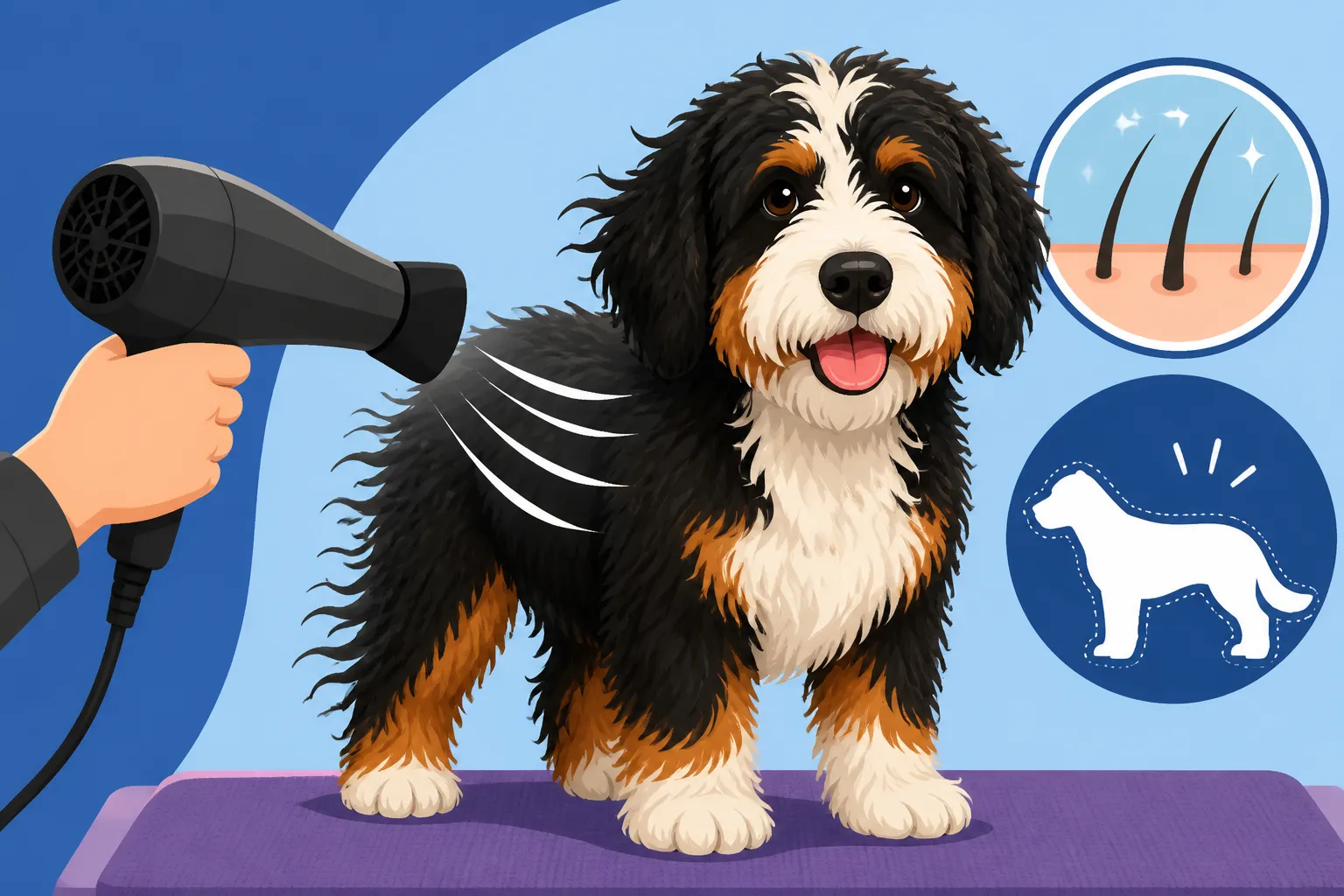
- Work against the grain: Point the nozzle so the air is blowing against the natural direction of hair growth. This helps to lift the hair and push the water away from the skin. You'll see the hair literally "explode" away from the skin, revealing the dampness underneath.
- Line brushing while drying: As you blow dry a section, use your slicker brush in your other hand to brush that section. This "line brushing" technique means you're holding back the hair above the section you're working on, exposing the roots and skin. Brush out from the roots, following the force dryer's airflow. Once that section is dry and brushed smooth, you can drop a bit more hair from above and repeat the process. This is the only way to ensure every single hair is separated and dried.
- Be systematic: Work from the hindquarters towards the head, or vice versa, ensuring you complete one section fully before moving to the next. Pay special attention to dense areas like the ruff around the neck, the "pants" on their hind legs, and their belly. These areas can hold a surprising amount of water.
This systematic approach, combined with the powerful airflow, allows you to literally push the water out of the coat, rather than just evaporating it. It's incredibly effective, and while it might take some time – easily an hour or more for a standard Bernedoodle – it’s the best way. As discussed in How Long a Bernedoodle Takes to Dry Through, this is not a quick job.
The Finish Line: Checking for Residual Dampness
Once you feel like you've gone over every inch of your Bernedoodle, it's time for the final check. This is crucial because even a tiny bit of dampness can lead to matting or skin issues later.
- Tactile check: Run your hands deep into your Bernedoodle's coat, feeling the skin. Is it cool? Is it slightly damp? Or is it truly dry and warm? Pay extra attention to those notoriously problematic areas. Get right into the armpits, behind the ears, under the tail, in their groin area, and deep in their "pants" on the hind legs. These are common culprits for hidden dampness and subsequent matting, often leading to Mats in a Bernedoodle's Armpits and Britches.
- Comb check: Take your metal comb and try to comb through the coat, starting from the skin. If the comb glides smoothly without snagging, you've done a good job. If it catches, especially near the roots, it means either there's still a tangle you missed or, more likely, residual dampness causing the hairs to stick together. Don't be afraid to go back with the force dryer on those specific spots.
- Smell test: Yes, really! If your Bernedoodle still has that faint "damp dog" smell, they're not fully dry. A truly dry dog should smell clean, like their shampoo, or just like a happy, healthy dog. Any hint of that damp odor means you need to keep going.
This thorough final inspection ensures that all your hard work pays off and your Bernedoodle is truly bone-dry and comfortable.
Common Drying Challenges and Solutions
Drying a Bernedoodle is a significant undertaking, and it's completely normal to encounter a few bumps in the road. Let's talk about some of the most common challenges and how to overcome them.
Dealing with a Dog Who Hates the Dryer
It's a common scenario: you bring out the force dryer, and your Bernedoodle acts like it's a monster from another dimension. The noise, the force of the air, it can all be overwhelming. But don't despair! Desensitization and positive reinforcement are your best friends here.
Start slowly, long before bath time. Set the dryer up in a room, let them sniff it while it's off. Give treats, praise, make it a positive experience. Then, turn it on at the lowest setting in another room so the sound is muffled. Gradually, over days or weeks, bring the dryer closer, always pairing the sound with high-value treats and calm praise. When you eventually use it on them, don't just blast their whole body. Start by directing the air at their paws or hindquarters for just a few seconds, immediately followed by treats and pets. Gradually increase the duration and move to other parts of their body.
Consider using a happy hoodie (a soft band that covers their ears) or cotton balls in their ears to dampen the sound. You can also place them on a cozy, non-slip mat or towel they associate with comfort. The key is to make it a calm, predictable routine, rewarding bravery and patience. Never force them or get angry, as this will only create a negative association. Remember, building trust and comfort takes time.
The Time Commitment: Reality Check for Bernedoodle Owners
Let's be real: drying a Bernedoodle is not a five-minute job. For a standard Bernedoodle, you're looking at a significant time investment after every bath. Depending on their coat density, length, and how cooperative they are, it can easily take an hour, two hours, or even longer to get them truly dry to the skin. The Weekly Hours a Standard Bernedoodle's Coat Takes for overall grooming might surprise you, and drying is a big part of that.
This isn't a task you can rush. Trying to speed through it will inevitably leave damp spots, which, as we've discussed, lead to mats and potential skin issues. Plan your bathing days accordingly, ensuring you have ample time set aside. Don't start a bath if you have to run out the door in an hour.
To make it more manageable, consider breaking up the drying session if your dog gets antsy. You could do a thorough towel dry, a quick force dry pass, then a short play break, and come back for the detailed force drying. Having another person to distract or soothe your dog with treats while you dry can also be incredibly helpful. Think of it as dedicated bonding time – you're providing essential care that keeps them healthy and happy.
When Professional Help is Best
Despite your best efforts and all the right tools, there might be times when professional help is simply the best option. If your Bernedoodle has an extremely dense, thick, or challenging coat that mats quickly, or if they are particularly resistant to home grooming, a professional groomer can be a lifesaver.
Groomers have powerful, professional-grade equipment, specialized techniques, and the experience to handle even the most challenging coats and temperaments. They can get your Bernedoodle thoroughly dry and mat-free, often much faster and more efficiently than you can at home, simply due to their expertise and tools. If you're struggling to keep your dog's coat healthy, noticing persistent matting, or finding the drying process too stressful for both of you, don't hesitate to reach out to a professional. This might be especially true for puppies as they go through the "coat change" phase, where their soft puppy fluff gives way to their dense adult coat and matting becomes a daily battle. Consider reading How Long a Standard Bernedoodle Takes to Groom to understand the time and skill involved even for professionals. Regular professional grooming, perhaps every 6-8 weeks, can make home maintenance much easier in between appointments.
Here's a quick comparison of drying approaches for your Bernedoodle:
| Method / Tool | Pros | Cons | Best For |
|---|---|---|---|
| Air Drying | No effort required | Leads to severe matting, skin issues, damp smell, discomfort | Absolutely never, for any Bernedoodle |
| Human Hairdryer | Readily available | Insufficient airflow for dense coats, can overheat skin, takes forever, not safe | Small, minor damp spots on very short hair, rarely needed |
| Towel Drying Only | Quick initial water removal | Cannot dry to the skin, leaves deep dampness, leads to mats | Initial prep before force drying |
| High-Velocity Dryer | Dries to the skin, prevents mats, faster, safer | Initial cost, can be noisy, requires training/desensitization | Essential for thorough Bernedoodle drying |
| Professional Groomer | Expert results, less stress for owner | Cost, scheduling, regular appointments | Complex coats, nervous dogs, owners short on time |
Disclaimer
This article is for general informational purposes only and does not constitute professional advice. Laws, prices and regulations vary by location and change over time. Consult a qualified professional for guidance on your specific situation.