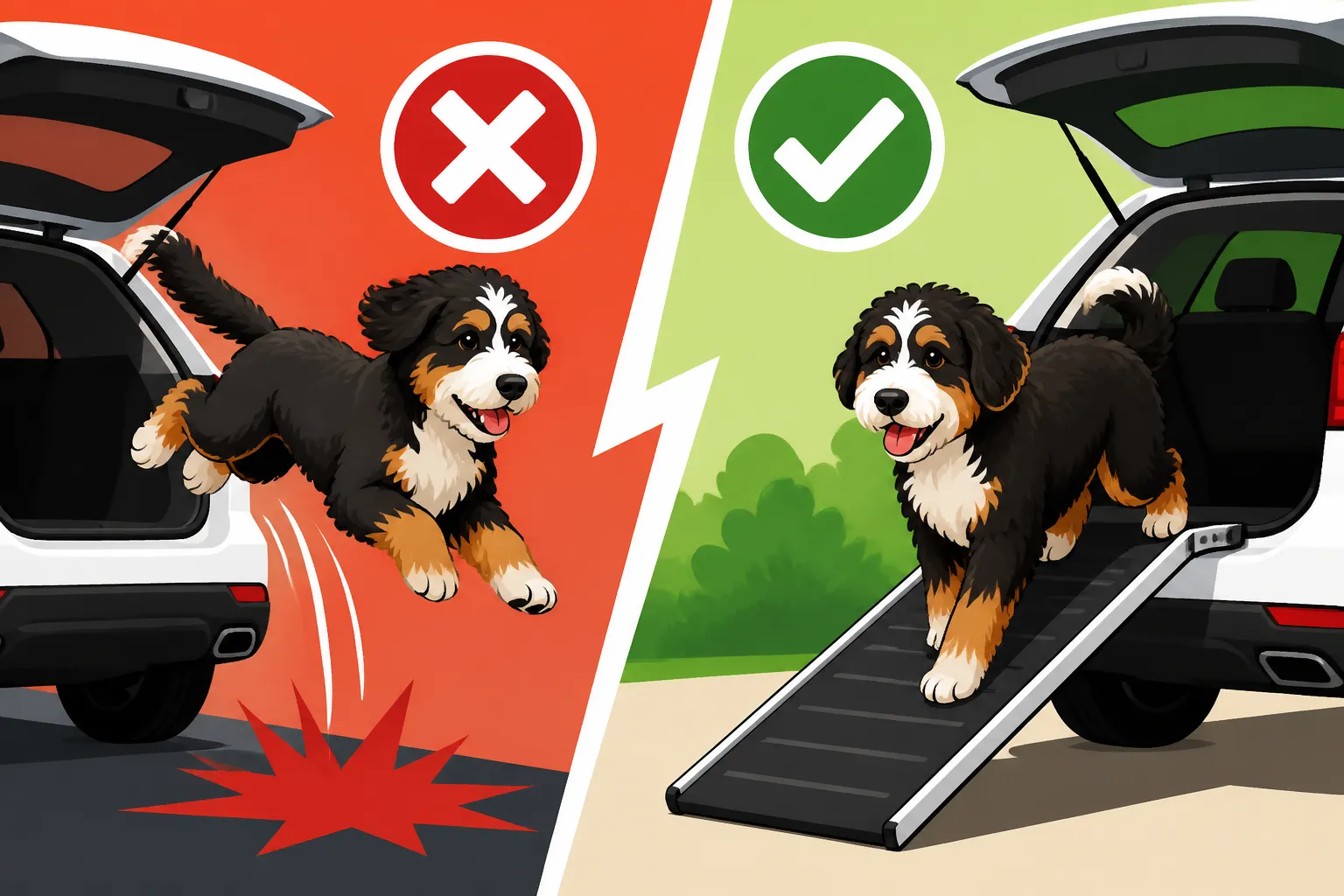
Whether a Bernedoodle Should Jump Out of the Car
It’s a common sight, isn't it? You pull up to your destination, perhaps the dog park or a favorite hiking trail, and before you can even get the door fully open, your eager Bernedoodle is launching themselves out of the car. It seems harmless, a burst of joyful energy, but that enthusiastic leap can actually be doing real damage to their joints and overall well-being, especially for a breed like the Bernedoodle. This guide is here to walk you through why that casual jump is a bigger deal than you might think and, more importantly, how to keep your beloved companion safe and sound as they enter and exit your vehicle.
Why Jumping Out of the Car is Risky for Bernedoodles
That moment of excited aerial prowess from your Bernedoodle might look impressive, but it’s actually a high-impact activity that can have serious, long-term repercussions for their musculoskeletal system. We’re talking about a breed that often carries significant weight and has a genetic predisposition to certain joint issues, making every single jump a calculated risk.
The Physics of the Jump and Landing Impact
Think about it this way: when your Bernedoodle launches themselves from your car, they're not just gracefully floating to the ground. They are essentially dropping their entire body weight, often considerable, from a height. The impact of this landing is absorbed primarily by their joints – ankles, wrists, elbows, shoulders, and spine. For a Standard Bernedoodle, which can easily weigh between 70 to 90 pounds, or even more, that's a lot of force crashing down on fragile structures.
Imagine dropping a heavy bag of flour repeatedly onto a hard surface. Each time, there’s a shockwave. Now imagine that shockwave going through delicate cartilage, ligaments, and bone. The force of hitting the ground, especially if it’s uneven pavement, gravel, or a slight incline, isn't distributed evenly. One leg might take the brunt, or a twist might occur. This isn't just a single event; it's a cumulative stress. Every jump adds to the wear and tear, slowly degrading the joint surfaces, straining the soft tissues, and potentially leading to microscopic injuries that, over time, manifest as chronic pain or debilitating conditions. It's an invisible injury that builds up with each happy-go-lucky leap.
Age and Size as Exacerbating Factors
While jumping out of a car isn't ideal for any dog, it's particularly problematic for Bernedoodles at specific life stages or of certain sizes. Our big, lovable goofballs are especially vulnerable.
Puppies: Bernedoodle puppies grow at an astonishing rate, sometimes gaining several pounds a week. During this rapid growth phase, their bones are still soft, and their growth plates (the areas of new bone growth at the ends of long bones) are open and incredibly vulnerable. A hard landing from a car jump can easily damage these growth plates, leading to irreversible deformities or developmental issues like Elbow Dysplasia in a Growing Bernedoodle or misaligned limbs. It can also contribute to improper joint formation, setting them up for problems later in life, even if they were born with excellent genetics. You might not see the damage immediately, but the seeds of future pain can be sown with just a few uncontrolled jumps. It’s vital to protect those rapidly developing joints. The Exercise a Bernedoodle Puppy Should Not Do also touches on similar concerns about protecting young joints.
Senior Bernedoodles: On the other end of the spectrum, our wise, graying Bernedoodles are also at high risk. As dogs age, their joints naturally start to show signs of wear and tear. Arthritis becomes more common, cartilage thins, and ligaments can lose elasticity. For a senior Bernedoodle, already navigating the challenges of aging, a car jump can be excruciatingly painful. What might have been a minor strain in their youth could now lead to a significant injury, a severe flare-up of arthritis, or even a fall that results in a fracture. Their coordination might not be what it once was, increasing the chance of an awkward landing. We want to Keep an Old Bernedoodle Comfortable, and preventing unnecessary stress on their aging bodies is a huge part of that. A single bad jump could set back their mobility for weeks or even months.
Large and Giant Bernedoodles: Regardless of age, the sheer size and weight of a Standard Bernedoodle means greater impact force. Even a fully mature adult Bernedoodle in peak condition is not immune. Their height means a greater drop, and their weight means a heavier landing. This breed’s lineage, with its Bernese Mountain Dog parent, makes them particularly susceptible to large breed joint issues, and adding high-impact activities like jumping from a car is like pouring gasoline on a potential fire. Think about Hips on a Ninety Pound Bernedoodle – any strain on these already stressed joints can lead to problems.
The Impact on Bernedoodle Joints
Understanding why the jump is bad is one thing, but knowing what specific conditions it contributes to can really drive home the importance of prevention. Bernedoodles, glorious as they are, come with a predisposition to certain joint and structural issues that are only aggravated by repetitive, high-impact activities.
Hip and Elbow Dysplasia Predisposition
One of the most significant concerns for Bernedoodles, stemming from their Bernese Mountain Dog heritage, is the risk of hip and elbow dysplasia. These are developmental conditions where the hip or elbow joints don't form correctly, leading to looseness, pain, and eventually debilitating arthritis. You can learn more about Elbow Dysplasia in a Growing Bernedoodle and Hips on a Ninety Pound Bernedoodle in our other articles.
When a Bernedoodle repeatedly jumps out of a car, the constant jarring and impact on these imperfectly formed joints can:
- Exacerbate existing dysplasia: If your Bernedoodle already has mild dysplasia that might have otherwise remained asymptomatic for longer, these repeated impacts can accelerate the progression of arthritis and pain. The unstable joint is further stressed with each hard landing, leading to inflammation and cartilage damage.
- Trigger symptoms earlier: For dogs with a genetic predisposition, but not yet showing signs, the constant stress can bring on symptoms of pain and lameness much sooner than they might have naturally appeared. It's like a ticking time bomb, and car jumps are pressing the "fast forward" button.
- Increase microtrauma: Even in a healthy joint, the repeated shock can cause tiny, cumulative damage to the joint capsule, cartilage, and surrounding ligaments. Over time, this microtrauma contributes to the breakdown of the joint, paving the way for degenerative joint disease.
It's a frustrating reality to face, knowing that something as seemingly innocuous as a car jump could be contributing to such painful conditions. But awareness is the first step toward proactive care.
Cruciate Ligament and Spinal Concerns
Beyond hip and elbow dysplasia, the force of jumping can also lead to acute injuries like cruciate ligament tears and chronic spinal issues. These are not minor problems and often require extensive veterinary intervention.
Cruciate Ligament Tears: The cranial cruciate ligament (CCL) in a dog's knee (similar to the ACL in humans) is vital for knee stability. Bernedoodles, being large and often robust, are susceptible to tears in this ligament, especially the more active ones. A hard, unbalanced landing from a car jump can cause a sudden twist or overextension of the knee, resulting in a partial or complete CCL tear. This is an incredibly painful injury that typically requires expensive surgery (TPLO or TTA are common procedures) and a long, challenging recovery period. Many owners describe the sudden lameness and distress their dog experiences. Knowing that Torn Cruciates in a Heavy Bernedoodle is a real risk makes avoiding these kinds of impacts even more critical.
Spinal Issues: The spine is a complex structure of vertebrae, discs, and nerves. When a large dog like a Bernedoodle jumps and lands hard, particularly if they land awkwardly or twist, it puts significant compressive force on their intervertebral discs. Repeated compression can lead to disc degeneration, bulging, or even herniation (Intervertebral Disc Disease, or IVDD). While IVDD is more common in certain long-backed breeds, any large, heavy dog can be affected. Symptoms can range from mild back pain and stiffness to severe neurological deficits, including paralysis. Imagine the surprise and heartache when a beloved pet suddenly can’t use their back legs, all potentially exacerbated by years of simple car jumps. It’s a silent, accumulating risk that we really need to consider.
Safer Alternatives for Car Entry and Exit
Okay, so we've established that letting your Bernedoodle jump out of the car is a big no-no for their long-term health. But what's the alternative when you have a 90-pound ball of fluff who's just itching to explore? Thankfully, there are several practical and safe solutions that protect your dog's precious joints and your back!
Ramps and Stairs for Easy Access
Hands down, one of the best investments you can make for a Bernedoodle is a good quality ramp or set of pet stairs. These tools completely eliminate the impact of jumping and provide a safe, gradual incline for your dog to walk in and out of the vehicle.
- Ramps: Pet ramps come in various styles: telescoping, foldable, or bi-fold. When choosing one, look for features like a non-slip surface, sturdy construction that can support your Bernedoodle's weight, and an appropriate length. A longer ramp means a shallower incline, which is easier on the joints. You can find excellent options on retailers like Chewy or Amazon. Make sure it's stable and doesn't wobble, as this can scare your dog. A ramp helps distribute their weight as they ascend and descend, making it a much smoother and less impactful process. This is especially vital for Whether an Old Bernedoodle Needs a Ramp, but it's a preventative measure every Bernedoodle owner should consider from puppyhood.
- Pet Stairs: For vehicles with lower entry points or for Bernedoodles who prefer steps, portable pet stairs are another great option. Again, prioritize stability, non-slip treads, and a height that matches your car's entry. Some stairs even fold down compactly for easy storage. The key with both ramps and stairs is to introduce them positively, with plenty of treats and praise, so your Bernedoodle sees them as a helpful tool, not a scary obstacle. Start on flat ground, then gradually introduce them to the car.
Lifting and Assisted Entry/Exit Techniques
Sometimes, a ramp might not be practical, or you might have a smaller Bernedoodle. In these cases, safely lifting or assisting your dog can prevent jumping.
- For Smaller Bernedoodles (Mini/Tiny): If you have a Mini or Tiny Bernedoodle, you might be able to lift them in and out of the car safely. Always lift with your legs, not your back, and support their body fully, especially their rear and chest. Make sure they are comfortable with being lifted, as some dogs can feel insecure. A good technique involves placing one arm under their chest and the other under their hindquarters, scooping them up in a secure hug.
- For Standard Bernedoodles: Lifting a Standard Bernedoodle can be a significant challenge due to their size and weight. If you must lift them, consider a two-person lift for safety, especially if your dog is reluctant or wiggly. Alternatively, a sturdy lifting harness with handles (many brands like Ruffwear offer these) can be incredibly helpful. This allows you to support their weight and guide them in and out, taking the brunt of the impact off their joints. You can even use the harness to simply support their hindquarters as they step down, providing controlled descent rather than a jump. The goal is to always maintain control and prevent that uncontrolled leap. Raising a Bernedoodle Puppy That Will Outweigh You reminds us that these dogs get big fast, so establishing safe habits early is critical.
Car Safety Restraints
Once your Bernedoodle is safely inside the car, your responsibility isn't over. Proper car restraints are crucial not only for their safety during travel but also for preventing them from attempting to jump out prematurely when you arrive.
- Crash-Tested Harnesses and Seatbelts: A properly fitted, crash-tested car harness that clips into your vehicle's seatbelt system can keep your Bernedoodle secure in their seat. This prevents them from roaming around the car, distracting the driver, and attempting to jump out as soon as a door opens. Look for brands that have undergone legitimate crash testing for pet safety.
- Crates and Carriers: For many Bernedoodle owners, a secure, appropriately sized crate in the back of an SUV or hatchback is the safest option. A crate prevents any movement, protects them in case of an accident, and completely eliminates the possibility of an uncontrolled exit. Just ensure the crate is secured so it doesn't slide around.
- Backseat Barriers: If a crate isn't feasible, a backseat barrier can keep your Bernedoodle confined to the back seat, preventing them from jumping into the front or trying to leap out of a window. Combined with a secure harness, this offers a good level of safety.
By using these methods, you're not just preventing injuries; you're also instilling good habits and ensuring a safer, more relaxed car experience for everyone involved. What a Bernedoodle Needs Every Day includes safety as a core component of their daily well-being.
Training Your Bernedoodle for Safe Car Travel
Beyond having the right tools, proactive training is absolutely key to ensuring your Bernedoodle's safe entry and exit from the car. Bernedoodles are intelligent and eager to please, even with their occasional stubborn streaks, so with patience and positive reinforcement, you can teach them to use ramps or wait calmly.
Teaching "Wait" and Controlled Exits
The "wait" command is your best friend when it comes to car safety. This command teaches your Bernedoodle to pause and not exit the vehicle until you give them the all-clear.
- Start Simple, Build Up: Begin practicing "wait" in a low-distraction environment, like inside your home. Ask your dog to sit or lie down, say "wait," and take a step or two away. If they stay, return and reward them lavishly with a high-value treat (even something tasty from Ollie can work wonders here!) and praise. Gradually increase the distance and duration.
- Practice at the Car Door: Once they're solid on "wait" indoors, move the training to the car. Have them sit, say "wait," and open the car door slightly. If they remain, reward. Slowly increase how wide you open the door. The goal is for them to understand that the open door isn't an invitation to leap out. If they break the "wait," gently close the door and restart.
- Leash Control: Always keep your Bernedoodle on a leash during this training, especially in an uncontrolled environment. This gives you a physical way to prevent a premature jump while they're learning. The leash is there to keep them safe, not to yank them. With consistency, they'll learn that waiting patiently means getting to their fun destination sooner. What a Bernedoodle Asks of a First Time Owner often includes patience for training these smart but sometimes independently-minded dogs.
Introducing Ramps or Steps
Ramps and steps might seem straightforward to us, but for a dog, they can be new and a little intimidating. Positive introduction is crucial.
- Make it Fun and Rewarding: Lay the ramp flat on the ground in a familiar area, like your living room or backyard. Lure your Bernedoodle with treats across the ramp. Don't force them; make it a game. Toss treats on the ramp, praise them for approaching, and generously reward them for walking on it.
- Gradual Elevation: Once they're comfortable walking on the flat ramp, introduce a slight incline. Start with a very low rise, perhaps by propping one end on a low curb or a stable step. Continue with treats and praise for every step they take on the ramp.
- Car Integration: When they're confidently navigating the incline, move the ramp to the car. Position it securely and repeat the positive reinforcement. Some Bernedoodles might need you to walk beside them, offering encouragement. For bigger Bernedoodles, having two people can help – one at the top with treats, one at the bottom offering gentle support. Remember that a Bernedoodle's large size means you want them confident and steady on the ramp, not rushing. Keeping a Standard Bernedoodle Sound Past Ten will depend heavily on avoiding these kinds of stresses throughout their life.
Consistency and Positive Reinforcement
Like all dog training, consistency is the bedrock of success. Bernedoodles thrive on routine and positive experiences.
- Every Time, Every Person: Ensure that everyone who transports your Bernedoodle in the car adheres to the same rules. If one person lets them jump, it undermines all the training you've done. This consistency reinforces the desired behavior and prevents confusion.
- High-Value Rewards: Use treats that your Bernedoodle absolutely loves. This reinforces the positive association with the ramp or the "wait" command. Praise, gentle petting, and excited verbal encouragement also go a long way. The more positive the experience, the quicker they'll learn.
- Patience is a Virtue: Some Bernedoodles might take to the ramp immediately, while others might be more hesitant. Don't get frustrated. Keep training sessions short, fun, and positive. If your dog seems stressed, take a break and try again later. With time, your Bernedoodle will associate safe car exits with good things, ensuring their well-being for years to come. Remember, you're not just training a trick; you're building a foundation for a healthier, longer life together.
| Method | Pros | Cons | Best for |
|---|---|---|---|
| Jumping Out | Quick for the dog (in the moment) | High risk of acute injury (cruciate tears, sprains), chronic joint damage (worsens dysplasia, arthritis), spinal issues, potential for slips/falls. Cumulative damage is significant for heavy Bernedoodles. | No dog, especially not large or long-bodied breeds like Bernedoodles. The perceived convenience is far outweighed by the long-term health risks and potential veterinary costs. |
| Ramps/Steps | Eliminates jumping impact, gentle on joints, promotes independence, reduces strain on owner's back. | Can be bulky to store, requires initial training for the dog to use confidently, takes up some car space (though many are foldable). Needs to be stable and non-slip. | All Bernedoodles, from puppies to seniors. Highly recommended for large breeds prone to joint issues. Essential for Managing Arthritis in an Old Bernedoodle or preventing issues in young, fast-growing pups. Many available from retailers like Chewy or Amazon. |
| Lifting | Direct control, no impact on dog's joints, useful in emergencies or for smaller dogs. | Physically demanding for owner (risk of back injury), risk of dropping large, squirming dogs. Can make a dog feel insecure if not done properly. Challenging for a 90-pound Bernedoodle. | Smaller Bernedoodles (Mini/Tiny) or for emergency assistance for a larger Bernedoodle with a two-person lift. A good lifting harness can make this more manageable for larger dogs, turning it into an assisted exit rather than a full lift. |
| Assisted Exit | Reduces impact significantly, builds trust and cooperation, allows dog to use some of their own strength. | Requires dog cooperation and consistent training. Still some minimal strain on joints compared to a full ramp. | Larger Bernedoodles that are learning or those who cannot use a ramp. Often involves using a sturdy harness with handles to support their weight as they step down, rather than allowing a full jump. This is a great intermediate step to or alongside ramp training. |
Disclaimer
This article is for general informational purposes only and does not constitute professional advice. Laws, prices and regulations vary by location and change over time. Consult a qualified professional for guidance on your specific situation.