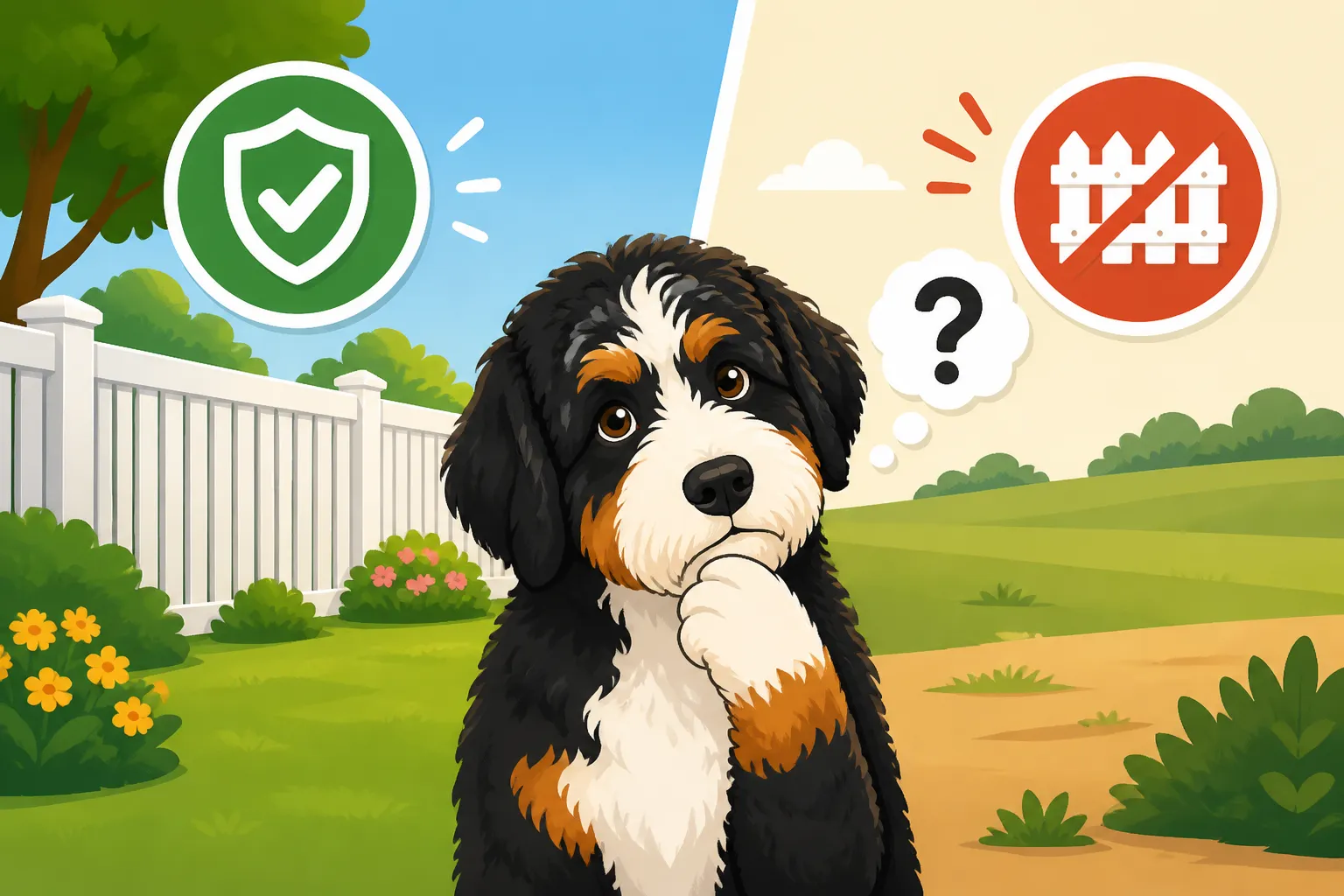
Whether a Bernedoodle Needs a Fenced Yard
A Bernedoodle does not automatically need a fenced yard, but a secure place to move and toilet can make daily life easier—especially with a large, lively dog. The real question is whether you can reliably meet your dog’s exercise, training, and safety needs without one. This guide compares practical setups and explains when a fence matters most.
Does a Bernedoodle need a fenced yard?
A yard is helpful, not a substitute for walks
A fenced yard can make quick bathroom breaks, play sessions, and training practice more convenient. That convenience is especially valuable when you have a puppy who needs frequent trips outside, or a Standard Bernedoodle whose size makes rushing downstairs from an apartment feel like a workout of its own.
But a yard does not replace walks, interaction, or training. Many dogs spend little time entertaining themselves outdoors, and some simply follow their person back inside. A dog with a yard still needs you to offer exercise and enrichment that suit its age, health, and temperament. For more on that daily balance, see The Exercise a Standard Bernedoodle Needs Daily.
Think of the yard as one useful tool, not a complete exercise plan. A short game of fetch, a sniffing walk, and a few minutes of recall practice may do more for your dog than being let out alone for a long stretch.
Bernedoodles vary in size and energy
“Bernedoodle” covers dogs with a wide range of adult sizes and individual temperaments. A Tiny or Mini Bernedoodle may be easier to take out for a quick walk around the block, while a large Standard may need more room to stretch its legs and more careful handling on leash. Still, size alone does not determine whether a yard is necessary.
A calm dog in an apartment can do well with a predictable routine, while a dog with a yard may still become restless if its days lack activity. Consider the dog in front of you, not just the breed label. Which Bernedoodle Size Suits Which Household can help you think through how size affects everyday logistics.
A fenced yard may be especially convenient during the puppy stage, but puppies also need supervision outside. They can chew plants, dig, squeeze through gaps, or discover a way to get beyond a gate. A yard is not automatically a safe place simply because it is enclosed.
The important distinction is access versus security
A Bernedoodle does not need a yard just to be happy. It does need safe opportunities to toilet, exercise, explore, and spend time with you. If you do not have a yard, those needs can be met with leash walks, planned play, training, and access to suitable outdoor spaces.
The safety question is different: can your dog be off leash without a real risk of running into a road, approaching an unfamiliar dog, or getting lost? A secure fence can provide a controlled place for off-leash activity. Without one, plan to keep your Bernedoodle on leash or use another enclosed area unless its recall is dependable and the setting is legally and physically safe. Even strong recall is not a guarantee in every situation. See Whether a Bernedoodle Can Be Trusted Off Leash for more on the limits of relying on a verbal cue.
What to consider if you do not have a fenced yard
Build a dependable toilet and exercise routine
For a home without a yard, consistency matters. Take your dog outside on leash after waking, after meals, after play, and before bed. Puppies usually need more frequent opportunities than adults, and an adult dog’s schedule may change with age, health, or weather.
Make the outing pleasant rather than treating every trip as a quick dash to a curb. Let your dog sniff, reward toileting in the appropriate place, and give it a little time to settle before heading back inside. In a busy Seattle neighborhood or a dense apartment area, that may mean choosing a quieter side street or a small green space instead of a crowded sidewalk.
Exercise can be split across the day. One longer sniffing walk, a shorter training outing, and indoor games may work better than trying to make a single walk solve everything. If you are comparing apartment life with yard access, Whether a Bernedoodle Suits a City Apartment offers another useful perspective.
Use a leash, long line, or enclosed public space thoughtfully
A standard leash is the simplest option for neighborhood walks and quick toilet breaks. A long line can offer more room to sniff and practice coming back while still giving you a way to prevent your dog from bolting. It is not appropriate everywhere, though: check local rules, avoid crowded paths, and keep the line away from bicycles, other dogs, and people.
A fenced dog park or private enclosed play area can provide room to run, but it will not suit every Bernedoodle. Some dogs enjoy social play; others are overwhelmed by unfamiliar dogs or prefer to explore with their person. Visit a new space at a quiet time, watch your dog’s body language, and leave if the experience becomes stressful.
When assembling an outing kit, keep equipment simple and properly fitted. Chewy can be one place to look for basics such as a leash or waste bags, but the key is choosing gear that suits your dog and using it safely. A long line should be handled with care, since it can wrap around legs or create a sudden jolt if the dog runs to the end.
Make indoor enrichment part of the plan
Without a yard, indoor activities can help fill the gaps between outings. Scatter part of your dog’s meal for a supervised sniffing game, practice basic cues in short sessions, or offer a suitable food puzzle. Rotate activities so your Bernedoodle has chances to think and explore rather than relying on repetitive fetch in a hallway.
Keep indoor play appropriate for your home and your dog’s joints. A young, fast-growing Standard Bernedoodle should not be encouraged to skid across slippery floors or repeatedly leap off furniture. Use rugs where needed, clear breakable items, and avoid turning a narrow space into a high-speed chase course.
A dog that is calm indoors is not necessarily under-exercised, and a dog that is restless is not necessarily asking for a yard. Consider the whole routine: sleep, walks, training, social contact, and time alone. Whether a Bernedoodle Is Calm Indoors may help you set realistic expectations for life at home.
If you have a yard, make sure it is genuinely secure
Check the whole boundary, not just the fence panels
A fence is only as secure as its weakest point. Walk the perimeter and look for loose boards, gaps beneath the fence, damaged sections, climbable objects, and places where a dog could squeeze through. Check gates carefully; a latch that looks closed may not catch properly, and a guest may leave it open.
The right setup depends on the dog and the property. A small dog may fit through a gap that a larger dog cannot, while a determined digger may get under a barrier that appears solid. Watch how your Bernedoodle behaves outside before assuming the boundary is reliable.
Think beyond the fence itself. Keep gardening tools, chemicals, compost, and potentially unsafe plants out of reach. Make sure your dog has access to shade and fresh water, and supervise outdoor time in hot weather. A yard should be a comfortable place to spend time, not a reason to leave a dog outside without checking on it.
Match the setup to your dog’s habits
Some dogs stay close to their people; others patrol the perimeter, chase squirrels, bark at passersby, or investigate every gap. A Bernedoodle who ignores the fence during the first week may behave differently after spotting a rabbit or hearing another dog. Supervision helps you learn what your dog actually does, not what you hope it will do.
If your dog digs, redirect the behavior and make the yard more interesting in appropriate ways. If it barks at people walking past, create distance from the fence line or bring it indoors before the behavior becomes a habit. Do not assume that a dog who is physically contained is necessarily comfortable or settled.
For renters, ask the property manager before making changes to an existing fence or installing a temporary barrier. In a rental home, a sturdy exercise pen or other approved containment option might help with supervised outdoor time, but it should not be treated as a substitute for a secure, dog-proof boundary.
Supervision still matters
Even a well-built fence cannot prevent every problem. A gate can be left open, another animal can enter, or a dog can become frightened and try to escape. Supervise your Bernedoodle outdoors, particularly when it is a puppy, new to the home, or still learning how to respond to distractions.
If you are considering a gate, tether, or temporary containment product, think carefully about how it will be used. A tether should not be left on an unattended dog, where it could snag or cause injury. Chewy may offer a range of pet-safety supplies, but suitability depends on the dog, the yard, and how the equipment is installed and monitored.
A fence also does not replace identification and a plan for emergencies. Keep identification details current, and teach your dog to come when called in low-distraction settings before expecting a reliable response outdoors. A secure yard and a trained recall support one another; neither makes the other unnecessary.
Choosing the right setup for your household
Compare the everyday options
There is no single arrangement that works for every Bernedoodle. The best choice is the one that gives your dog safe outdoor access and gives you a routine you can maintain on busy weekdays, in poor weather, and as your dog grows.
| Outdoor setup | Main advantage | Main limitation | Best fit |
|---|---|---|---|
| Secure fenced yard | Convenient toilet breaks and supervised off-leash play | Requires maintenance and supervision | Homes with a safe, well-maintained boundary |
| Leash walks from home | Works in apartments and unfenced homes | Requires you to accompany the dog each time | Owners who can keep a consistent outing routine |
| Long line in a suitable area | Allows more sniffing room with physical control | Can tangle and is unsuitable in crowded places | Training and relaxed exploration in open areas |
| Fenced public play area | Provides enclosed space beyond the home | May be busy or stressful for some dogs | Dogs comfortable with the setting and other users |
| Indoor enrichment plus outdoor walks | Adds mental activity between outings | Does not provide toilet access or replace outdoor exercise | Bad-weather days and homes without yards |
If you are choosing between a larger home with a yard and an apartment with good walking access, consider your actual daily schedule. A small yard beside a busy road may be less useful than safe walking routes nearby. A large yard that you rarely use may not add much to your dog’s life.
Ask practical questions before deciding
Before bringing a Bernedoodle home, consider how quickly you can take the dog outside, whether you can manage walks in winter or rain, and who will provide care when you are away. If you work long hours, a yard alone does not solve the need for supervision, companionship, or bathroom breaks. Whether a Bernedoodle Needs Someone Home can help you think through that part of the routine.
Also consider the dog’s likely adult size and your ability to handle it on leash. A powerful, excited dog pulling toward a squirrel can be difficult to control, even if it has a yard at home. Training leash manners early is useful whether you live in a detached house, a townhouse, or an apartment. For practical planning around a larger dog, see Whether a Standard Bernedoodle Needs a Big Yard.
If your household already has outdoor access, take a close look at its limits: shared yards may not be secure, apartment courtyards may require leash use, and public green spaces may have rules about dogs. A quick check of the property agreement and local requirements can prevent unpleasant surprises.
Decide based on the dog you can safely manage
A fenced yard is a genuine convenience, but it is not a requirement for every Bernedoodle. Without one, you need a workable plan for walks, toilet breaks, training, and safe play. With one, you still need to supervise, maintain the boundary, and make time for interaction beyond simply opening the door.
If you are uncertain, be honest about the routine you can sustain. A townhouse owner who takes regular walks and provides indoor enrichment may offer a better fit than a yard owner who expects the dog to exercise itself. On the other hand, if your schedule makes frequent leash trips difficult, a secure yard may make everyday care much more manageable.
The most reliable setup is the one that keeps your Bernedoodle safe and active without depending on luck. Focus on secure boundaries, thoughtful supervision, and routines that work for your specific dog. Chewy is one possible source for everyday walking or cleanup supplies, but equipment cannot replace consistent handling and a sensible outdoor plan.
Disclaimer
This article is for general informational purposes only and does not constitute professional advice. Laws, prices and regulations vary by location and change over time. Consult a qualified professional for guidance on your specific situation.