Whether a Bernedoodle Can Be Trusted Off Leash
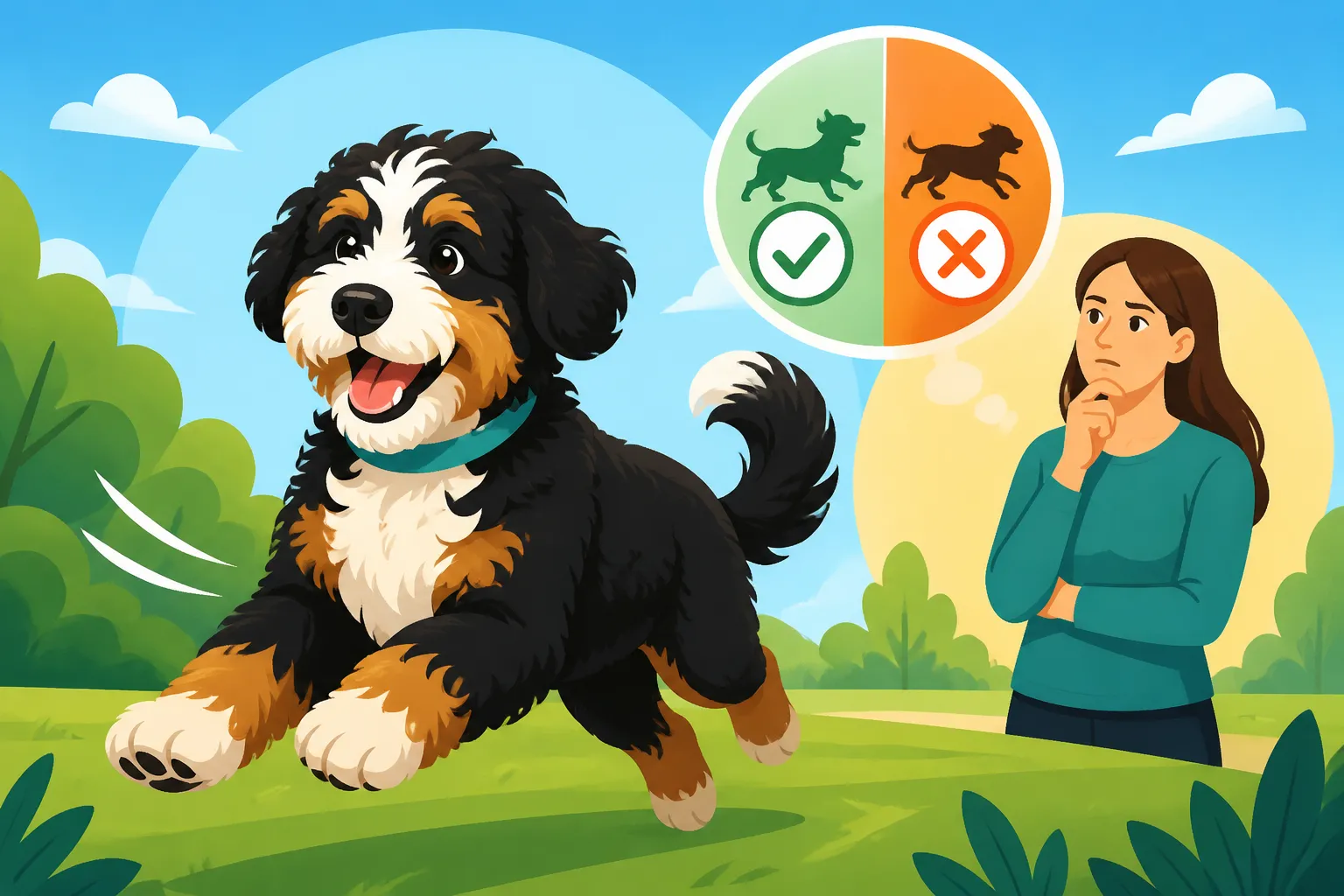
That dream of your Bernedoodle romping freely in a wide-open field, coming back to you with joy the moment you call, is a beautiful one. But the reality for many Bernedoodle owners is a nagging fear: can you truly trust your lovable, sometimes goofy, giant to be off-leash? This guide will dive deep into the factors that influence a Bernedoodle's off-leash reliability, the risks involved, and how you can build the foundation for safe, confident adventures.
Understanding the Bernedoodle's Innate Qualities for Off-Leash Freedom
It’s easy to look at a Bernedoodle and just see a big, fluffy, friendly dog. But beneath that charming exterior are the strong traits inherited from two distinct working breeds: the Bernese Mountain Dog and the Poodle. Understanding these genetic predispositions is crucial when considering off-leash privileges.
The Bernese Influence: Loyalty and Independent Sniffing
From the Bernese Mountain Dog side, you get that incredible loyalty and desire to be with their people. Bernese were bred for farm work, pulling carts, and guarding livestock, but they also had to be reliable companions, staying close to their families. This often translates to a Bernedoodle who naturally wants to keep tabs on you. They are usually not the type to bolt and run for miles without a backward glance, preferring to stay within sight or sound of their human pack.
However, the Bernese side also brings a love for sniffing and exploring. A fascinating scent can sometimes override their desire to stay close, especially in a rich, stimulating environment like a forest trail or a park with lots of interesting smells. They might not disappear, but they might become deeply engrossed in a scent trail, making recall a bit more challenging. This isn't stubbornness, but rather a strong instinct to investigate the world with their nose. You might find them leaning into you one minute, then suddenly nose-to-the-ground, following an invisible trail. It’s important to respect this natural drive while also working to ensure your voice is more compelling than the latest squirrel scent.
The Poodle Influence: Intelligence and Potential Distractibility
Now, let's talk about the Poodle side. Poodles are highly intelligent and excel at learning commands, often eager to please and quick to pick up new tricks. This is a huge advantage for recall training, as they generally have the mental capacity and drive to understand what you want. They're often highly motivated by praise, toys, or high-value treats, which makes them very trainable. You might find your Bernedoodle catches on to a "come" command surprisingly fast if they have a strong Poodle influence.
The flip side of that intelligence and eagerness, however, can be a tendency towards distractibility. Poodles are observant and can be easily diverted by movement, sounds, or other dogs. A passing bird, a distant jogger, or another dog playing can suddenly become far more interesting than your recall cue, especially for a younger Bernedoodle still in their adolescent phase. The Age a Bernedoodle Finally Settles can vary, but until they reach full maturity, you can expect periods where their focus is, shall we say, a work in progress. It's not malicious; it's just the world being a very exciting place for a smart, curious dog. This means that while they can learn quickly, maintaining that focus in a high-distraction environment requires consistent, dedicated training and a deep understanding of what truly motivates your individual Bernedoodle.
Individual Personality: More Than Just Breed Traits
Beyond the breed characteristics, every Bernedoodle has its own unique personality. You might have a Bernedoodle who is naturally a "velcro dog," never wanting to be more than a few feet from you. Or you might have one with a bolder, more adventurous spirit who loves to explore further afield. Some are incredibly focused and eager to work, while others possess The Stubborn Streak Under a Bernedoodle's Poodle Brain that makes training a bit more of a negotiation.
Consider your Bernedoodle's energy levels, too. The Exercise a Standard Bernedoodle Needs Daily is significant, and an under-exercised Bernedoodle might be more prone to taking off on their own adventure if they're bursting with pent-up energy. Their socialization history also plays a huge role. A Bernedoodle that was well-socialized as a puppy, exposed to various sights, sounds, people, and other dogs, is generally more confident and less likely to react fearfully or unpredictably when off-leash. Conversely, a Bernedoodle who wasn't adequately socialized might be prone to anxiety or fear reactions, making off-leash scenarios unsafe for them and others.
Ultimately, whether your Bernedoodle can be trusted off-leash isn't just about their breed; it's about their specific blend of traits, their training, and your relationship with them.
Assessing the Risks: Why Off-Leash Isn't Always the Safest Choice
The idea of letting your Bernedoodle run free is undeniably appealing, a picture of canine joy and freedom. However, for many Bernedoodles, and indeed many dogs, the risks of being off-leash far outweigh the benefits, especially in uncontrolled environments. It's a sobering thought, but it's crucial for responsible dog ownership to truly consider what could go wrong.
The Dangers of Traffic and Unfamiliar Environments
One of the most immediate and terrifying risks is traffic. Even if you're in a seemingly quiet park or rural area, a road is often closer than you think. A squirrel dashing across the street, a child on a bike, or another dog can trigger a chase instinct that a Bernedoodle, even a well-trained one, might find irresistible. The sheer size and strength of a Bernedoodle, especially a standard one heading for ninety pounds, means that once they're running, stopping them can be impossible. The tragic outcome of a dog hit by a car is every owner's worst nightmare, and it's a risk that dramatically increases the moment a dog is off-leash near any road.
Beyond traffic, unfamiliar environments present their own set of hazards. Untreated areas can hide harmful plants, toxic mushrooms, or even discarded human items that could cause serious illness if ingested. Ponds and lakes might contain blue-green algae, which is highly toxic. Wildlife encounters are also a concern; a Bernedoodle's playful chase of a deer could lead them far astray, or worse, put them in danger from a protective wild animal. Even seemingly benign encounters with other off-leash dogs can turn sour, leading to fights and potential injuries, especially if one dog is reactive or poorly socialized. This is why understanding Whether a Bernedoodle Is Friendly With Strangers (both human and canine) is vital before considering off-leash privileges.
Legal and Social Ramifications
Beyond direct physical dangers, there are significant legal and social consequences to consider. Many municipalities have strict leash laws, and allowing your dog off-leash in an area where it's not permitted can result in hefty fines. More importantly, if your off-leash Bernedoodle causes an incident – even something as innocent as jumping on an elderly person or playfully knocking over a child – you could be held liable for any injuries or damages. This isn't just about your dog's behavior; it's about perception and public safety. A large, boisterous Bernedoodle, no matter how sweet-natured, can be intimidating to some people.
Moreover, allowing your dog off-leash in areas where others are on-leash can be incredibly disruptive and even dangerous for other dogs and their owners. A leashed dog might be reactive, fearful, or recovering from an injury, and an approaching off-leash dog, however friendly, can cause immense stress or trigger an aggressive response. It's about respecting other dog owners and their space. The responsibility for ensuring your dog does not negatively impact others always falls on the off-leash owner.
Overestimating Your Bernedoodle's Recall Reliability
This is perhaps the biggest pitfall. We love our dogs, and we want to believe they'll always come back when called. However, a reliable recall in the backyard or a quiet park is very different from a reliable recall in a high-distraction environment. Many owners assume their dog is "good enough" off-leash because they've had success in controlled settings. But the true test of off-leash trust comes when there's an overwhelming distraction: a deer, a rabbit, a child with a dropped snack, or another dog.
Even highly intelligent dogs like Bernedoodles can have moments where instinct trumps training. One lapse in judgment, one moment of forgetting their manners, can have serious repercussions. It's not about being a bad dog; it's about being a dog with natural instincts. Until your Bernedoodle has demonstrated a truly bulletproof recall in a wide variety of challenging, distracting environments, it's safer to assume they're not fully trustworthy off-leash. It's far better to err on the side of caution than to face a situation where you regret giving them that freedom.
Building a Reliable Recall: The Foundation of Off-Leash Safety
The bedrock of any off-leash privilege for a Bernedoodle, or any dog for that matter, is a truly bulletproof recall. This isn't just about your dog knowing what "come" means; it's about them choosing to return to you, enthusiastically, every single time, no matter what tempting distractions are pulling their attention away. It’s a huge investment of time and effort, but it’s absolutely worth it for your Bernedoodle's safety.
Start Early and Make It Positive
Recall training should begin the moment you bring your Bernedoodle puppy home. Even tiny puppies can start to associate "come" with good things. Make it a game! Call their name, say "come!" in a happy, excited voice, and when they take even one step towards you, reward them instantly with a super high-value treat, a quick game of tug, or enthusiastic praise. The key is to make coming to you the most rewarding thing in their world. Never use recall as a command to scold them or end something fun, like playing in the yard. If "come" means the fun stops, they'll learn to avoid it.
Practice in a quiet, distraction-free environment first, like your living room or a securely fenced yard. As they get better, gradually introduce mild distractions – a toy rolling nearby, another family member walking past. Always set your Bernedoodle up for success. If you're not confident they'll come, don't call them. This prevents them from learning that they can ignore the command. Consistency is king here; every family member should use the same command and reward system. For more targeted help, programs like BAXTER & Bella offer comprehensive online training resources that often break down complex behaviors like recall into manageable steps, offering guidance from puppyhood through adulthood.
Use High-Value Rewards and Vary Your Locations
What truly motivates your Bernedoodle? For some, it's a chunk of cheese; for others, it's a squeaky ball. Figure out What a Bernedoodle Will Work For and reserve those super high-value treats exclusively for recall. They shouldn't get them for any other command. This elevates the "come" cue to something extraordinary. Carry these treats in a training pouch or your pocket whenever you're out with your Bernedoodle, even on-leash walks. You want to be ready to reward them any time they choose to check in with you, even if you haven't called them.
Once your Bernedoodle is reliably coming to you in a fenced area with mild distractions, it's time to gradually increase the challenge. Practice recall in different locations: a friend's fenced yard, an empty ball field, or even just another part of your own yard. The variety helps generalize the command, so they understand "come" means "come to me" no matter where you are or what's going on. Always start with a long line (a 20-30 foot leash) in new, open environments. This allows them to experience a sense of freedom while still giving you control if they don't respond to your call. Amazon offers a wide selection of durable long lines that are perfect for this stage of training.
Proofing Your Recall in Distracting Environments
This is the hardest part, and where many owners falter. Proofing recall means practicing in increasingly distracting, real-world scenarios. This might include:
- Other dogs: Start with a calm, known dog, then move to multiple dogs or unknown dogs.
- People: Strangers walking by, children playing.
- Moving objects: Bikes, strollers, cars (at a safe distance).
- Wildlife: Squirrels, birds (this is often the ultimate test!).
Always begin with your Bernedoodle on a long line. Let them explore, then call them back when they're moderately distracted. If they ignore you, gently reel them in with the long line, giving a friendly, non-punishing "good dog!" when they reach you, and still provide that high-value reward. The long line acts as a safety net and helps reinforce the idea that you are in control, even when they think they're free. Gradually, over many sessions and many successful recalls, you might be able to start introducing short periods of off-leash freedom in a very controlled, safe, and legal environment, always with that long line ready to be re-attached if needed. Remember, every successful recall builds trust, and every ignored recall erodes it.
Responsible Off-Leash Practices: Where and How to Practice Safely
Even with a strong recall, true off-leash freedom for a Bernedoodle is a privilege that must be earned and maintained with consistent effort and a deep understanding of responsible practices. It's not a "set it and forget it" kind of training.
Choosing the Right Environment
The single most important decision when considering off-leash time is where you'll allow your Bernedoodle to run free. Not all open spaces are created equal, and many public areas have strict leash laws for good reason.
Dedicated Dog Parks (with caution): Dog parks can offer a fenced, off-leash environment. However, they come with their own set of risks. Not all dogs or owners follow proper etiquette, and the mix of different temperaments, sizes, and play styles can lead to conflict. Observe the park dynamics carefully before letting your Bernedoodle loose. Look for signs of stress or aggression in other dogs, and be prepared to leave if the energy feels overwhelming or unsafe. Your Bernedoodle should be well-socialized and confident around other dogs. Introducing a Bernedoodle to the Dog You Already Have is a good start, but a dog park is a different beast entirely.
Securely Fenced Private Land: This is truly the gold standard for off-leash practice. If you have access to your own large, securely fenced property, or a friend's, it's the safest place to allow your Bernedoodle to run free and practice their recall without the dangers of traffic or unknown dogs. Ensure the fence is tall enough and secure enough to prevent escape – a determined Bernedoodle can find a way out if motivated!
Designated Off-Leash Areas (research required): Some cities and towns have specific, clearly marked off-leash trails or fields within larger parks. Always check local regulations before assuming an area is off-leash friendly. These areas are generally safer than open public spaces but still require vigilance for unexpected encounters or hidden hazards. Be aware of the boundaries and respect them.
Equipping for Safety
Even when off-leash, your Bernedoodle needs to be identifiable and, ideally, trackable.
Identification: Your Bernedoodle should always wear a collar with up-to-date ID tags that include your phone number. This is your first line of defense if they somehow get separated from you. Microchipping is also essential and should be considered mandatory for all dogs.
GPS Trackers: For an added layer of security, especially if you're venturing into a larger, less contained area, a GPS tracker can be invaluable. These devices attach to your Bernedoodle's collar and allow you to track their location in real-time via your smartphone. While they aren't a substitute for training, they offer immense peace of mind. They are readily available on platforms like Amazon and can be a fantastic investment for any dog owner, especially those with adventurous Bernedoodles.
Maintaining Vigilance and Situational Awareness
When your Bernedoodle is off-leash, your job isn't done; it's just different. You need to be hyper-aware of your surroundings and your dog's behavior.
Constant Observation: Keep your eyes on your Bernedoodle at all times. Are they checking in with you regularly? Are they showing signs of interest in something potentially problematic (a distant dog, a squirrel near the road)? Anticipate potential distractions before they become a problem.
Regular Check-Ins: Don't just call your Bernedoodle when you need them to come. Regularly call them for a quick check-in, reward them, and then release them to play again. This keeps the recall command fresh, reinforces the positive association, and ensures they're not just associating "come" with "time to go home." These check-ins are crucial for maintaining a strong Building a Recall on a Bernedoodle.
Be Prepared to Intervene: Always carry high-value treats and a long line or leash, even if you don't plan to use it. If your Bernedoodle's recall suddenly falters, or if an unexpected situation arises, you need to be ready to get them back under control quickly. This might mean verbally redirecting them, using your recall command, or if necessary, physically retrieving them.
When to Keep Them On-Leash
It's equally important to know when off-leash is simply not appropriate, regardless of how well-trained your Bernedoodle might be.
- Near roads or busy areas: Absolutely no exceptions. The risk is too high.
- In areas with heavy foot traffic or other dogs: Unless it's a designated, well-managed off-leash dog park, avoid it.
- If your Bernedoodle is easily distracted or over-stimulated: Some days, your Bernedoodle might just be too excited or stressed for off-leash time. Listen to them and choose safety over perceived freedom.
- If you haven't recently practiced recall: Like any skill, recall can rust. Regular practice is key.
- If you are in an area with known wildlife or hunting: Protect your Bernedoodle and the local ecosystem.
- If your Bernedoodle is not fully mature: The Age a Bernedoodle Finally Settles often means that young, adolescent Bernedoodles, despite their size, can have unpredictable impulses and are less reliable.
Ultimately, the decision to trust your Bernedoodle off-leash is a heavy one. It demands constant assessment, unwavering commitment to training, and a willingness to prioritize safety above all else. When done responsibly, it can be a joyful experience, but it’s a privilege, not a right, and should be treated with the utmost respect for your dog's well-being and the safety of others.
Disclaimer
This article is for general informational purposes only and does not constitute professional advice. Laws, prices and regulations vary by location and change over time. Consult a qualified professional for guidance on your specific situation.