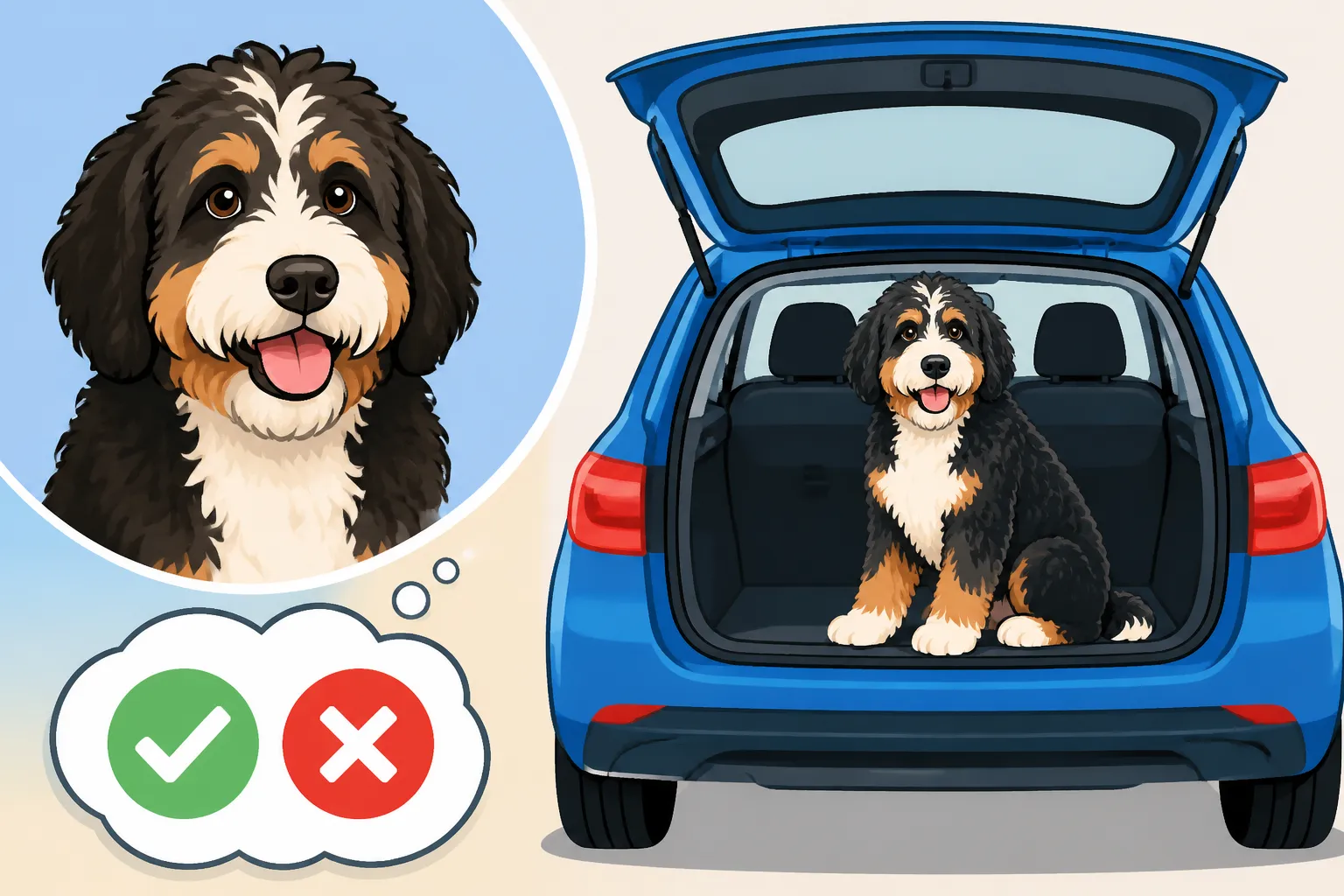
Whether a Bernedoodle Fits in a Small Car
A Bernedoodle can fit in a small car, but “fit” needs to mean more than squeezing through the door. The dog needs enough room to ride safely, and you still need space for people, luggage, and a properly secured restraint. This guide explains how to judge your car and your dog’s adult size before a daily drive turns into an uncomfortable puzzle.
What “small car” means for a Bernedoodle
The dog’s size matters more than its label
Bernedoodles are commonly described as standard, mini, or tiny, but those labels don’t tell you exactly how much room a particular dog will take up. A standard may be a large, long-legged dog who needs substantial floor space, while a mini can still be a solid, active travel companion rather than a lap-sized pet. A tiny Bernedoodle may fit more easily, but individual dogs vary.
For car planning, focus on the dog’s likely adult height, length, and build—not just the name of its size category. A puppy that curls up neatly in the back seat may eventually need more room to turn around, lie down, and brace comfortably when the car moves. If you’re still comparing sizes, The Three Bernedoodle Sizes and What Sets Them is a useful starting point.
Adult-size estimates are not guarantees. Parent size, breeding, and individual growth all matter, so it’s wise to plan for some variation rather than choosing a car based on the smallest estimate you’ve heard. Whether a Bernedoodle's Adult Size Can Be Predicted and Whether a Bernedoodle Ends Up Bigger Than Promised can help set realistic expectations.
The car’s usable space is not its advertised size
A car may look roomy in a showroom and feel surprisingly cramped once a dog, people, and travel gear are inside. The shape of the cabin matters as much as the vehicle’s overall size. A low roof, narrow rear door, sloping hatch, or raised cargo floor can make it difficult for a dog to enter, turn, or settle—even if the published cargo capacity sounds generous.
Think through the actual route your dog will take into the car. Will the dog climb through a rear door, or enter through a hatch? Is there enough height to avoid bumping its head? If you plan to use the cargo area, will the dog have a flat surface once the seats are folded? A deep cargo well may leave a large dog hunched or perched at an awkward angle.
Measure the space that will be available with the car configured as you normally use it. Include the door opening, the width and length of the dog’s riding area, and the space left after a child seat or passenger is in place. Don’t rely on a quick glance at an empty car; test the layout with the actual seat positions and travel items you expect to bring.
How to check whether your Bernedoodle will fit
Measure the dog and the planned riding space
If your dog already lives with you, take a few simple measurements before making a decision. Measure from the nose to the base of the tail while the dog is standing naturally, and note its height while standing and sitting. Then observe how much space it uses when lying down in a relaxed position. A dog that can curl tightly on the living-room rug may stretch out differently in a warm car or after a long walk.
Next, measure the car’s intended riding area. Check the width between the doors or wheel wells, the usable floor length, and the height from the floor to the roof or cargo cover. If the dog will ride in the back seat, account for the space taken up by the seat belt restraint and any other passengers. If it will ride in the cargo area, check whether the floor is level and whether the dog can turn around without becoming wedged against a seatback.
A practical test is to let the dog enter the parked car and settle in the planned position. Keep the engine off and doors open, and give the dog time to explore without pressure. Look for signs that the space is genuinely workable: the dog can get in and out without being lifted awkwardly, turn around, lie down, and sit or stand without pressing against the roof or window.
Compare the likely fit by size and car layout
The table below is a screening guide, not a promise. A short, compact dog may fit more comfortably than a taller dog of similar weight, and a roomy hatchback may offer a better layout than a small sedan with a cramped rear seat.
| Bernedoodle size | Small-car fit to investigate | Main space concern | What to test |
|---|---|---|---|
| Tiny | Rear seat or cargo area may be workable, depending on the dog and restraint | A small dog can still be crowded by luggage or a bulky carrier | Can the dog sit, lie down, and stay secured without being boxed in? |
| Mini | Rear-seat space may work in some cars; cargo-area space may be more practical in others | Body length and build vary considerably | Can the dog settle without taking over the passenger’s legroom? |
| Standard | Often challenging in a compact cabin; a hatchback or larger vehicle may offer a more usable layout | Height, length, and turning space | Can the dog enter, turn, lie down, and remain securely restrained? |
For a standard Bernedoodle, estimated adult weight and height can help you anticipate space needs, but the fit still depends on body shape and the vehicle’s interior. The Height and Weight of a Standard Bernedoodle offers context for the range you may be planning around. If you’re comparing a compact car with a roomier model, Car Travel With a Standard Bernedoodle covers additional practical considerations.
Try the setup before relying on it
If possible, test the dog in the car you intend to use before committing to a long drive. For a puppy, remember that today’s fit is only a snapshot. Ask whether the setup will still work as the dog grows, and whether you can adjust the arrangement without compromising passenger safety.
When a test drive isn’t possible, gather measurements from the car’s owner manual or manufacturer information and compare them with your dog’s measurements. Pay special attention to the available floor area, not just the volume of the cargo space. A broad but shallow area may suit a dog better than a deep, narrow one.
Bring the restraint or travel crate you plan to use when checking the layout. A dog may fit in an empty cargo area but not once a crate, barrier, or seat-belt attachment is installed. If you’re shopping for travel equipment, product dimensions and fitting guidance matter more than a broad “large dog” label. Chewy listings can be one place to compare stated product measurements, but measure your actual car and dog rather than assuming the label guarantees a fit.
Plan for safe and comfortable travel
Make restraint part of the fit test
A dog that physically fits but cannot be safely restrained does not have a complete travel setup. Loose dogs can distract the driver, move into unsafe positions, or be thrown around if the car stops suddenly. Choose a restraint that is appropriate for your dog and vehicle, and follow the manufacturer’s instructions for installation and use.
For some dogs, a crash-tested travel crate that fits securely in the vehicle may be an option. Others may travel in a properly secured harness attached to a suitable seat-belt system. The right choice depends on the dog’s size, temperament, the car’s layout, and the specific product. Don’t improvise by attaching a leash to a collar or using a restraint in a way the maker does not recommend.
A crate is not automatically the safest or easiest answer if it cannot be anchored properly or leaves the dog cramped. Likewise, a harness should not be chosen by appearance alone. Check that the product fits your dog’s body and can be used in your vehicle as intended. Whether a Bernedoodle Fits in a Crate in a Car is helpful if you’re weighing a crate-based setup.
Keep the dog’s comfort in mind
A tight fit can make a short errand unpleasant and a longer trip difficult. Your Bernedoodle should be able to rest in a natural position, with enough room to adjust its posture. Avoid packing bags or loose equipment beside the dog where they could shift or crowd its space. If your dog is still getting comfortable with car travel, start with brief, low-pressure rides before expecting it to settle for a long journey.
Plan for familiar travel essentials without letting them overtake the riding area. A water bowl, leash, towel, and a small amount of familiar bedding may help, but every item should be secured or placed where it cannot slide around. Chewy carries a range of pet travel products; compare the dimensions and attachment instructions carefully, and check that any item works with your particular car and restraint setup.
Warm weather deserves extra attention. A dog’s comfort depends on ventilation and the conditions in the vehicle, not simply on how much space it has. Never leave a dog unattended in a parked car, and plan stops where the dog can safely stretch, drink, and take a bathroom break. A trip that seems manageable to a person may feel much longer to a dog confined in one position.
When a small car may not be a good match
Look for signs the setup is too cramped
The clearest warning sign is that your dog cannot change position comfortably. If it has to crouch, twist sharply, wedge itself between a seat and the door, or remain upright for the entire ride, the space is not suitable for routine travel. Difficulty getting in or out is another concern, especially for a large dog, a puppy with growing joints, or an older dog with stiffness.
Watch how your dog behaves in the parked car. Repeatedly shifting, panting when the car is not hot, trying to climb into the front, or refusing to enter may suggest stress or discomfort. Those behaviors can have several causes, so they are not proof that the car is too small; still, they are reasons to reassess the setup rather than assuming the dog will simply get used to it.
Also consider the humans sharing the car. A dog that takes up the rear seat may leave little room for passengers, while a crate in the cargo area may eliminate space for groceries or luggage. If each trip involves moving equipment, folding seats, or squeezing belongings around the dog, the arrangement may be technically possible but impractical for everyday life.
Consider another vehicle or travel arrangement
If your dog cannot sit or lie comfortably with an appropriate restraint, a larger vehicle may be the simplest answer. That doesn’t necessarily mean a very large SUV or van; it means finding a layout with enough usable space for the dog and the people or items traveling with it. A hatchback with a practical cargo area may be more useful than a small sedan, but the individual vehicle still needs to be measured and tested.
Some households can use a second vehicle for longer outings, borrow a roomier car for a specific trip, or arrange dog transport with help from someone who has an appropriate setup. These options may be less convenient than using the car you already own, but they can avoid turning every ride into a compromise. If you are still deciding whether a smaller Bernedoodle might better suit your everyday routine, Which Bernedoodle Size Fits Which Household can help you think beyond the car alone. For a broader comparison of smaller living spaces and dog size, see Which Bernedoodle Size Fits an Apartment.
A good fit is one your dog can enter, occupy, and leave comfortably while staying properly secured. If the car only works when the dog is squeezed into a corner or the restraint is left out, it isn’t a dependable solution. Take measurements, test the actual setup, and plan for the dog’s adult size before relying on a small car for regular travel.
Disclaimer
This article is for general informational purposes only and does not constitute professional advice. Laws, prices and regulations vary by location and change over time. Consult a qualified professional for guidance on your specific situation.