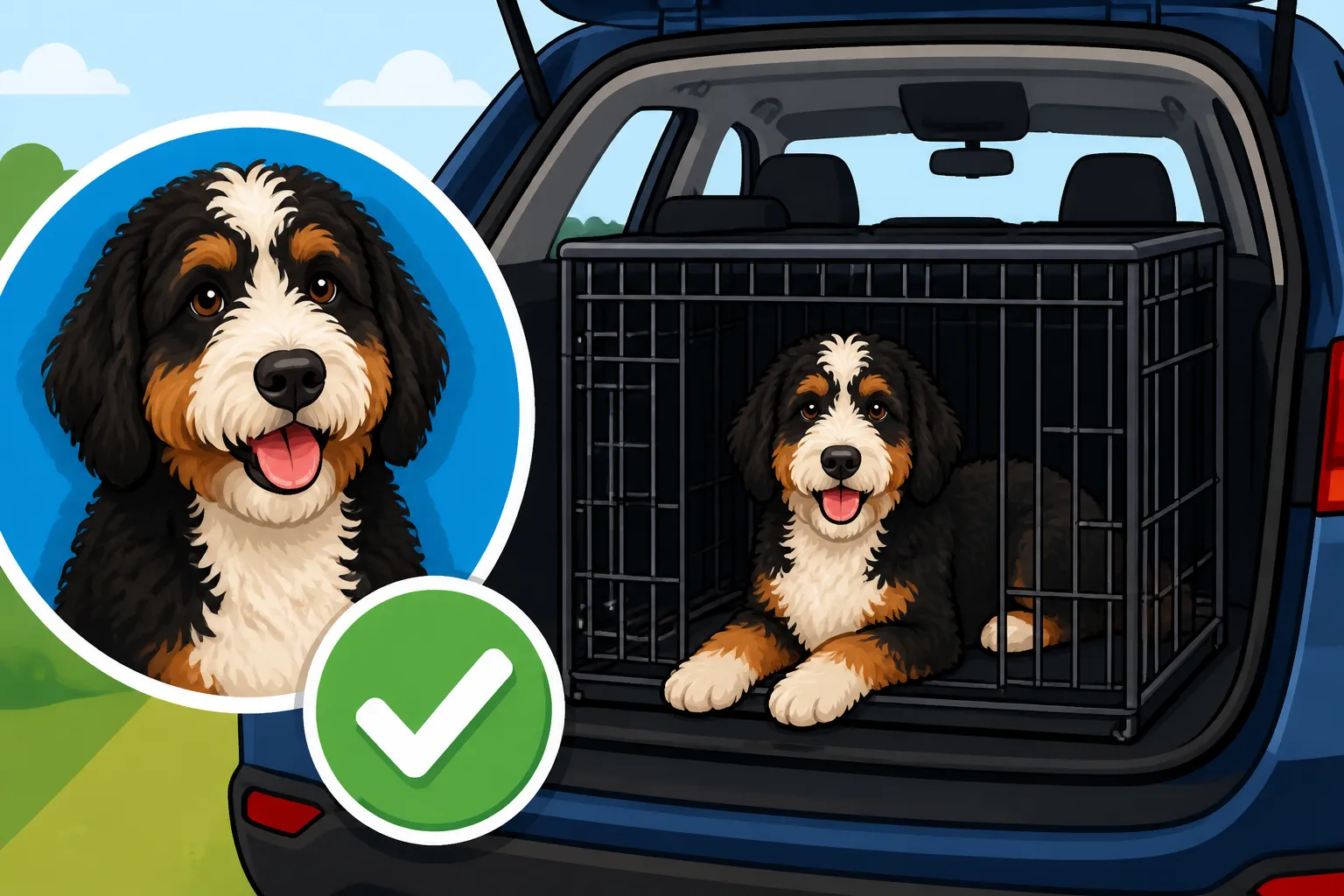
Whether a Bernedoodle Fits in a Crate in a Car
Oh, the age-old question that many a Bernedoodle parent has grappled with! You adore your fluffy companion, and you want to ensure their safety and comfort on car trips, whether it's just a quick run to the vet or a cross-country adventure. The dilemma often arises when you realize just how much space a magnificent Bernedoodle and their necessary travel gear, like a sturdy crate, truly command in your vehicle. This guide is all about navigating that tight squeeze, helping you figure out if a crate will fit in your car, what kind of crate works best, and how to make car travel safe and stress-free for your beloved Bernedoodle.
Understanding Bernedoodle Sizes and Crate Dimensions
One of the first hurdles you'll encounter is the sheer variety in Bernedoodle sizes. While they're all charming, a "Bernedoodle" can mean anything from a snuggly lap dog to a gentle giant, and that makes a massive difference when you're trying to fit a crate into your family car.
The Range of Bernedoodle Sizes
Bernedoodles come in a delightful array of sizes, largely dependent on the Poodle parent involved in the mix. You might be picturing a standard Poodle, but breeders also use miniature and toy Poodles to create smaller Bernedoodles.
Let's break down the general categories:
- Standard Bernedoodle: These are the big kids on the block, typically resulting from a Standard Poodle and a Bernese Mountain Dog. They can range anywhere from 70 to a whopping 90+ pounds, and their height can reach over 29 inches at the shoulder. Imagine trying to fit a crate for a dog that size! It's no small feat, and often requires a larger SUV or truck. If you have one of these magnificent beasts, you'll be nodding your head at the challenge. You might find our post on The Standard Bernedoodle at Seventy to Ninety Pounds helpful for more context on their size.
- Mini Bernedoodle: These adorable companions are usually a cross between a Bernese Mountain Dog and a Miniature Poodle. They tend to weigh between 25 and 50 pounds, with a height of around 18-22 inches. While significantly smaller than a Standard, a 50-pound dog still needs a substantial crate, especially if you want them to be able to stand and turn around comfortably. Don't let the "mini" fool you; they can still take up a good chunk of space. We delve deeper into their dimensions in The Mini Bernedoodle at Twenty Five to Fifty Pounds.
- Tiny Bernedoodle (or Micro/Toy): The smallest of the bunch, these Bernedoodles are bred using a Toy Poodle. They usually weigh under 25 pounds, often in the 10-25 pound range, and stand under 18 inches tall. For these little bundles, finding a crate that fits isn't usually the main problem; the challenge is ensuring the crate is secure and won't jostle around in a larger vehicle. The Tiny Bernedoodle Under Twenty Five Pounds has more on these compact cuties.
The frustrating part is that even within these categories, there's quite a bit of variation. Two "Standard" Bernedoodles might have different heights and lengths, meaning one crate might work for one but not the other. This variability makes pre-purchase planning absolutely essential. You can't just guess!
Essential Crate Sizing for Safety and Comfort
Once you know your Bernedoodle's approximate adult size (or your current puppy's measurements), the next step is choosing the right crate size. This isn't just about getting one that "fits" your dog; it's about providing a safe, secure, and comfortable space, especially for car travel. A crate that's too small is cramped and uncomfortable, leading to anxiety and even injury. A crate that's too large can allow your dog to be thrown around in a sudden stop or accident, essentially defeating the purpose of canine car safety.
Here's how to measure your dog for a travel crate:
- Length: Measure your Bernedoodle from the tip of their nose to the base of their tail (don't include the tail itself). Then, add 2-4 inches to this measurement. This extra length allows them to stretch out fully when lying down.
- Height: Measure your Bernedoodle from the top of their head to the ground while they are standing. If they have erect ears, include the tip of the ears. Add 2-4 inches to this measurement. This ensures they can stand up comfortably without having to crouch.
For car travel, some experts actually recommend a slightly snugger fit than for a home crate. The idea is that in the event of a collision, less empty space means less room for your dog to be jostled or injured. However, "snug" does not mean "cramped." They still need to be able to stand up, turn around, and lie down in a natural position.
Think about it: if your Bernedoodle is on a long trip, they'll want to shift positions, stretch, and get comfortable. A crate that only allows them to sit or lie in one rigid position is going to make for a very unhappy traveler, no matter how safe it technically is.
Different Crate Types and Their Car Compatibility
Not all crates are created equal, especially when it comes to car travel. Each type has its own set of pros and cons regarding safety, durability, and how easily it fits into a vehicle.
- Wire Crates: These are common for home use due to their excellent ventilation and collapsibility. They're great for familiarizing your Bernedoodle with crating. However, for car travel, they have significant drawbacks. In an accident, the wire can bend, potentially causing injury. They also don't offer much protection from flying debris. While they might fit into your car, they often aren't the safest choice. On the flip side, their collapsible nature means they can be stored more easily when not in use.
- Plastic/Vari-Kennel Style Crates: These rigid plastic crates offer more protection than wire crates. They're enclosed, which can make some dogs feel more secure, and they do a better job of containing your dog in an impact. They are generally sturdier and less likely to collapse. However, their fixed shape means they don't fold down, making them bulkier to store when not in use. Ventilation can also be a concern in warmer weather, so ensuring good airflow is crucial. Many people find these a good compromise for car travel.
- Soft-Sided Crates: These are lightweight and portable, often folding down quite compactly. They are fantastic for quick trips, indoor events, or for a dog who is already very calm in a crate. However, for true car safety, they offer almost no protection in an accident. They can easily collapse or tear, and your Bernedoodle could be seriously injured. They're best reserved for very short, low-speed trips or as a temporary resting spot, not for serious crash protection.
- Crash-Tested Travel Crates: These are the gold standard for car safety. Brands like Gunner Kennels or Ruffland Performance Kennels design their crates with rigorous testing to withstand impacts. They are often made from heavy-duty roto-molded plastic, similar to what kayaks are made from, and feature reinforced doors and tie-down points. The downside? They are significantly more expensive, heavier, and bulkier than standard crates. They don't fold down, and their robust construction means they take up a lot of space. If safety is your absolute top priority (and for a big Bernedoodle, it really should be), these are the ones to consider, but they will demand the most real estate in your vehicle.
| Crate Type | Pros for Car Travel | Cons for Car Travel | Space Implication |
|---|---|---|---|
| Wire Crate | Good ventilation, collapsible for storage | Poor crash protection, potential for injury, less secure | Can feel less bulky when collapsed, but rigid when set |
| Plastic Crate | Better protection than wire, more secure | Not collapsible, ventilation can be limited | Fixed shape can be awkward to fit, moderate bulk |
| Soft-Sided Crate | Lightweight, highly portable, folds flat | Minimal crash protection, not truly safe for accidents | Very compact when collapsed, flexible when set |
| Crash-Tested | Superior crash protection, highly durable | Very expensive, heavy, bulky, no collapsibility | Demands significant, dedicated cargo space |
When making your choice, balance your Bernedoodle's size, your vehicle's capacity, your budget, and most importantly, your furry friend's safety. For a large dog like a Standard Bernedoodle, opting for a crash-tested crate, if your vehicle can accommodate it, truly offers the best peace of mind.
Assessing Car Space and Crate Placement
This is where the rubber meets the road, quite literally! You might have the perfect crate picked out, but if it doesn't physically fit into your vehicle, then you're back to square one. Bernedoodles, especially the Standard size, are big dogs, and their crates are commensurately large.
Measuring Your Vehicle's Cargo Area
Before you even think about buying a crate, you absolutely must measure the space in your car where you intend the crate to go. Don't rely on online specs for your vehicle; actual usable space can vary depending on interior contours, wheel wells, and seat configurations.
Here’s how to do it accurately:
- Clear the Space: Remove everything from the cargo area or back seat that would interfere with the crate. This includes floor mats, spare tires (if applicable), and any junk that might normally live back there.
- Measure Depth: Measure from the very back of the cargo area (or the back of the seats) to the tailgate or the back of the second-row seats. Pay attention to how the angle of the tailgate or rear window might cut into the usable space at the top. Some SUVs have a significant slope, which reduces the effective height available for a tall crate.
- Measure Width: Measure the widest point between the wheel wells. This is often the most restrictive measurement in an SUV or wagon. Don't just measure at the floor; measure at various heights to account for any inward tapering.
- Measure Height: Measure from the floor of the cargo area to the lowest point of the ceiling or the top of the tailgate opening. Again, consider the slope of the rear window. Remember, your Bernedoodle needs to be able to stand up comfortably inside the crate, so the crate's internal height needs to be less than your car's usable height.
Write these measurements down! Bring them with you when you shop for crates. It sounds tedious, but it will save you immense frustration (and potential return shipping costs) later. Many people find their initial assumption of space is much greater than the reality once they start measuring.
Crate Orientation and Accessibility
Once you have your vehicle's measurements, you'll need to consider how the crate will actually sit in the car and how your Bernedoodle will get in and out.
-
Lengthwise vs. Widthwise: In many SUVs or wagons, you'll have the option to place the crate either with its longest side running parallel to the length of the car (lengthwise) or parallel to the width of the car (widthwise).
- Lengthwise: This typically means the crate door will face the back of the vehicle, opening towards the tailgate. This can be easier for loading a large Bernedoodle, as they can walk straight in. However, it often takes up more linear space, which might be an issue if you have a shallower cargo area.
- Widthwise: This means the crate door might open towards one side of the car, or even a side-facing door might be needed if the crate has one. This configuration can be better for maximizing space in wider, but less deep, cargo areas. The challenge here is often getting your Bernedoodle to turn and enter, especially if it's a tight fit.
-
Door Orientation: Think about where the crate door is located. Does it swing open in a way that allows easy access for your Bernedoodle? If you're using a single-door crate, you'll need to ensure that door can fully open without hitting the car's interior. Some crates have multiple doors (front, side, top), offering more flexibility. For instance, a crate with a side door might be ideal if you need to place it widthwise and slide it against the back of the seats.
-
Loading and Unloading: For a large Standard Bernedoodle, getting them into a crate that's tucked deep in the cargo area can be a workout. Consider their comfort as well as yours. Will they have enough clearance to jump in, or will they need assistance? Is there enough space around the crate to help guide them? These practical considerations are often overlooked until the first time you try to load your excited dog for a trip. Our article Car Travel With a Standard Bernedoodle touches on some of these unique challenges.
The Impact of Passenger Needs and Gear
The reality of car travel often involves more than just your Bernedoodle. Families travel with kids, luggage, groceries, sports equipment, or even other pets. A Bernedoodle crate, especially for a Standard or even a larger Mini, is a significant footprint that can dramatically reduce your available space for everything else.
- People vs. Pet Space: If your Bernedoodle's crate needs to occupy the entire cargo area, what does that mean for your groceries? If you have a two-row SUV, and the crate takes up the entire back, suddenly the kids' sports bags or your weekend camping gear has nowhere to go. Sometimes, a crate might even necessitate folding down one of the back seats, turning a five-seater into a three-seater, which might not work for your family.
- Visibility: A large crate can also obstruct your rear visibility, especially if it's tall. Always ensure you have clear sightlines through your rear window and side mirrors for safe driving.
- Ventilation for All: If the crate takes up so much space that it's pressed right against windows or cargo, make sure there's still adequate airflow. A Bernedoodle, with their thick coat, can easily overheat, especially during warmer months. Why a Bernedoodle Cannot Cope With Heat and Why a Black Coat Makes a Bernedoodle Suffer in Summer are essential reads to understand this risk.
It's a delicate balancing act, and sometimes you have to make compromises. Be realistic about what you need to carry versus what you want to carry. For many Bernedoodle owners, choosing a vehicle large enough to accommodate their dog's safety equipment becomes a major factor in car purchasing decisions.
Practical Strategies for Fitting a Bernedoodle Crate
Okay, so you've measured, you've chosen a crate type, and you've faced the reality of your vehicle's available space. Now what? If it's a tight squeeze, there are still strategies you can employ to make it work, or alternative solutions to consider.
Maximizing Space in Smaller Vehicles
If you don't drive a full-size SUV or a minivan, fitting a large Bernedoodle crate can feel like playing Tetris. But there are tricks to gain every precious inch.
- Folding Seats Strategically: Many SUVs and wagons have 60/40 split-fold rear seats. If you only need one or two passenger seats in the back, folding down one section can create a longer, uninterrupted space that might accommodate a larger crate lengthwise. This might mean your family has to get cozy in the remaining seats, but it's a way to prioritize your Bernedoodle's safe travel.
- Removing Headrests: Sometimes, the headrests on the rear seats can prevent a crate from pushing all the way back against the seatbacks, costing you valuable depth. Check if they can be easily removed, which might give you an extra inch or two.
- Custom-Fit or Modular Crates: While more niche, some manufacturers offer crates designed to perfectly fit specific vehicle models. These might have cut-outs for wheel wells or be shaped to utilize every curve of a car's interior. Brands like variocage often have adjustable options, allowing you to fine-tune the depth. This can be a significant investment but can be a game-changer for maximizing space. You might find such specialized items on sites like Amazon or through dedicated pet supply retailers.
- Consider a Roof Rack: If the interior just won't cut it for luggage and the crate, sometimes a roof rack is the answer for your other gear. This frees up interior space specifically for your Bernedoodle's crate. Just be mindful of weight limits and aerodynamics.
Investing in Vehicle-Specific Solutions
Sometimes, a generic crate just won't cut it. For owners committed to taking their Bernedoodles everywhere, a more integrated solution might be necessary.
- Vehicle-Specific Cages/Kennels: Some companies specialize in custom-built dog crates that are designed to fit perfectly into the back of popular SUV models. These aren't just crates; they're often full-on dog compartments, maximizing safety and space. They typically fit snugly against the back seats and fill the entire width of the cargo area, often incorporating escape hatches or dividers. These are usually crash-tested and represent the pinnacle of pet safety in vehicles.
- Car Barriers and Dividers: If a full crate is impossible, a heavy-duty car barrier can be installed behind the second or third row of seats. While this doesn't offer the same protection as a crate in a rollover or severe impact, it does prevent your Bernedoodle from becoming a projectile in a sudden stop or from distracting the driver. These barriers can be purchased from pet retailers like Chewy or auto accessory stores. They come in various styles, from tension-mounted to those that bolt into the vehicle's frame. Some also come with side panels or dividers to create a semi-enclosed space.
These solutions are often pricier and require more permanent installation, but they are designed to solve the very problem of fitting large dogs safely into cars.
Alternative Secure Travel Methods
What if, despite all your efforts, a crate just isn't feasible for your Bernedoodle in your current car? Don't despair! There are other options, though it's important to understand their limitations compared to a properly secured, crash-tested crate.
- Crash-Tested Safety Harnesses: For dogs too large for common crash-tested crates or in cars where a crate simply won't fit, a crash-tested safety harness can be a viable alternative. These harnesses are designed to attach to your car's seatbelt system and distribute impact forces across your dog's chest, similar to how a human seatbelt works. Look for certifications from organizations like the Center for Pet Safety (CPS). Brands like Sleepypod or Kurgo offer highly-rated harnesses.
- Pros: Much less bulky than a crate, allows your Bernedoodle to ride in a back seat (secured), relatively affordable.
- Cons: While crash-tested, they don't offer the same level of protection from flying debris or in rollovers as a sturdy crate. They also don't contain your dog if they get carsick or have an accident. It's crucial that your Bernedoodle is comfortable wearing a harness for extended periods.
- Car Seats/Boosters (for smaller Bernedoodles): For Mini or Tiny Bernedoodles, a dedicated car seat or booster seat can provide a secure and comfortable spot. These typically elevate your dog so they can look out the window, and they come with straps to secure the dog's harness (never just a collar) to the seat.
- Pros: Comfort, visibility for your dog, helps prevent motion sickness for some.
- Cons: Not suitable for Standard Bernedoodles due to size. Offers less crash protection than a hard-sided, crash-tested crate. The dog must still be secured with a separate harness.
Always prioritize safety. While it might be tempting to just let your Bernedoodle ride loose, an unsecured dog is a dangerous projectile in an accident, not just for themselves but for human passengers too. Whatever method you choose, ensure it's robust and correctly installed.
Safety Considerations Beyond Fit
Getting the crate to fit is only half the battle. Ensuring it's a truly safe and comfortable environment for your Bernedoodle during car travel involves several other crucial considerations.
Securing the Crate in the Vehicle
This is absolutely non-negotiable for safety. An unsecured crate, even if it fits perfectly, can become a deadly projectile in a sudden stop or collision. Imagine a 70-pound Bernedoodle inside a 30-pound crate – that's 100 pounds of force flying forward in an accident.
- Tie-Down Points: Most heavy-duty or crash-tested crates will have built-in tie-down points or handles. These are designed for straps to pass through and anchor the crate to your vehicle's cargo hooks.
- Cargo Hooks: Most SUVs, wagons, and even some sedans have D-rings or hooks in the cargo area, often near the floor. These are what you'll use to secure the crate. If your vehicle doesn't have enough, or they're in awkward positions, consider having additional ones installed by a professional.
- Heavy-Duty Straps: Use strong, non-elastic straps – like ratchet straps or cam buckle straps – to tightly secure the crate. You want absolutely no movement. Pull the straps taut in multiple directions (e.g., forward to the back of the seats, and to the sides) to prevent shifting. Many crash-tested crates come with their own proprietary strap systems, so always follow the manufacturer's instructions.
- Anti-Slip Mats: Even with straps, a rubber anti-slip mat placed under the crate can add an extra layer of stability and prevent minor shifts, reducing wear and tear on your vehicle's cargo area.
When in doubt, consult the crate manufacturer's guidelines for securing their specific product. Your Bernedoodle's safety depends on it!
Ventilation and Temperature Control
Bernedoodles have those gorgeous, thick coats, which makes them highly susceptible to overheating, especially in a confined space like a car. This is a critical safety concern, particularly for longer trips or during warmer weather.
- Airflow is Key: Ensure that your crate placement doesn't block the car's air vents. Position the crate so that air can circulate freely around it. If it's shoved into a corner with no space, your Bernedoodle won't get the benefit of the AC.
- Air Conditioning: On warm days, the air conditioning in your car is your Bernedoodle's best friend. Don't rely on just cracking a window; that often provides insufficient airflow, especially in the back cargo area. Always run the AC to keep the temperature comfortable, even if it means you bundle up. For an in-depth look at this, check out Whether a Bernedoodle Should Be Walked in Summer and Signs a Bernedoodle Is Overheating.
- Cooling Mats and Water: For very long trips or in exceptionally hot climates, consider adding a cooling mat inside the crate (ensure it's not chewable!) and always have plenty of fresh water available. Consider a spill-proof bowl that can be secured to the crate. Brands available on Chewy or Amazon often have a good selection of these travel accessories.
- Never Leave Unattended: This should go without saying, but never leave your Bernedoodle in a parked car, even for a few minutes, especially with their thick coats. Temperatures inside a car can skyrocket rapidly, leading to heatstroke, even on a mild day.
Acclimating Your Bernedoodle to Car Travel in a Crate
Even if the crate fits perfectly and is secured, a Bernedoodle who isn't used to it might find car travel stressful. It's vital to make the crate a positive and comfortable experience for them.
- Start at Home: Before you even put the crate in the car, make it a den at home. Encourage your Bernedoodle to go in voluntarily with treats, toys, and comfy bedding. Feed them meals inside the crate. This builds a positive association. We discussed how to achieve this for a large dog in Whether a Crate Suits a Ninety Pound Bernedoodle.
- Introduce to the Car, Stationary: Once they're comfortable with the crate, place it in the car, but don't go anywhere. Let them explore it, get in and out, and get used to the new environment. Offer high-value treats.
- Short, Positive Trips: Start with very short drives – just around the block or to a nearby park. Make the destination something fun and rewarding. Avoid making the first few trips to the vet or groomer, which can create negative associations.
- Gradually Increase Duration: As your Bernedoodle gets more comfortable, slowly increase the length of your trips. Always end on a positive note.
- Crate Games: Play games where they go in and out of the crate, rewarding them each time. This builds confidence and makes the crate a place of good things.
- Comfort Items: Include a familiar blanket or toy in the crate to provide comfort and reduce anxiety.
Patience is key. Some Bernedoodles take to car travel in a crate easily, while others need more time and consistent positive reinforcement. Rushing the process can create a lifelong aversion to the crate or car. If you're planning a very long journey, consider their regular routine; for instance, make sure they get The Exercise a Standard Bernedoodle Needs Daily before a long car ride, and plan stops for potty breaks and stretching. For feeding during travel, be mindful of their meal schedule, and perhaps bring some travel-friendly food from a brand like Ollie or their regular kibble.
Finding the right crate and making it fit safely in your car can be a puzzle, but with careful planning, measurement, and patience, you can ensure your Bernedoodle enjoys all your adventures together, securely and comfortably.
Disclaimer
This article is for general informational purposes only and does not constitute professional advice. Laws, prices and regulations vary by location and change over time. Consult a qualified professional for guidance on your specific situation.