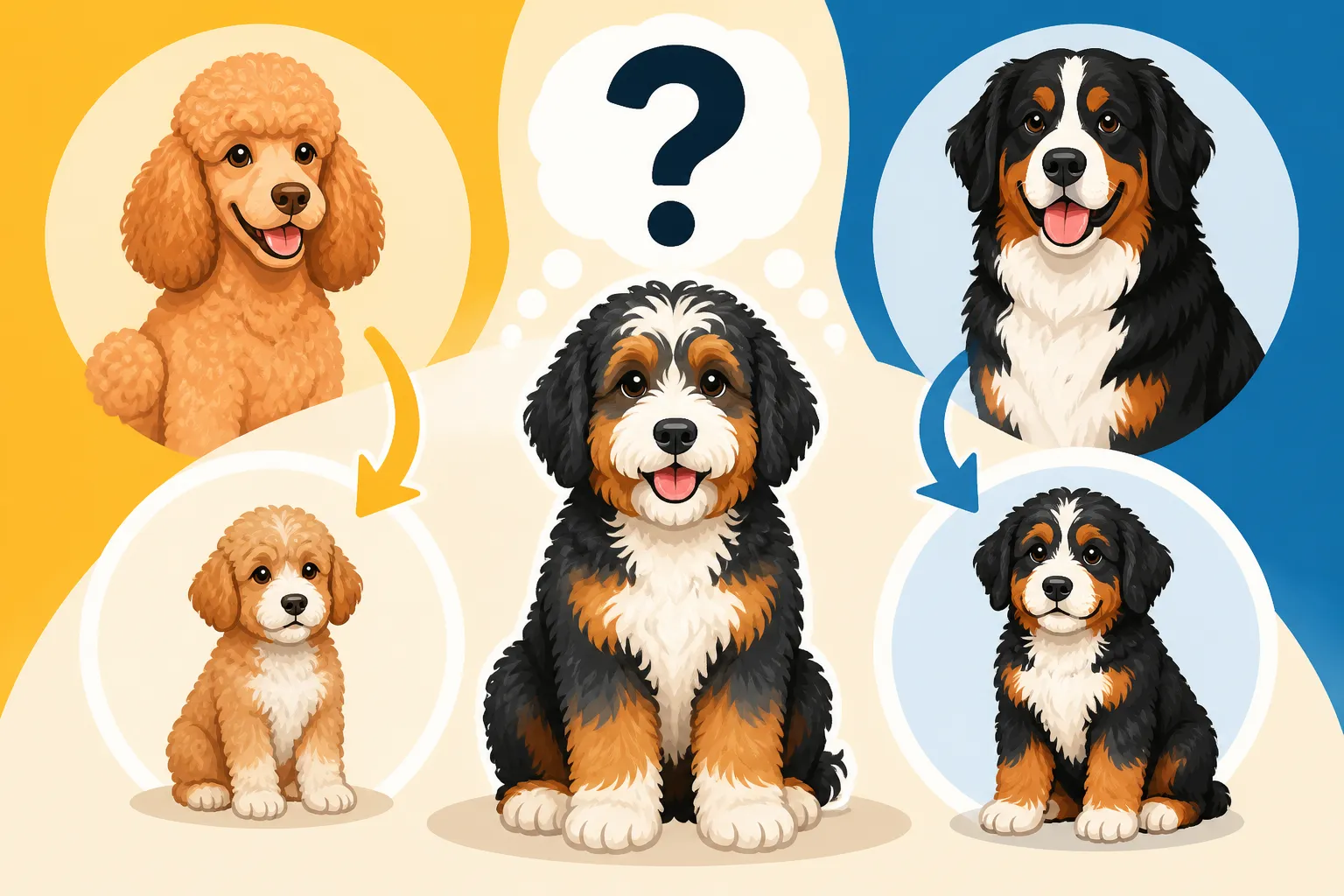
Whether the Poodle or the Bernese Sets a Bernedoodle’s Size
One of the biggest questions new Bernedoodle families have is figuring out how big their adorable fluffball will actually get. It's a common misconception that since the Bernese Mountain Dog is so large, they'll always be the dominant factor in a Bernedoodle's size, but the truth is a bit more nuanced. This comprehensive guide will help you understand the intricate dance between Bernese and Poodle genetics that ultimately determines your Bernedoodle's adult stature.
The Genetic Blueprint: Poodle vs. Bernese Influence
When you breed two distinct dog breeds like the Bernese Mountain Dog and the Poodle, you're essentially mixing two very different genetic recipes. It's not always as simple as taking half of one and half of the other. The way these genes interact, especially in a first-generation cross, can lead to a surprising range of outcomes. Understanding the individual contributions of each parent breed is the first step in unraveling the mystery of your Bernedoodle's potential size.
Understanding the Parent Breeds' Contributions
Let's start with the magnificent Bernese Mountain Dog. These are genuinely large dogs, known for their substantial build and robust bone structure. A typical male Bernese can stand anywhere from 25 to 27.5 inches at the shoulder and weigh between 80 to 115 pounds. Females are slightly smaller, usually 23 to 26 inches tall and 70 to 95 pounds. They're bred for strength and endurance, traditionally used for drafting and herding in the Swiss Alps, which necessitates their impressive size and powerful physique. When a Bernese contributes to the Bernedoodle, it brings genes for significant height, broad shoulders, and a generally heavy-set frame.
On the other side of the equation, we have the Poodle, a breed celebrated for its intelligence, elegance, and diverse sizing. Poodles come in three main varieties: Standard, Miniature, and Toy. The Standard Poodle, which is typically used for breeding Standard Bernedoodles, is still a substantial dog, usually standing over 15 inches tall (often 22-27 inches) and weighing 40-70 pounds. Miniature Poodles are generally 10-15 inches tall and 10-15 pounds, while Toy Poodles are under 10 inches and usually under 10 pounds. When a Poodle is part of the mix, it introduces genes for a leaner build, often a more athletic frame, and, depending on the Poodle size used, a significant reduction in overall mass and height compared to the Bernese. It's the Poodle's varying sizes that truly allow for the diverse size categories we see in Bernedoodles today.
Hybrid Vigor and Predictability Challenges
The term "hybrid vigor," or heterosis, often comes up when discussing crossbreeds. It refers to the increased strength, health, and often size, of hybrid offspring compared to the purebred parents. In Bernedoodles, this can sometimes lead to an offspring that is larger or healthier than either parent breed might suggest individually. While hybrid vigor is generally a positive trait in terms of overall health and genetic diversity, it can also contribute to the unpredictability of size, especially in first-generation (F1) Bernedoodles, where a Bernese and a Standard Poodle are directly crossed.
Because you're combining the full genetic spectrum of two very different-sized breeds, the F1 generation can be a bit of a genetic lottery. Some F1 Bernedoodles might lean more towards the Bernese side in terms of build and height, while others might inherit more of the Poodle's leaner frame. It's not uncommon to see littermates with noticeable size differences, even if their parents were a standard Bernese and a standard Poodle. This unpredictability is part of the charm (or challenge!) of crossbreeds, and it's why asking a breeder about their specific lines and previous litter sizes is so important. When considering your future companion, you might want to read about The Three Bernedoodle Sizes and What Sets Them to better understand these variations.
Factors Influencing a Bernedoodle's Adult Size
Beyond the basic genetic contributions of the parent breeds, several other critical factors play a role in shaping your Bernedoodle's final adult size. These include the specific generation of the cross, the precise lineage of the parents, and even aspects of their early development like nutrition. It's a complex interplay, and understanding these elements can help you make a more informed prediction, although a degree of uncertainty always remains.
Generation Type (F1, F1b, Multigen)
The generation of your Bernedoodle is perhaps the most significant predictor of its potential size and consistency.
- F1 Bernedoodle: This is a first-generation cross between a purebred Bernese Mountain Dog and a purebred Poodle (often a Standard Poodle for Standard Bernedoodles, or Miniature/Toy for smaller versions). As mentioned, these can be the most unpredictable in terms of size and coat, as they inherit a 50/50 split of genes from two distinct breeds. While some may lean more Poodle and others more Bernese, the range within a single litter can be quite wide.
- F1b Bernedoodle: This stands for a "first-generation backcross." It's the result of breeding an F1 Bernedoodle back to a purebred Poodle. The "b" often means "backcross" to a Poodle to increase the Poodle traits (like a more non-shedding coat). This usually results in a dog that is approximately 75% Poodle and 25% Bernese. Consequently, F1b Bernedoodles tend to be more consistent in size and usually fall closer to the Poodle's size range, often being slightly smaller and leaner than F1s, even if a Standard Poodle was used for the backcross. The goal is often to stabilize certain traits, including size and coat type. If you're wondering Whether an F1b Bernedoodle Lives Longer Than an F1, genetic factors are always at play.
- Multigen Bernedoodle: This refers to any Bernedoodle beyond the F1 or F1b generations, where both parents are Bernedoodles themselves (e.g., F1 x F1, F1b x F1b, or F1 x F1b). The goal with multigen breeding is to further stabilize desired traits, including size. Reputable multigen breeders are often working towards more consistent sizing within their lines, carefully selecting parents whose size aligns with their breeding goals. However, even with multigens, surprises can happen, especially if there's still a broad genetic pool.
Breeders might aim to produce "mini" or "tiny" Bernedoodles by using Miniature or Toy Poodles in the mix, and these generations (F1 mini, F1b mini, etc.) would follow the same genetic principles, but with a much smaller Poodle parent influencing the outcome. This is why Whether a Mini Bernedoodle Is Easier to Live With might depend on its precise genetic makeup.
Parental Size and Lineage
While generation type gives us a good clue, the actual size of the parent dogs is arguably the most reliable indicator you have for predicting your puppy's adult size. A good breeder will be transparent about the height and weight of both the Bernese parent (or Bernedoodle parent, in the case of multigens) and the Poodle parent.
If you're getting a Standard Bernedoodle puppy from a Bernese that's at the higher end of the weight range (say, 100+ lbs) and a Standard Poodle that's also quite large (70+ lbs), your puppy has a much higher chance of being a larger Bernedoodle, potentially reaching 80-100 pounds. Conversely, if the parents are on the smaller side of their respective breed standards, the offspring are likely to be smaller.
Don't just look at the immediate parents, though. If possible, inquire about the size of the grandparents or previous litters from the same pairing. This gives you a better sense of the genetic trends in that particular lineage. Some breeders may even be able to show you photos of adult Bernedoodles from previous litters by the same parents, which can be incredibly helpful. This due diligence can give you a better idea of The Height and Weight of a Standard Bernedoodle from that specific breeding program.
Nutrition and Growth Rate
Nutrition plays a surprisingly significant role not just in the overall health of your growing Bernedoodle, but also in how their size develops. Large breed puppies, like Bernedoodles, have specific nutritional needs that differ from smaller breeds. Overfeeding a large breed puppy, especially with foods that are too high in calories or have an improper calcium-to-phosphorus ratio, can lead to rapid growth. While rapid growth might sound appealing, it can put undue stress on their developing bones and joints, potentially contributing to orthopedic issues like hip or elbow dysplasia. This is why responsible breeders and veterinarians often advocate for "slow growth" diets for large breed puppies.
A quality large breed puppy food, like those offered by brands you might find on Chewy, is formulated to support a slower, more controlled growth rate, allowing their skeletal system to mature properly without excessive strain. Feeding the right amount is key, and it's best to follow the guidelines provided by your breeder or veterinarian, rather than free-feeding. Reputable dog food companies, including fresh food options like Ollie, also focus on balanced nutrition for healthy development. Remember that Why Calcium Levels Matter for a Growing Bernedoodle is particularly important for these larger breeds to avoid developmental issues. Good nutrition ensures they reach their genetic potential for size in a healthy way, rather than being unnaturally pushed to grow too quickly.
What to Expect: Predicting Your Bernedoodle's Size
Despite the genetic complexities, there are definitely ways to gain a clearer picture of your Bernedoodle's eventual size. While nothing is 100% guaranteed, working with a reputable breeder and understanding key developmental milestones can help manage expectations. It's all about gathering information and making informed decisions.
Puppy Size vs. Adult Size
It's natural to look at a fluffy Bernedoodle puppy and try to guess its adult size, but puppy size can be quite deceptive! A common myth is that paw size is a good indicator – "big paws, big dog." While a very large paw might suggest a larger dog, it's far from a precise science. Puppies grow at different rates, even within the same litter. Some might have a growth spurt earlier, while others catch up later.
More reliable indicators include:
- Weight at Specific Ages: A breeder might be able to give you a weight range based on their past litters. For instance, knowing the typical weight of a 10-week-old puppy from a specific pairing can sometimes offer a rough projection.
- Growth Charts: Some breeders use generalized growth charts for Bernedoodles, though these should always be taken with a grain of salt, as they are averages. These charts usually track weight gain over the first year to 18 months, which is around The Age a Bernedoodle Reaches Full Height.
- Body Proportions: Look at the puppy's overall build. Does it seem particularly long-legged for its age, or does it have a very heavy bone structure already? These can sometimes hint at a larger adult size.
Ultimately, while adorable, a puppy's initial size is just a snapshot. The genetic blueprint and the size of the parents are far more influential. If you're curious, you can find more specific details on How Much Food a Bernedoodle Puppy Needs at Four Months to ensure healthy growth.
Breeder Transparency and Guarantees
This is where a responsible breeder truly shines. A reputable Bernedoodle breeder understands the genetic variability and will be upfront about the potential size range of their puppies. They won't make outlandish promises or guarantee an exact weight, but they will provide you with comprehensive information, such as:
- Parental Heights and Weights: They should readily share the exact measurements of the dam and sire, as discussed earlier.
- OFA/PennHIP Clearances: While not directly about size prediction, health clearances for hips and elbows (like What OFA Elbow Grades Mean on a Bernedoodle) are crucial for large breeds. A breeder who invests in these screenings demonstrates a commitment to healthy dogs, which often correlates with ethical breeding practices and a better understanding of their lines, including expected size and build.
- Previous Litter Information: Asking to see photos or hear about the adult sizes of puppies from previous litters by the same parents can be incredibly insightful. Some breeders even share client testimonials with updated photos of their dogs.
- Size Guarantees (or Lack Thereof): Be wary of breeders who offer exact size guarantees. While they might give an estimated range, guaranteeing a dog will be exactly X pounds is almost impossible given genetic variability. However, some breeders might offer a clause in their contract regarding significant deviations from an expected size range. It's always worth asking Whether a Breeder Refunds an Oversized Bernedoodle or has other provisions in place, though these are rare.
Always ask to see the full health clearances and be prepared to ask many questions. A good breeder welcomes your curiosity and wants you to be well-informed.
Managing Expectations
Even with all the information in the world, dog breeding, especially with crossbreeds, isn't an exact science. You might have your heart set on a 60-pound Bernedoodle, only to find your puppy grows to 75 pounds. Or, conversely, you might expect a giant and end up with a slightly more moderate-sized companion.
The best approach is to be prepared for a range. If you absolutely cannot accommodate a dog at the larger end of the Bernedoodle spectrum (say, an 80-90 pound standard, or a 50-pound mini), then you might need to reconsider or seek out breeders who have established lines with consistently smaller or larger outcomes, keeping in mind that these might come with a different price point. It's helpful to discuss with your breeder what to do Whether a Bernedoodle Outgrows Its Size Class.
Remember, a Bernedoodle's temperament, health, and personality are far more important than a few pounds difference in their adult weight. While size is a practical consideration for living space, car travel, and handling, focusing too much on an exact weight can detract from the joy of welcoming a unique furry family member. Insurance options like Healthy Paws can help with unexpected health issues regardless of size, providing peace of mind. Regular vet check-ups and a high-quality diet, perhaps from Chewy or Ollie, will support your Bernedoodle's healthy growth throughout its life, helping it reach its full, healthy potential, whatever its final size may be.
Disclaimer
This article is for general informational purposes only and does not constitute professional advice. Laws, prices and regulations vary by location and change over time. Consult a qualified professional for guidance on your specific situation.