What Dematting a Bernedoodle Costs by the Hour
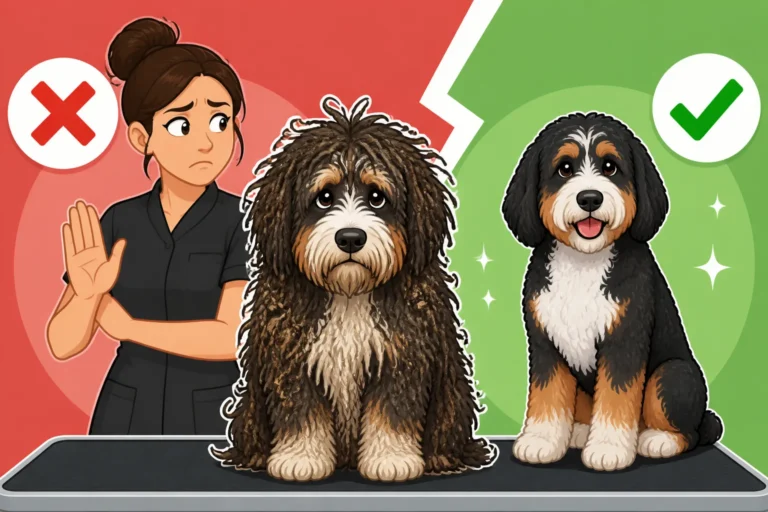
Oh, the dreaded matted Bernedoodle! If you're here, you've probably faced that gut-wrenching moment of running a comb through your beloved dog's beautiful coat, only to hit a wall of tangled fur, leaving you wondering how much it's going to cost to fix this hairy situation. This guide is going to walk you through the realities of dematting costs, why groomers charge what they do, and most importantly, how to prevent those costly, painful tangles from ever forming again.
Understanding Why Your Bernedoodle Gets Matted
Let's be honest, those glorious Bernedoodle coats are a double-edged sword. They're stunning, soft, and often low-shedding, which is a huge draw for many of us. But that very combination of Poodle curl and Bernese Mountain Dog density creates a perfect storm for matting. It’s not your fault; it’s just the nature of this wonderful, fluffy beast.
The Bernedoodle Coat Types and Their Matting Potential
Not all Bernedoodle coats are created equal, but they all share a propensity for matting in varying degrees. You might have a wavy, curly, or even a straight-coated Bernedoodle, and each comes with its own set of grooming challenges.
The wavy coat is often seen as the "ideal" Bernedoodle coat. It's usually soft, flowing, and has a lovely loose curl. However, don't let its beauty deceive you. This coat type easily tangles because the individual hairs are longer and have just enough texture to intertwine and snag on each other. When dirt, moisture, or friction (like from a harness or collar) are added, these waves can quickly lock together, forming mats close to the skin. Owners often think this coat is easy, but it requires diligent brushing, even if it looks effortlessly casual.
Then there's the curly coat, which leans heavily towards the Poodle side. This dense, tightly curled coat is fantastic for those with allergies, as it typically sheds very little. But those tight curls are like Velcro. Any stray hair or dead undercoat that isn't regularly brushed out will get caught in the surrounding curls, quickly spiraling into tight, felt-like mats that cling to the skin. A curly Bernedoodle often needs even more consistent grooming than a wavy one, sometimes daily, especially if kept at a longer length.
Finally, you might encounter a straight-coated Bernedoodle, sometimes affectionately called a "flat coat." This coat type is usually less common and tends to shed more, resembling the Bernese Mountain Dog parent. While you might think it would be less prone to matting, the density can still lead to mats, particularly if it's long and thick. It can develop dense undercoat mats, similar to a Bernese, particularly during seasonal shedding or if dampness is allowed to sit in the coat. Regardless of the exact texture, the sheer volume and often double-layer nature of a Bernedoodle's coat mean matting is a constant battle for many owners. And let's not forget that dreaded "blowing coat" phase when puppies transition to their adult fur – that's a prime matting period! The Month a Bernedoodle Puppy Starts Matting Daily can be a real shock for new owners.
Common Areas Where Mats Form on a Bernedoodle
Mats don't just appear randomly; they tend to gravitate to specific areas on your Bernedoodle's body where there's friction, moisture, or simply denser hair. Knowing these hotspots is key to proactive grooming.
One of the most notorious spots is behind the ears and around the neck. Think about it: every time your dog shakes their head, plays, or wears a collar, there's movement and friction. The hair here is often finer and softer, making it particularly prone to tangling. These mats can be tricky to spot until they become quite dense, and they are often painful when brushed or handled. Similarly, the armpits and groin areas are constant culprits. These are high-friction zones where legs rub against the body. They also collect moisture, especially if your Bernedoodle loves to play in puddles or get caught in the rain. These mats can restrict movement, causing discomfort and even chafing.
The "britches" or rear leg feathering are another common matting zone. This area is often very dense and catches everything – burrs, leaves, dirt, and anything else your dog might brush against. When they sit or lie down, this hair gets compressed, and mats form quickly. Then there are the paws and between the toes. This hair tends to grow long and can collect debris, forming tight little knots that are both painful and can make walking uncomfortable. Even the hair on the tail can mat, especially if it's long and drags on the ground. Any area where moisture lingers, like around the mouth (the beard) if not cleaned regularly, or under the harness/collar, will be a breeding ground for mats. It feels like every snuggly spot is also a mat trap! Mats in a Bernedoodle's Armpits and Britches are particularly tough to deal with because of their location.
The Financial Reality: Why Dematting is Priced by the Hour
When you bring your matted Bernedoodle to a groomer, you're not just paying for a haircut; you're paying for expertise, patience, and often a lot of physical effort. Dematting is one of the most labor-intensive aspects of dog grooming, and it's priced accordingly.
The Time and Skill Dematting Requires
Dematting isn't just a quick brush-through. It's a meticulous, painstaking process that demands a significant amount of a groomer's time, skill, and even physical stamina. Imagine untangling a hundred strands of fine, knotted yarn, all while trying not to pull too hard and hurt the source. That's essentially what a groomer faces, except the yarn is attached to a living, sometimes squirming, animal.
A professional groomer uses specific techniques and tools to gently separate the matted hair without causing unnecessary pain or skin irritation to your Bernedoodle. They often work section by section, starting from the ends of the hair and slowly working towards the skin, using detangling sprays and special combs. This isn't something you can rush; a hasty approach can tear the skin, cause brush burn, or make the dog fear grooming for life. It takes a calm hand, a sharp eye, and an understanding of canine anatomy and pain tolerance. The sheer concentration required to meticulously pick apart mats, all while ensuring the dog remains calm and safe, is immense. It's not just a physical task; it's a mental one. They’re managing the dog's comfort, the integrity of the coat, and their own tools, all simultaneously. This skilled labor, which can take hours for a severely matted Bernedoodle, is why groomers have to charge by the hour. It's a true test of their professional capabilities and dedication to animal welfare.
Typical Hourly Rates for Professional Dematting Services
When it comes to the cost, you'll find that hourly rates for dematting services vary, but they consistently reflect the specialized, labor-intensive nature of the work. You won't find a set flat fee for dematting because the severity of matting is never uniform.
Groomers typically assess the extent of the matting and estimate the time it will take, then quote an hourly rate for that specific service. This rate can depend on a number of factors: the groomer's experience level, their reputation, the salon's location (city versus rural, for example), and the demand for their services. For very minor, surface-level matting, some groomers might just include it in the standard groom price or charge a small additional fee per knot. However, once the matting becomes widespread or tight to the skin, it absolutely shifts to an hourly charge. Keep in mind that this hourly charge for dematting is usually in addition to the base price of the regular groom. If the matting is extensive, they might even dedicate an entire appointment solely to dematting or advise that a shave-down is the only humane option. It’s always best to be upfront with your groomer about any matting before the appointment, so they can allocate the appropriate time and give you an accurate estimate. They might also advise you on Whether a Groomer Will Turn Away a Matted Bernedoodle due to the severity, which can also influence your options.
Factors That Increase the Dematting Time and Cost
Several factors can dramatically increase the time and, consequently, the cost of dematting your Bernedoodle. Understanding these can help you appreciate why the bill might be higher than expected.
Firstly, the severity and location of the mats are paramount. A few loose mats on the ears are one thing; full-body pelting (where the mats form a solid sheet against the skin) is entirely another. Mats that are tight to the skin, large in area, or located in sensitive spots like armpits or groin take significantly longer and require more delicate handling. Secondly, your Bernedoodle's coat type and length play a huge role. A dense, curly coat will mat more deeply and tightly than a wavy one, requiring more effort to separate. If the coat is also kept very long, it offers more hair for mats to form within. A very long coat, even if only moderately matted, will still take more time to work through.
The temperament and cooperation of your Bernedoodle are also critical. A dog that is patient and stands still makes the groomer's job much easier and faster. A fearful, squirming, or reactive dog not only takes longer but also adds a layer of risk for both the dog and the groomer, requiring more breaks and careful restraint, which adds to the clock. Groomers will prioritize your dog's comfort and safety above all else, which means they won't rush a stressed animal. Lastly, the size of your Bernedoodle is an obvious factor. A 90-pound standard Bernedoodle simply has a lot more real estate to cover than a tiny Bernedoodle, even with comparable matting severity. More dog means more hair, more time, and ultimately, a higher cost. All of these elements compound, making each dematting session unique in its challenge and its price tag.
| Factor | Impact on Dematting Time/Cost |
|---|---|
| Severity of Matting | Minor surface mats: less time, lower cost. Tight, pelted mats: much longer, significantly higher cost. |
| Location of Mats | Sensitive areas (ears, armpits): more delicate work, increased time. |
| Coat Type | Dense, curly coats: more prone to tight matting, longer to detangle. |
| Coat Length | Longer coats: more hair to work through, takes more time. |
| Dog's Cooperation | Calm, patient dog: quicker. Anxious, squirming dog: slower, more breaks, higher cost. |
| Bernedoodle Size | Standard size: larger area to cover, more time. Mini/Tiny: smaller area, potentially less time. |
| Groomer's Experience | Highly experienced groomer may work faster, but also commands higher rates for their expertise. |
Weighing the Options: Dematting vs. Shaving Down
This is often the hardest conversation a groomer has with an owner, and the toughest decision an owner has to make. It pits the desire for a beautiful, long coat against the reality of severe matting and your dog's comfort.
When Dematting is a Viable Option
Dematting is truly a viable option when the matting is minor to moderate, and crucially, when it can be done humanely and without causing your Bernedoodle undue stress or pain. A good groomer will always prioritize the dog's welfare over preserving a coat length.
Typically, groomers use what's often called the "2-finger rule" to assess the situation: if you can get two fingers comfortably between the mat and the dog's skin, there's a chance it can be dematted safely. These are usually surface mats or smaller, looser tangles that haven't tightened into a felt-like sheet. In these cases, the groomer can carefully work through the tangles with detangling products and specialized tools, minimizing discomfort. They'll take frequent breaks and monitor your Bernedoodle's reaction closely. It might still add a significant amount of time and cost to the groom, but if the matting is manageable, and your dog has a patient temperament, dematting can save the coat. It's a judgment call made with compassion and expertise, always keeping in mind that prolonged pain and stress during grooming can create a negative association for your dog, making future sessions even harder. For minor tangles, products from Chewy can help you stay on top of things between professional grooms.
The Inevitable Decision: Shaving Down a Matted Bernedoodle
Sometimes, despite our best intentions, the matting is just too severe, too tight, or too extensive for humane dematting. In these cases, the kindest and most responsible decision is often to shave down your Bernedoodle. It’s a moment that can bring tears to an owner's eyes, seeing their fluffy companion lose their signature look, but it’s truly for their well-being.
When mats are tight against the skin, they pull and tug with every movement, causing constant pain and discomfort, similar to having your hair pulled nonstop. They restrict airflow, leading to skin infections, hot spots, and parasites, which can escalate quickly into serious health issues. A groomer faced with severe matting will explain that attempting to pull apart these dense mats would be excruciating for your dog, potentially causing significant trauma to the skin, bruising, and even tearing. The process would be long, painful, and deeply stressful for your Bernedoodle, potentially making them fearful of all future grooming. Shaving off the matted coat provides immediate relief. It's a fresh start. While your Bernedoodle might look a little different for a few weeks, they will feel immensely better. This option is also often more cost-effective than hours of agonizing dematting, as a shave-down takes less time and less specialized, painstaking effort. It allows you to start fresh with a healthy coat, creating a positive grooming routine moving forward. What Shaving a Bernedoodle Down Costs is often a fraction of the price of extensive dematting.
The Emotional and Physical Toll on Your Bernedoodle
It's absolutely vital to understand that severe matting isn't just a cosmetic issue; it takes a significant emotional and physical toll on your Bernedoodle. We often focus on the aesthetic, but our dogs experience very real discomfort.
Imagine wearing a tight, uncomfortable sweater that constantly pulls at your skin, gathering in painful bunches, and never being able to take it off. That's essentially what a matted coat feels like. Mats pull on the skin, causing constant irritation, inflammation, and sometimes even open sores that can become infected. They restrict blood flow and movement, making it painful for your dog to walk, run, or even lie down comfortably. If your Bernedoodle seems unusually quiet, less playful, or reluctant to be touched in certain areas, severe matting could be the culprit. Furthermore, the dematting process itself, even when done gently, can be stressful. Your dog might endure hours of pulling, buzzing clippers, and unfamiliar hands, which can be a frightening experience. This stress isn't just mental; it can lead to physical exhaustion and heightened anxiety for future grooming appointments. In extreme cases, the skin beneath a matted coat can be so damaged that cuts or nicks during shaving are unavoidable, sometimes requiring veterinary attention. This is why a groomer's recommendation to shave down, though heartbreaking for an owner, is often the most compassionate choice, prioritizing your dog's immediate relief and long-term well-being above all else. This kind of pain can even exacerbate underlying conditions, making it crucial to consider overall health, and perhaps even checking insurance coverage from providers like Healthy Paws for any unforeseen skin issues that might arise.
Preventing Future Matting and Saving on Grooming Bills
The best way to avoid the expense and stress of dematting is, unsurprisingly, prevention! Establishing a consistent and effective grooming routine at home can make a world of difference for your Bernedoodle's coat, comfort, and your wallet.
Daily Brushing and Line Brushing Techniques
Daily brushing isn't just a suggestion for a Bernedoodle; it's a non-negotiable part of their care. And not just any brushing – we're talking about effective, to-the-skin brushing, often called "line brushing."
Line brushing ensures you're actually reaching the base of the hair shaft, where mats begin to form. To do it correctly, you'll need a good quality slicker brush and a sturdy metal comb. Start by parting your Bernedoodle's coat in a straight line, close to the skin, usually starting at the bottom of a leg or flank. Hold the hair above the part upwards with one hand, exposing a small strip of skin. With your other hand, use the slicker brush to brush downwards and outwards on that small strip of hair, from the skin out, making sure you feel the bristles gently scratching the skin. Once that section is tangle-free, drop another small section of hair and repeat the process, working your way up and across your dog's body. After slicker brushing a section, follow up with your metal comb. The comb should be able to glide smoothly through the brushed section from root to tip. If it snags, you've missed a mat, and you need to go back with your slicker brush. Pay extra attention to those notorious matting spots: behind the ears, armpits, britches, and tail. This daily effort might seem daunting at first, but it quickly becomes a bonding routine and saves you immense headaches and costs down the line. Remember, a few minutes every day is far better than hours of painful dematting once a month. The Slicker and Rake a Bernedoodle Needs are essential tools for this task.
Regular Professional Grooming Schedule
Even with the most diligent at-home brushing, professional grooming is an absolute must for Bernedoodles. Their unique coats demand it, and a regular schedule is your best defense against matting disasters.
Think of your professional groomer as a partner in your Bernedoodle's coat care. They have the expertise, specialized tools, and powerful dryers to get down to the skin, thoroughly wash, dry, and brush out your dog's thick coat in a way that's incredibly difficult to replicate at home, especially with a large Bernedoodle. A general recommendation for Bernedoodles is to schedule professional grooming every 6 to 8 weeks. This consistent schedule ensures that any minor tangles you might have missed are caught and addressed before they escalate into serious mats. It also keeps their coat at a manageable length, preventing excessive growth that can quickly lead to matting. A groomer will trim sanitary areas, clip nails, and clean ears – all crucial aspects of overall health and comfort that are hard for many owners to do effectively at home. Establishing this routine means your groomer gets to know your dog's coat and temperament, making each visit smoother and less stressful for everyone involved. Regular professional grooms, though an investment, are a preventative measure that will save you the higher costs of dematting or emergency shave-downs. What a Bernedoodle Groom Costs Every Six Weeks might seem like a lot, but it’s an essential part of ownership.
Smart Grooming Choices: Lengths and Styles
One of the easiest ways to prevent matting and simplify your Bernedoodle's grooming routine is to make smart choices about their coat length and style. While a long, flowing coat is beautiful, it's also a high-maintenance commitment.
If you find yourself struggling to keep up with daily brushing, or if your Bernedoodle is very active and prone to getting dirty, consider opting for a shorter, more practical cut. A "puppy cut" or a "teddy bear cut," where the coat is kept at an even, shorter length all over, can drastically reduce matting potential. Talk to your groomer about a length that works for your lifestyle and your dog's activity level. Even a one-inch or two-inch cut can still look adorable and maintain the Bernedoodle charm without the intense matting risk. You might also consider specific areas for shorter trims. For example, keeping the hair in the armpits, groin, and behind the ears shorter can prevent mats from forming in these common trouble spots. Many owners also opt for a shorter trim during warmer months to help with cooling, which also coincidentally reduces matting risk. The Summer Clip Length for a Bernedoodle can be a lifesaver. Being realistic about how much time you can dedicate to at-home grooming will help you choose a style that keeps your Bernedoodle comfortable and mat-free without constant battles.
Investing in Quality Grooming Tools and Products
While professional grooming is indispensable, equipping yourself with the right at-home tools and products is a crucial investment that prevents matting and makes your daily routine more effective. Skimping on these can actually cost you more in dematting fees later.
Start with a high-quality slicker brush and a durable metal comb with both wide and narrow teeth. These are your foundational tools. Beyond that, consider a good detangling spray; a light spritz before brushing can help loosen minor tangles and protect the hair. When it comes to bathing, use a professional-grade dog shampoo and conditioner. Human products are not formulated for canine skin and coat pH and can strip natural oils, making the coat more prone to dryness and matting. Post-bath, a powerful force dryer (not a human hairdryer, which can burn their skin) is invaluable. Drying your Bernedoodle completely and thoroughly down to the skin is critical, as damp undercoats can quickly felt and mat. Products like those found at Chewy can really make a difference. Even consider a good set of blunt-nosed grooming scissors for safely trimming hair around the eyes or paws if you feel comfortable. Investing in these quality items reduces your Bernedoodle's discomfort, makes your grooming sessions more efficient, and ultimately saves you from needing costly dematting services. And if you're looking into high-quality food options like Ollie, remember that good nutrition also supports a healthier coat, which can be less prone to dryness and breakage, though it won't prevent matting on its own.
Disclaimer
This article is for general informational purposes only and does not constitute professional advice. Laws, prices and regulations vary by location and change over time. Consult a qualified professional for guidance on your specific situation.