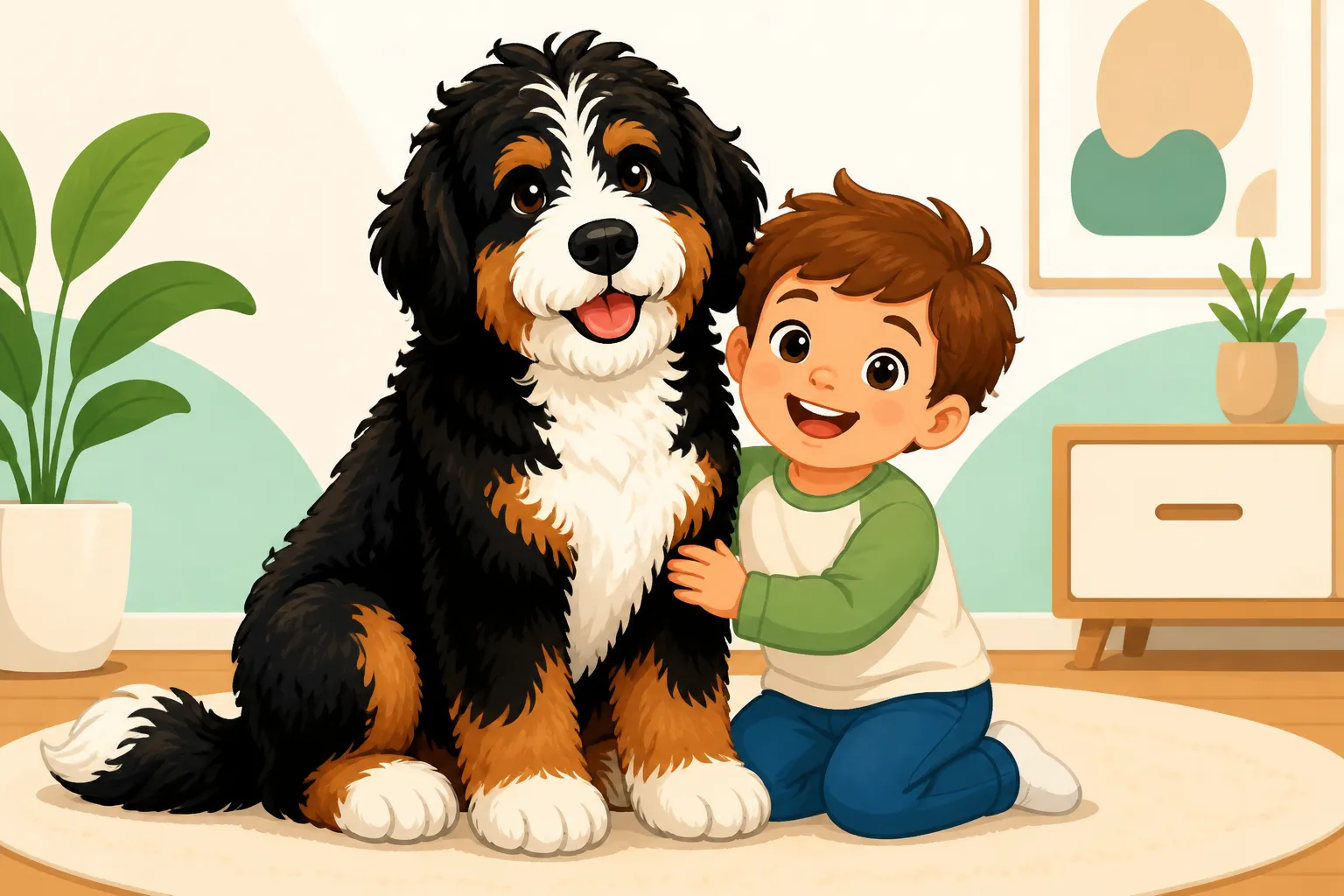
A Standard Bernedoodle and a Small Child
Bringing a standard Bernedoodle into a home with small children can feel like walking a tightrope – you dream of that gentle giant, a furry companion for your little ones, but the reality of a large, energetic puppy and a curious toddler can quickly turn into a chaotic nightmare. This comprehensive guide will walk you through setting up a safe, harmonious environment where both your Bernedoodle and your small child can thrive, offering practical strategies for training, socialization, and crucial supervision.
Understanding the Bernedoodle Temperament with Kids
Many families fall in love with the idea of a Bernedoodle precisely because of their reputation for being wonderful family dogs. But it's important to remember that they are a mix, and while you might get the best of both worlds, you could also get a challenging combination. Their temperament around children is a critical factor, and understanding both parent breeds helps manage expectations.
The Bernese Gentleness
The Bernese Mountain Dog side of your Bernedoodle brings a deep-seated desire to be with its family, often displaying a calm, affectionate, and famously tolerant nature. Bernese are known for their "nanny dog" tendencies, being patient and gentle even with the most enthusiastic toddlers. This inherent sweetness is what many people hope for in their Bernedoodle, a dog that will happily allow a child to lean against it or share its space without complaint. They often have a protective, yet not aggressive, instinct towards their family members, viewing children as part of their treasured pack.
However, even the most gentle Bernese can be overwhelmed if not given proper boundaries and respect. While they might tolerate a lot, it doesn't mean they enjoy every interaction, and repeated unwelcome attention can erode even the most patient disposition. It's vital to remember that a Bernedoodle inherits a tendency towards this gentleness, but it's not a guarantee, and individual personalities vary widely. A Bernedoodle, especially a puppy, might not have developed the calm demeanor of a mature Bernese, making early interactions more unpredictable.
The Poodle's Playfulness and Intelligence
Then you have the Poodle, a highly intelligent and often very playful breed. Poodles bring an energetic, sometimes goofy, and highly trainable aspect to the Bernedoodle mix. This intelligence means they can learn quickly, which is fantastic for training, but it also means they can learn undesirable behaviors just as fast if not guided properly. Their energy levels can range from moderate to high, especially as puppies and adolescents. This playful drive can manifest as boisterous games, jumping, and a desire to be involved in everything, which can be a lot for a small child.
A Poodle's inherent smarts also mean they thrive on mental stimulation. If a Bernedoodle doesn't get enough of this, it might find its own "games," which could involve chasing a running child, grabbing at clothing, or counter-surfing for snacks. While not malicious, these behaviors can be frightening or even dangerous for a small child. The combination of high intelligence and boundless energy means a Bernedoodle puppy needs consistent training and ample outlets for its mind and body to ensure that playful energy is directed appropriately.
Hybrid Vigor and Temperament Unpredictability
The term "hybrid vigor" often gets tossed around when discussing designer breeds, implying increased health and, sometimes, better temperaments. While a well-bred Bernedoodle can indeed be a wonderful companion, it’s crucial to understand that being a hybrid doesn't automatically mean a perfect dog. With a mixed breed, you can never predict exactly which traits from which parent breed will dominate. You might get a dog that is predominantly Poodle in its energy and smarts, or one that leans heavily on the Bernese side for its calm, gentle nature.
This unpredictability means that while a breeder might aim for a specific blend, each puppy is an individual. One Bernedoodle might be a low-energy cuddle bug, while its littermate could be a high-octane clown. This is why meeting the parents, if possible, and observing the puppy's individual personality are so important. Even then, temperament can evolve as the puppy grows, especially during that awkward adolescent phase when they seem to Why a Bernedoodle Matures Slower Than It Grows. Ultimately, investing time in consistent training and early socialization is the best way to shape the temperament you desire, regardless of genetic predispositions.
Managing Size and Strength: Early Training is Key
One of the biggest concerns for families with small children is the sheer size and strength a standard Bernedoodle can achieve. A ninety-pound dog can easily knock over a small child, even unintentionally. Early and consistent training focused on manners and impulse control is absolutely non-negotiable to ensure safety for everyone in the household.
The Puppy Nipping Phase
All puppies go through a nipping and biting phase, using their mouths to explore the world and learn bite inhibition. For a tiny Chihuahua puppy, this is inconvenient; for a Bernedoodle puppy destined to be ninety pounds, it's a serious matter. Those sharp puppy teeth can break skin easily, and what starts as playful nips can quickly escalate if not properly managed. It's often one of the first frustrations new Bernedoodle owners face, especially when those nips are directed at a child's flailing hands or bare ankles.
The key here is redirection and consistency. When your Bernedoodle puppy nips, immediately redirect their attention to an appropriate chew toy. Praise them when they chew the toy instead of you or your child. Avoid pulling your hand away quickly, as this can make the puppy think you're playing a game. Instead, yelp sharply (like another puppy would), withdraw attention for a moment, and then offer a toy. Teach your children to do the same, or at least to calmly remove themselves and alert an adult. This phase is crucial for teaching bite inhibition, ensuring your growing Bernedoodle understands that human skin is sensitive and not for mouthing.
Teaching "Off" and "Four on the Floor"
As your Bernedoodle grows, its enthusiasm often manifests as jumping. A happy Bernedoodle can clear an adult's waist with ease, let alone a small child's head. The command "off" becomes incredibly important, not just for furniture, but for people. It teaches your dog that all four paws must remain on the floor when greeting or interacting. This is challenging because dogs naturally jump up to greet, and often, excited squeals from children can inadvertently reinforce the behavior.
Start training "off" early and practice it constantly with every family member, including older children. When your Bernedoodle jumps, turn your back, cross your arms, and completely ignore them until all four paws are on the floor. The moment they are, turn around and calmly reward them with praise and a treat at their nose level, reinforcing the "four on the floor" behavior. For a large, strong Bernedoodle, you might also consider using a no-pull harness or Leash Manners on a Bernedoodle Heading for Ninety Pounds when greeting guests, just to give you more physical control during the learning process.
Dealing with the "Bernedoodle Lean"
The "Bernedoodle lean" is an endearing trait inherited from their Bernese side, where they love to lean their full body weight against you as a sign of affection or to solicit pets. While adorable for adults, a ninety-pound dog leaning into a small child can easily knock them off balance or even pin them. This isn't aggressive behavior; it's simply a large dog showing affection without understanding its own size relative to a tiny human. A Bernedoodle That Leans on Everyone is a common scenario in many households.
To manage the lean, teach your Bernedoodle a "gentle" or "space" command. When they lean, gently guide them to sit beside you or the child, rather than leaning into them. Reward them for sitting close without leaning. You can also teach your child to gently push back or step forward slightly, creating a barrier without being harsh. The goal isn't to discourage affection, but to teach them how to be affectionate safely. It requires vigilance from adults to intervene before a lean becomes a tumble, ensuring that both dog and child learn appropriate physical interaction.
Socializing Your Bernedoodle Puppy for Family Life
Proper socialization is the bedrock of a well-adjusted dog, and it's doubly important for a large breed living with children. A Bernedoodle needs to learn that children are a normal, non-threatening, and even pleasant part of their world, rather than something to fear or dominate. This process begins the moment you bring your puppy home.
Early Positive Experiences
The critical socialization window for puppies closes around 12-16 weeks. During this time, it's vital to expose your Bernedoodle puppy to a wide variety of sights, sounds, people, and gentle experiences, all in a positive and controlled manner. This includes children of different ages, temperaments, and noise levels. Don't just expose them to your children; invite friends with kids over, ensuring all interactions are supervised and positive. If the only children your puppy meets are your own, they might generalize poorly to other children outside the home. Socializing a Bernedoodle Before Twelve Weeks is paramount for success.
Positive experiences mean associating children with good things. When a child is present, give your puppy high-value treats, offer a favorite toy, or engage in a fun, calm game. Avoid forcing interactions or allowing children to corner or overly stimulate the puppy. If your puppy seems overwhelmed, remove them to a quiet space. The goal is to build a foundation where children predict positive outcomes, rather than anxiety or fear. This early work helps prevent issues like fear-based reactivity or guarding behaviors later on.
Gradual Introductions and Controlled Encounters
Even with early socialization, introductions to new children should always be gradual and controlled. Don't just throw your Bernedoodle into a room with a group of boisterous toddlers and hope for the best. Introduce one child at a time, keeping the encounter short and positive. Have the child sit quietly and offer a treat, or toss a toy away from themselves for the puppy to retrieve. This teaches the Bernedoodle that children can be a source of good things, but also that they don't have to be physically close to enjoy the interaction.
For toddlers, who lack impulse control and can be unpredictable, managing these introductions is even more critical. Keep your Bernedoodle on a leash, even indoors, during initial interactions with very young children. This gives you immediate control to prevent jumping, nipping, or overly enthusiastic play. Praise and reward calm behavior. If your Bernedoodle shows any signs of stress – lip licking, yawning, turning away, stiffness – immediately create distance. The aim is to build positive associations slowly, rather than rushing and creating a negative experience that can be hard to undo.
Exposure to Different Child Ages and Temperaments
It's not enough to expose your Bernedoodle to just one type of child. Children vary wildly in their energy, voices, and movements. A calm, older child will interact differently than a screaming, running toddler. Your Bernedoodle needs to experience this spectrum in a safe way. This means walks in parks where children play, supervised visits to friends' houses with kids, or even simply playing child-like sounds (like laughing or crying babies) at a low volume in your home while you offer treats.
Pay particular attention to your Bernedoodle's reactions to different stimuli. Does loud screaming make them nervous? Do fast-moving children trigger a chase instinct? Identify these triggers and work on counter-conditioning them. For instance, if loud noises are a problem, play them softly while giving treats, gradually increasing the volume over time. The more diverse and positive experiences your Bernedoodle has with children, the more adaptable and trustworthy they will be in a variety of situations. This comprehensive exposure helps build a confident, rather than anxious or overly stimulated, family dog.
Setting Boundaries: For Both Dog and Child
Creating a safe home for both a large Bernedoodle and small children isn't just about training the dog; it's equally about training the children and setting clear boundaries that everyone respects. This prevents misunderstandings, accidental injuries, and ultimately fosters a respectful relationship between your furry family member and your human ones.
Creating a Safe Retreat for Your Dog
Every dog, especially a large breed in a busy family home, needs a designated safe space where they can retreat and be undisturbed. This might be a crate, a dog bed in a quiet corner, or even a separate room behind a baby gate. This space is not a punishment zone; it's their sanctuary. Teach your children from day one that when the Bernedoodle is in its bed or crate, they are to leave the dog alone, no matter what. No petting, no poking, no trying to play. This is the dog's personal decompression zone.
This boundary is crucial for preventing stress and resource guarding issues. A Bernedoodle, no matter how gentle, needs to feel secure in its ability to escape unwelcome attention. If a child constantly invades their space, the dog might eventually feel it has no option but to growl or snap to get its point across. By enforcing this boundary, you are teaching your children respect for animals and empowering your dog with the ability to "opt out" of interactions when needed, which builds trust and reduces anxiety. Think of it as their "dog cave" or personal room, protected by a silent "do not disturb" sign.
Teaching Children Gentle Interactions
Just as you teach your Bernedoodle appropriate behavior, you must teach your children how to interact gently and respectfully with the dog. Small children, by nature, can be grabby, loud, and unpredictable. They don't understand that pulling fur, poking eyes, or riding on a dog's back is painful or frightening. It's your job to be a constant advocate for your dog and to teach these crucial lessons. Start by demonstrating gentle petting, using an open hand on their back or chest, avoiding sensitive areas like the face, ears, or tail.
Use simple, consistent language like "gentle hands" or "soft touches." Supervise every single interaction between your Bernedoodle and small children, intervening immediately if you see anything inappropriate. This means literally being within arm's reach. Never assume your Bernedoodle will just tolerate rough handling. Teach children to offer toys politely (not snatch them), to sit calmly when petting, and to let the dog come to them, rather than chasing. Consistency in these lessons will create a child who respects animal boundaries, and a Bernedoodle who feels safe around children.
The "No-Go" Zones
Beyond personal space, establish "no-go" zones for your Bernedoodle around children's toys, food, and designated play areas. Conversely, children should also have "no-go" zones around the dog's food bowls, toys, and sleeping areas. These boundaries help prevent resource guarding issues, where a dog might feel the need to protect its possessions from perceived threats, including children. A standard Bernedoodle, Raising a Bernedoodle Puppy That Will Outweigh You, can inadvertently cause serious harm if it feels its resources are threatened.
For dog food, feed your Bernedoodle in its crate or a separate room, away from where children play or eat. Pick up food bowls immediately after meals. For children's toys, teach them to keep small, enticing items off the floor where the dog might mistake them for its own. If your Bernedoodle tends to steal toys, teach a "leave it" command rigorously. Using baby gates or playpens can be incredibly helpful for physically separating dog and child when you can't offer 100% supervision. These clear physical and behavioral boundaries reduce potential conflicts and ensure both species understand what belongs to whom, and what areas are off-limits.
Supervision and Safety: Non-Negotiable Rules
When you have a large dog and small children, supervision isn't just a good idea; it's an absolute necessity. Even the best-behaved Bernedoodle and the most well-meaning child can have an accident if left unsupervised. Understanding dog body language and proactively managing interactions are critical for maintaining a safe household.
The "Never Leave Unsupervised" Rule
This rule is paramount: never leave a Bernedoodle and a small child alone together, even for a moment. This means if you have to step away to answer the door, use the restroom, or grab something from another room, either the dog or the child must be safely separated. This isn't because you don't trust your dog; it's because accidents happen quickly, and a large dog's play can easily become too rough without adult intervention. What might start as innocent play can escalate to a child getting knocked over, scratched, or even bitten if boundaries are crossed and no adult is there to mediate.
Toddlers, especially, are unpredictable and lack the judgment to understand a dog's signals. They might pull an ear, step on a paw, or grab food, igniting a reaction from even the most patient Bernedoodle. By diligently enforcing the "never leave unsupervised" rule, you are proactively preventing potential incidents. This might involve crating your Bernedoodle when you step away, using baby gates to create physical barriers, or simply having a designated adult whose sole responsibility is to watch the interactions when they are together. It's a constant commitment, but it's the safest approach for everyone.
Reading Your Bernedoodle's Body Language
Learning to interpret your Bernedoodle's body language is one of the most powerful tools you have to prevent incidents. Dogs communicate constantly, and often their signals of stress or discomfort are subtle. Look for signs like lip licking, yawning (when not tired), turning their head away, avoiding eye contact, tail tucked low, stiff posture, showing the whites of their eyes ("whale eye"), or even a slight tremor. These are all indicators that your Bernedoodle is feeling uncomfortable or stressed and needs space. A Bernedoodle might not be Whether a Bernedoodle Is Safe Around Toddlers in certain situations if these signals are ignored.
It's equally important to recognize when your dog is relaxed and happy (loose body, soft eyes, wagging tail, relaxed mouth). The moment you see signs of stress, intervene immediately. This means gently separating the dog and child, redirecting the dog to its safe space, or changing the environment. Don't wait for a growl or a snap; those are often the last resorts of a dog whose earlier, more subtle warnings have been ignored. Understanding and respecting these signals shows your dog that you are listening and helps build a stronger, safer bond.
Child-Proofing Your Dog's Space
Just as you child-proof your home for safety, consider dog-proofing the areas where your children play. This goes hand-in-hand with setting boundaries and using "no-go" zones. Ensure that your Bernedoodle's food, water, and favorite toys are not easily accessible to small children, especially toddlers who are prone to putting everything in their mouths. A child picking up a dog's prized chew bone can lead to a guarding incident.
Consider the practicalities: use sturdy, tall baby gates to block off rooms or sections of the house, ensuring your Bernedoodle can't jump over them and your child can't easily climb through. Store dog food and treats in secure containers out of reach. Provide your Bernedoodle with durable, child-safe toys that won't easily break into small pieces a child could swallow. Setting up the physical environment to minimize accidental interactions with valuable resources reduces the chances of conflict and creates a more predictable, safer space for both your Bernedoodle and your small children. Sometimes, the right equipment, easily found on a platform like Amazon, can make all the difference in creating these safe boundaries.
Navigating Adolescent Bernedoodle Energy
Ah, the teenage years! Just like human teenagers, adolescent Bernedoodles can be a handful. They're often physically mature but mentally still very much puppies, bursting with energy and prone to testing boundaries. This phase, typically from around 6 months to 18-24 months, can be particularly challenging in a home with small children.
Managing the Teenage Zoomies
One moment your Bernedoodle might be napping peacefully, and the next they're tearing through the house in a burst of "zoomies," racing from room to room, knocking over anything (or anyone!) in their path. This surge of undirected energy can be terrifying for a small child and cause accidental collisions. A ninety-pound dog at full speed is a force of nature, and while it's a natural dog behavior, it needs to be managed in a family home.
The key to managing zoomies is prevention and redirection. Ensure your Bernedoodle gets plenty of appropriate physical exercise daily. The Exercise a Standard Bernedoodle Needs Daily is significant, and channeling that energy through structured walks, playtime in a fenced yard, or dog sports can reduce the likelihood of indoor chaos. If zoomies start inside, calmly direct your dog to a safer space, like a yard or a larger room, away from children. Teach a "settle" command to help them de-escalate. Never chase or yell, as this can inadvertently turn it into a game for the dog. The goal is to channel that energy into productive, safe outlets.
Reinforcing Established Commands
Adolescence often brings a temporary dip in obedience. Your Bernedoodle, who previously aced "sit" and "stay," might suddenly act as if they've never heard these commands before. This isn't defiance; it's often a combination of surging hormones, increased distractions, and a developing brain. However, in a home with small children, reliable obedience is critical. A Bernedoodle That Jumps on People is a common adolescent behavior that needs consistent correction.
This means doubling down on basic obedience training. Go back to basics, practice commands in a variety of environments, and increase the value of your rewards. Short, frequent training sessions using high-value treats (think cooked chicken or cheese) can be very effective. Involve older children in these training sessions, allowing them to give commands and reward the dog, always under adult supervision. The goal is to solidify those commands so they become instinctual, even when your Bernedoodle is excited or distracted by a child. Consistency, patience, and positive reinforcement are your best friends during this phase.
Channeling Energy Productively
Bernedoodles are intelligent dogs, and physical exercise alone might not be enough to satisfy them. Mental stimulation is just as important, especially for those Poodle brains. Providing productive outlets for their energy can prevent boredom-induced behaviors that might involve children, such as chasing, nipping, or stealing toys. This is where engaging their minds comes in.
Consider puzzle toys, sniff games, or even introducing them to dog sports. The Draft Dog Work a Bernedoodle Can Still Do or agility can be fantastic ways to bond with your dog and channel their physical and mental energy in a structured, positive way. Regular training sessions, learning new tricks, or even just working on a "find it" game with treats hidden around the house can be incredibly tiring for their brains. A tired Bernedoodle, both physically and mentally, is a well-behaved Bernedoodle, much less likely to seek out inappropriate ways to entertain themselves, especially involving your children. Platforms like BAXTER & Bella offer excellent online resources for structured puppy and adolescent training that families can do together.
When Things Go Wrong: Recognizing Stress Signals
Even with the best intentions and diligent training, sometimes interactions between a Bernedoodle and a small child can go awry. It's crucial for owners to understand the subtle (and not-so-subtle) signs that a dog is uncomfortable or feeling threatened, and to know how to respond safely and effectively. Ignoring these signals can lead to escalation and potentially serious incidents.
Subtle Signs of Discomfort
Dogs rarely bite without warning. Instead, they communicate a hierarchy of stress and discomfort signals that, if ignored, can build up to a growl or a snap. These subtle signs include:
- Lip licking: Often a sign of stress, not just hunger.
- Yawning: When not tired, it's a calming signal.
- Turning head or body away: An attempt to disengage.
- Stiff body posture: Indicates tension.
- "Whale eye": When the whites of the eyes are visible, indicating fear or anxiety.
- Tail tucked: A classic sign of fear.
- Panting: When not hot or exercising.
- Ears flattened or back: Indicates apprehension.
Learning to spot these early warnings is critical. If your Bernedoodle exhibits any of these signs when a child is nearby or interacting, it means they are uncomfortable and need space. Immediately separate them calmly and quietly. Never punish your dog for showing these signs, as this can suppress the warnings and lead to a dog that bites without any apparent precursor. Your Bernedoodle might be naturally The Shyness a Bernedoodle Gets From the Bernese, which makes these subtle signals even more important to catch.
When Growls and Snaps Happen
If subtle signals are missed or ignored, a dog may escalate to more obvious warnings: growling, air snapping (snapping at the air near the child without making contact), or even a quick nip that doesn't break skin. These are urgent, neon-sign warnings that the dog's boundaries have been severely breached, and they are feeling truly threatened or cornered. While terrifying, these are still warnings, and they indicate that the dog is communicating its distress.
Your immediate response to a growl or snap should be to safely separate the dog and child, ensuring the child is out of harm's way. Do not yell at, hit, or punish your Bernedoodle for growling or snapping. As counterintuitive as it might feel in the moment of fear, punishing these warnings teaches the dog that growling is not allowed, effectively removing their communication tools. A dog that is not allowed to growl may go straight to a bite next time. Instead, focus on understanding why the growl happened and preventing that situation from recurring. This is a critical moment to re-evaluate supervision and management strategies.
Seeking Professional Help
If your Bernedoodle exhibits growling, snapping, or any signs of aggression towards a child, it is absolutely essential to seek professional help immediately. This is not a problem you can solve by simply "training it out" or ignoring it. A qualified professional, such as a certified professional dog trainer (CPDT-KA) or a veterinary behaviorist (DACVB), can assess the situation, identify the root cause of the behavior, and develop a safe and effective behavior modification plan.
These professionals can observe your dog's interactions, help you refine your ability to read body language, and guide you in implementing management strategies that keep everyone safe. They can also rule out any underlying medical issues that might be contributing to behavioral changes. Waiting to address these issues can lead to more serious incidents and put both your child and your Bernedoodle at risk. Investing in professional guidance is an investment in the safety and harmony of your entire family.
Long-Term Harmony: Maintaining a Positive Relationship
Building a safe and loving relationship between a standard Bernedoodle and small children isn't a one-time event; it's an ongoing process. As children grow, and as your Bernedoodle ages, their interactions will evolve. Continuously reinforcing good habits, providing enrichment, and being observant will ensure long-term harmony.
Continuing Education for Everyone
The learning doesn't stop once your Bernedoodle is out of puppyhood or your child is past toddlerhood. As children grow, their understanding of animal behavior increases, but so does their potential to accidentally instigate problems through more elaborate play or less supervised interactions. Similarly, as your Bernedoodle matures, their personality might settle, but they can also develop new anxieties or physical limitations.
Therefore, ongoing education for both your human and canine family members is vital. Regularly review the "gentle hands" rule with your children. Teach them about their dog's body language in an age-appropriate way. For your Bernedoodle, continue with obedience refreshers and enroll in fun classes like Whether a Bernedoodle Compares in Carting or nose work to keep their minds engaged. Use resources like the BAXTER & Bella online programs for new ideas and continued guidance. A family that learns and grows together will foster a stronger, more resilient bond.
Enrichment for a Happy Dog
A bored or under-stimulated Bernedoodle is more likely to develop undesirable behaviors, which can often impact children. These dogs are intelligent and require significant mental and physical outlets. Simply letting them out in the yard isn't enough; they need engagement. Ensuring your Bernedoodle is happy and fulfilled is a cornerstone of maintaining peace in a multi-species household.
Provide a variety of enrichment activities:
- Puzzle toys: Toys that dispense treats as your dog manipulates them.
- Chews: Long-lasting chews can keep them occupied and happy.
- Sniff walks: Let them explore on walks, sniffing to their heart's content, which is incredibly mentally stimulating.
- Training games: Incorporate short, fun training sessions into your daily routine.
- Playdates: Arrange supervised playdates with other dog-friendly dogs.
A Bernedoodle with enough mental and physical stimulation is generally calmer, more settled, and less likely to engage in behaviors that might overwhelm or accidentally harm a small child. When their needs are met, they are content to relax alongside their family, making for a much more harmonious home environment.
Addressing Age-Related Changes
As your Bernedoodle ages, its needs and tolerances will change, and these changes can impact its interactions with children. An older Bernedoodle might develop arthritis (Arthritis in a Bernedoodle at Eight), hearing loss, or vision impairment, making them less tolerant of sudden movements, loud noises, or being jostled. What was once a patient, tolerant dog might become irritable or fearful if they are in pain or easily startled.
It's crucial to be mindful of these changes. Provide soft, supportive beds. Limit physical activity if they are struggling. Teach children to be extra gentle and respectful of an aging dog's need for space and quiet. Ensure children understand that an old dog might not want to play as much and needs undisturbed rest. Regular veterinary check-ups are essential to manage any age-related discomfort. By understanding and adapting to your Bernedoodle's evolving needs, you can ensure they remain a cherished and safe family member throughout their entire life.
Key Considerations for Bernedoodles and Children
Ensuring a happy and safe home with both a Bernedoodle and small children requires ongoing commitment. It's a journey, not a destination, and being proactive and consistent is key.
| Aspect | Bernedoodle Needs | Child Needs | Adult Responsibility |
|---|---|---|---|
| Size & Strength | Early training for "off," "four on the floor," no jumping. | Safety from accidental bumps, tumbles, and nips. | Consistent training, physical management (leash), safe space. |
| Temperament | Socialization to view children positively. | Learning gentle interaction and respect for dog's space. | Supervise ALL interactions, teach boundaries, advocate for dog. |
| Energy & Play | Ample exercise and mental stimulation. | Understanding dog play signals, not being overwhelmed. | Channel energy productively, provide appropriate toys. |
| Communication | Needs signals of discomfort to be understood. | Needs to learn dog body language (stress, happiness). | Be fluent in dog body language, intervene immediately. |
| Boundaries | A safe, undisturbed retreat. | Clear "no-go" zones (dog's food/bed, child's toys). | Enforce rules strictly, use physical barriers. |
| Adolescence | Patience, consistent training, productive outlets. | Understanding temporary regression in manners. | Re-training, increased exercise/mental work. |
| Aging | Comfort, respect for pain/sensory loss, quiet space. | Understanding dog's reduced tolerance/playfulness. | Vet care, adapting environment, teaching extra gentleness. |
This table serves as a quick reference, but remember that each Bernedoodle and child is unique, and constant observation and adaptation are your most important tools. The bond between a well-raised Bernedoodle and a child can be truly magical, but it’s a bond that is built with intention, patience, and unwavering commitment from the adults in the home.
Disclaimer
This article is for general informational purposes only and does not constitute professional advice. Laws, prices and regulations vary by location and change over time. Consult a qualified professional for guidance on your specific situation.