Whether a Bernedoodle Is Safe Around Toddlers
Bringing a Bernedoodle into a home with toddlers can feel like juggling two adorable, yet unpredictable, forces of nature. Many families dream of a gentle, loving dog that will grow up alongside their little ones, but the reality can be complex and sometimes, honestly, a bit nerve-wracking. This comprehensive guide will walk you through the nuances of Bernedoodle temperament, crucial socialization steps, essential training, and practical management strategies to ensure a safe and harmonious environment for both your furry family member and your small children.
Understanding the Bernedoodle Temperament with Young Children
When you consider whether a Bernedoodle is safe around toddlers, you're really delving into the fascinating blend of its parent breeds: the Bernese Mountain Dog and the Poodle. Each brings distinct traits to the table, and understanding them is key to predicting (and shaping) your Bernedoodle's behavior around the littlest members of your family.
The Bernese Mountain Dog Influence on Gentleness
The Bernese Mountain Dog is renowned for its calm, gentle, and affectionate nature. They are often described as "nanny dogs" due to their patient demeanor and protective instincts towards children. This heritage is a huge part of what makes Bernedoodles so appealing to families. They inherit that lovely, laid-back disposition that can be incredibly reassuring when you have a tiny human wobbling around. Imagine a big, fluffy teddy bear who tolerates a lot of enthusiastic pats and clumsy hugs – that's the Bernese influence shining through. They tend to be stable, not easily startled, and possess a natural inclination to be near their people, including the small ones. This steadiness is a massive plus when you're dealing with the unpredictable movements and noises of a toddler.
However, even with this gentle nature, their sheer size can be a factor. A full-grown Standard Bernedoodle, often weighing between 70 to 90 pounds, might accidentally knock over a small child just by wagging its tail with gusto or turning too quickly. It's not maliciousness, but rather a lack of spatial awareness that comes with being a large, enthusiastic dog. The Height and Weight of a Standard Bernedoodle covers this in more detail. It's crucial to remember that while their hearts are typically pure, their physical presence needs to be managed around delicate little bodies.
The Poodle's Contribution to Trainability and Patience
Then we have the Poodle side, which brings intelligence, trainability, and a surprising amount of patience. Poodles are incredibly smart dogs, often eager to please, which means they can be excellent students when it comes to learning boundaries and appropriate behavior around children. This intelligence allows them to pick up on cues quickly and understand what's expected of them. A Poodle's calm and observant nature can also translate into a Bernedoodle who is not easily flustered by a toddler's sudden squeal or dropped toy. They can learn to differentiate between playful child noises and genuine distress, and their inherent desire for mental stimulation means they often enjoy interactive training sessions that reinforce good behavior.
The Poodle also contributes to the Bernedoodle's moderate energy levels, which can be a double-edged sword. While they aren't typically hyperactive, they do need regular exercise to prevent boredom and pent-up energy, which could otherwise manifest as boisterous play that's too rough for a toddler. A well-exercised Bernedoodle is a calmer Bernedoodle, better equipped to handle the energetic antics of a small child. Their keen observational skills also mean they can sometimes be more sensitive to stress or tension in the household, so maintaining a peaceful environment is beneficial for everyone.
Temperament Variations Within the Bernedoodle Breed
It’s important to acknowledge that not every Bernedoodle is a carbon copy of this ideal blend. As a hybrid breed, there’s a wider range of temperament variation than in a purebred dog. Some Bernedoodles might lean more heavily towards the Poodle's energetic and sometimes more reserved nature, while others might embody the Bernese's placid, affectionate, but potentially more stubborn side. You might find a Bernedoodle that is a social butterfly from day one, eager to greet everyone, while another might be more cautious or even A Bernedoodle That Backs Away From Strangers.
Factors like genetics, early socialization, and the individual puppy's personality all play a huge role. It's not uncommon to hear stories of a Bernedoodle who is goofy and playful but a bit too bouncy for tiny legs, or one who is incredibly calm but also prone to "leaning" with their full body weight, which can easily topple a toddler. This unpredictability means you can’t simply assume your Bernedoodle will inherently be "good with kids" just because of its breed mix. Diligent observation, consistent training, and active management are always necessary, regardless of how wonderful their inherited traits might be.
Early Socialization: The Foundation for Toddler Safety
The saying "it takes a village" applies not just to raising children, but also to raising a well-adjusted dog, especially one destined to live with young children. Early and ongoing socialization is the single most critical factor in shaping a Bernedoodle puppy into a confident, calm, and toddler-safe adult dog.
Crucial Socialization During Puppyhood
The window for critical socialization for puppies is relatively short, primarily between 3 to 16 weeks of age. During this time, every experience, good or bad, forms the building blocks of their adult personality. For a Bernedoodle puppy, this means exposing them to a wide variety of sights, sounds, smells, and textures in a positive, controlled manner. Think about all the things a toddler brings into a home: loud toys, sudden movements, high-pitched squeals, crawling on the floor, unexpected drops, and even peculiar smells. Your puppy needs to learn that these things are normal and not something to fear or react aggressively to.
This isn't just about meeting children; it's about building resilience. Introduce your Bernedoodle puppy to different types of people (men, women, children of various ages, people with hats, glasses, or in wheelchairs), different environments (parks, stores where dogs are allowed, car rides), and different sounds (vacuum cleaners, doorbells, crying babies played softly from a speaker). Always keep these experiences positive with treats and praise. Puppy classes are fantastic for this, allowing them to interact safely with other dogs and people under supervision. A breeder who has already begun this process, exposing puppies to gentle handling and varied stimuli, gives your puppy a head start. Socializing a Bernedoodle Before Twelve Weeks offers more insights into this critical period.
Exposure to Children (Safely, Of Course!)
While exposure to children is vital, it must be done with extreme caution and control. Never, ever just "throw" your puppy and toddler together and hope for the best. This can be a recipe for disaster and create negative associations for both the dog and the child. Instead, introduce them gradually and always under direct, hands-on supervision. Start by having your puppy observe children from a distance – perhaps at a park, or through a baby gate in your home while your toddler plays quietly. Reward your puppy for calm observation.
When you allow closer interaction, it should always be brief, positive, and managed. Keep your puppy on a leash, or in your lap, and have the child gently pet them under your strict guidance. Teach your toddler the "one gentle pet" rule and then give the puppy a treat and praise. These initial encounters should be short and sweet, ending before either the puppy or the child gets overwhelmed or over-excited. The goal is for the Bernedoodle to associate children with pleasant, calm interactions and tasty rewards. A Standard Bernedoodle and a Small Child explores these dynamics further. Remember, your puppy's brain is still developing, and positive reinforcement during these interactions builds trust and comfort.
Reading Your Bernedoodle's Body Language Around Kids
One of the most valuable skills any Bernedoodle owner, especially those with toddlers, can develop is the ability to read their dog's body language. Dogs communicate constantly through subtle (and sometimes not-so-subtle) cues. Learning to recognize these signals can help you intervene before an incident occurs, protecting both your dog and your child.
Look for signs of stress or discomfort in your Bernedoodle: lip licking, yawning (when not tired), turning their head away, avoiding eye contact, "whale eye" (where the whites of their eyes are visible), a tucked tail, lowered body posture, stiffness, or even a subtle shift in weight. A hard stare or freezing in place can also be precursors to a snap or bite if the dog feels cornered or threatened. On the flip side, signs of a happy, comfortable dog include a loose, relaxed body, a soft gaze, a gently wagging tail (not stiff or high), and relaxed ears.
If you see any signs of stress, remove your Bernedoodle from the situation immediately, calmly, and without scolding. They are telling you they are uncomfortable and need space. Never punish a dog for growling or snapping, as this can suppress the warning signs, making a bite more likely to happen without any prior indication. Instead, reward calm behavior and manage the environment to prevent stress in the first place. Early detection of discomfort is your best tool for preventing escalation.
Training for a Toddler-Friendly Bernedoodle
A well-trained Bernedoodle is a safer Bernedoodle, especially when you have a tiny human navigating the same space. Training isn't about crushing their spirit; it's about establishing clear communication, boundaries, and polite manners that ensure everyone's safety and peace of mind.
Teaching Essential Manners and Impulse Control
Basic obedience commands are the bedrock of a well-behaved dog in a family setting. "Sit," "stay," "down," "come," and "leave it" are non-negotiable, particularly when you have a curious, unpredictable toddler around. Imagine your Bernedoodle getting overly excited and jumping towards your child – a solid "sit" or "down" can immediately de-escalate the situation. "Leave it" is incredibly useful if your toddler drops food, or if your Bernedoodle shows too much interest in a child's toy.
Impulse control training is equally important. This involves teaching your Bernedoodle to wait patiently for things they want, rather than lunging or demanding. Games like "It's Your Choice" where your dog learns to look at a treat but not take it until given permission, or waiting at the door before going out, build valuable self-control. This skill directly translates to situations with toddlers, where a dog needs to resist the urge to snatch a dropped cookie or chase a running child. Using positive reinforcement methods, where desired behaviors are rewarded with treats, praise, or toys, makes training fun and effective. Online training platforms like BAXTER & Bella can be fantastic resources for step-by-step guidance on these fundamental commands, offering structured lessons you can follow at your own pace.
Managing Physical Interactions: Jumping and Leaning
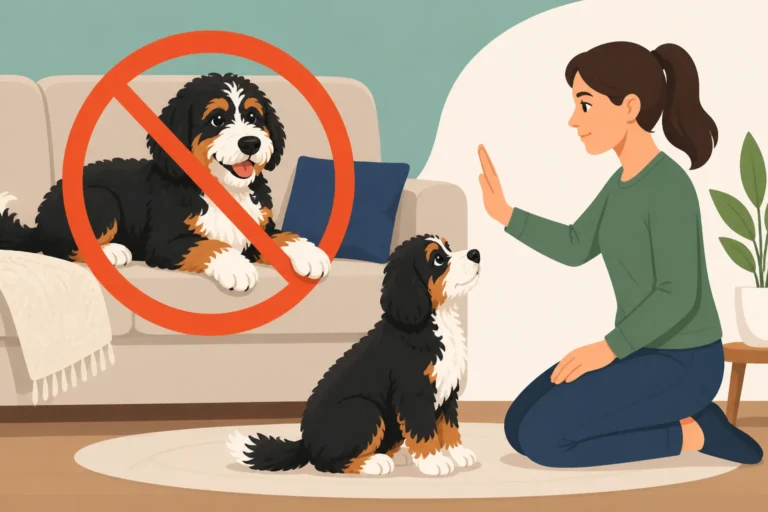
Bernedoodles, especially Standard ones, can be quite large and physically enthusiastic. Jumping up to greet people is a common canine behavior that, while sometimes endearing to adults, can easily injure a small child. A Bernedoodle That Jumps on People is a common frustration. Teaching a solid "four on the floor" rule from puppyhood is essential. When your Bernedoodle jumps, calmly turn your back, ignore them, and only engage when all four paws are on the ground. Reward lavishly when they offer a calm sit or stand. Consistency is key here; everyone in the household, and even guests, needs to adhere to this rule.
Another Bernedoodle trait is their tendency to "lean" on people with their full body weight. Again, while a large, cuddly dog leaning into you can feel nice, that same force can easily knock a toddler off balance. Teaching a "place" command or sending them to a mat can help manage this. When they start to lean, gently redirect them to their designated spot, rewarding them for staying there. Providing plenty of appropriate outlets for physical contact, such as structured cuddle time on the floor or leaning into an adult, can help satisfy their need for closeness without endangering a child.
Crate Training and Safe Spaces for Both
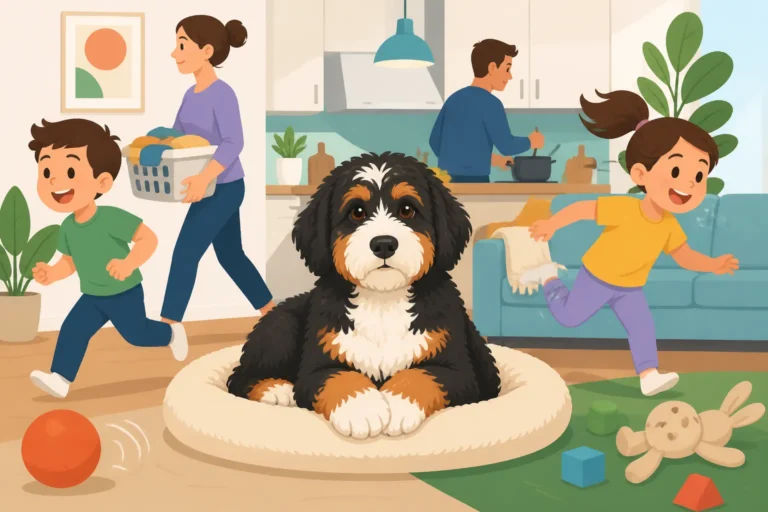
Crate training is not just a tool for potty training; it's a vital safety measure for a multi-species household. A crate, when introduced positively, becomes your Bernedoodle's personal sanctuary, a place where they can retreat and feel safe from the unpredictable movements and noises of a toddler. It gives them a break and prevents overstimulation. This is particularly important when you can't offer 100% focused supervision, like when you're cooking dinner or taking a quick phone call.
Equally important are baby gates. These aren't just for toddlers; they create physical barriers that allow you to separate your Bernedoodle from your child when needed, providing both with much-needed space. A solid baby gate can prevent a curious toddler from wandering into the dog's resting area, or stop an excited Bernedoodle from barging into a child's play zone. Teaching your Bernedoodle to be comfortable behind a gate, receiving treats for calm behavior, reinforces the idea that these barriers are part of a positive routine. Having clear, separate safe spaces is crucial for preventing conflicts and allowing both your dog and your child to feel secure in their environment. Whether a Crate Suits a Ninety Pound Bernedoodle can give you more perspective on sizing and usage.
Supervising Interactions: The Golden Rule
This cannot be stressed enough: never leave a Bernedoodle and a toddler unsupervised, not even for a second. This is the golden rule, the non-negotiable bedrock of safety in a home with both young children and dogs.
Active, Constant Supervision is Non-Negotiable
Toddlers are inherently unpredictable, and even the most patient dog can have its limits tested. A sudden grab of an ear, a poke in the eye, or a stumble onto the dog can elicit a startled reaction that could lead to a bite, even from a dog that has never shown aggression before. Your presence isn't just about watching; it's about actively managing the interaction. This means being close enough to physically intervene if necessary, redirecting both the child and the dog, and constantly reading the room for signs of discomfort from either party.
Think of yourself as a referee, ensuring fair play and immediate timeouts when needed. This level of supervision is exhausting, but it's crucial for the safety and well-being of everyone involved. This might mean keeping your dog on a leash while your toddler is awake and active, or using baby gates to create physical barriers between them for short periods. This diligence needs to continue until your child is old enough to understand and consistently apply rules for interacting with dogs, and your dog has a long, consistent history of appropriate behavior in diverse situations, which often isn't until the child is school-aged.
Educating Toddlers on How to Interact with Dogs
Children are not born knowing how to interact appropriately with dogs; it's a skill that must be taught patiently and consistently. Start early, even before your Bernedoodle puppy arrives. Teach your toddler "gentle hands" – demonstrating soft pats rather than grabbing, hitting, or pulling. Show them how to touch the dog on the back or shoulder, avoiding sensitive areas like the face, ears, and tail.
Crucially, teach them to respect the dog's space. "Leave the dog alone when it's eating, sleeping, or in its bed" is a rule that must be enforced without exception. Teach them to ask permission before approaching the dog and to let the dog come to them, rather than chasing or cornering it. Use simple, consistent language they can understand. Reading books about dog safety with your child can also be a helpful, non-threatening way to introduce these concepts. Repetition and consistent enforcement from all adults in the household are key to embedding these safety rules.
Recognizing and Respecting Your Bernedoodle's Boundaries
Just as toddlers need to learn appropriate behavior, adults need to advocate for their Bernedoodle and respect its boundaries. Your dog has a right to feel safe and comfortable in its own home. If your Bernedoodle is showing signs of stress or avoidance – even subtle ones like turning its head away or looking uncomfortable – it's your job to step in. Don't force interactions. If your dog walks away from a child, that's a good thing; it means they are trying to de-escalate the situation themselves.
Teach children that "no" or "stop" from an adult means they must immediately disengage from the dog. If your Bernedoodle frequently retreats or shows consistent signs of discomfort around your toddler, it's a clear signal that they need more space, more training, or a revised management plan. Sometimes, respecting boundaries means making tough choices, like having longer periods of separation or ensuring your dog has an escape route in every room where the toddler might be. Ignoring a dog's pleas for space is how incidents happen.
Practical Considerations for a Multi-Species Household
Integrating a Bernedoodle into a home with toddlers requires more than just training; it involves thoughtful environmental setup and proactive management to create a harmonious living space.
Setting Up Your Home for Success
Your physical environment plays a huge role in successful integration. Consider strategic placement of baby gates to create child-free zones for your dog, or dog-free zones for your child, depending on the situation. For instance, a gate across the doorway to your Bernedoodle's crate area ensures quiet rest. Or, a gate enclosing your child's playpen can give them safe floor time without accidental dog interactions.
Invest in dog-specific toys and chew items that are appropriate for your Bernedoodle's size and chewing style, keeping them distinctly separate from your toddler's toys. This helps prevent resource guarding and confusion. Consider placing your dog's food and water bowls in an area inaccessible to your toddler, like behind a baby gate in the laundry room or a utility space. Even simple steps like keeping dog treats and food out of reach can prevent a toddler from offering them to the dog inappropriately. Comfortable dog beds in quiet corners of the house provide additional safe havens. For a large dog, Beds That Support a Heavy Old Bernedoodle can also be a consideration for younger dogs to support their joints over time.
Managing Resources and Preventing Guarding
Resource guarding – when a dog protects its food, toys, sleeping spots, or even people – is a natural canine behavior that can become problematic, especially with toddlers. A child innocently reaching for a dog's toy or bowl can trigger an aggressive response. Proactive management is critical.
Never allow your Bernedoodle to eat or chew high-value items (like bones or special chews) around your toddler. Always supervise feeding times, keeping your toddler at a safe distance or in a separate room. Teach your Bernedoodle a reliable "drop it" command, practiced frequently with low-value items, so you can safely retrieve anything they shouldn't have or anything a child might want. Engage in "trade-up" games where you offer a higher-value treat in exchange for a toy the dog has, reinforcing that giving things up leads to good outcomes. This teaches your dog that human hands near their resources mean good things, not threats. Consistency with these practices is vital to prevent guarding issues from developing.
When to Seek Professional Guidance
Sometimes, despite your best efforts, you might encounter challenges that feel beyond your capabilities. This is perfectly normal, and it's a sign of a responsible owner to know when to call in the cavalry. If you observe any concerning behaviors from your Bernedoodle towards your toddler, such as growling, snapping, prolonged stiff body posture, or obsessive guarding, seek professional help immediately. Do not wait for an incident to occur.
Look for a certified professional dog trainer or a veterinary behaviorist who specializes in positive reinforcement and force-free methods. Avoid anyone who suggests harsh corrections, dominance theory, or "alpha" techniques, as these can exacerbate fear and aggression, making the situation worse. A good professional can assess your specific situation, help you understand your Bernedoodle's behavior, and develop a customized training and management plan tailored to your family's needs. They can also provide hands-on guidance for specific issues, offering invaluable peace of mind. Platforms like BAXTER & Bella also often offer one-on-one coaching for more personalized support.
Common Challenges and Proactive Solutions
Even with the best intentions and preparations, living with a Bernedoodle and a toddler can present some unique challenges. Knowing what to look for and how to respond proactively can make all the difference.
Addressing Nipping and Mouthiness
Bernedoodle puppies, like all puppies, explore the world with their mouths. They nip, chew, and mouth everything, including human skin. While this is normal puppy behavior, it's absolutely unacceptable when directed at a toddler. A puppy's sharp teeth can easily break a child's delicate skin, even in play.
The key is consistent redirection and bite inhibition training. When your Bernedoodle puppy mouths or nips, let out a high-pitched "ouch!" or "yip!" and immediately withdraw attention. If they continue, remove yourself from the room for 30-60 seconds (a "reverse timeout"). This teaches them that mouthing humans makes the fun stop. Provide plenty of appropriate chew toys, redirecting their attention to these whenever they try to mouth you or your child. For a persistent puppy, a chew-resistant toy from Amazon or a Kong filled with frozen peanut butter can be a lifesaver. Ensure they have access to suitable outlets for their chewing instincts at all times. When a Bernedoodle Puppy Stops Mouthing provides more guidance on this developmental stage.
Handling Excitement and Overstimulation
Bernedoodles, especially younger ones, can sometimes get over-excited. This might manifest as jumping, zoomies, or playful nips that are too much for a toddler. Toddlers, in turn, can easily overstimulate a dog with their high-pitched voices, sudden movements, and boundless energy.
The best approach is prevention and proactive management. Ensure your Bernedoodle gets adequate physical and mental exercise daily to burn off excess energy. A tired dog is a good dog! When things start to get too chaotic, separate your Bernedoodle and your toddler using a baby gate or by sending your dog to its crate for a calm chew toy. Teach your Bernedoodle to settle on command by rewarding them for lying down calmly. Providing a quiet place for your dog to retreat to, away from the hustle and bustle of family life, is crucial. If your Bernedoodle consistently struggles with self-regulation, consider working with a professional trainer on impulse control exercises.
Dealing with Fear or Shyness Around Children
While many Bernedoodles are naturally friendly, some may inherit a degree of shyness from their Bernese side, or develop fear if they haven't been properly socialized. A Bernedoodle that is fearful or timid around children can be just as dangerous as an overly boisterous one, as fear can lead to defensive aggression. Building Confidence in a Timid Bernedoodle is an important topic to address.
If your Bernedoodle exhibits fear (cowering, backing away, trembling, growling) around children, never force interactions. This will only worsen the fear. Instead, create positive associations from a distance. Have your Bernedoodle observe children from a safe, comfortable distance, rewarding them with high-value treats for calm behavior. Gradually decrease the distance only when your dog remains relaxed. This process should be slow and patient. If the fear is significant or persistent, consult a veterinary behaviorist. They can help you implement a desensitization and counter-conditioning program safely and effectively, and rule out any underlying medical causes for the fear. The goal is to help your Bernedoodle feel safe and secure, rather than forcing them to tolerate something that genuinely frightens them.
| Interaction Type | Recommended Action | Why It's Important |
|---|---|---|
| Feeding Time | Separate dog and child (e.g., dog behind a gate, child in high chair). | Prevents resource guarding and accidental injury. |
| Dog Sleeping | Child must never disturb a sleeping dog. Use crate/bed as a "do not disturb" zone. | Startled dogs can snap; teaches respect for boundaries. |
| Playtime (Dog) | Supervised, structured play with appropriate toys. Child teaches "gentle hands." | Prevents overstimulation, reinforces positive touch, teaches impulse control. |
| Playtime (Child) | Dog should be calm or separated. Use baby gates or a crate if child is active and dog is too excited. | Prevents accidental knocking over, nipping, or unwanted interruptions. |
| Toddler Approaching Dog | Teach child to ask permission, approach slowly, pet gently. Adult supervision always. | Empowers child, prevents startling dog, allows adult intervention. |
| Dog Approaching Toddler | Manage dog's excitement with "sit," "stay" commands. Reward calm greetings. | Prevents jumping, ensures dog is calm before interaction. |
| Dropped Food | Use "leave it" command. Immediately remove dog or food. | Prevents resource guarding, teaches impulse control, avoids dietary upsets. |
| Any Sign of Stress | Immediately separate dog and child calmly. | Prevents escalation, respects dog's communication, protects both. |
Disclaimer
This article is for general informational purposes only and does not constitute professional advice. Laws, prices and regulations vary by location and change over time. Consult a qualified professional for guidance on your specific situation.