What Clearances a Bernedoodle Breeder Should Publish
It's incredibly frustrating when you're trying to do your homework on bringing a Bernedoodle into your family, and every breeder website seems to have a different list of tests they perform, or worse, none at all. How do you even begin to tell if you're looking at a responsible breeder who truly prioritizes the health of their puppies, or someone just breeding for profit? This guide will cut through the confusion, clearly outlining the essential health clearances every reputable Bernedoodle breeder should be publishing, and why these documents are so vital for your future companion.
Why Health Clearances Are Absolutely Non-Negotiable
Thinking about a Bernedoodle, you're likely captivated by their charm, their fluffy coats, and that wonderful blend of the gentle Bernese Mountain Dog and the intelligent Poodle. What many prospective owners don't realize, however, is that this "designer dog" status doesn't automatically grant them immunity from the genetic health issues that plague their parent breeds. In fact, without careful, responsible breeding, you could end up with a puppy predisposed to a host of expensive and heartbreaking conditions.
The whole point of the Bernedoodle cross was often to introduce hybrid vigor and potentially reduce the incidence of certain diseases, particularly the tragically short lifespan and high cancer rates of the Bernese. While a well-bred Bernedoodle can have a better prognosis, simply mixing two dogs doesn't magically erase genetic predispositions. It's a common misconception that crossbreeds are inherently healthier; they are only as healthy as the careful selection of their parentage allows. If a breeder isn't doing the proper health clearances on both parent dogs, they are essentially rolling the dice with your future puppy's health and your wallet. Investing in a puppy whose parents lack these crucial screenings is a gamble with incredibly high stakes, both financially and emotionally.
The Core Clearances Every Reputable Bernedoodle Breeder Should Publish
When you're sifting through breeder websites or talking to them directly, there are specific health clearances you need to look for. These aren't just "nice-to-haves"; they are fundamental tests designed to identify genetic predispositions that could seriously impact your Bernedoodle's quality of life and longevity. A breeder who doesn't openly share these results for both parent dogs is not a breeder you want to work with.
Hip and Elbow Dysplasia Screenings
Both Bernese Mountain Dogs and Standard Poodles are large breeds, and unfortunately, both can be prone to hip and elbow dysplasia. These are painful, debilitating conditions where the hip or elbow joints don't form properly, leading to arthritis, lameness, and significant veterinary intervention. Imagine your beautiful, energetic Bernedoodle struggling to walk, climb stairs, or even play fetch before they're truly old. It's a devastating prospect, and one that can often be mitigated by careful breeding.
Reputable breeders will have both parent dogs evaluated by the Orthopedic Foundation for Animals (OFA) or through PennHIP. For hips, OFA results are graded as Excellent, Good, Fair, Borderline, or Dysplastic. You want to see Excellent, Good, or Fair. For elbows, the grades are Normal, Grade I, Grade II, or Grade III. Only Normal elbows are considered passing. Don't just take their word for it; ask for the official OFA numbers for both parents, which you can then verify on the OFA public database. These clearances are typically done after the dog is two years old, ensuring their joints are fully mature. For more on this, check out Hips on a Ninety Pound Bernedoodle and Elbow Dysplasia in a Growing Bernedoodle.
Eye Examinations
While perhaps not as immediately life-threatening as severe joint disease, eye conditions can greatly reduce a dog's quality of life and incur significant costs. Poodles, in particular, can carry genes for various eye problems, including Progressive Retinal Atrophy (PRA), cataracts, and other retinal disorders. The Bernese Mountain Dog can also contribute to certain inherited eye conditions.
Breeders should have their breeding dogs undergo an annual eye examination by a board-certified veterinary ophthalmologist. These results are submitted to the OFA and listed as Canine Eye Registry Foundation (CAER) clearances. A "Normal" or "Clear" result indicates no evidence of inherited eye disease at the time of examination. Remember, these need to be done yearly because some conditions can develop later in life. This helps ensure your puppy inherits the best possible vision. You can learn more about specific concerns in The Eye Conditions a Bernedoodle Is Tested For.
Cardiac Health Screenings
Heart disease, particularly subvalvular aortic stenosis (SAS) in Bernese Mountain Dogs and various forms of cardiomyopathy in Poodles, can be a serious concern. While not all heart conditions are genetic or preventable, screening breeding stock helps reduce the risk of passing on inherited forms of heart disease.
The OFA offers cardiac evaluations, typically performed by a board-certified veterinary cardiologist. A "Normal" or "Clear" certification means no congenital heart disease was detected. While some heart issues may develop later in life and aren't always detectable by these screenings, ensuring the parents are clear from known congenital issues is a vital step in responsible breeding.
Von Willebrand's Disease (vWD) Testing
This is a critically important one, especially because the Bernese Mountain Dog side of the Bernedoodle is prone to Von Willebrand's Disease (vWD), a common inherited bleeding disorder. Dogs with vWD have a deficiency in a specific protein necessary for proper blood clotting. This can lead to excessive bleeding during surgeries, injuries, or even minor traumas.
Testing for vWD is typically done via a DNA test, which can identify whether a dog is clear, a carrier, or affected. A responsible breeder should ensure that at least one parent is "Clear" of the vWD gene. If both parents are carriers, there's a 25% chance of producing an affected puppy. You absolutely want to see "Clear" results for both parents, or at least one clear and one carrier, never two carriers. This test is crucial for ensuring your Bernedoodle doesn't face life-threatening bleeding episodes. For more detail, read Von Willebrand's Disease in a Bernedoodle.
Degenerative Myelopathy (DM) Testing
Degenerative Myelopathy is another significant concern, particularly from the Bernese Mountain Dog side, but also seen in some Poodle lines. This progressive neurological disease affects the spinal cord, leading to weakness, ataxia (loss of coordination), and eventually paralysis in the hind limbs. It's similar to Lou Gehrig's disease in humans.
Like vWD, DM is identified through a DNA test for the SOD1 gene. Results will show if a dog is Clear (N/N), a Carrier (N/A), or At-Risk (A/A). For a Bernedoodle, it is absolutely paramount that at least one parent is clear (N/N) for DM. If both parents are carriers (N/A), puppies can be At-Risk (A/A). If one parent is At-Risk, the other must be Clear (N/N). A reputable breeder will never breed two carriers or an At-Risk dog with another At-Risk or carrier dog. Understanding this test is crucial for a long, healthy life for your dog, and you can learn more in Degenerative Myelopathy Both Bernedoodle Parents Can Carry and The SOD1 Test Both Bernedoodle Parents Need.
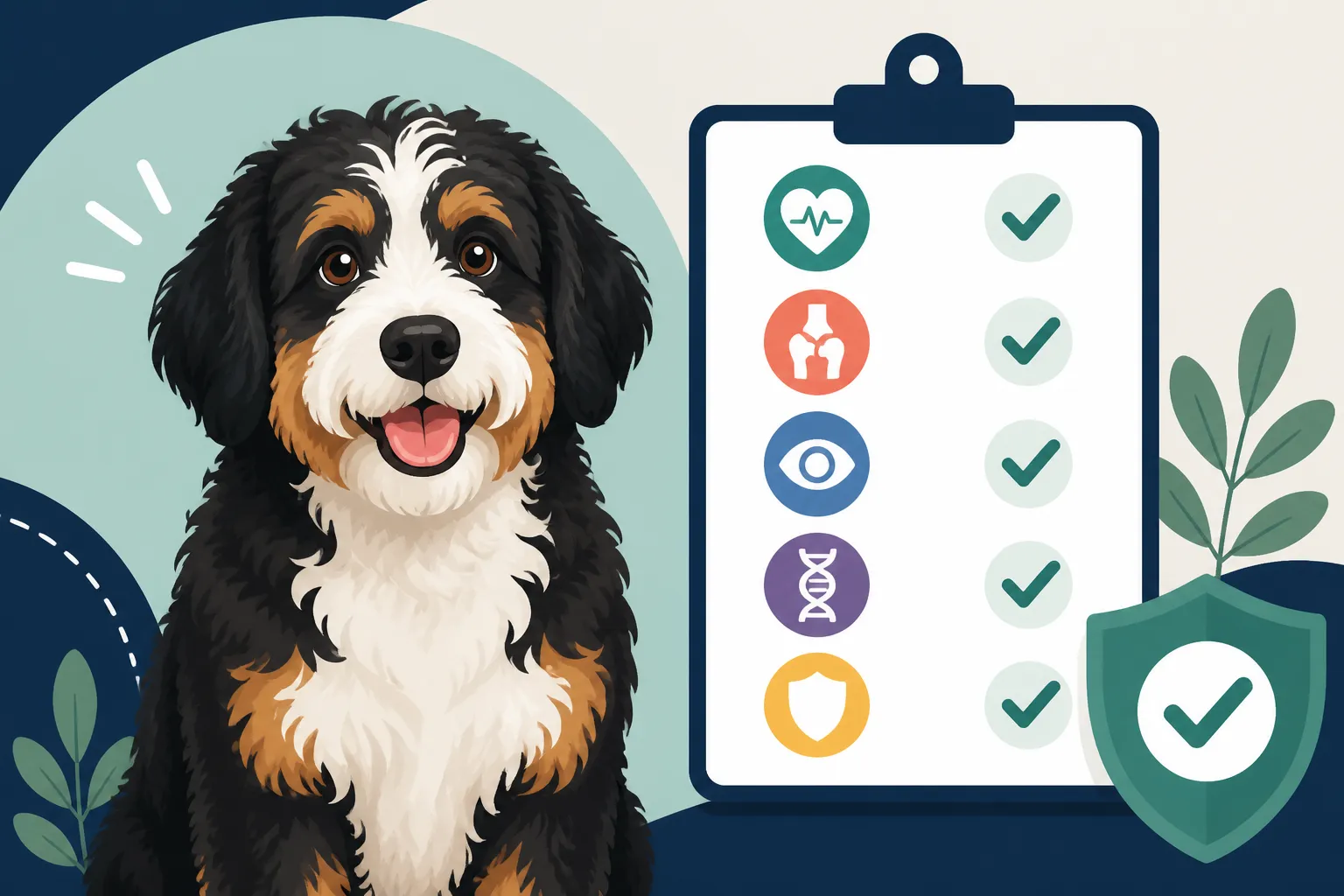
Here’s a quick summary of the key health clearances you should expect to see:
| Health Clearance | What it Tests For | Why it Matters for Bernedoodles | Recommended Result |
|---|---|---|---|
| OFA Hips | Proper formation of hip joints | Prevents painful arthritis and lameness in large breeds | Excellent, Good, or Fair |
| OFA Elbows | Proper formation of elbow joints | Prevents painful arthritis and lameness in large breeds | Normal |
| OFA CAER (Eyes) | Inherited eye diseases (e.g., PRA, cataracts) | Preserves vision and prevents costly treatments | Normal, Clear (annual) |
| OFA Cardiac | Congenital heart conditions | Reduces risk of inherited heart disease | Normal |
| Von Willebrand's Disease | Genetic bleeding disorder | Prevents excessive bleeding from injury or surgery | Clear (at least one parent) |
| Degenerative Myelopathy | Progressive neurological spinal cord disease | Prevents hind limb paralysis and improves quality of life | Clear (at least one parent) |
Beyond the Papers: Red Flags and Green Lights
Simply asking about "health testing" isn't enough. You need to know exactly what tests were performed, what the results were, and how to verify them. This is where a truly responsible breeder shines, and a less scrupulous one reveals their shortcomings.
Verifying Clearances: Don't Just Take Their Word For It
A green light is a breeder who not only tells you about the clearances but provides you with the specific OFA numbers and DNA test results for both parents. The OFA has a public database where you can search by a dog's registered name or OFA number to view their health certifications. If a breeder gives you a dog's registered name, you should be able to look up their hip, elbow, and cardiac clearances there. For DNA tests like vWD and DM, they should provide the actual lab reports from companies like Embark or Paw Print Genetics. This transparency is key.
A major red flag is a breeder who says things like "The vet checked them and they're fine," or "We only breed healthy dogs." While a vet exam is important for general health, it is not a substitute for specific genetic and structural clearances. Another red flag is a breeder who tries to explain away missing clearances or suggests that because Bernedoodles are a mixed breed, these tests aren't as important. That's simply untrue and goes against all principles of responsible breeding.
The Difference Between Genetic Testing and Actual Clearances
It's easy to get confused between a comprehensive "genetic panel" that might test for dozens of conditions and the structural clearances (like hips and elbows). While DNA panels are excellent for identifying genetic carriers for diseases like vWD and DM, they don't tell you anything about the physical structure of a dog's joints or heart. Both types of testing are crucial. A full genetic panel might include tests for Whether a Bernedoodle Inherits PRA From the Poodle or Hypothyroidism From the Bernese Side of a Bernedoodle, but these complement, rather than replace, OFA certifications.
A good breeder will present a holistic picture of their breeding dogs' health, covering both genetic predispositions and physical soundness. They should be able to discuss the specific conditions prevalent in Bernese Mountain Dogs and Poodles and how their breeding program addresses these risks through testing. They understand that while a full panel might test for 100 conditions, perhaps only 10 are highly relevant to the Bernedoodle cross, and they've prioritized those.
What a Health Guarantee Actually Means
Many breeders offer a "health guarantee" in their contract. While this sounds reassuring, it's vital to understand the specifics. A good health guarantee typically covers severe, debilitating genetic conditions for a certain period, often two years. However, the terms can vary wildly. Some might only offer a partial refund, or require you to return the dog, which for many families is unthinkable once they've bonded.
It's important to read the fine print. Does it cover the conditions you're most concerned about, like hip or elbow dysplasia, or specific cancers if they appear early? Does it simply replace the puppy, or does it offer financial assistance for veterinary treatment? A health guarantee from a breeder who also performs and publishes all recommended health clearances is far more valuable than one from a breeder who relies solely on the guarantee without proactive testing. This guarantee acts as a layer of protection, but the clearances are your first line of defense. You might want to explore What a Bernedoodle Health Guarantee Covers for more details on this topic.
What to Do If a Breeder Doesn't Publish Clearances
This is a tough one, because it's easy to fall in love with a cute puppy picture. But if a breeder isn't transparent about their health clearances, or worse, admits they don't do them, my advice is firm: walk away. I know it's hard, especially if you've been waiting for a puppy, but the long-term emotional and financial costs of an unhealthy dog are immense.
The True Cost of Skipping Clearances
Choosing a puppy from parents without clearances might save you a little money upfront, but it's a false economy. The potential veterinary bills for conditions like severe hip dysplasia, advanced degenerative myelopathy, or inherited heart problems can easily run into the thousands, or even tens of thousands, over your dog's lifetime. Think about what What Cancer Treatment Costs a Bernedoodle Owner could be if your dog is predisposed to early-onset cancer from untested lines. You'll be caught between your deep love for your companion and the crushing weight of medical expenses.
Beyond the money, there's the heartbreak. Watching your beloved Bernedoodle suffer from a preventable genetic condition is truly devastating. Choosing a responsible breeder, even if it means waiting longer or paying a bit more, is an investment in a healthier, happier life for your dog and less stress for your family.
Pet Insurance as a Safety Net
Even with the most meticulously bred Bernedoodle, accidents and unexpected illnesses can happen. This is why pet insurance is such a valuable tool for any dog owner, but especially for those with breeds that can have predispositions. Companies like Healthy Paws offer coverage that can help offset the costs of unforeseen veterinary care, from sudden injuries to chronic conditions that develop later in life. It's not a substitute for proper breeding, but it's an excellent backup. Many owners also find value in subscription services like Ollie, which can provide high-quality, fresh dog food tailored to your Bernedoodle's needs, potentially contributing to overall health and well-being. And for those routine supplies, Chewy is a fantastic resource, often carrying specialized diets or supplements recommended by your vet.
Consider Reputable Bernedoodle Rescues
If finding a breeder who meets all these stringent requirements feels overwhelming, or if you're concerned about the upfront cost of a well-bred puppy, consider looking into Bernedoodle rescues. While rescue dogs may not always come with full parentage health clearances, many rescue organizations perform comprehensive veterinary checks on the dogs in their care, addressing any known issues before adoption. They can also often provide insights into a dog's temperament and known medical history, offering a different, but equally rewarding, path to Bernedoodle ownership.
Ultimately, your commitment to finding a breeder who publishes comprehensive health clearances is one of the most loving and responsible decisions you can make for your future Bernedoodle. It sets the foundation for a lifetime of joy, health, and fewer worries.
Disclaimer
This article is for general informational purposes only and does not constitute professional advice. Laws, prices and regulations vary by location and change over time. Consult a qualified professional for guidance on your specific situation.