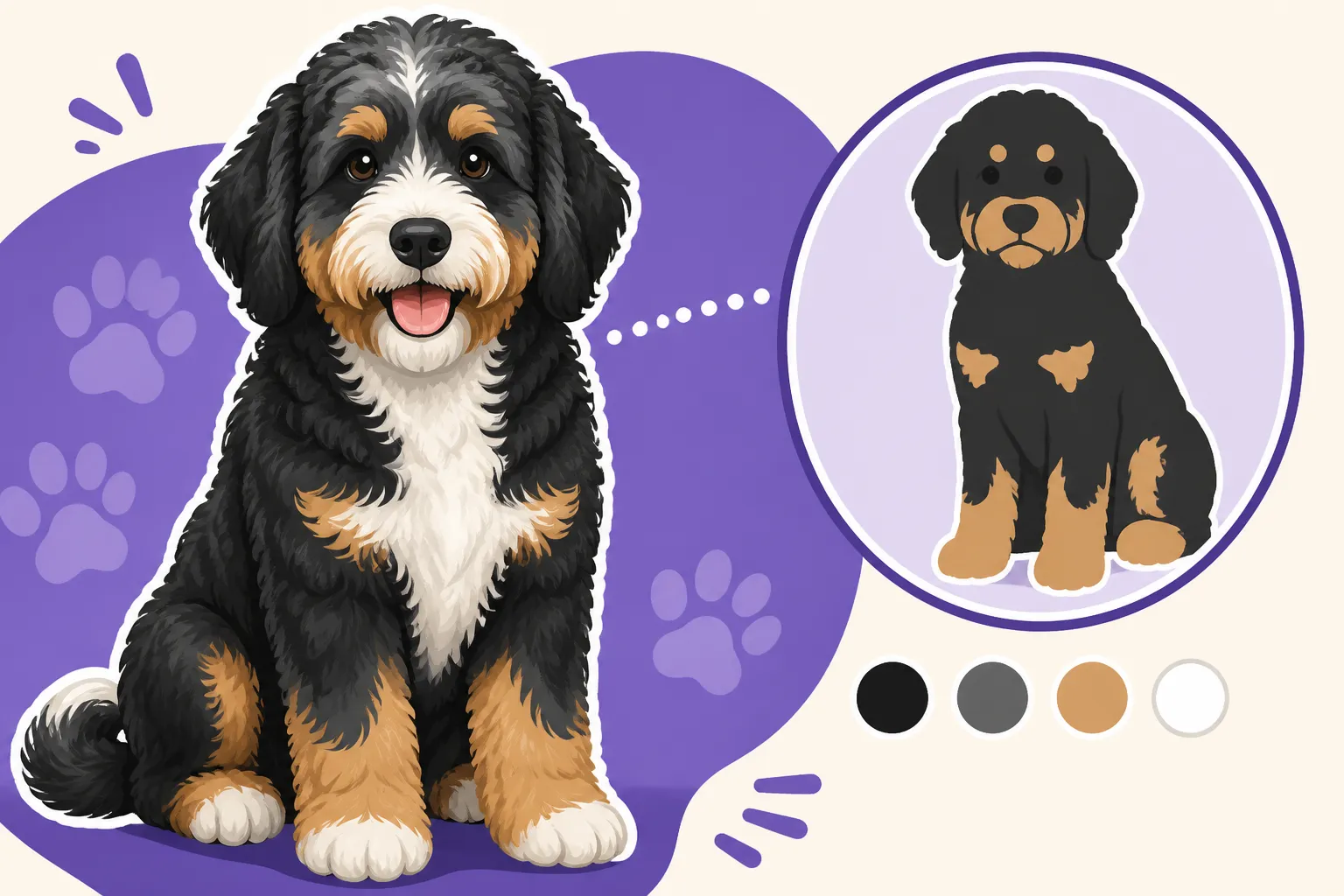
What a Phantom Bernedoodle Looks Like
One of the most exciting, and sometimes confusing, parts of welcoming a Bernedoodle into your family is trying to understand all the incredible variations in their coats. You might spend hours scrolling through pictures, falling in love with a particular look, only to find yourself scratching your head about what makes a certain pattern unique. It's especially common when you hear terms like "phantom" thrown around, and you're left wondering, "What exactly is a phantom Bernedoodle?" This guide is here to demystify the phantom pattern, detailing its distinctive appearance, the genetics behind it, and what you can expect as your puppy grows.
Unmasking the Phantom Bernedoodle: What Exactly Are We Looking At?
When people talk about a phantom Bernedoodle, they're referring to a very specific, striking color pattern that gives the dog the appearance of having "eyebrows" and "socks." It’s truly a head-turner, reminiscent of the traditional markings you might see on a Doberman Pinscher or a Rottweiler, but in the lovable, fluffy package of a Bernedoodle. It’s distinct, elegant, and often sought after by those who appreciate a classic, well-defined pattern on their canine companions.
The Distinctive Markings: A Tale of Two Colors
At its heart, a phantom Bernedoodle is a two-color dog, but not just any two colors. It has a primary, solid base color, and then a secondary, lighter accent color that appears in very specific locations on the body. Think of it as a solid coat with carefully placed highlights that look almost painted on. The contrast between these two colors is what truly makes the phantom pattern pop, giving these dogs a sophisticated and often quite expressive face.
The base color is typically a rich, deep hue like black or chocolate, but you can also find phantom Bernedoodles with silver, blue, or even sable as their primary color. The accent color, known as the "points," is almost always a lighter shade, most commonly tan, cream, or silver. So, you might see a stunning black and tan phantom, a luxurious chocolate and cream phantom, or a rare silver and tan variation. These points aren't just random patches; they follow a predictable pattern, which is part of what makes the phantom so recognizable and beautiful. This isn't like a marbled merle coat, where patches are irregular; phantom markings are quite symmetrical and defined.
Where the Phantom Pattern Appears
The phantom pattern isn't scattered willy-nilly across the dog's body. Oh no, it's very precise! These lighter accent points consistently show up in specific areas, creating that signature phantom look. If you know what to look for, you can spot a phantom Bernedoodle from a mile away.
You'll see those distinctive secondary color patches:
- Above each eye: Giving them those adorable "eyebrows" that make them look incredibly expressive, almost as if they're constantly wondering what you're up to.
- On the sides of the muzzle: Often extending up towards the cheeks, framing their sweet faces.
- On the chest: Usually in two triangles on either side of the forechest.
- On all four legs: Inside the legs, extending down to the paws, like little socks or stockings.
- Under the tail: A flash of the accent color that becomes visible when their tail is raised.
When you put these markings together, they create a cohesive and striking visual. It's almost like the dog is wearing a custom-tailored suit with perfectly placed accents. Unlike a solid black Bernedoodle, which has one uniform color, or a bi-color that might have large blocks of two different colors, the phantom pattern is all about these well-defined "points" against a contrasting background. It’s a genetic artistry that breeders work hard to achieve, making each phantom Bernedoodle a unique masterpiece.
The Genetics Behind the Phantom Magic
Understanding the genetic underpinnings of the phantom pattern might sound a bit like a science lesson, but it’s actually fascinating and helps explain why these beautiful dogs look the way they do. The Bernedoodle inherits its phantom coloring primarily from its Poodle lineage, as the Bernese Mountain Dog typically carries genes for solid colors or tri-color. It’s the clever combination of genes from both parents that gives us such a diverse palette in Bernedoodle coats.
Understanding the K-Locus and A-Locus Genes
The phantom pattern is governed by a specific set of genes, mainly located on what geneticists call the A-locus (Agouti locus) and the K-locus (Dominant Black locus). Without getting bogged down in complex scientific terms, think of it like this: the K-locus determines if a dog is solid colored (dominant black), brindle, or allows the patterns from the A-locus to express. For a phantom pattern to show up, the dog needs to carry two copies of a specific gene on the A-locus called "at," which stands for "tan points." So, you'll often hear breeders talk about an "at/at" dog.
If a dog has at least one dominant black gene (KB) on the K-locus, it will typically be solid black, even if it carries the "at/at" gene for tan points. This dominant black gene essentially "masks" any pattern from the A-locus. However, if a Bernedoodle inherits two recessive non-black genes (ky/ky) on the K-locus, and two tan point genes (at/at) on the A-locus, then — voilà! — you get the beautiful phantom pattern. The Poodle side of the Bernedoodle equation is largely responsible for contributing these specific genes, as phantom is a well-known Poodle coloration. This careful genetic dance results in those perfectly placed accents that define a phantom Bernedoodle, making it distinct from a simple bi-color or solid-colored dog.
Phantom vs. Tri-Color: A Common Mix-Up
This is where a lot of people get confused, and it’s a perfectly understandable mix-up! Phantom and tri-color Bernedoodles can look quite similar at first glance because both feature a base color with tan or rust points. However, there's one key difference that sets them apart: the presence of white markings.
A phantom Bernedoodle has a primary base color (like black or chocolate) and those tan points we just described, but no distinct white markings. Think of it as a two-tone dog. For example, a black and tan phantom will be entirely black with tan points, with no white patches at all.
On the other hand, a traditional tri-color Bernedoodle takes the phantom pattern a step further by adding significant white markings, typically on the chest, muzzle, and paws. So, a true tri-color Bernedoodle will have a black base coat, tan points (like a phantom), and those classic white Bernese Mountain Dog markings. These white patches are usually quite bold and distinct. You can learn more about this in What a Traditional Tri Color Bernedoodle Looks Like. It's the addition of this third color, white, that defines the "tri" in tri-color. So, while both patterns are undeniably beautiful, remembering the absence or presence of white is your best bet for telling them apart.
| Characteristic | Phantom Bernedoodle | Tri-Color Bernedoodle |
|---|---|---|
| Number of Colors | Two distinct colors | Three distinct colors (base, points, white) |
| Base Color | Solid (e.g., black, chocolate, silver, blue) | Solid (most commonly black) |
| Accent Points | Tan, cream, silver, or rust in specific areas | Tan, cream, silver, or rust in specific areas |
| White Markings | NO white markings anywhere | YES, distinct white markings on chest, muzzle, blaze, paws |
| Parent Influence | Primarily from Poodle side (for phantom gene) | Combination of Bernese (for white) and Poodle (for phantom/tan) |
| Overall Look | Elegant, two-tone with contrasting highlights | Classic Bernese look, with bold white and tan accents |
Living with a Phantom Bernedoodle: Appearance and Care Considerations
Choosing a Bernedoodle is about more than just their looks, but the appearance, especially that gorgeous phantom pattern, is definitely a huge draw! It's natural to wonder how these beautiful markings will evolve and what special care, if any, they might require. Good news: a phantom pattern doesn't typically add any extra care complexity beyond what any other Bernedoodle needs.
Does a Phantom Bernedoodle's Color Change?
It’s a common question, and yes, sometimes the phantom pattern can evolve a bit as your Bernedoodle matures. This phenomenon, often called "clearing" or "fading," is largely inherited from the Poodle side of their lineage. Poodles are known for their coats changing color over time; for instance, a black Poodle puppy might "clear" to a blue or silver adult.
With a phantom Bernedoodle, you might see the tan or cream points lighten or even deepen slightly. A dark tan might become a softer cream, or a jet black base could develop a subtle blue or silver hue as they age. This change is usually most noticeable as your puppy sheds its soft, fluffy When a Bernedoodle's Puppy Fluff Becomes an Adult Coat and transitions to its denser adult coat. It's usually a gradual process, not a sudden switch, and doesn't affect the pattern itself, just the exact shade of the colors. So, don't be surprised if your black and tan puppy looks a bit more like a silver and cream phantom by the time they’re two years old! This is a normal part of the Bernedoodle's coat journey. For more on this, check out Whether a Bernedoodle's Color Changes After the Puppy Coat.
Grooming the Beautiful Phantom Coat
The phantom pattern itself doesn't demand any unique grooming techniques, but the Bernedoodle's coat, regardless of color, definitely requires consistent attention. Those beautiful markings mean nothing if the coat underneath is matted and uncomfortable. Bernedoodles, even those with wavy or straight coats, often have a dense double coat that can easily tangle.
Regular brushing, typically several times a week, is essential to prevent matting, especially in high-friction areas like behind the ears, armpits, and under the harness. You'll want to invest in good quality brushes, like a slicker brush and a metal comb, to get through that thick coat right down to the skin. Many Bernedoodle owners find a force dryer invaluable after baths to ensure the coat is completely dry and tangle-free. You can find excellent grooming tools and supplies, from brushes to shampoos, on sites like Chewy. Professional grooming every 6-8 weeks is also a must for most Bernedoodles to keep their coat trimmed, healthy, and looking its best. Your groomer can even highlight those phantom markings with a stylish clip!
Beyond the Look: Temperament and Health
While the phantom pattern is undeniably gorgeous and a huge part of a Bernedoodle's appeal, it's crucial to remember that a dog's coat color is purely aesthetic. It has absolutely no bearing on their wonderful personality or their overall health. You're bringing a family member into your home, and while their beauty will be admired, their temperament and well-being are what truly matter.
Does Color Influence Temperament or Health?
Let's be clear: a phantom Bernedoodle will not have a different temperament or be inherently healthier or unhealthier than a solid black, bi-color, or tri-color Bernedoodle. The charming, goofy, loyal, and intelligent traits that make Bernedoodles so beloved are a result of their Bernese Mountain Dog and Poodle heritage, not their color. You can expect a phantom Bernedoodle to be just as loving and playful as any other Bernedoodle. You might find more information on their general character in What a Bernedoodle Keeps of the Bernese Temperament.
When it comes to health, genetic testing and responsible breeding practices are far more important than coat color. Reputable Bernedoodle breeders will screen their parent dogs for common health issues found in both Bernese Mountain Dogs and Poodles, such as hip and elbow dysplasia, certain eye conditions, and genetic diseases like Von Willebrand's disease and degenerative myelopathy. These health clearances are critical for every Bernedoodle, regardless of their color or pattern. A breeder who focuses solely on "rare" colors without proper health testing should raise a red flag. Always ask about The Five Clearances a Bernedoodle Breeder Should Have. Remember, while some anecdotal stories circulate, there's no scientific evidence to suggest that Whether Color Affects a Bernedoodle's Health. Your phantom Bernedoodle's health and happiness will depend on good genetics, proper nutrition (easily found at places like Chewy), and loving care, not the shade of their eyebrows!
Disclaimer
This article is for general informational purposes only and does not constitute professional advice. Laws, prices and regulations vary by location and change over time. Consult a qualified professional for guidance on your specific situation.