Whether a Bernedoodle Sheds Less Than a Bernese
A Bernedoodle may leave less hair around your home than a Bernese Mountain Dog, but that is not guaranteed. Some inherit a curlier coat that holds onto loose hairs; others have a straighter, shedding coat closer to the Bernese parent. This guide explains what affects shedding, what you can reasonably expect, and how to choose and care for a coat that suits your household.
Do Bernedoodles shed less than Bernese Mountain Dogs
Why the Bernese coat sheds so much
Bernese Mountain Dogs have a long double coat: a topcoat over a dense undercoat. Loose hairs can come away throughout the year, with heavier shedding often noticeable as the dog sheds its undercoat seasonally. In practice, that can mean hair on clothing, furniture, car seats, and the floor—especially when the dog is blowing coat.
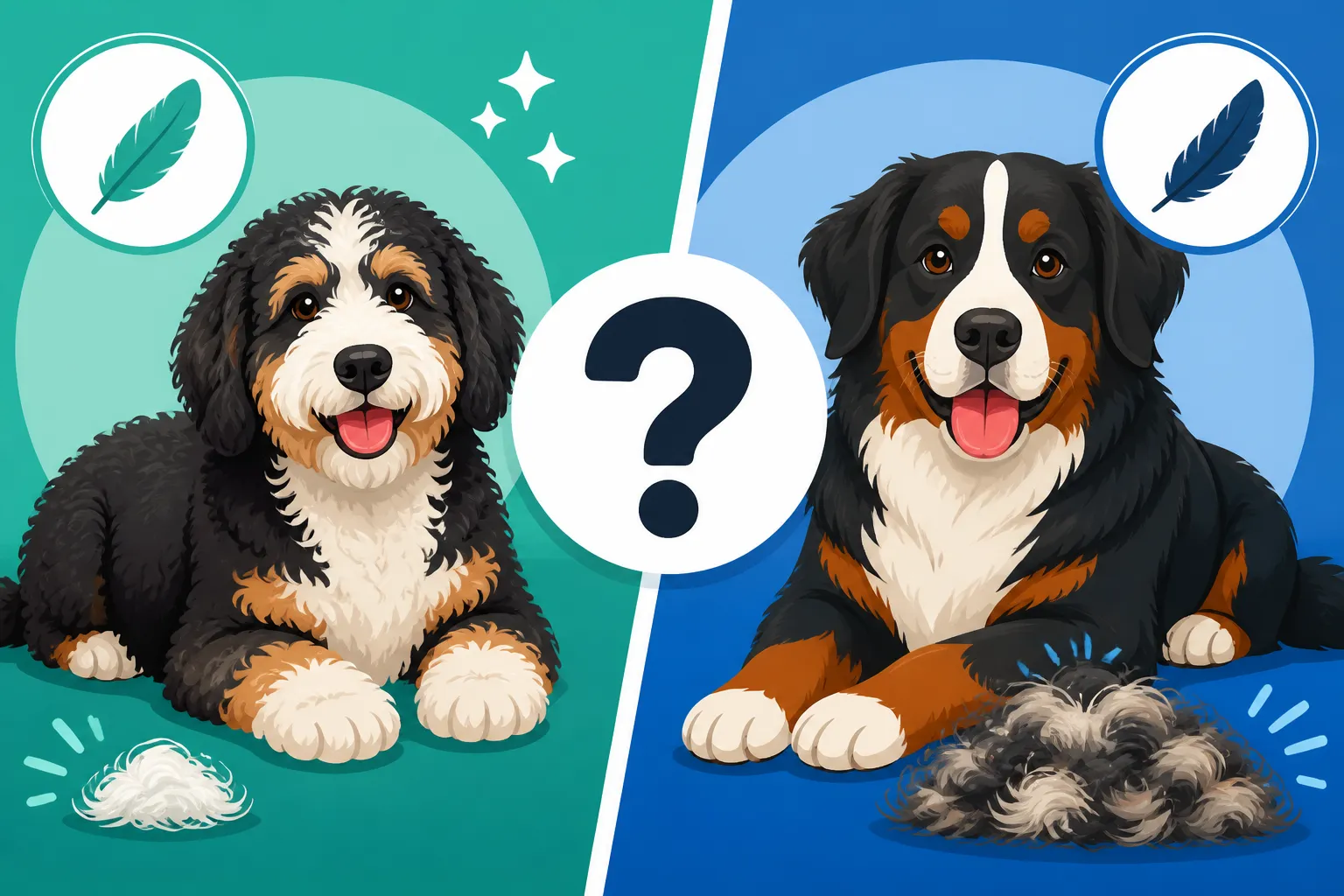
A Bernedoodle inherits traits from both a Bernese Mountain Dog and a Poodle, but the mix does not produce one standard coat. One dog may inherit more of the Bernese coat’s texture and shedding pattern, while a littermate may have a curlier coat that catches loose hairs. So, compared with a Bernese, a particular Bernedoodle may leave less visible hair around the house—but the breed mix alone cannot promise that outcome.
It also helps to distinguish between shedding and loose hair you can see. A curly coat can hold loose hair close to the dog until brushing or bathing removes it. That may look like less shedding around your home, even though loose hairs are still being produced and need regular removal.
What coat types mean for shedding
Coat texture offers clues, not guarantees. Straight-coated Bernedoodles are more likely to release loose hairs where you can see them. Wavy and curly coats may trap more of that hair, but they can also mat if brushing does not reach down to the skin. The practical trade-off is often less visible hair in the house in exchange for more hands-on coat care.
| Bernedoodle coat type | What you may notice around the home | Main care consideration |
|---|---|---|
| Straight | More loose hairs may be visible on floors and fabric | Regular brushing helps remove dead hair |
| Wavy | Shedding can vary; some loose hair may stay caught in the coat | Brush thoroughly, especially in friction areas |
| Curly | Loose hairs may be less noticeable around the home | Frequent, careful brushing helps prevent mats |
These are general patterns, not a promise about an individual dog. Even dogs with similar-looking coats can differ in how much they shed, and coat length, seasonal changes, health, and grooming habits can all affect what you notice. For a closer look at coat variation, see The Straight Coated Bernedoodle That Sheds, The Wavy Coat Most Bernedoodles Carry, and The Curly Coat Bernedoodle and Its Upkeep.
Is “less shedding” the same as non-shedding
No. A Bernedoodle can shed less visibly than a Bernese Mountain Dog without being non-shedding. Loose hair may be caught in the coat, removed during brushing, or collected during grooming instead of scattering around the house. That can make a real difference to daily cleanup, but it does not mean there is no hair or coat maintenance.
This distinction matters if you are hoping to avoid vacuuming altogether. A curly Bernedoodle may still need regular brushing, professional grooming, and cleanup after a brushing session. If a coat is neglected, trapped loose hairs can tangle with the rest of the coat and form mats, which can make grooming more difficult and uncomfortable.
If you are comparing claims from breeders or online listings, be cautious of firm promises that a puppy will never shed. The more useful questions are what coat types the parents have, whether adult offspring have predictable coat patterns, and what grooming the breeder expects owners to maintain. For more on the limits of the label, read Whether Any Bernedoodle Is Truly Non Shedding.
How generation and genetics affect Bernedoodle shedding
Why an F1 Bernedoodle can vary so much
An F1 Bernedoodle is the first-generation cross between a Bernese Mountain Dog and a Poodle. With one parent from each breed, the puppies can inherit a range of coat traits. One puppy may have a straighter coat and shed more visibly, while another may have a curlier coat that holds loose hair.
That variation can surprise families who expect every puppy in a litter to have the same coat. Even siblings can look and behave differently as their adult coats come in. Puppy fluff is not always a reliable preview of the mature coat, so a young dog’s texture can change as it grows.
An F1 puppy may shed less than a Bernese parent, but there is no dependable rule that every F1 will. For a comparison of generations, see Whether an F1 Bernedoodle Sheds More Than an F1b. The key is to treat generation as one piece of information, not a guarantee about the dog you will bring home.
What an F1b or later-generation cross can and cannot tell you
An F1b Bernedoodle is commonly bred by crossing a Bernedoodle back to a Poodle. Because of that, some F1b dogs have curlier coats and may leave less loose hair visibly scattered around the home than a Bernese or a straighter-coated Bernedoodle. But a higher proportion of Poodle ancestry does not make an individual dog’s shedding behavior certain.
Later-generation Bernedoodles can also vary, depending on the dogs used in the breeding and the traits passed down. A label such as “F1b” or “multigenerational” tells you something about the breeding history; it does not replace information about the parents’ coats or the variation seen in related adult dogs.
A breeder can describe what they observe in their own lines, but it is sensible to ask what they can show rather than relying only on a broad claim. Ask whether the parents shed noticeably, how their coats feel and behave, and what grooming their adult offspring need. If you are considering a coat test, Whether a Coat Test Tells You If a Bernedoodle Will Shed can help frame what a test may—and may not—tell you.
Why appearance alone can mislead
A fluffy puppy can look as if it will grow into a low-shedding adult, but softness and curliness at one age do not settle the question. Coat texture may change during development, and even a visibly curly adult coat still needs consistent care. A puppy’s first impression is not a dependable substitute for a discussion about its parents and family history.
The reverse can be misleading too: seeing a few hairs on a puppy blanket does not necessarily tell you how much an adult dog will shed over a full season. Consider the coat over time and ask how loose hair behaves during brushing and grooming. That gives a more practical picture than judging from a single photograph.
What to consider if shedding matters in your home
Think about allergies separately from cleanup
People often ask whether a Bernedoodle sheds less because someone in the household has allergies. Less visible hair may reduce some of the daily mess, but it does not guarantee fewer allergy symptoms. Allergic reactions can involve proteins found in a dog’s dander and saliva as well as its hair, and individual reactions vary.
If allergies are a concern, spend time around adult dogs with coats similar to the one you are considering, if possible. A short visit cannot guarantee how someone will react after living with a dog, but it may provide more relevant information than choosing based on a breed label. It is also wise to discuss persistent symptoms with a qualified health professional rather than assuming a particular coat will solve them.
A low-shedding claim should not be treated as an allergy guarantee. For more context, read Whether a Bernedoodle Is Hypoallergenic and Whether the Bernese Half Ruins the Allergy Claim. Families who are mainly frustrated by hair on furniture may have a different priority from families trying to manage allergy symptoms.
Match the coat to the care you can maintain
If your main concern is hair on the sofa, a curlier coat may be appealing. But be honest about the routine that comes with it. You may need to brush systematically, check friction-prone areas, and keep up with professional grooming. If you would rather do less coat maintenance, a straighter coat may feel simpler day to day, though you may see more loose hair around the home.
A grooming setup does not need to be complicated, but it should be consistent. A suitable slicker brush and comb are common starting points; the right tools depend on the coat’s length and texture. Pet supply retailers such as Chewy carry a range of grooming tools, but the important part is learning how to brush all the way through the coat rather than only smoothing the surface.
Pay particular attention to areas where hair rubs or gathers: behind the ears, under the collar or harness, in the armpits, and around the legs. Check a small section down to the skin with a comb. If the comb catches, a mat may be forming even when the top of the coat looks fluffy and tidy. Chewy’s grooming supplies can help you assemble basic tools, but a groomer can show you which brush and technique suit your dog. For a coat that mats easily, Chewy may also be one place to look for a comb or detangling product, while your groomer can advise whether a particular product is appropriate.
Ask useful questions before choosing a puppy
Rather than asking only, “Will this puppy shed?”, ask questions that invite specific answers:
- What coat types do the puppy’s parents have, and how much do they shed?
- How does the breeder describe the coats of adult dogs from related litters?
- How often do adult dogs in the line need brushing and professional grooming?
- What changes have owners noticed as puppies’ coats matured?
- Can the breeder explain what they mean by “low shedding” in practical terms?
Look for clear, realistic answers. A responsible breeder should be able to explain that coats vary and that even a lower-shedding dog needs grooming. Be wary of absolute promises that a Bernedoodle will not shed or will be suitable for every allergy sufferer.
It can also help to meet adult Bernedoodles, not only puppies. Notice whether loose hair is visible on clothing after contact, ask owners about their cleaning routine, and learn how much time they spend brushing. One dog cannot predict another perfectly, but firsthand experience gives you a more grounded sense of the coat and its upkeep.
A realistic expectation for hair and grooming
Decide which inconvenience you would rather manage
A Bernedoodle may shed less visibly than a Bernese Mountain Dog, particularly if it inherits a curlier coat that catches loose hairs. But there is no single answer for every dog. A straighter-coated Bernedoodle can leave noticeable hair, while a curlier one may require more brushing and grooming to keep trapped hair from becoming a mat.
Before choosing, picture the everyday reality you can live with. Would you rather vacuum more often, or spend regular time brushing and arranging grooming appointments? Neither choice is automatically easier. A family that is comfortable with brushing may prefer the reduced loose hair of a curlier coat, while someone who dislikes coat maintenance may find that trade-off frustrating.
The clearest answer is this: many Bernedoodles may shed less visibly than Bernese Mountain Dogs, but the amount varies by dog, and lower visible shedding usually comes with ongoing coat care. If you need a predictable, completely hair-free home, a Bernedoodle is not a reliable guarantee. Choose with the dog’s likely grooming needs—not just the promise of less hair—in mind.
Keep the household routine manageable
Set up a simple routine early: brush in short, calm sessions, check the coat for tangles, and note how much loose hair collects in the brush. If your puppy is new to grooming, introduce handling gradually so brushing does not become a struggle. Chewy can be a convenient place to find basic brushes and combs, but your breeder or groomer can help you choose tools that fit the dog’s coat.
You can also reduce the feeling that shedding is taking over the house by keeping a washable blanket on a favorite resting spot, cleaning fabric surfaces regularly, and checking the car after trips. Those steps do not change how much the dog sheds, but they can make the hair easier to manage. Above all, expect some combination of loose hair and coat maintenance rather than a no-shed outcome.
Disclaimer
This article is for general informational purposes only and does not constitute professional advice. Laws, prices and regulations vary by location and change over time. Consult a qualified professional for guidance on your specific situation.