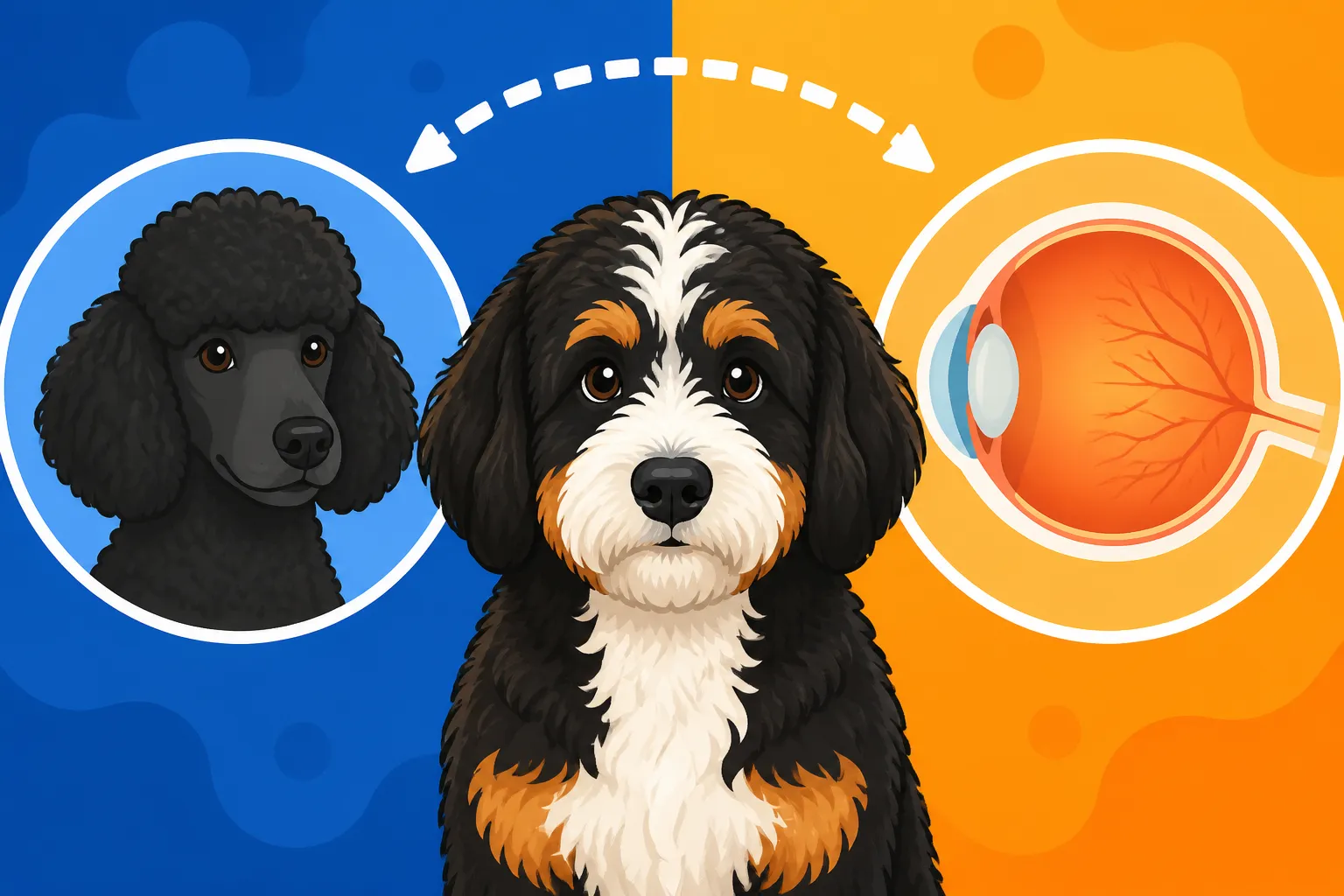
Whether a Bernedoodle Inherits PRA From the Poodle
It’s a scary moment for any Bernedoodle owner when you start noticing changes in your beloved dog's vision or hear whispers about genetic eye conditions. You pour so much love and care into these fluffy family members, and the thought of them losing their sight can be truly heartbreaking. This guide aims to demystify Progressive Retinal Atrophy (PRA) in Bernedoodles, focusing on how this condition, primarily linked to their Poodle heritage, can impact their health and what you can do to understand and mitigate the risks.
Understanding Progressive Retinal Atrophy (PRA) in Dogs
Progressive Retinal Atrophy, often simply called PRA, is a blanket term for a group of genetic diseases that cause the degeneration of the retina in dogs. It's not one single disease but several, all leading to gradual vision loss and, eventually, blindness. For Bernedoodle owners, understanding PRA starts with looking at both parent breeds, particularly the Poodle side, which is known for carrying certain forms of this condition.
What is PRA and How Does It Affect Vision?
Imagine the back of your dog's eye, the retina, as the film in an old camera. This delicate layer of tissue contains photoreceptor cells—rods and cones—that detect light and send signals to the brain, allowing your dog to see. With PRA, these cells begin to deteriorate. In most cases, the rods, which are responsible for vision in low light, are affected first. This means one of the earliest signs you might notice is your Bernedoodle struggling to see in dimly lit rooms or becoming hesitant on evening walks, especially as it gets dark outside. This is often called "night blindness."
As the disease progresses, the cone cells, which handle bright light and color vision, also begin to fail. This leads to a more generalized loss of vision, eventually culminating in total blindness. The progression isn't usually painful, but it's undoubtedly disorienting and stressful for your dog. They might start bumping into furniture, especially if it's been moved, or become more hesitant to jump on and off familiar surfaces. It’s a slow, insidious process that can take months or even years, depending on the specific form of PRA. Owners often remark on their dog's eyes appearing more reflective or "shiny" in photos due to the retinal thinning, or their pupils becoming noticeably dilated, trying to let in more light to compensate for the diminishing vision.
The Genetic Basis of PRA in Poodles
The Poodle, one of the two foundational breeds for the Bernedoodle, is known to carry several genetic mutations that can lead to PRA. The most common form seen in Poodles, and therefore a concern for Bernedoodles, is progressive rod-cone degeneration (prcd-PRA). This particular form of PRA is inherited in an autosomal recessive manner. What does "autosomal recessive" mean for you and your Bernedoodle? It means a dog must inherit two copies of the defective gene—one from each parent—to be affected by the disease and eventually go blind.
If a dog inherits only one copy of the defective gene, it's considered a carrier. A carrier dog will not develop PRA themselves, but they can pass the gene on to their offspring. This is incredibly important because a Bernedoodle puppy, having one Poodle parent, is directly at risk if that Poodle parent is either a carrier or, worse, affected by prcd-PRA. Reputable Bernedoodle breeders go to great lengths to test their breeding Poodles for this specific gene mutation to prevent passing it on. Without proper testing, it's a genetic lottery, and unfortunately, many well-meaning but uneducated breeders might unknowingly pair a carrier Poodle with a Bernese Mountain Dog, creating a whole litter of potential carriers or affected puppies.
Different Forms of PRA and Their Onset
While prcd-PRA is the most prevalent form associated with Poodles, it's worth noting that PRA isn't a monolith. There are other types, like rcd4-PRA (rod-cone degeneration 4), which is also found in some Poodle lines, although less commonly than prcd-PRA. The distinction between these forms often comes down to the specific gene mutation involved and the typical age of onset.
With prcd-PRA, symptoms usually begin to appear in young to middle-aged dogs, typically between 3 and 5 years old, though it can vary. The progression is slow and steady. Owners might first notice subtle changes around 3 years, like the night blindness, which gradually worsens. For rcd4-PRA, the onset can sometimes be later, but the outcome is the same: eventual blindness.
Understanding that these are progressive conditions is key. A Bernedoodle puppy won't be born blind from PRA. Instead, their vision will gradually worsen over time as the photoreceptor cells slowly degrade. This slow onset can sometimes make it difficult to diagnose in the very early stages without specific veterinary ophthalmological examinations and, crucially, genetic testing. It highlights why asking a breeder about The Eye Conditions a Bernedoodle Is Tested For is so critical, and why comprehensive genetic screening for both parent breeds is the best defense.
PRA Inheritance in Bernedoodles: What You Need to Know
For future or current Bernedoodle owners, the question of PRA inheritance directly from the Poodle parent is a serious and valid concern. It’s not just about what a purebred Poodle might carry, but how that genetic risk translates into the mixed breed.
The Role of Poodle Genetics in Bernedoodle PRA Risk
Since PRA, particularly prcd-PRA, is an autosomal recessive condition, the Poodle parent's genetic status is paramount for a Bernedoodle puppy. Let's break down the possibilities:
- Poodle Parent is "Clear" (N/N): If the Poodle parent has two normal copies of the gene, they cannot pass on the PRA mutation. Any Bernedoodle puppy from this Poodle will be clear, regardless of the Bernese parent's status. This is the ideal scenario.
- Poodle Parent is a "Carrier" (N/P): If the Poodle parent has one normal copy and one defective copy of the gene, they won't develop PRA themselves. However, each puppy they produce has a 50% chance of inheriting the defective gene and becoming a carrier. If this carrier Poodle is bred to a Bernese Mountain Dog that also happens to be a carrier (which is less common but not impossible for some forms of PRA, or if the Bernese carries another form of PRA not typically tested for in Poodles), then there's a 25% chance of an affected puppy. Most importantly, if this carrier Poodle is bred to a Bernese who is also affected (highly unlikely for prcd-PRA, but possible for other genetic eye diseases), the risk to puppies skyrockets.
- Poodle Parent is "Affected" (P/P): If the Poodle parent has two defective copies of the gene, they will develop PRA and eventually go blind. If this Poodle is bred to any Bernese Mountain Dog, every single Bernedoodle puppy they produce will inherit at least one copy of the defective gene, making them all carriers (at minimum) or potentially affected, depending on the Bernese parent's status. Breeding an affected dog is considered highly irresponsible.
This is why DNA testing of the Poodle parent is not just good practice; it’s essential for ethical Bernedoodle breeding. A responsible breeder will be able to show you documentation that their Poodle breeding stock is clear of known PRA mutations. This dramatically reduces the risk for your future furry friend.
Understanding Carrier, Affected, and Clear Status
When you look at genetic test results for PRA, you'll typically see these three categories:
- Clear (N/N): This means the dog has two normal copies of the gene. They will not develop this specific form of PRA, nor will they pass the defective gene on to their offspring. This is what you want to see for both parents of your Bernedoodle.
- Carrier (N/P): This dog has one normal copy and one defective copy of the gene. They will not develop PRA themselves. However, if they are bred, they can pass that single defective gene to 50% of their offspring, making those puppies carriers. Breeding two carriers together is how affected puppies are born.
- Affected (P/P): This dog has two copies of the defective gene and will develop PRA, leading to blindness. They will pass one defective copy of the gene to 100% of their offspring, making all their puppies at least carriers.
It's a simple Punnett square scenario, but the implications are huge. Imagine a situation where a breeder uses a carrier Poodle and an untested Bernese. If the Bernese also happens to be a carrier (for instance, if the Bernese carries Degenerative Myelopathy Both Bernedoodle Parents Can Carry, which is a different genetic issue but illustrates the point of carrier status), then a quarter of the litter could be affected. This is why screening is so fundamental to responsible breeding and ensuring a healthy start for your puppy.
Why Responsible Breeding Practices Are Crucial
The cornerstone of preventing PRA in Bernedoodles lies entirely with responsible breeding. A breeder committed to the health of their puppies will perform genetic testing on all their breeding stock, particularly the Poodles, for known PRA mutations like prcd-PRA. They won't just tell you they test; they will be eager to show you the official certificates from reputable genetic testing labs, like Embark Veterinary or Canine Health Check.
When looking for a Bernedoodle puppy, always ask to see the health clearances for both parents. This includes not only PRA testing for the Poodle but also clearances for other common Bernedoodle health concerns such as hip and elbow dysplasia, heart health, and Von Willebrand's disease. A breeder who cannot or will not provide these documents is a red flag. They might be cutting corners, and that means you, as the future owner, are taking on a significant risk. Remember, the initial cost of a puppy from a thoroughly tested breeder might seem higher, but it pales in comparison to the emotional and financial cost of caring for a dog with a preventable genetic disease later in life. Insurance providers like Healthy Paws are fantastic for unexpected illnesses or accidents, but many genetic conditions that could have been screened for in breeding dogs might have limitations on coverage if not diagnosed at a certain age or if part of a pre-existing condition.
Genetic Testing and Prevention for Bernedoodle Owners
Genetic testing has revolutionized how we can predict and prevent hereditary diseases in dogs. For Bernedoodle owners, it offers a powerful tool to ensure the long-term health of their furry companions.
How DNA Testing Identifies PRA Risk
DNA testing for PRA is incredibly straightforward and non-invasive. Typically, a veterinarian or breeder will collect a cheek swab from the dog. This sample, containing the dog's DNA, is then sent to a specialized laboratory. The lab analyzes the DNA for the specific gene mutations known to cause various forms of PRA.
The results will clearly indicate whether the dog is "Clear," "Carrier," or "Affected" for the tested PRA variant. This information is invaluable for breeders, as it allows them to make informed decisions about mating pairs to avoid producing affected puppies. For potential puppy buyers, it provides peace of mind when choosing a puppy from parents documented as "Clear." Even if a puppy's parents are both carriers, a DNA test on the puppy itself can determine its individual status. This is one of the essential screenings a Bernedoodle should have yearly, especially if considering a puppy from parents with unknown histories.
Choosing a Reputable Bernedoodle Breeder
The single most impactful decision you can make regarding your Bernedoodle's health, including its risk of PRA, is choosing the right breeder. A reputable breeder prioritizes the health and well-being of their dogs above all else. Here’s what to look for:
- Transparency and Documentation: They should freely provide proof of health clearances for both parent dogs, including DNA tests for PRA (specifically prcd-PRA and potentially rcd4-PRA for the Poodle parent), hip and elbow evaluations (like OFA or PennHIP), and cardiac and eye certifications. Don't accept vague assurances; ask for the official paperwork. These documents are part of The Five Clearances a Bernedoodle Breeder Should Have.
- Understanding Genetics: A good breeder understands the genetics behind their dogs and can explain inheritance patterns clearly, especially regarding recessive genes like those for PRA. They should be able to articulate why they've chosen specific pairings.
- No "Designer" Claims Without Substance: Be wary of breeders who focus solely on "rare" colors or "hypoallergenic" claims without emphasizing health testing. While Bernedoodles are known for their lovely coats, health should always be the top priority.
- Health Guarantee: A responsible breeder will offer a health guarantee for their puppies, typically covering genetic conditions. Understand the terms of this guarantee, which should be clearly outlined in your puppy contract. This is a critical part of What a Bernedoodle Health Guarantee Covers.
- Limited Litters and Proper Care: They won't have multiple litters available all the time. Their breeding dogs will live in their home, not in kennels, and receive excellent care, nutrition, and veterinary attention. They will be happy for you to visit their facility (if local) or connect via video call to see the living conditions of their dogs.
- References and Support: They should provide references from previous puppy buyers and be a resource for you throughout your dog's life.
Ultimately, choosing an untested Bernedoodle litter is like rolling the dice with your dog's future health. It’s a gamble that often leads to heartache and significant veterinary bills later on, some of which pet insurance like Healthy Paws might not cover if linked to preventable genetic conditions.
Living with a Bernedoodle Affected by PRA
If, despite all precautions, your Bernedoodle is diagnosed with PRA, it’s certainly devastating news. However, it's important to remember that PRA is not painful, and dogs are remarkably adaptable. Your Bernedoodle can still live a full, happy life with some adjustments and extra love.
- Maintain Consistency: Dogs with vision loss thrive on routine and familiarity. Try not to rearrange furniture frequently. Keep food and water bowls in the same spot.
- Auditory Cues: Rely more on verbal cues and sounds. Use toys that make noise. Talk to your dog as you approach to avoid startling them.
- Safety First: Block off stairs or dangerous areas with gates. Always keep your dog on a leash when outside, even in a fenced yard, as their depth perception will be compromised. Consider adding textured mats at the top and bottom of stairs to alert them.
- Scent Markers: Some owners use essential oils (safely diluted and applied to objects, not directly on the dog) or different textured rugs to mark important locations like doorways or water bowls.
- Enrichment: Engage their other senses! Scent games, puzzle toys that dispense treats, and plenty of cuddle time can keep them mentally stimulated and happy. Continue walks in familiar, safe areas.
- Veterinary Support: Regular check-ups with your vet and potentially a veterinary ophthalmologist can help monitor the progression and address any secondary issues, though there is currently no cure for PRA. Your vet can advise on ways to keep them comfortable and suggest helpful resources.
- Patience and Empathy: This transition is challenging for both of you. Your Bernedoodle will rely on you more than ever. Your patience, understanding, and unwavering love will be their guiding light.
Beyond PRA: Other Eye Conditions to Watch For in Bernedoodles
While PRA is a significant concern due to the Poodle parentage, Bernedoodles can inherit other eye conditions from either the Bernese Mountain Dog or Poodle side. Being aware of these can help you stay vigilant and provide the best care.
Common Eye Issues in Bernese Mountain Dogs and Poodles
Both Bernese Mountain Dogs and Poodles can bring their own set of potential eye problems to the Bernedoodle mix:
- Cataracts: This condition involves the clouding of the lens of the eye, leading to blurred vision and, if severe, blindness. While cataracts can occur in older dogs of any breed (age-related cataracts), hereditary cataracts can appear at a younger age. Both Poodles and Bernese Mountain Dogs can be prone to various forms of hereditary cataracts. If you notice a cloudy appearance in your Bernedoodle's eyes, especially as they get older, it's worth getting checked out, as discussed in Cataracts in an Older Bernedoodle.
- Entropion: This is a condition where the eyelid rolls inward, causing the eyelashes or hair to rub against the cornea. It can be painful, irritating, and lead to corneal ulcers or infections. Both Poodles and Bernese Mountain Dogs can be affected by entropion. Symptoms include excessive tearing, squinting, and discharge. Early intervention, often through surgery, is usually required for Entropion in a Bernedoodle's Eyelids.
- Progressive Retinal Atrophy (other forms): As mentioned, Poodles are known for prcd-PRA and rcd4-PRA. However, other forms of PRA, with different genetic mutations and onset patterns, exist across many breeds. While testing often focuses on the most common forms for each parent breed, a comprehensive eye exam can sometimes detect early signs even before genetic tests.
- Distichiasis/Ectopic Cilia: These involve extra eyelashes growing from an abnormal spot, often rubbing against the eye and causing irritation. These can be found in various breeds, including Poodles.
It's clear that while Bernedoodles are wonderful companions, they are not immune to genetic predispositions from their parent breeds. Being informed helps you advocate for your dog's health.
Regular Veterinary Eye Exams (CAER Exams)
Beyond genetic testing for specific conditions like PRA, regular veterinary eye examinations are crucial for all Bernedoodles, especially as they age. A certified veterinary ophthalmologist can perform what's known as a CAER (Companion Animal Eye Registry) exam, formerly known as an OFA Eye Exam.
During a CAER exam, the ophthalmologist will thoroughly examine all parts of your Bernedoodle’s eye, including the eyelids, conjunctiva, cornea, lens, retina, and optic nerve, often using specialized equipment and dilating drops. They are looking for any signs of inherited eye diseases, whether or not a genetic test is available for that specific condition. These exams can detect early signs of cataracts, glaucoma, retinal detachment, or other issues that might not be covered by standard genetic panels.
It is generally recommended that breeding dogs undergo CAER exams annually to ensure they are free from observable eye diseases before breeding. For pet Bernedoodles, yearly eye checks are an excellent idea, particularly as they enter their senior years, when age-related conditions become more prevalent. This is especially true for conditions like Whether a Bernedoodle Needs a CAER Exam Each Year. Early detection of many eye problems can lead to more effective management and a better quality of life for your Bernedoodle. Even with pet insurance like Healthy Paws, routine exams are key to establishing baselines and catching potential issues early, which can sometimes impact coverage terms if a condition becomes chronic.
PRA Genetic Status Overview
To help you visualize the genetic possibilities with PRA, here’s a simple table:
| Poodle Parent Genetic Status | Bernese Parent Genetic Status (for PRA) | Bernedoodle Puppy Outcomes (Probability) | Implications for Puppy |
|---|---|---|---|
| Clear (N/N) | Clear (N/N) | 100% Clear (N/N) | No PRA, no carrier |
| Clear (N/N) | Carrier (N/P) | 100% Clear (N/N) | No PRA, no carrier |
| Clear (N/N) | Affected (P/P) | 100% Carrier (N/P) | No PRA, but can pass on if bred |
| Carrier (N/P) | Clear (N/N) | 50% Clear (N/N), 50% Carrier (N/P) | 50% chance no PRA, 50% chance carrier |
| Carrier (N/P) | Carrier (N/P) | 25% Affected (P/P), 50% Carrier (N/P), 25% Clear (N/N) | High risk of PRA, 50% chance carrier |
| Carrier (N/P) | Affected (P/P) | 50% Affected (P/P), 50% Carrier (N/P) | Very high risk of PRA |
| Affected (P/P) | Clear (N/N) | 100% Carrier (N/P) | No PRA, but can pass on if bred |
| Affected (P/P) | Carrier (N/P) | 50% Affected (P/P), 50% Carrier (N/P) | Very high risk of PRA |
| Affected (P/P) | Affected (P/P) | 100% Affected (P/P) | Guaranteed PRA |
Note: For simplicity, this table assumes PRA is caused by a single, identical gene mutation carried by both breeds. In reality, specific forms of PRA (e.g., prcd-PRA) are more commonly associated with the Poodle, while the Bernese Mountain Dog is typically clear for these specific Poodle-linked PRA genes. Therefore, the rows involving an "Affected" Bernese or a Bernese "Carrier" for Poodle-specific PRA are highly unlikely in practice for a responsibly bred Bernedoodle, emphasizing the Poodle parent's critical role.
Disclaimer
The information provided in this article is for general educational purposes only and should not be considered a substitute for professional veterinary advice. Always consult with a qualified veterinarian or veterinary ophthalmologist for any health concerns or before making any decisions about your pet's medical care or breeding practices. Individual circumstances may vary, and only a licensed professional can provide accurate diagnoses and treatment plans.