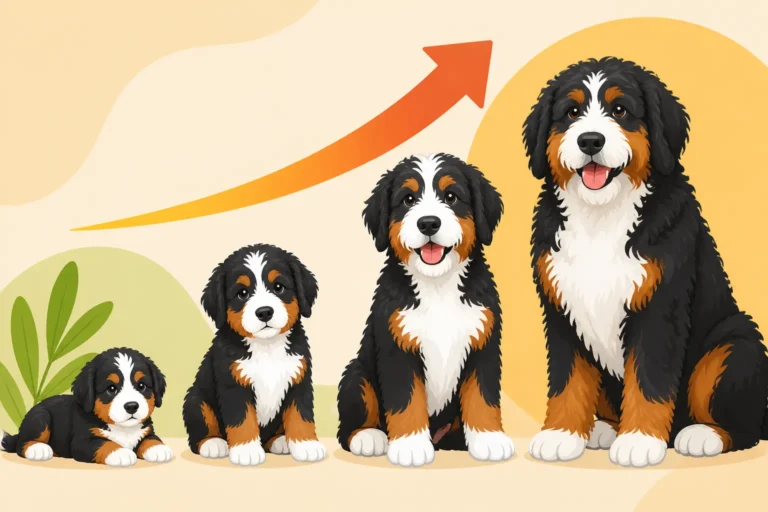
Whether a Bernedoodle Ends Up Bigger Than Promised
It’s a common scenario, isn't it? You fall in love with a fluffy Bernedoodle puppy, dreaming of a certain size, only to watch them sprout far beyond what you or even the breeder might have initially estimated. This can be a real headache, especially if you planned for a smaller dog or live in a cozy space. This guide is here to shed light on why your Bernedoodle might end up bigger than you expected and what you can do to manage those delightful, oversized bundles of joy.
The Tricky Science of Bernedoodle Size Prediction
Let's be honest, predicting the exact adult size of any mixed-breed dog, especially one as diverse in its genetic makeup as a Bernedoodle, is more art than science. It's not like purebreds where generations of consistent breeding have narrowed down size ranges to a predictable few pounds. With Bernedoodles, you're mixing the substantial Bernese Mountain Dog with the highly variable Poodle, and that cocktail can lead to some surprises.
The Genetic Wild Card: Poodle Meets Bernese
Think about the parent breeds for a moment. A Bernese Mountain Dog is a large, sturdy dog, typically weighing between 70 to 115 pounds. Then you have the Poodle, which comes in three distinct sizes: Toy (4-6 pounds), Miniature (10-15 pounds), and Standard (40-70 pounds). When you cross these, you're not just getting an average. You're opening up a genetic lottery. Even if a breeder uses a Standard Poodle, there can be "throwback" genes or a wider range of expression than expected. The Bernese side can also bring in larger-than-average genes. It's this beautiful, unpredictable blend that makes Bernedoodles so unique, but also so varied in size. You might anticipate a happy medium, but genetics don't always read the textbook.
Hybrid Vigor and Growth Spurts
The term "hybrid vigor" often refers to improved health and vitality in crossbred animals, but it can also manifest in growth. Sometimes, mixing two distinct gene pools can result in offspring that are larger or grow faster than either parent might individually predict. This isn't always the case, but it's another layer of complexity. You might have a puppy that seems perfectly in line with size expectations for the first few months, then suddenly hits a growth spurt that takes your breath away – and leaves you wondering where your "mini" Bernedoodle went. These growth spurts can be quite dramatic, leading to a much larger dog than originally envisioned. The Age a Bernedoodle Reaches Full Size can also surprise many owners.
The Myth of Paw Size as a Predictor
We've all heard the old wives' tale: "Look at their paws! If they're big, the puppy will be big." While it might offer a very rough estimate, it's far from a reliable scientific indicator. Some breeds naturally have larger paws than others, regardless of their eventual adult size, and growing puppies often have disproportionately large paws as they are still developing. Relying on this anecdotal method can set you up for disappointment or, more accurately, surprise, when your Bernedoodle puppy with seemingly average paws still outgrows the "mini" category. For a more scientific approach, consider reading Predicting What a Bernedoodle Puppy Will Weigh.
Key Factors Influencing Your Bernedoodle's Adult Size
While genetics are the primary driver, several other factors play a significant role in determining whether your Bernedoodle will end up a bit more substantial than you initially bargained for. Understanding these can help you manage expectations or, if you're still looking for a puppy, make more informed decisions.
F-Generation: F1, F1b, and Beyond
The "F-generation" refers to the filial generation in crossbreeding, and it tells you a lot about the genetic mix.
- F1 Bernedoodle (Bernese x Poodle): This is a first-generation cross. You get a 50/50 split of genes. This generation often has the most variability in size, as both parent breeds contribute equally, and you can see a wide spectrum of traits. One puppy in the litter might lean heavily towards the Bernese size, while another might favor the Poodle.
- F1b Bernedoodle (F1 Bernedoodle x Poodle): This is a backcross, meaning an F1 Bernedoodle is bred back to a Poodle. This typically results in about 75% Poodle genetics and 25% Bernese. Generally, F1b Bernedoodles tend to be smaller than F1s because of the increased Poodle influence. However, even within F1bs, a particularly large F1 parent or a Standard Poodle grandparent could still produce a larger dog than anticipated.
- Multigen Bernedoodles: These are subsequent generations, often F2, F3, or beyond, where Bernedoodles are bred to other Bernedoodles. While breeders aim for more consistency in these generations, the genetic lottery still exists. There's no absolute guarantee against a larger-than-expected pup popping up, especially if diverse parent lines were used in earlier generations.
This is why understanding the F-generation of your puppy is vital when discussing size expectations with a breeder.
Parent Dog Sizes and Pedigree
The most reliable indicator of a Bernedoodle puppy's potential adult size comes from the size of its parents. A responsible breeder should always be transparent about the weights and heights of both the Bernese Mountain Dog and the Poodle used in the cross.
- Direct Parent Influence: If both parents are on the larger end of their respective size ranges, it's reasonable to expect their offspring to follow suit. Conversely, if a breeder is aiming for a "mini" Bernedoodle, they should be using a Miniature Poodle and a smaller Bernese female.
- Grandparent/Extended Pedigree: Sometimes, a puppy can take after a grandparent more than its direct parents. If there are larger dogs further back in the pedigree, those genes can still express themselves, leading to a surprise when your pup matures. Always ask to see not just the immediate parents, but any available information on their lineage. The Height and Weight of a Standard Bernedoodle, The Weight a Mini Bernedoodle Settles At, and How Small a Tiny Bernedoodle Stays give you typical ranges to compare.
Nutrition and Growth Rate
While genetics set the potential, nutrition plays a crucial role in how that potential is realized. Overfeeding a Bernedoodle puppy, especially with foods high in protein and calcium not specifically formulated for large breeds, can lead to accelerated growth. While a rapidly growing puppy might seem impressive, it can actually be detrimental to their joint health. Fast growth puts excessive stress on developing bones and joints, increasing the risk of conditions like hip and elbow dysplasia later in life. This is why many breeders and vets advocate for "slow growth" in large and giant breeds. Growing a Standard Bernedoodle Slowly on Purpose offers more insight into this approach.
Always feed a high-quality, large-breed puppy formula that is specifically designed to support appropriate, controlled growth. Many reputable brands offer these, and it's easy to find a wide selection on platforms like Chewy. These formulas often have carefully balanced calcium and phosphorus levels to prevent rapid bone development. Whether Overfeeding a Bernedoodle Puppy Damages Its Joints is a must-read for any Bernedoodle owner.
Gender Differences
Like many dog breeds, male Bernedoodles often grow to be larger and heavier than female Bernedoodles. While this isn't a hard and fast rule, it's a general trend. If you have your heart set on a smaller Bernedoodle, opting for a female might slightly increase your chances, though it's still not a guarantee. These differences are typically accounted for in breeder's estimated ranges, but an individual male might still push the upper limits.
Setting Realistic Expectations with Your Breeder
Navigating the size question with a Bernedoodle breeder can be challenging, but it's absolutely critical for managing your expectations. A good breeder will be transparent about the potential for size variation.
Breeder Guarantees and Size Estimates
Many reputable Bernedoodle breeders will provide a size estimate for their puppies, often based on the weight of the parents and their past litters. It's important to understand that this is almost always an estimate, not a guarantee. Dogs are living beings, and their growth isn't always perfectly predictable.
- What to Look For: A breeder who offers a narrow, precise size guarantee for a mixed breed should raise a red flag. A more realistic approach is a range, such as "expected to be 50-70 pounds" for a mini or "75-95 pounds" for a standard. They should also be able to explain the specific parents' sizes and why they expect a certain range.
- Contractual Clauses: Some breeder contracts might address size, but again, it's usually in terms of a range. Be sure to read any health guarantee or contract carefully regarding size. While rare, Whether a Breeder Refunds an Oversized Bernedoodle is a question some owners find themselves asking. Understanding the terms before you commit is crucial. Don't be shy about asking direct questions like Whether Size Is Guaranteed in a Bernedoodle Contract.
The Importance of Transparency
A transparent breeder will readily share information about their parent dogs, including their weights, heights, and photos. They should also be open about the lineage and any known size variations in previous litters. If a breeder is cagey about parent sizes or insists on absolute certainty for a puppy's adult weight, it might be a sign they're not fully understanding or communicating the realities of crossbreeding. This isn't about blaming the breeder for natural genetic variation, but about ensuring honest communication. They should be able to share historical data on previous puppies from the same pairings.
What to Do When Your Bernedoodle Gets Bigger Than Expected
So, your adorable little Bernedoodle puppy has turned into a magnificent, large dog, perhaps a bit (or a lot) bigger than you planned. It can feel overwhelming, but there are practical steps you can take to adapt and ensure both you and your Bernedoodle thrive.
Adjusting Your Space and Supplies
An oversized Bernedoodle means adjusting your physical environment and the supplies you need.
- Crate Size: That medium-sized crate you bought might quickly become a sardine can. You'll likely need a large or even extra-large crate. Measure your dog standing and lying down to ensure they have enough room to turn around comfortably. Chewy is an excellent resource for finding appropriately sized crates and beds, often with helpful reviews from other large-dog owners.
- Dog Beds: A large Bernedoodle needs a substantial, supportive dog bed. Look for orthopedic options, especially as they age, to support their joints.
- Car Travel: If your Bernedoodle is significantly larger, your car might not be suitable for them to ride comfortably or safely. Consider cargo barriers, larger car crates, or even a different vehicle if long trips are common. Safety harnesses designed for large dogs are also essential.
- Home Layout: Review your home for potential hazards. Slippery floors can be tough on large, growing dogs. Consider runners or rugs to provide traction. Ensure there's ample space for your dog to move around without constantly bumping into furniture.
Rethinking Exercise and Training
A bigger dog often means more power and a different approach to exercise and training.
- Leash Training: An 80-pound Bernedoodle pulling on the leash is a completely different challenge than a 40-pound one. Invest in good quality, strong harnesses or head halters designed for large breeds. Early and consistent Leash Manners on a Bernedoodle Heading for Ninety Pounds is paramount.
- Joint Health: Larger dogs, especially rapidly growing ones, are prone to joint issues. Avoid high-impact exercise, excessive jumping, or long runs until they are fully grown (usually around 18-24 months). Focus on controlled walks and swimming, which is great for joints. The Five Minute Rule on a Bernedoodle Puppy's Walks is a good guideline for young pups.
- "Gentle Giant" Training: Bernedoodles are known for being affectionate, but a large, clumsy dog can accidentally knock over children or elderly family members. Emphasize "off" commands, teaching them to greet people politely without jumping, and how to appropriately interact with smaller individuals. A Standard Bernedoodle and a Small Child is a valuable read if you have young ones in the house.
Adjusting Your Budget
Let's be real, bigger dogs mean bigger expenses.
- Food: More dog means more food. Your food bill will be higher than anticipated. Buying in bulk from retailers like Chewy can help manage costs.
- Grooming: While not directly tied to unexpected size increases, remember that a larger dog with a Bernedoodle coat will incur significant grooming costs. The Seventy to Hundred Fifty Dollar Bernedoodle Groom is a good baseline, but a larger dog might require more time and product, potentially increasing that.
- Vet Care: Medications, flea/tick prevention, and joint supplements are often dosed by weight, meaning a larger dog will require larger (and more expensive) doses. Regular check-ups are especially important for monitoring joint health in big dogs.
It's a lot to consider, but with a bit of foresight and flexibility, you can happily accommodate a Bernedoodle that grew a little more than you expected. After all, their giant hearts often grow right along with them!
| Bernedoodle Size Category | Typical Weight Range (Adult) | Common Reasons for Deviation | Management Considerations if Larger |
|---|---|---|---|
| Tiny | Under 25 lbs | Large Poodle parent in lineage, overfeeding puppy, genetic unpredictability (especially F1) | Needs more space than anticipated, stronger leash, larger food portions |
| Mini | 25-50 lbs | Standard Poodle or larger Bernese parent influence, hybrid vigor, gender (males often larger) | May require standard-sized crate/bed, can be more challenging to lift, higher food costs |
| Standard | 70-90 lbs+ | Extra-large Bernese parent, larger Standard Poodle, individual genetic variability pushing upper limits | Requires very large crate/bed, specialized large breed food, careful joint care, strong training for leash manners |
Disclaimer
This article is for general informational purposes only and does not constitute professional advice. Laws, prices and regulations vary by location and change over time. Consult a qualified professional for guidance on your specific situation.