Whether a Bernedoodle Will Ever Breed True
A Bernedoodle may become more predictable over generations, but “breeding true” is not a switch that flips after a certain number of crosses. Puppies can still vary in coat, size, temperament, and health, even when both parents are Bernedoodles. This guide explains what consistency really means, what careful selection can achieve, and what prospective owners should ask breeders before trusting the promise.
What it means for a Bernedoodle to breed true
A breed that breeds true produces recognizable, consistent offspring
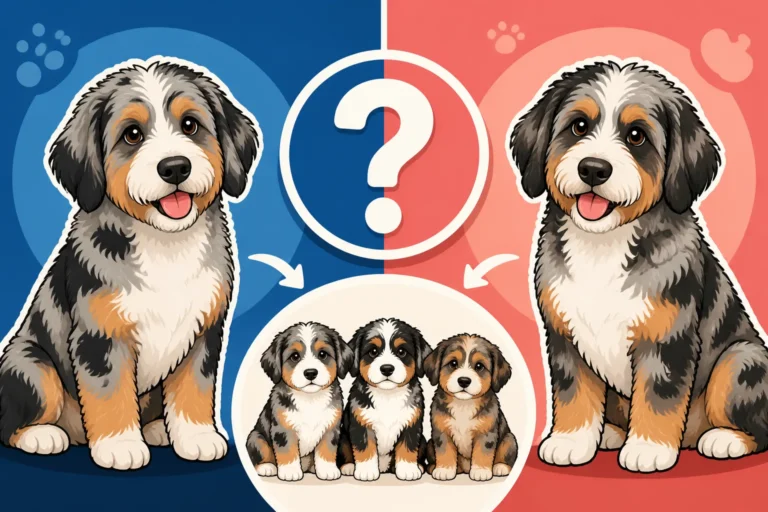
When people ask whether a Bernedoodle will ever “breed true,” they usually mean: if two Bernedoodles are bred together, will their puppies reliably look and behave like Bernedoodles? In the strictest sense, breeding true means offspring consistently inherit a predictable set of traits across generations. It does not mean every puppy is identical, but it does mean the range of likely outcomes is relatively well understood.
A recognizable breed generally has a defined standard describing its expected appearance and other characteristics, along with breeders selecting toward those traits over generations. The more consistently breeders choose compatible dogs for the same goals, the more predictable some features may become. But producing a similar-looking litter is not, on its own, proof that a population breeds true.
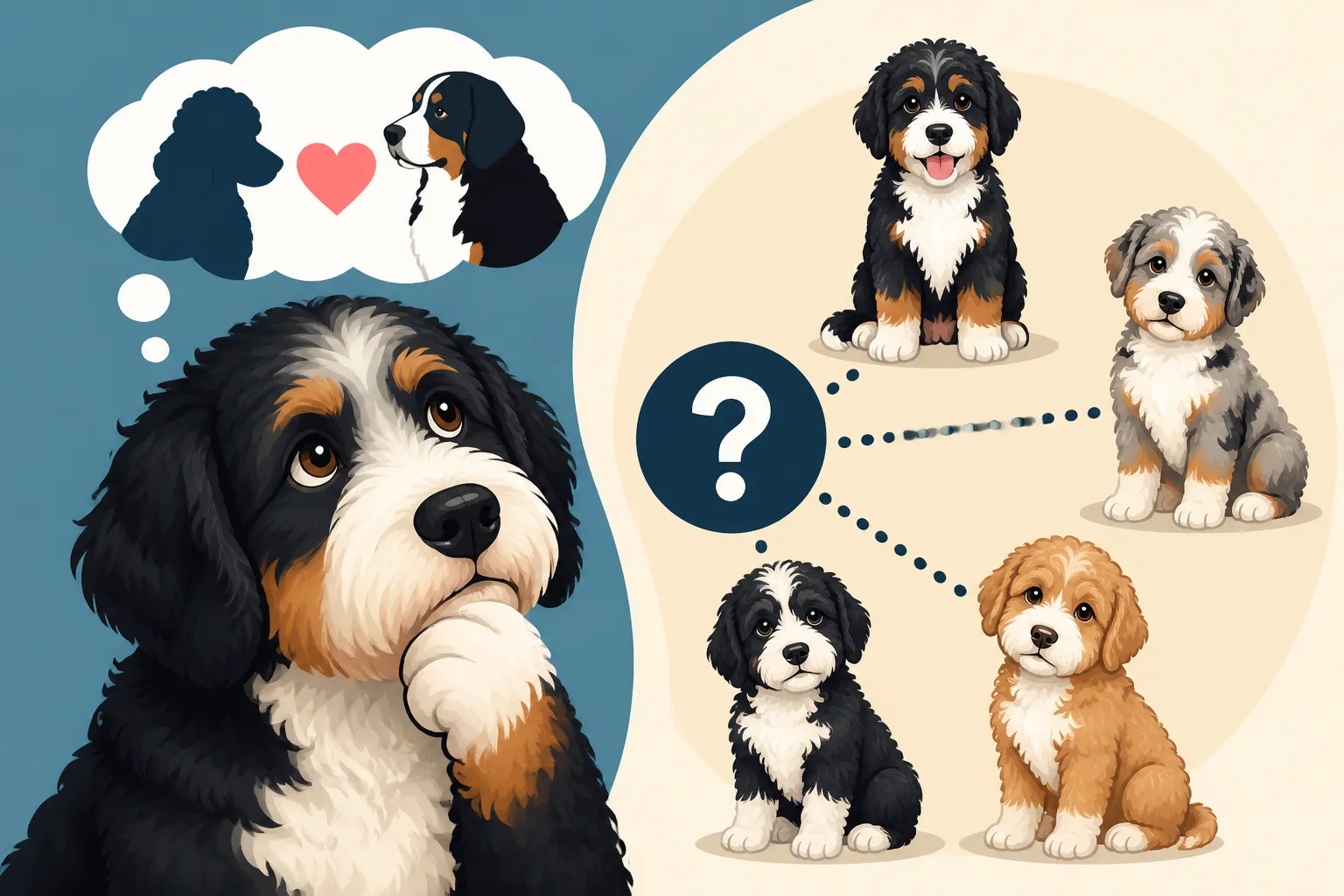
Bernedoodles are crosses between Bernese Mountain Dogs and Poodles, and individual dogs can inherit different combinations from each parent. One puppy may have a wavy, lower-shedding coat, while a littermate has a straighter coat that sheds more. Size, facial features, energy level, and social confidence can also vary. That variation is part of why “Will it ever breed true?” does not have a simple yes-or-no answer.
Being a popular cross is not the same as being a standardized breed
The term Bernedoodle describes a cross, but it does not guarantee that every dog sold under that name fits one tightly defined appearance or temperament. Different breeders may have different goals: some may prioritize coat type, others size, color, health testing, or a particular temperament. Without shared criteria and consistent selection, the label alone cannot tell you how closely a puppy will resemble other Bernedoodles.
People also use “breed” in different ways. In everyday conversation, someone may call Bernedoodles a breed because they are recognizable and intentionally bred. In a more formal sense, a breed is usually associated with a stable population, a written standard, and an established process for recording pedigrees and evaluating breeding dogs. Those ideas are related, but they are not interchangeable. For a closer look, see Whether the Bernedoodle Counts as a Breed Yet and Whether Anyone Has Written a Bernedoodle Standard.
A registry or a set of papers can record a dog’s parentage, but paperwork alone does not prove that a population produces consistent puppies. To understand what a registry does—and what it cannot guarantee—read The Registries That Record Bernedoodles and Whether Bernedoodle Papers Mean Anything. The practical question for a puppy buyer is not only what a dog is called, but how much evidence the breeder can show about the parents, relatives, and results of past litters.
Why Bernedoodle puppies can still vary
Generations describe ancestry, not a guaranteed result
Labels such as F1, F1b, and multigenerational give buyers a shorthand for ancestry. They can be useful, but they do not promise that every puppy in a litter will have the same coat, adult size, or temperament. Two dogs with the same generation label may have different family histories and may pass on different combinations of inherited traits.
For example, an F1 Bernedoodle comes from a Bernese Mountain Dog and a Poodle. An F1b commonly refers to a Bernedoodle crossed back to one of its parent breeds, often a Poodle, though breeders may use the term in different ways. “Multigenerational” generally indicates that Bernedoodles appear on both sides of the recent pedigree, but the label does not reveal whether the dogs were selected for the same traits or how predictable their offspring have been.
That is why generation labels are best treated as a starting point for questions, not a substitute for answers. Ask which dogs are in the pedigree, what traits the breeder is selecting for, and how previous litters turned out. If you want to understand the difference between generations and traits, What the Poodle Contributes to a Bernedoodle offers useful context, as does Whether a Bernedoodle's Adult Size Can Be Predicted.
Traits do not all settle into consistency at the same pace
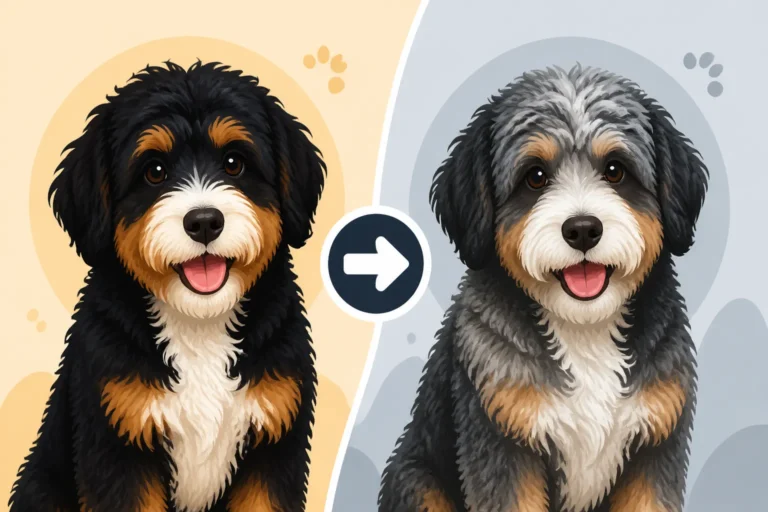
Some visible characteristics may become more predictable through careful selection, especially when breeders use dogs with similar, well-documented traits. But coat, size, color, structure, temperament, and health are not one single package. A breeder may achieve greater consistency in coat type while still seeing a broad range of adult sizes, or produce reliably tri-colored puppies without producing the same coat texture in every litter.
Color can make this especially clear. A breeder may aim for traditional tri-color markings, but inheritance is not a simple guarantee that two dogs with similar markings will produce puppies with matching markings. For a closer look at that specific question, see Whether Two Tri Bernedoodles Throw Tri Puppies. Coat type has its own uncertainty, and even a test associated with coat traits should not be treated as a complete prediction of adult shedding. Whether a Coat Test Tells You If a Bernedoodle Will Shed explores that distinction.
Temperament is also shaped by more than a breed label. Inherited tendencies matter, but early social experiences, the individual dog, health, and the home environment all play a role. A litter can include a bold puppy, a quieter puppy, and one that needs more time to warm up. A responsible breeder should describe the puppies as individuals rather than implying that every puppy will have the same easygoing personality.
| What a buyer wants to predict | What careful breeding may improve | What remains uncertain |
|---|---|---|
| Coat type | The likelihood of producing a preferred coat pattern or texture | Adult shedding and grooming needs can still vary |
| Adult size | A more informed estimate using parents and relatives | Puppy growth and final size are not guaranteed |
| Color and markings | The frequency of selected colors in a line | A particular puppy’s markings cannot always be promised |
| Temperament | Selection for stable, suitable breeding dogs | Individual personality and life experience still matter |
| Health | Reduced risk through appropriate screening and careful pairing | No screening can guarantee a lifetime free of disease |
What could make Bernedoodles more predictable over time
Consistent selection matters more than simply breeding two Bernedoodles
Breeding two Bernedoodles together does not automatically make their puppies more consistent. The dogs could carry different traits, and their puppies may inherit a wide mix. More predictability comes from deliberate selection over multiple generations: breeders need clear goals, accurate pedigrees, honest records of puppy outcomes, and decisions that prioritize soundness and temperament as well as appearance.
That work also means not breeding a dog solely because it has the desired look. A dog with a popular coat color or an especially curly coat is not automatically a good breeding choice. Breeders need to consider health, structure, behavior, and the traits in the dog’s family. They should also be willing to change course if a pairing produces problems or a trait proves difficult to predict.
Buyers can look for a pattern of thoughtful choices rather than a marketing promise. Ask how the breeder defines the traits they are working toward, how they assess adult dogs, and whether they can discuss the range of outcomes in previous litters. A breeder who says every puppy will be non-shedding, a particular adult size, or identical in temperament is offering more certainty than inheritance can provide.
Health consistency requires screening, not just a breed label
A population becoming more predictable in appearance does not mean it has become healthier. Health depends on inherited risk, the dogs chosen for breeding, screening practices, and the broader family history. A cross is not automatically protected from conditions found in either parent breed, and selecting for a specific look does not remove inherited health risks.
Ask what health evaluations have been completed for both parents and whether the results can be independently reviewed. It is also reasonable to ask about health issues in close relatives and what the breeder has learned from dogs they have produced. For context on claims that crossing breeds automatically prevents disease, see Whether the Cross Was Meant to Fix Cancer. The same general caution applies to broad claims that any cross is guaranteed to be healthier.
Good records matter because they let breeders make decisions based on more than memory or advertising. A breeder should be able to explain why a particular pairing was chosen and what outcomes they are monitoring. If the answer is only that both parents are Bernedoodles, that tells you their ancestry, not whether the pairing was carefully planned.
How to judge a breeder’s claims about consistency
Ask for evidence from adult dogs and previous litters
Photos of puppies can be appealing, but puppies are not reliable demonstrations of adult size, mature coat, or long-term temperament. Ask to see adult dogs from the same breeding program and, when possible, adult offspring from earlier litters. These examples cannot guarantee how your puppy will turn out, but they can help you understand the range the breeder has actually produced.
Ask direct, practical questions: How much did earlier puppies vary in size? Did their coats change as they matured? Have families reported shedding or grooming needs that surprised them? What kinds of temperaments appeared in the litter? A candid answer that describes variation is more useful than a sweeping promise that every puppy turns out the same.
It can also help to ask what the breeder does when a puppy does not match the hoped-for look or coat. Responsible breeding means being honest about the dog in front of them, not treating every puppy as a guaranteed version of a sales description. If a breeder cannot share meaningful information about previous litters or avoids questions about unexpected outcomes, take that seriously.
Treat “breed true” as a long-term goal, not a puppy guarantee
If Bernedoodle breeders continue to use clear selection goals, keep reliable records, and make health and temperament a priority, some lines may become more consistent in particular traits over time. That could make it easier to estimate likely outcomes within those lines. It still would not mean every Bernedoodle everywhere shares the same predictable features, especially while breeding goals and practices differ from one program to another.
For an individual buyer, the most useful question is often narrower than “Will Bernedoodles breed true?” Ask how predictable the specific breeder’s dogs are in the traits that matter to you. If low shedding is essential, discuss the parents’ coats and the variation in adult offspring. If size is important, ask about parents and mature relatives, while recognizing that an estimate is not a guarantee.
Be ready for the practical side of variation, too. A Bernedoodle’s coat may demand more brushing or professional grooming than you expected, even if the puppy looked easy-care at first. Some owners find it helpful to plan for grooming tools early; Chewy or a local pet shop may be one option for basic supplies, but the right brush and routine depend on the dog’s actual coat. That planning matters more than relying on a label to promise a maintenance-free dog.
If a Bernedoodle’s coat proves denser or more prone to tangles than expected, adjust the routine rather than waiting for a painful mat to form. Chewy is one place owners may look for general grooming supplies, while a groomer can help identify what works for a particular coat. The same practical approach applies to food bowls, bedding, and other everyday needs: choose items for the dog you have, not for an idealized description of the cross.
A Bernedoodle may become more consistent within carefully selected lines, but the label itself does not guarantee that outcome. Look for transparent breeding goals, health information, adult-dog examples, and honest discussion of variation. If a breeder promises certainty in traits that naturally vary, ask for evidence—and consider whether you are comfortable with the range of outcomes a real dog may bring.
Disclaimer
This article is for general informational purposes only and does not constitute professional advice. Laws, prices and regulations vary by location and change over time. Consult a qualified professional for guidance on your specific situation.