Whether Tri Color Is Recessive in Bernedoodles
One of the most exciting, and sometimes frustrating, parts of bringing a Bernedoodle into your life is anticipating what their coat will look like. Many of us fall head over heels for the classic tri-color pattern, the beautiful black, rust, and white markings that harken back to the Bernese Mountain Dog parent. But trying to understand why some Bernedoodle puppies end up tri-color and others don't can feel like deciphering a secret code. This guide aims to pull back the curtain on the genetics of Bernedoodle coat colors, specifically addressing whether the coveted tri-color pattern is indeed a recessive trait.
Understanding Bernedoodle Genetics: A Quick Primer on Coat Color
Before we dive specifically into the tri-color pattern, it's helpful to grasp the basics of how dog coat colors are inherited. It's not as simple as mixing two paint colors; it's a complex interplay of genes, often called loci, each controlling different aspects of color and pattern.
The Basics of Canine Coat Color Inheritance
Think of dog genetics like a recipe book, where each gene is an ingredient that influences the final product – in this case, the dog's coat. Genes come in pairs, one inherited from each parent, and these pairs can have different versions, called alleles. Some alleles are dominant, meaning if a dog inherits just one copy, that trait will be expressed. Other alleles are recessive, requiring two copies (one from each parent) for the trait to show up. If a dog carries one dominant and one recessive allele, it will express the dominant trait but silently carry the recessive one, making it a "carrier."
It's this dance between dominant and recessive alleles that makes predicting puppy colors so fascinating and sometimes challenging. A dog's base color (like black or red), its pattern (like solid, merle, or brindle), and its markings (like tan points or white spots) are all determined by different gene locations on its chromosomes. Understanding these fundamental principles is key to unraveling the mystery of the tri-color Bernedoodle.
Where Tri-Color Markings Come From
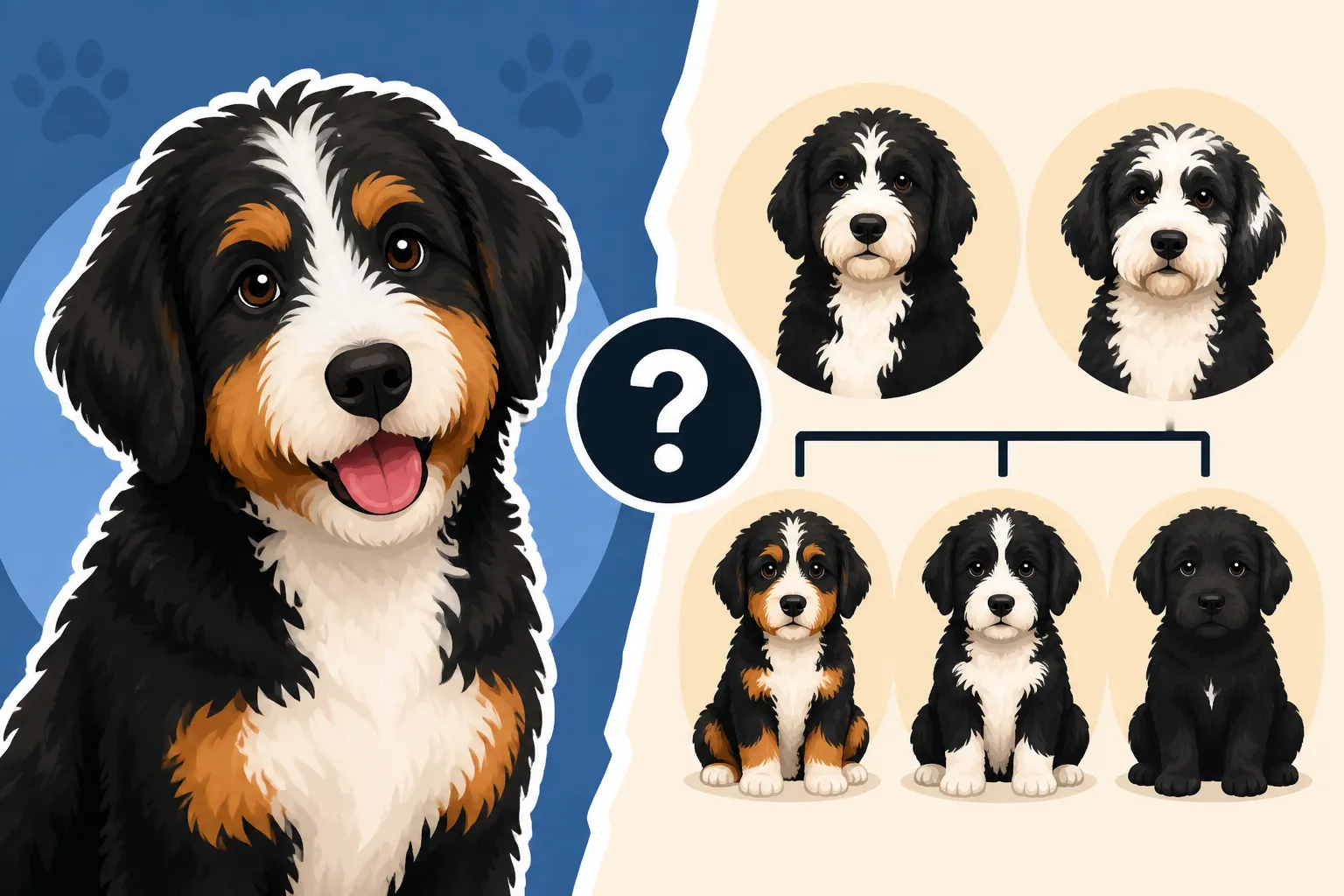
The stunning tri-color pattern that so many people adore in a Bernedoodle is directly inherited from its Bernese Mountain Dog lineage. A purebred Bernese Mountain Dog nearly always displays this classic pattern: a deep black base coat, rich rust or tan markings (often called "points") over the eyebrows, cheeks, chest, and legs, and distinct white markings, typically on the chest, blaze (stripe on the face), and paw tips. This combination is what truly defines What Tri Color Means on a Bernedoodle.
These specific markings aren't just random; they're governed by specific genetic alleles. The tan points are controlled by a particular allele at what geneticists call the "A locus" (Agouti series), while the white markings are controlled by genes at the "S locus" (Spotting series). For a dog to display the full tri-color pattern, it needs the right combination of alleles at both these loci. The Bernese Mountain Dog naturally carries the genes for both, which is why their appearance is so consistent.
Is Tri-Color Recessive in Bernedoodles? Decoding the A Locus
Now for the million-dollar question: is tri-color recessive in Bernedoodles? The answer, specifically concerning the tan points that are a critical part of the tri-color pattern, is yes. However, it's a bit more nuanced than a simple dominant/recessive pair, as several alleles exist at the "A locus" that interact with each other.
The Specifics of the 'at' Allele for Tri-Color
The tan point pattern, which forms the "tri" in tri-color (along with white markings), is controlled by the at allele at the A locus. This at allele, responsible for the tan points, is indeed recessive to the dominant black allele (K^B or K on the K locus, which dictates if a dog is solid black) and sable/fawn (Ay) alleles. It is, however, dominant to the recessive black allele (a). This means that for a Bernedoodle to express the tan point pattern, it typically needs to inherit two copies of the at allele (one from each parent), or one at allele if the other A locus allele is a (recessive black), and not have a dominant black allele (K) at the K locus masking the pattern.
Let's break that down:
- Dominant Black (K Locus): The most crucial factor often masking tri-color in Bernedoodles comes from the Poodle side. Many Poodles carry a dominant black gene (K) at the K locus. If a puppy inherits even one copy of this dominant black gene, it will be solid black, regardless of what's happening at the A locus. So, a Bernedoodle could genetically carry the at/at (tan point) alleles, but if it also has a dominant black K allele, it will simply be solid black with no visible tan points.
- A Locus (Agouti Series): The at allele (for tan points) is recessive to Ay (sable/fawn) and Aw (wild sable/agouti), but it is dominant over a (recessive black). So, to show tan points, a dog usually needs to be at/at or at/a.
So, while at (tan points) is recessive to some other A-locus alleles and easily masked by dominant black from the K locus, it's not simply recessive to "no tri-color." The Genetics Behind a Bernedoodle's Tri Markings are a sophisticated dance. The bottom line is, you need the right genetic combination at multiple points for those gorgeous tan points to make an appearance.
Why it Seems "Hard" to Get Tri-Color in Bernedoodles
Given the complex genetic factors, it's understandable why producing a tri-color Bernedoodle can seem challenging, almost like hitting the genetic jackpot. The primary reason often lies with the Poodle parent. While Bernese Mountain Dogs are genetically predisposed to tri-color (carrying the at allele and lacking the dominant black K allele), Poodles come in a vast array of colors and patterns. Many Poodles carry the dominant black (K) allele, which, as we discussed, will mask any tan points present at the A locus.
Imagine pairing a Bernese Mountain Dog (who is at/at and not dominant black) with a Poodle who is dominant black (K) and might be Ay/Ay (sable). Even if that Poodle also carries one copy of the at allele (meaning it's Ay/at but visually sable or solid black), its dominant black gene will likely produce solid black F1 Bernedoodles. These F1 puppies will inherit one at from the Bernese and might inherit the dominant black from the Poodle, leading to solid black puppies that are carriers of the tan point gene.
This doesn't mean tri-color is impossible in the first generation (F1). If the Poodle parent doesn't carry the dominant black gene and does carry the tan point gene (at/at or at/a), then tri-color F1 puppies are very possible. But finding such a Poodle that meets all health and temperament criteria for breeding is part of the challenge. This is why some breeders focus on F1b Bernedoodles (Bernedoodle x Poodle or Bernedoodle x Bernese) where they have more control over the genetic makeup for color. Whether an F1 Bernedoodle Can Be Tri Color depends heavily on the specific Poodle's genetics.
Breeding for Tri-Color: What a Bernedoodle Breeder Aims For
Responsible Bernedoodle breeders don't just hope for a specific color; they carefully plan for it using their knowledge of genetics and, crucially, DNA testing. Their goal isn't just a pretty puppy, but a healthy one, and understanding coat genetics is part of that comprehensive approach.
Parental Contributions and Expected Outcomes
When a breeder sets out to produce tri-color Bernedoodles, they are making very specific choices about the parent dogs.
- F1 Generation (Bernese x Poodle): As mentioned, the Bernese Mountain Dog will contribute the necessary at alleles and the genes for white markings. The challenge lies with the Poodle. If the Poodle is dominant black (K) or does not carry the at allele, then tri-color puppies are unlikely, even impossible, in that specific litter. The puppies might carry the gene silently, but they won't express it. A breeder aiming for F1 tri-colors would need a Poodle that is genetically not dominant black and does carry at least one at allele, preferably two.
- F1b and Multigen Generations: This is where careful breeding truly shines for specific colors like tri-color. By breeding an F1 Bernedoodle (which likely carries the at allele, even if solid black) back to either a Poodle that also carries at and is not dominant black, or even back to a Bernese Mountain Dog, the chances of producing tri-color puppies increase significantly. In these later generations, breeders can select parents known to carry the desired recessive genes, increasing the probability that puppies will inherit two copies. This is also why Whether Two Tri Parents Guarantee a Tri Bernedoodle isn't a simple yes – other masking genes still play a role.
It's a delicate balance of managing various genetic loci, all while prioritizing health and temperament above all else. A good breeder will always ensure the parents have passed all their health clearances, regardless of their planned coat color. The Five Clearances a Bernedoodle Breeder Should Have are far more important than any specific color.
The Role of DNA Testing in Predicting Coat Color
For serious Bernedoodle breeders, DNA testing isn't an option; it's a necessity, especially when aiming for specific coat colors and patterns like tri-color. Gone are the days of simply guessing based on what the parents look like. Genetic testing allows breeders to know, with remarkable accuracy, what coat color genes each parent dog carries.
Breeders can send a simple cheek swab or blood sample to specialized labs that test for various genetic markers, including those on the A locus, K locus, and S locus (for white spotting).
- Identifying Carriers: A Poodle that looks solid black might actually carry the recessive at allele. DNA testing reveals this hidden potential. This Poodle could then be a suitable match for a Bernese (or a Bernedoodle) to produce tri-color offspring.
- Predicting Litter Outcomes: With the genetic profiles of both parents, a breeder can predict the probability of specific colors appearing in a litter. They can say, "There's a 25% chance of tri-color, a 50% chance of black, and a 25% chance of phantom, assuming these other genes are present." This scientific approach takes much of the guesswork out of breeding and helps them manage expectations for potential puppy buyers.
- Responsible Breeding: Beyond color, DNA testing is crucial for avoiding genetic health issues. While a specific color like tri-color isn't linked to health problems, other color genes (like merle, as discussed in Whether Merle Is Safe to Breed in a Bernedoodle) can be. Responsible breeders use DNA tests to avoid unknowingly producing puppies with serious health conditions. This commitment to genetic health is paramount, even when striving for a beautiful coat pattern.
Beyond Genetics: The Beauty and Nuance of Bernedoodle Tri-Color
While the science of genetics explains how tri-color happens, the actual appearance and popularity of these dogs speak to a different aspect – the aesthetic appeal and what it means to owners.
The Spectrum of Tri-Color Markings
When we talk about a tri-color Bernedoodle, most people envision What a Traditional Tri Color Bernedoodle Looks Like: a stunning dog with a predominantly black body, accented by rich rust or tan "points" (patches of color above the eyes, on the cheeks, inside the ears, on the chest, and sometimes down the legs), and crisp white markings typically forming a blaze on the face, a patch on the chest, and white "socks" on the paws, often with a white tail tip. This is the classic Bernese Mountain Dog pattern that Bernedoodle lovers adore.
However, even within the "tri-color" umbrella, there can be delightful variations.
- Phantom: Sometimes you'll hear about "phantom" Bernedoodles. These dogs have the black and tan points but lack the white markings. They still carry the at allele for tan points, but their S locus genes don't produce the desired white patches. What a Phantom Bernedoodle Looks Like is striking in its own right, showcasing the bi-color aspect of the tan points.
- Sable Tri: This variation introduces the sable coloring. Instead of a solid black base, a sable tri Bernedoodle will have sable fur (often appearing as shades of brown, tan, or red with black tipping) along with the tan points and white markings. The sable color can create a softer, more blended tri-color look. What a Sable Bernedoodle Looks Like can be quite distinctive, and sometimes their colors can even change and develop as they mature, as explored in Whether a Bernedoodle's Color Changes After the Puppy Coat.
- Chocolate Tri: Less common, but equally beautiful, a chocolate tri Bernedoodle replaces the black base coat with rich chocolate brown, maintaining the tan points and white markings. This variation requires specific genes for brown coloring (at the B locus) in addition to the tri-color genes.
The vibrancy and placement of these markings can differ from dog to dog, making each tri-color Bernedoodle a unique work of art.
The Value and Demand for Tri-Color Bernedoodles
It's no secret that tri-color Bernedoodles often command a significant amount of attention, and yes, sometimes a higher price tag. This isn't just arbitrary; it's a reflection of several factors. Firstly, the tri-color pattern is incredibly eye-catching and distinctive, strongly evoking the beloved Bernese Mountain Dog while still showcasing the Poodle's influence in coat texture. Many prospective owners specifically seek out this aesthetic, drawn to its classic beauty.
Secondly, as we've discussed, producing a true tri-color Bernedoodle requires careful genetic planning and often specialized DNA testing, particularly if breeders are working to establish the pattern in later generations. This extra effort, time, and investment in genetic screening can contribute to the overall cost of a tri-color puppy. Breeders who are committed to understanding and ethically breeding for specific traits, including color, often invest heavily in their breeding stock and practices. This means that The Premium a Tri Color Bernedoodle Carries is often a reflection of the breeder's expertise and commitment.
However, it’s crucial for any potential Bernedoodle owner to remember that color, while delightful, should never be the sole criterion for choosing a puppy. Health, temperament, and responsible breeding practices always come first. A reputable breeder will always prioritize these factors, and prospective owners should too. While the tri-color is undeniably beautiful, a loving, healthy companion is the true prize.
Bernedoodle Coat Color Genetics at a Glance
This table simplifies some common genetic interactions related to the tri-color pattern. Remember, these are probabilities and simplified scenarios, as real-world genetics can be more complex due to other interacting genes.
| Parent 1 (Visible Color/Genes) | Parent 2 (Visible Color/Genes) | Typical F1 Litter Outcomes for Tri-Color (Simplified) | Key Genetic Principle |
|---|---|---|---|
| Bernese (Tri-Color: at/at, no K) | Poodle (Solid Black: K, Ay/at) | All Solid Black (carriers of tri-color) | Dominant Black (K) masks at |
| Bernese (Tri-Color: at/at, no K) | Poodle (Phantom: at/at, no K) | All Phantom (no white) or Tri-Color (with white) | at expressed, S locus for white |
| F1 Bernedoodle (Solid Black: K, at/at) | Poodle (Solid Black: K, at/at) | Solid Black, some could be tri-color carriers | Dominant black still at play |
| F1 Bernedoodle (Black/Tan Carrier: K, at/at) | F1 Bernedoodle (Black/Tan Carrier: K, at/at) | Mix of Solid Black, Phantom, and Tri-Color possible | Recessive at can combine if K is absent |
| F1b Bernedoodle (Tri-Color: at/at, no K) | Poodle (Phantom: at/at, no K) | High chance of Tri-Color or Phantom | Breeding for desired recessive traits |
Disclaimer
This article is for general informational purposes only and does not constitute professional advice. Laws, prices and regulations vary by location and change over time. Consult a qualified professional for guidance on your specific situation.