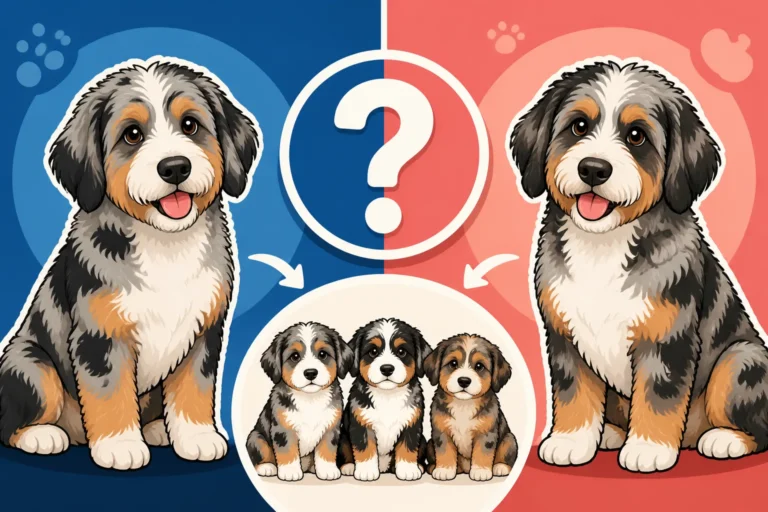
Whether a Bernedoodle Can Be Chocolate Tri
It’s perfectly natural to fall in love with a specific look for your future furry family member, and the idea of a chocolate tri Bernedoodle certainly conjures up a beautiful image! Many aspiring Bernedoodle owners dream of those classic tri-color markings but in a warm, rich brown instead of the usual black. This guide is going to dive deep into the fascinating world of Bernedoodle coat genetics to explain why a true chocolate tri Bernedoodle is so rare, what it would actually entail genetically, and what to look out for if you’re hoping for this particular aesthetic.
Decoding Bernedoodle Coat Colors: The Basics of Genetics
The stunning array of colors and patterns we see in Bernedoodles is a direct result of the genetic lottery played out between their Bernese Mountain Dog and Poodle parents. Understanding this foundational genetics is key to unraveling the mystery of the chocolate tri.
Understanding the "Tri" in Bernedoodle
When we talk about a traditional "tri-color" Bernedoodle, we're typically referring to a dog with a black base coat, distinct white markings (often on the chest, blaze on the face, and feet), and rust or tan points (above the eyes, on the cheeks, chest, and legs). This classic appearance is directly inherited from the Bernese Mountain Dog side of the family. The Bernese Mountain Dog is known for its beautiful and consistent tri-color pattern, which is genetically determined by specific loci.
The key to this pattern involves several genes working together. First, you need the gene for black pigment (often dominant 'B' at the B locus) and then genes that allow for those "tan points" to be expressed. These tan points are governed by the 'at' allele at the Agouti locus. Without getting too bogged down in the scientific jargon, think of it this way: the dog has the genetic instructions to be black, but also has a separate set of instructions that say, "hey, put some tan patches in these specific places." The white markings are typically controlled by another set of genes, often referred to as the S locus (for spotting or piebald). So, a traditional tri-color Bernedoodle is genetically black, carries the tan point gene, and has white spotting. You can learn more about What a Traditional Tri Color Bernedoodle Looks Like to understand the typical Bernedoodle tri-color.
The Role of the Poodle in Color Genetics
Now, let's bring the Poodle into the mix. Poodles come in a vast array of colors – black, white, cream, apricot, red, silver, blue, and, critically for our discussion, brown (often called chocolate or liver). Poodles can also carry patterns like phantom (which looks very similar to tri-color, just without the white markings) and sable. The Poodle's genetic contribution adds complexity, especially regarding the 'B' locus that determines whether a dog is black or brown.
The 'B' locus has two main alleles: 'B' for black pigment and 'b' for brown (chocolate/liver) pigment. If a dog inherits at least one dominant 'B' allele (e.g., BB or Bb), it will have a black nose, black paw pads, and a black base coat (assuming no other modifying genes are at play for dilution or red pigment). If a dog inherits two recessive 'b' alleles (bb), it will have a brown nose, brown paw pads, and a brown base coat. This is where the possibility of "chocolate" comes in. A Bernedoodle, being a mix, can inherit the 'b' allele from either parent, or from both. This is why you see beautiful brown Bernedoodles or even brown phantom Bernedoodles.
The challenge arises when you want to combine the "chocolate" base coat with the "tri-color" pattern from the Bernese side. The Bernese Mountain Dog is genetically fixed on having a black base coat for its tri-color pattern. While Bernese Mountain Dogs can technically carry the 'b' allele, it's not a common or recognized color in the purebred standard, and breeding them for it is rare. Poodles, on the other hand, do have brown as a recognized color and can carry the phantom pattern. This creates a genetic puzzle when trying to achieve a chocolate tri-color.
The Elusive Chocolate Tri Bernedoodle: Is It Possible?
This is where the dream of a true chocolate tri Bernedoodle meets the realities of canine genetics. While it's certainly theoretically possible, it's incredibly rare to find a Bernedoodle that genuinely fits the bill of a chocolate tri.
The Genetic Requirements for Chocolate Tri
For a Bernedoodle to be a true chocolate tri, it would need a very specific combination of genes.
- Brown Base Coat: The dog would need to inherit two copies of the recessive 'b' allele (bb) at the B locus. This gives it the brown (chocolate) pigment for its nose, paw pads, and overall base coat color.
- Tri-Color Pattern Genes: It would also need the specific genes from the Bernese Mountain Dog that create the "tan points" (the 'at' allele at the Agouti locus) and the white spotting genes (from the S locus).
The difficulty lies in sourcing parent dogs that can pass on this precise combination. A Bernese Mountain Dog parent would typically contribute the black base color and the tri-color pattern. A Poodle parent might contribute the brown gene. So, you would need a Bernese Mountain Dog that carries the recessive 'b' allele (which is rare for a purebred Bernese) or a Poodle that is brown and also carries the specific 'at' allele for tan points and the white spotting gene. Breeding specifically for these complex combinations, especially when one parent breed doesn't naturally express the desired base color with the pattern, makes it a genetic needle in a haystack.
Often, when people envision a "chocolate tri" Bernedoodle, they're picturing the traditional Bernese tri-color pattern, but with all the black areas replaced by chocolate. This is indeed the true definition. However, it's far more common to see other patterns that might be mistaken for it. This is why careful genetic testing of the parent dogs is so crucial. A reputable breeder should be able to show you the genetic panel results for the parents, particularly concerning color loci. Don't be afraid to ask about The Five Clearances a Bernedoodle Breeder Should Have, and color genetics should be part of their transparency.
Why True Chocolate Tri Is Rare (and Often Misidentified)
Because the genetic combination for a true chocolate tri is so intricate, what's sometimes marketed or perceived as a "chocolate tri" Bernedoodle might actually be one of several other color patterns that have a brown base:
- Brown Phantom: This is a brown dog with tan points, just like a phantom Poodle. The distinction is that a phantom dog does not have the distinct white markings that are characteristic of a Bernese-derived tri-color. A brown phantom is genetically a brown dog with the 'at' allele, but without the white spotting allele. These dogs are beautiful and share many of the color elements of a tri, but miss that iconic white blaze and chest patch. You can see What a Phantom Bernedoodle Looks Like to understand this better.
- Faded Sable Phantom/Tri: Sable Bernedoodles have coats where each hair is banded with different colors, often appearing dark at the tips and lighter at the base. They can have tan points and white markings, resembling a tri-color. As they mature, sable coats often fade or "clear," becoming much lighter. If a sable phantom or sable tri Bernedoodle with a brown base coat fades, it might take on a lighter, somewhat "chocolate" hue, but it’s not a true genetically determined chocolate tri. The color can change quite a bit Whether a Bernedoodle's Color Changes After the Puppy Coat.
- Liver-Nosed Tri: Sometimes, a breeder might have a "liver-nosed" dog that has the classic tri-color pattern, but because of a dilute gene or another genetic factor, the black pigment is softened to a liver or brown hue. While the nose and paw pads will be brown, the overall effect on the black parts of the tri-color pattern might not be the rich, uniform chocolate that people imagine. This is still not the same as a dog that is genetically 'bb' (chocolate) and 'at' (tan points) and 'S' (white spotting).
The pursuit of rare or unusual colors can sometimes lead to less scrupulous breeding practices. Ethical breeders prioritize health and temperament above all else. While color is certainly a lovely bonus, it should never come at the expense of a dog's well-being. Always investigate a breeder's practices and health testing protocols before making any commitments. Asking about Whether an Untested Bernedoodle Litter Is Worth Buying is always a good idea.
Identifying and Appreciating Bernedoodle Colors
While the true chocolate tri Bernedoodle remains a rare gem, there are many stunning variations of brown and tri-color in the breed. The important thing is to understand what you're looking at and what to expect from a reputable breeder.
What to Look for in a "Chocolate Tri" Claim
If you encounter a breeder advertising "chocolate tri" Bernedoodles, here are some questions to ask and things to consider:
- Ask for Genetic Testing Results: A responsible breeder should have DNA color panels done on their breeding dogs. Specifically, you'd want to see if the parents carry the 'bb' alleles for brown and the 'at' allele for tan points, along with the white spotting gene. This is the only way to scientifically confirm the potential for a true chocolate tri.
- Clarify "Chocolate Tri": Politely ask the breeder what they mean by "chocolate tri." Are they referring to a brown phantom with some white (perhaps from another gene or just minor residual white), or a true brown base with distinct tan points and white Bernese markings? Understanding their terminology can help manage expectations.
- Observe the Parents: While not always foolproof, looking at the parent dogs can give you clues. Is one parent a brown Poodle that also has tan points and white? Is the Bernese parent a carrier of the 'b' allele, or are they only breeding black tri Bernese?
- Look at the Nose and Paw Pads: For a dog to truly have a "chocolate" base, its nose and paw pads must be brown, not black. If the dog advertised as chocolate tri has a black nose, it is not genetically a chocolate base.
- Beware of Exaggerated Claims: If a breeder claims an exceptionally rare or unique color and charges a significantly higher price without providing clear genetic backing, proceed with caution. The Premium a Tri Color Bernedoodle Carries is already quite high, and further claims should be rigorously verified.
Remember, a true genetic chocolate tri Bernedoodle is very distinct. The color will be a rich, solid brown where a black tri would be black, with crisp tan points above the eyes, on the cheeks, and legs, and clean white markings on the chest and blaze. Any deviation, such as a faded brown or indistinct points, might indicate a different genetic pattern.
| Color Pattern Description | Base Color | Tan Points | White Markings | Genetic Likelihood for Bernedoodle |
|---|---|---|---|---|
| Traditional Tri-Color | Black | Yes | Yes | Common (from Bernese parent) |
| Black Phantom | Black | Yes | No | Common (from Poodle parent) |
| Brown Phantom | Brown | Yes | No | Possible |
| Sable Tri/Phantom (faded) | Variable | Yes | Yes/No | Common, often confused |
| True Chocolate Tri | Brown | Yes | Yes | Extremely Rare |
Embracing the Spectrum of Bernedoodle Hues
While the hunt for a true chocolate tri Bernedoodle can be exciting, it’s also important to remember what truly makes these dogs so wonderful. Their incredible temperaments, intelligence, and loving natures are what make them such cherished companions, regardless of their coat color.
Bernedoodles come in a stunning variety of other colors that are more commonly available and equally beautiful. You'll find solid blacks, gorgeous bi-colors (often black and white), striking phantoms (What a Phantom Bernedoodle Looks Like), and charming sables (What a Sable Bernedoodle Looks Like). Each of these colors and patterns has its own unique appeal, and they all boast the same wonderful qualities that make Bernedoodles so popular. For example, Whether an F1 Bernedoodle Can Be Tri Color is a common question, and the answer is yes, they absolutely can, and often do inherit the tri-color pattern from their Bernese parent.
When selecting a Bernedoodle, focusing on health and temperament should always be the top priority. A well-bred Bernedoodle from health-tested parents will bring years of joy, regardless of whether their markings are black, brown, or any other shade. Make sure to talk to breeders about their health screening, socialization practices, and the personalities of their parent dogs. The health and happiness of your Bernedoodle will always shine brighter than any specific color. And remember, once you bring your Bernedoodle home, no matter the color, you'll need all sorts of supplies, from quality food to fun toys, which you can often find from great retailers like Chewy.
Disclaimer
This article is for general informational purposes only and does not constitute professional advice. Laws, prices and regulations vary by location and change over time. Consult a qualified professional for guidance on your specific situation.