Why Tri Color Is Harder to Breed in a Bernedoodle
It's a familiar scenario: you’ve fallen head over heels for the Bernedoodle, particularly those striking tri-color markings that truly capture the best of both the Bernese Mountain Dog and the Poodle. You scroll through endless photos, dreaming of bringing home that perfect black, white, and rust-colored puppy. But then you start looking at litters, and suddenly, those traditional tri-colors seem as rare as hen's teeth, or command a price tag that makes your jaw drop. It can be incredibly frustrating when you have such a specific vision in mind, only to find it's not as straightforward as you'd hoped. This comprehensive guide will peel back the layers of Bernedoodle genetics to explain exactly why breeding for that gorgeous tri-color pattern is far more complex than many people realize, and what that means for hopeful owners.
Understanding Bernedoodle Genetics: A Quick Primer
Before we dive deep into the specific challenges of tri-color Bernedoodles, it's really helpful to get a basic understanding of how coat color works in dogs. Think of it like a puzzle, where each piece is a gene, and they all have to fit together just right to create the final picture of your dog's coat. Without this foundation, it’s easy to get lost in the jargon, and we certainly don't want that!
The Basics of Coat Color Inheritance in Dogs
Every dog inherits two copies of each gene, one from each parent. These gene copies are called alleles. Some alleles are dominant, meaning if a dog has even one copy of that allele, the trait it controls will be expressed. Other alleles are recessive, meaning a dog needs two copies of that allele (one from each parent) for the trait to show up. If a dog has one dominant and one recessive allele, it will express the dominant trait but will also be a "carrier" for the recessive one, meaning it can pass it on to its puppies. This dance between dominant and recessive is at the heart of why some colors are so common and others are much harder to predict.
It’s not just one gene that determines a dog’s coat color and pattern, but a whole cast of characters working together on different "loci" – specific locations on the dog's chromosomes. Each locus controls a different aspect: base color, patterns, dilution, and more. Imagine trying to bake a cake where you need the right flour (base color), the right flavorings (patterns), and the right amount of leavening (dilution) all in perfect balance. If one ingredient is off, the whole cake changes! This intricate system is why even experienced breeders use genetic testing to understand what colors their dogs truly carry beneath the visible coat.
Key Genes Involved in Bernedoodle Coloring
When it comes to Bernedoodle colors, especially the coveted tri-color, several key gene loci are at play. The most important ones for our discussion are the K-locus (which determines if a dog is solid color, brindle, or allows patterns like sable or tri-color to show), the A-locus (which controls patterns like sable, fawn, tan points, or solid black), and the E-locus (which influences whether black pigment is fully expressed or if red/yellow colors appear). Other loci can also affect shade, intensity, and dilution, but these three are the big players for tri-color.
For a Bernedoodle to express the traditional tri-color pattern, it needs to inherit the right combination of recessive alleles that allow those tan points and white markings to show, and it needs to not inherit dominant masking genes that would cover them up. This is where the challenge really begins, because the Bernese Mountain Dog and the Poodle bring very different genetic palettes to the table. Understanding these specific gene interactions is key to appreciating The Genetics Behind a Bernedoodle's Tri Markings.
The Bernese Mountain Dog: The Tri-Color Blueprint
The Bernese Mountain Dog is undeniably where the tri-color dream for the Bernedoodle begins. These majestic dogs are famous for their stunning, consistent black, rust (tan points), and white markings. It’s a pattern so inherent to the breed that it's practically their calling card.
The Specific Tri-Color Gene from the Bernese
Bernese Mountain Dogs are genetically fixed for the tri-color pattern. This means that every Bernese carries a specific combination of alleles at the K-locus and A-locus that dictates this pattern. At the A-locus, they typically carry two copies of the "tan point" allele (at/at). This allele is responsible for those beautiful rust-colored markings above the eyes, on the cheeks, chest, legs, and under the tail. Simultaneously, their K-locus allows for the expression of these patterns rather than being solid black. The white markings are controlled by other genes, often referred to as the S-locus (spotting), but the "tri" part specifically refers to the black and tan points.
When you see a Bernese, you know exactly what you're getting in terms of color pattern. There’s no guessing game. This consistency is one of the many reasons people are drawn to the Bernese, and by extension, to the Bernedoodle. They offer a strong genetic foundation for that classic look, but this consistency doesn't necessarily mean it's easy to reproduce in a crossbreed. The uniformity of the Bernese's color genes is a double-edged sword when introducing another breed with much wider genetic diversity.
Why the Bernese Always Carries Tri-Color
The Bernese Mountain Dog's genetic makeup for coat color is remarkably stable. They are what geneticists call "homozygous" for many of the alleles that produce their tri-color pattern. This means they consistently carry two identical copies of these crucial alleles. Because of this, when a Bernese is bred, it always passes on the genetic instructions for black with tan points to its offspring. It's not something they can "skip" or hide; it's a fixed trait within their breed.
This genetic constancy is a huge benefit for breeders aiming for predictable results within the purebred Bernese line. However, it sets up an interesting challenge when they are crossed with a breed like the Poodle, which has a vast array of color and pattern genes. While the Bernese dutifully contributes its tri-color blueprint, whether that blueprint actually gets expressed in the Bernedoodle depends entirely on what the Poodle brings to the table, and how those genes interact.
The Poodle: The Wildcard in the Genetic Deck
If the Bernese Mountain Dog is the picture of genetic consistency when it comes to coat color, the Poodle is the exact opposite. Poodles come in an incredible spectrum of colors and patterns, which is a testament to their diverse genetic code. This genetic richness, while beautiful in its own right, is precisely what makes breeding for a specific pattern like tri-color in a Bernedoodle so challenging.
Poodle Color Genes and How They Interact
Poodles can carry a multitude of dominant and recessive alleles at all the major color loci. For instance, at the K-locus, many Poodles carry a dominant black allele (K), which, if present, will cause the dog to be solid black, completely masking any tan point genes (at/at) they might also carry at the A-locus. So, a Poodle could be genetically capable of producing tan points, but if it has that dominant K allele, you'd never know it by looking at it – it would just be solid black.
Beyond solid black, Poodles can also be phantom, sable, brindle, or even parti-colored, and they come in various shades of red, apricot, cream, silver, blue, and brown. Each of these colors and patterns is governed by different gene combinations, some dominant, some recessive. The sheer number of possibilities means that randomly selecting a Poodle to breed with a Bernese is like throwing darts at a color wheel – you might hit what you want, but the odds are often stacked against you without careful genetic planning.
Dilution and Pattern-Masking Effects
The Poodle’s genetic makeup includes genes that can dilute colors or mask patterns entirely. For example, some Poodles carry genes that dilute black pigment to blue or silver, or brown pigment to café au lait. While these colors are beautiful, they deviate from the crisp black and rust of a traditional tri-color Bernedoodle. Even more significantly, many Poodles carry dominant genes that prevent the expression of certain patterns.
As mentioned, a Poodle with a dominant K allele at the K-locus will appear solid, even if it carries the recessive tan point gene (at/at) from the Bernese side. This is a classic example of a masking gene. The genetic potential for tri-color is there, buried in the dog’s DNA, but it simply cannot show through because a dominant gene is overriding it. It's like having a beautiful painting hidden under a layer of opaque paint. Breeders need to understand these complex interactions to accurately predict a litter's potential colors, which is why genetic testing of parent dogs is so crucial. A good breeder will leverage resources, perhaps even finding specialized foods or supplements on Chewy to support breeding dogs and their litters, ensuring they're in peak condition regardless of color outcomes.
Why the Tri-Color "Disappears" in F1 Bernedoodles
This is often where the initial disappointment for aspiring Bernedoodle owners sets in. You see a beautiful tri-color Bernese and a handsome Poodle, and you naturally expect their "F1" (first generation) puppies to be a lovely mix, perhaps with those desirable tri-color markings. Yet, many F1 Bernedoodles are solid black or phantom, rather than the traditional tri-color. This isn't a breeding "failure," but rather a demonstration of dominant gene expression.
The Dominance of Solid and Phantom Genes from the Poodle
When a Bernese Mountain Dog (which is fixed for tri-color, meaning it carries the recessive alleles for tan points and allows their expression) is bred to a Poodle, the Poodle's genes often take precedence in the F1 generation. Many Poodles carry a dominant allele at the K-locus (typically K/K or K/k) which results in a solid coat color. If an F1 Bernedoodle inherits even one copy of this dominant K allele from the Poodle parent, it will express as a solid color (usually black, given the Bernese's black base coat), completely masking the Bernese's tri-color genes. So, while the puppy carries the tri-color genetic potential from its Bernese parent, it simply can't show it.
Similarly, Poodles can also carry genes for phantom markings (at/at at the A-locus, similar to the Bernese's tan points) that can interact in complex ways. However, if that dominant K allele from the Poodle is present, the phantom pattern might also be suppressed or expressed differently than the classic Bernese tri-color. This means that an F1 Bernedoodle often ends up being solid black, black and white (bi-color, if the white spotting gene is expressed), or a black and tan phantom, rather than the distinct tri-color beloved in the Bernese. The beautiful black tri-color, with its crisp rust points and distinct white blaze, is a specific combination of genes that has to line up just right, and that often doesn't happen in the first cross due to dominant masking genes.
The Role of Recessive Genes and Carrier Status
The tri-color pattern, with its specific tan points, relies on recessive alleles at the A-locus (at/at) and the absence of dominant masking alleles at the K-locus. The Bernese Mountain Dog provides the necessary at/at alleles and the "non-solid" allele at the K-locus (ky/ky or kbr/ky, which allow patterns to show). However, many Poodles are not only dominant black (K) but might also carry other patterns that don't align perfectly with the Bernese tri-color.
So, in an F1 Bernedoodle, the puppy will inherit one set of tri-color genes from its Bernese parent. If the Poodle parent also carries the recessive alleles that allow tri-color to show and doesn't contribute a dominant masking gene, then the tri-color could express. But more often, the Poodle contributes a dominant masking gene (like solid black K), meaning the F1 Bernedoodle will simply be a carrier for the tri-color pattern, but won't display it. This is why you'll often see F1 Bernedoodles that are black, black and white, or phantom; they might be carrying the tri-color potential, but it's not visible. This genetic lottery is why it's so important to verify what a breeder claims about their puppies’ colors, and why discerning buyers often ask about genetic testing results for parent dogs. You can find excellent resources, including books on canine genetics and dog-specific genetic testing kits, on platforms like Chewy for those interested in diving deeper into their own dog's genetic potential.
Achieving Tri-Color: The Challenges of F1b and Multigen Crosses
Given the genetic complexities, breeding for consistent tri-color in Bernedoodles usually requires moving beyond the F1 generation. This means intentional breeding with F1b (first-generation backcross) or multigen (multi-generational) Bernedoodles, where breeders have a better chance of influencing the genetic outcome. It's a testament to dedicated breeders that they navigate these waters to produce the desired colors.
Strategic Breeding for Tri-Color Expression
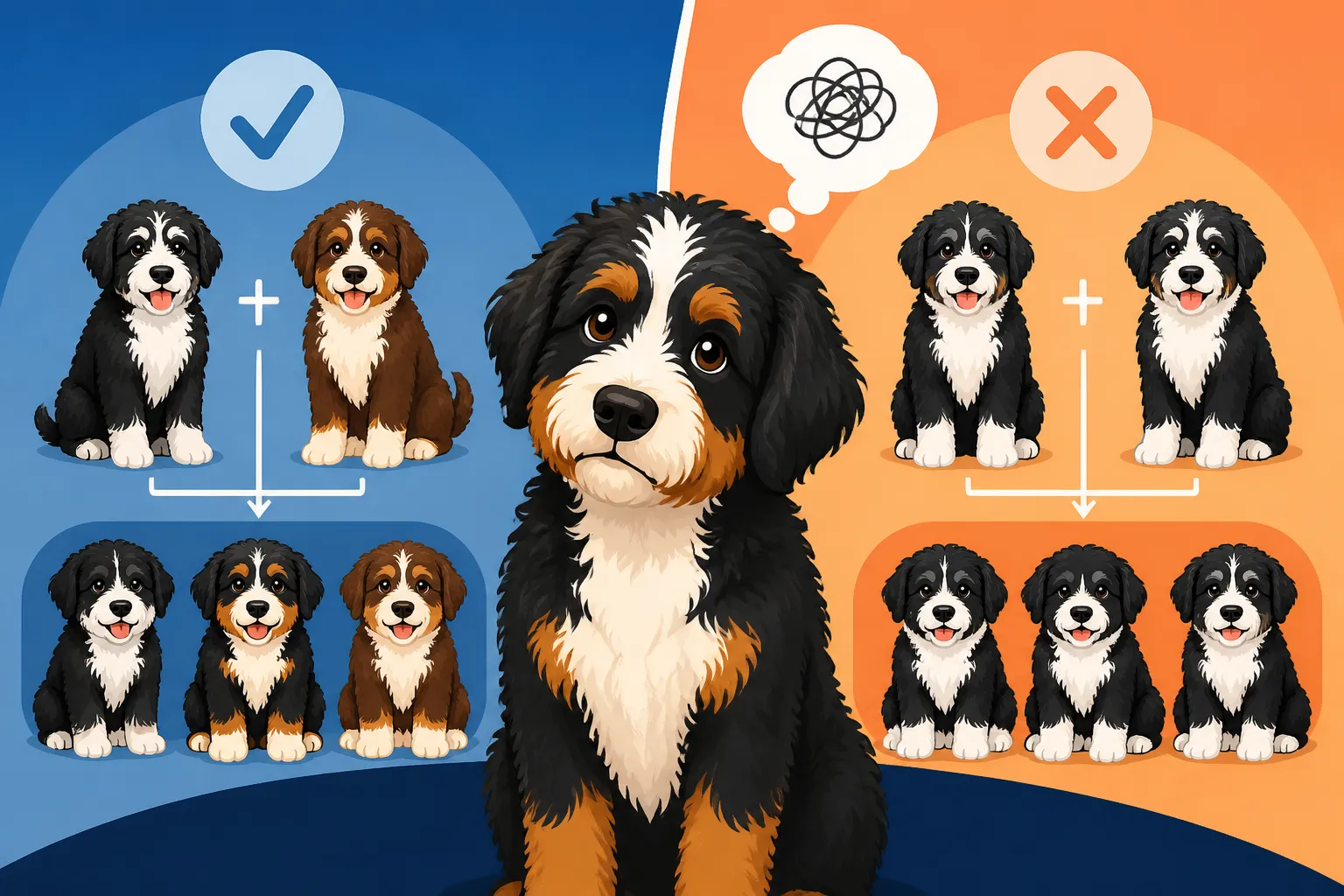
To achieve a true tri-color Bernedoodle, breeders often employ specific strategies. One common approach is an F1b cross, where an F1 Bernedoodle (which carries the tri-color gene from its Bernese parent, even if it's masked) is bred back to a Poodle. The trick here is that the Poodle chosen for this backcross must be carefully selected. This Poodle should ideally carry the recessive alleles that allow for pattern expression (meaning it doesn't have the dominant K allele for solid black) and, if possible, carry genes for tan points itself (at/at). By breeding an F1 Bernedoodle (carrying Bernese tri-color) to a Poodle that allows those patterns to express, the chances of getting tri-color puppies increase significantly.
Another strategy involves breeding two F1 Bernedoodles together, or breeding F1b or multigen Bernedoodles that are known to carry and express the tri-color pattern. In these cases, both parents must contribute the correct combination of recessive genes that allow the black, rust, and white markings to appear. It's a careful dance of genetics, where breeders need to understand the genetic makeup of both parents, often through extensive DNA testing, to maximize the probability of producing tri-color offspring. This is far more involved than simply pairing a Bernese with any Poodle. This careful genetic matching is key to ensuring that Whether Two Tri Parents Guarantee a Tri Bernedoodle holds true, as sometimes even two outwardly tri-color parents can carry hidden genes that produce unexpected results.
The Increased Complexity of Multi-Generational Crosses
As you move into multigen Bernedoodles (F2, F3, etc.), the genetic pool broadens even further, which can either simplify or complicate the breeding for specific colors like tri-color. On one hand, if a breeder has successfully established a line of multigen Bernedoodles that consistently produce tri-colors, then breeding within that line can become more predictable. These dogs have been selected for specific genetic traits that allow tri-color expression.
However, if the breeding is not meticulously planned and parent dogs aren't thoroughly genetically tested, multigen crosses can introduce even more variability. Genes for fading, dilution, or other patterns from the Poodle side can become more prevalent, potentially altering the crispness or traditional look of the tri-color markings. It takes an immense amount of knowledge, careful selection, and often genetic testing to ensure that desirable traits, like the tri-color pattern, are consistently passed down while maintaining overall health and temperament. Breeders also consider other factors, like the desired coat type, trying to avoid The Straight Coated Bernedoodle That Sheds while still pursuing beautiful colors. It's a complex balance of art and science, making the process of producing specific traits like tri-color truly a labor of love for dedicated breeders. You'll find many breeders sharing their experiences, and discussing essential supplies they use, like high-quality grooming tools or specialized puppy food from retailers like Chewy, ensuring optimal health for their precious, genetically diverse litters.
Beyond Aesthetics: The Importance of Ethical Breeding
While the allure of a tri-color Bernedoodle is undeniable, it's absolutely crucial to remember that ethical breeding goes far beyond just pretty colors. A responsible breeder will always prioritize the health, temperament, and overall well-being of their dogs above all else. Focusing solely on a specific color can lead to neglecting more important genetic considerations, potentially introducing health issues into the line.
Focusing on Health Over Color
The primary goal of any ethical Bernedoodle breeder should be to produce healthy, well-adjusted puppies with sound temperaments. This means conducting extensive health clearances on both parent dogs for conditions common in Bernese Mountain Dogs and Poodles, such as hip and elbow dysplasia, various eye conditions, heart problems, and genetic diseases like Von Willebrand's disease and degenerative myelopathy. Hips on a Ninety Pound Bernedoodle and Elbow Dysplasia in a Growing Bernedoodle are significant concerns that require careful screening. A breeder who is truly dedicated to their dogs will be transparent about these health tests and will prioritize them over simply achieving a certain coat color.
Unfortunately, in the quest for popular colors or "rare" patterns, some less scrupulous breeders might overlook crucial health screenings, leading to puppies with genetic predispositions to serious health problems. Always ask to see proof of health clearances for both parent dogs, regardless of how beautiful their colors are. A stunning coat is wonderful, but a healthy, happy companion for years to come is priceless. The Five Clearances a Bernedoodle Breeder Should Have is an excellent resource to understand what to look for.
How Reputable Breeders Approach Color Breeding
Reputable breeders understand the genetic complexities of coat color and approach it with a scientific, ethical mindset. They use genetic testing not just to predict color, but to ensure that they are not doubling up on undesirable recessive genes for health conditions. They keep detailed records of their breeding lines, understanding which dogs carry specific color genes and which might carry masking genes. Their goal isn't just to produce a tri-color puppy, but to produce a healthy tri-color puppy.
They might strategically plan F1b or multigen crosses, not just for color, but to also select for the best temperaments, conformation, and health characteristics from both parent breeds. They will be transparent about the probabilities of certain colors in a litter and will never make guarantees they can't uphold. If a breeder seems too focused on color, or promises specific "rare" colors without discussing health testing, it's a major red flag. Always prioritize a breeder who is open, knowledgeable about genetics beyond just color, and prioritizes the health and temperament of their puppies first and foremost. This commitment ensures that your future companion will not only be beautiful but, more importantly, a healthy and joyful addition to your family. It's worth remembering that a dog's health often outweighs fleeting aesthetic trends.
Disclaimer
This article is for general informational purposes only and does not constitute professional advice. Laws, prices and regulations vary by location and change over time. Consult a qualified professional for guidance on your specific situation.