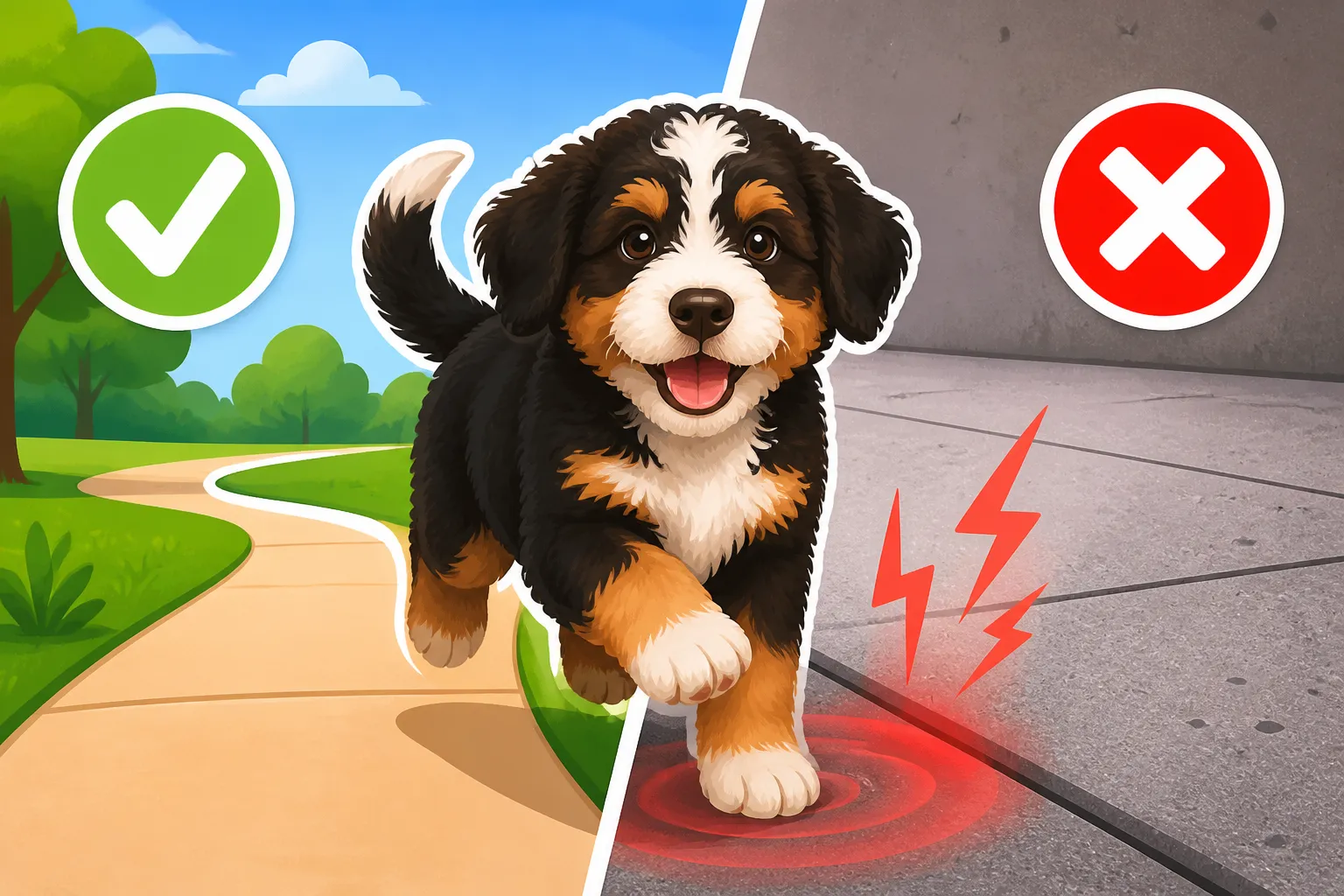
Whether a Bernedoodle Puppy Should Run on Concrete
Your Bernedoodle puppy is bouncing off the walls, the only open space nearby is a concrete path or a paved cul de sac, and someone at the dog park just told you that running on hard surfaces will ruin their joints. Now every walk feels like a risk. This guide explains what concrete really does to a growing Bernedoodle, when it matters, and how to exercise your puppy safely without wrapping them in bubble wrap.
What Happens Inside a Growing Bernedoodle
Before deciding whether concrete is safe, it helps to understand what is going on in a Bernedoodle puppy’s body. The concern is not the concrete itself so much as the skeleton that is landing on it.
Growth Plates and Why They Matter
Puppies grow through soft areas of cartilage near the ends of their long bones called growth plates. These plates gradually turn into solid bone as the puppy matures. Until they close, they are softer and more vulnerable to injury than the rest of the bone.
In large and giant breeds, these plates stay open longer. A standard Bernedoodle, which often lands somewhere in the seventy to ninety pound range or beyond, may keep growing until somewhere between twelve and eighteen months, and some keep filling out after that. Mini and tiny Bernedoodles usually finish growing sooner, though the exact timing varies with the individual dog and its parents.
Repeated hard impact, sudden twisting and heavy loads on open growth plates are what worry vets and breeders. An injury to a growth plate can, in rare cases, affect how a bone grows. That is why the question of surfaces comes up so often with big doodles.
The Size Factor in Standard Bernedoodles
A standard Bernedoodle is a big puppy carrying a lot of weight on joints that are still forming. The Bernese Mountain Dog side brings a heavy frame and a breed history of hip and elbow problems. The Poodle side brings height and long legs. Together, that creates a puppy that can look gangly and coordinated in equal measure, and that often has more enthusiasm than body awareness.
If you are not sure how big your puppy will get, the site’s guide Predicting What a Bernedoodle Puppy Will Weigh can give you a rough idea. Size matters here because a ninety pound adult puts far more force through each stride than a thirty pound mini, and the risk picture for joints scales with it.
Picture two littermates. One is a standard bound for eighty five pounds, the other a mini expected to finish near thirty five. Both love to sprint. The standard’s joints will carry more than twice the load in every landing, so the same game on the same surface is a different proposition for each dog.
Hips and Elbows in the Doodle Mix
Hip and elbow dysplasia are developmental joint conditions where the joint does not form correctly. Genetics play a major role, but environment matters too. Rapid growth, being overweight and certain types of exercise can make an existing tendency worse.
The site’s articles Loose Hips in a Growing Standard Bernedoodle and Elbow Dysplasia in a Growing Bernedoodle go deeper into these conditions. The key point here is that concrete is one environmental factor among many. It is not the main cause of dysplasia, but it can contribute to wear and strain in a puppy that is already predisposed.
What Concrete Actually Does to Paws and Joints
Concrete is everywhere in urban and suburban life. Sidewalks, driveways, patios and parking lots are hard to avoid. The question is not whether your puppy ever touches concrete, but how they use it.
Impact, Grip and Sudden Turns
Concrete does not give underfoot. When a puppy runs on it, the impact travels up through the paws and into the joints. Walking on concrete is generally fine for most puppies in moderate amounts. The concern rises with repetitive, high impact activity like sprinting, hard ball chasing or repeated jumping.
Concrete can also be slippery when wet or dusty, and its grip is uneven. A puppy that skids while turning sharply can twist a joint or strain a ligament. Smooth concrete patios and polished garage floors are particularly slick, especially for gangly puppies with long legs and big feet.
Think about a puppy chasing a ball on a smooth driveway. Each time they slam on the brakes and pivot, they put sideways force through their wrists, elbows and knees. Doing that occasionally is unlikely to cause harm. Doing it over and over every day while the joints are still forming is where the risk increases.
Heat, Abrasion and Paw Pads
Concrete holds heat. On a sunny day, the surface can become much hotter than the air. A puppy running on hot concrete can burn their paw pads, sometimes before you realize it. Dark coated Bernedoodles also absorb more heat, which adds to the risk of overheating during exercise.
A simple test is to place the back of your hand on the concrete for several seconds. If it is too hot for you to keep it there comfortably, it is too hot for your puppy’s paws. The site’s guide The Temperature a Bernedoodle Should Not Be Walked In covers heat safety in more detail.
Concrete is also abrasive. Repeated running, especially on rough surfaces, can wear down paw pads, causing redness, tenderness or small abrasions. Young pads are softer and more sensitive than adult pads, so they can get sore more easily.
Concrete Compared With Other Surfaces
Every surface has trade offs. The table below compares common surfaces for Bernedoodle puppy exercise.
| Surface | Impact on Joints | Traction | Heat Risk | Best Use for Puppies |
|---|---|---|---|---|
| Concrete or asphalt | High | Variable, slick when wet | High in sun | Short leash walks, potty trips |
| Packed dirt trail | Moderate | Generally good | Moderate | Gentle walks and sniffing |
| Grass lawn or field | Lower | Good when dry | Lower | Free play and short games |
| Sand | Low impact, high effort | Shifting | High on hot days | Short supervised play only |
| Rubber or turf mats | Lower | Good | Moderate to high in sun | Indoor or covered play areas |
| Wood or tile floors | Moderate | Often slippery | Low | Calm play on rugs or runners |
How Exposure Adds Up Over a Week
One run on a sidewalk is rarely the problem. What matters is the total load a puppy’s joints carry over weeks and months. A puppy that spends a few minutes on pavement getting to the park, then plays on grass, has a very different week from a puppy whose only exercise is daily fetch on a concrete patio.
It helps to think of exercise as a budget. Soft ground, sniffing and calm walking spend very little of that budget. Sprinting, braking, jumping and twisting on hard ground spend a lot. A growing Bernedoodle can afford some expensive activity, but not every day and not for long stretches.
If you track what your puppy actually does for a week, you may be surprised. Many owners discover that the “short” ball session on the driveway is happening three or four times a day, because it is the easiest way to burn off energy before work. Spotting that pattern is often the single most useful change you can make.
Common Myths About Puppies and Hard Surfaces
Advice about puppies and concrete tends to swing between two extremes. Some people say any pavement will wreck a puppy’s hips. Others say it is all overblown. The truth sits in between, and clearing up a few myths makes it easier to plan.
Myth: Any Concrete Causes Hip Dysplasia
Hip dysplasia is strongly influenced by genetics. A puppy from parents with poor hips has a higher risk no matter what surfaces it walks on, and a puppy from parents with well scored hips can still develop problems if it is overweight or over exercised. Concrete does not create dysplasia on its own.
What hard surfaces can do is add strain to joints that are already developing imperfectly. That is why surface choice matters more for some puppies than others, and why knowing the parents’ hip and elbow results helps you judge how careful to be. Ask your breeder for those results if you have not seen them.
Myth: Puppies Need No Limits Because They Stop When Tired
Puppies do tend to self regulate during free play, but that instinct is easily overridden. A puppy chasing a ball, keeping up with a bike or trying to follow an adult dog will often push past the point where it would have stopped on its own. Excitement and the desire to stay with you are powerful.
That is why free play on soft ground is different from structured activities on hard ground. In free play, your puppy chooses when to rest. In structured activities, you set the pace, and the puppy will try to match it.
Myth: A Big Puppy Is Ready Sooner
Standard Bernedoodles can look like adults well before their skeletons have finished developing. A seven month old standard might already weigh more than many adult dogs of other breeds, which tempts owners to treat them like grown dogs.
Size is not the same as maturity. Large breeds often take longer to finish developing, not shorter. A puppy that looks big enough to jog with you is often the one that most needs patience. Your vet can help you decide when your dog is ready, sometimes with the help of x rays if you plan intense activities.
When a Bernedoodle Puppy Can Use Concrete Safely
The question in the title is whether a Bernedoodle puppy should run on concrete. The short answer is that walking on concrete is fine, short bursts are usually fine, but structured or repetitive running on concrete is best avoided until growth plates have closed and your vet is comfortable with more intense exercise.
Everyday Walking on Sidewalks
For most puppies, normal leash walks on sidewalks are perfectly acceptable. A relaxed walk at your pace, with time to sniff and explore, does not put the same strain on joints as sprinting or jumping. Many city puppies spend much of their walking time on pavement and grow up with healthy joints.
To keep walks joint friendly, avoid long distances early on, especially for standards. Increase the length gradually as your puppy grows. Mix in grassy areas or dirt paths when you can. If your puppy starts lagging, lying down or seems sore later, shorten the walk next time.
Avoid letting a young Bernedoodle pull hard on the leash for long stretches. Heavy pulling puts strain on the shoulders and front legs. The site’s piece Whether Pulling Damages a Young Bernedoodle’s Joints explains why teaching loose leash walking early helps protect your puppy.
The Five Minute Guideline and Its Limits
Many owners have heard of the “five minutes of exercise per month of age, up to twice a day” guideline for puppies. It is a rough starting point, not a strict rule backed by firm science. It can help remind owners not to overdo structured exercise, but it does not account for how active a puppy is at home or the type of activity.
For a Bernedoodle, focus less on the exact minute count and more on the quality of exercise. Free play on soft ground, short training sessions and calm sniff walks are very different from long forced runs on pavement. The site’s guide The Five Minute Rule on a Bernedoodle Puppy’s Walks looks at how to use this guideline sensibly.
A four month old standard might happily do two twenty minute sniff walks, plus some indoor play and training. That same puppy should not be taken on a twenty minute jog on concrete, even though the minutes look similar on paper.
Activities to Avoid on Concrete
Some activities are best kept off concrete entirely while your Bernedoodle is growing:
- Long jogs or runs beside a bike or runner.
- Repetitive ball or frisbee chasing with sudden stops and turns.
- Jumping on and off curbs, benches or walls for fun.
- High impact games with bigger dogs on hard surfaces.
- Agility style weaving or jumping practice.
These activities are not dangerous in themselves when done appropriately on suitable surfaces and at the right age, but on concrete with an immature skeleton, they add up. The site’s article The Age a Bernedoodle Can Start Long Walks explains how to build distance gradually as your dog matures.
Safer Ways to Exercise a Bernedoodle Puppy
Bernedoodles are smart, social and often energetic. They need daily exercise and mental stimulation to stay happy and avoid boredom behaviors. The goal is to meet those needs while protecting their developing joints.
Soft Ground Free Play
Free play on grass or soft ground is one of the best forms of exercise for a growing puppy. Puppies naturally self regulate when they are allowed to play at their own pace, stopping to rest when they are tired. This is very different from structured exercise where they feel pressure to keep up with you.
If you have a yard, let your puppy explore, sniff and play with suitable toys. If not, look for local parks with fenced areas, quiet fields or trails where you can safely use a long line. Avoid dog parks with very large, rough dogs until your puppy is a bit older and more confident.
Supervised play with a gentle adult dog that knows how to tone things down can be ideal. Rough play with much larger dogs, especially on hard surfaces, increases the risk of collisions and strains.
Mental Exercise and Training
Mental exercise can tire a puppy just as much as physical exercise. Short training sessions, puzzle toys and scent games are excellent ways to burn energy without stressing joints.
Try teaching simple cues like sit, down, stay, come and leave it. Hide treats around the house for your puppy to find, or use snuffle mats and puzzle feeders at mealtimes. Many owners pick up puzzle toys, snuffle mats and long lines from Chewy or Amazon, but any well made option works. Choose sturdy products suited to your puppy’s size and chewing style.
Ten minutes of focused training followed by a nap is often enough to settle a busy puppy. It also builds habits, like walking calmly on a leash, that make concrete walks safer later.
Managing Stairs, Jumping and Slick Floors
Concrete is not the only hard surface that matters. Stairs, slippery floors and jumping off furniture can also stress young joints. The site’s guides Whether Stairs Hurt a Standard Bernedoodle Puppy and Whether Jumping Off Furniture Hurts a Bernedoodle explain how to handle these everyday situations.
You might use baby gates to limit stair access, carry very young puppies up and down stairs, and add rugs or runners to slippery floors. Encourage your puppy to stay off high furniture or provide ramps or steps if they are allowed on the couch or bed.
Think about the car too. A standard puppy leaping out of an SUV onto a concrete driveway is one of the hardest single landings it will make all day. Lifting them, or using a ramp, removes that impact entirely.
Paw Care, Boots and Building Tough Pads
Healthy pads are your puppy’s first line of defense on any surface. Young pads toughen gradually with regular, varied walking, which is one reason short daily walks on mixed ground are better than long, occasional outings on pavement. A puppy that walks mostly on carpet and grass and then suddenly goes on a long concrete walk is far more likely to come home with sore feet.
Look at your puppy’s paws after walks. Healthy pads are firm, slightly rough and free of cracks. Warning signs include redness, shiny worn patches, small blisters, limping on a hot day or licking at the feet afterward. If you see any of these, rest the paws on soft surfaces for a few days and check with your vet if they do not improve.
Dog boots can help in specific situations, such as very hot pavement you cannot avoid, salted winter sidewalks or rough gravel. Many puppies find boots strange at first, so introduce them slowly indoors with treats, one paw at a time, before asking your puppy to walk in them outside. Boots should fit snugly without rubbing and should never be used as a reason to walk on surfaces that are too hot for safe exercise.
Paw balms can help keep pads supple, especially in dry or cold weather. Use products made for dogs and wipe off any excess so your puppy does not lick large amounts. Keeping the hair between the pads trimmed also improves grip on smooth concrete and indoor floors.
Supporting Joint Health Beyond Surface Choice
Surface choice is one piece of the joint health puzzle. Genetics, nutrition, weight and overall activity matter just as much.
Weight, Diet and Growth Rate
Keeping your Bernedoodle puppy lean is one of the most powerful ways to protect their joints. Extra weight increases load on hips, elbows and knees every time they move. Rapid growth from overfeeding can also increase the risk of developmental joint problems in large breed dogs.
Feed a diet formulated for large or giant breed puppies if your Bernedoodle is a standard or likely to be large. These diets are designed to support steady growth with appropriate calcium and calorie levels. Some owners use fresh food services such as Ollie, while others choose a high quality commercial kibble. Whatever you choose, follow your vet’s guidance on portion sizes and body condition.
You should be able to feel your puppy’s ribs easily with a light layer of fat over them and see a waist when viewed from above. If you are unsure, ask your vet to show you how to assess body condition. The site’s guide Keeping a Ninety Pound Bernedoodle Off Its Joints explains why this matters even more as your puppy reaches adult size.
Joint Supplements
Many owners consider joint supplements for large breed puppies. Products often contain ingredients like glucosamine, chondroitin and omega 3 fatty acids. While some dogs may benefit, evidence is mixed, and supplements are not a substitute for good genetics, appropriate exercise and weight management.
If you are interested in joint supplements, talk with your vet before starting. They can help you choose a product and dose that are appropriate for your puppy’s age and size. The site’s article Whether a Bernedoodle Needs Joint Supplements From Young covers this topic in more depth.
Watching for Early Signs of Joint Trouble
Even with careful management, some Bernedoodles will develop joint problems. Catching signs early allows you to work with your vet on treatment and exercise changes. Watch for:
- Limping or favoring one leg, especially after activity.
- Stiffness when getting up after rest.
- Bunny hopping with both back legs together when running.
- Reluctance to climb stairs, jump into the car or play.
- Sitting or lying in unusual positions to avoid putting weight on certain joints.
If you notice any of these, schedule a vet visit. Your vet may recommend x rays or referral to an orthopedic specialist. The site’s guide Signs a Bernedoodle Puppy’s Elbows Hurt explains what elbow pain can look like in a young dog.
Making Concrete Work in Real Life
You may live in a city where concrete is unavoidable, or you might have a long driveway that serves as the main play area. That does not mean your Bernedoodle is doomed. It just means you need to be intentional about how that space is used.
Small Changes for Urban Owners
For urban owners, think in terms of routes and timing. Use sidewalks for getting from place to place, and seek out grassy patches, pocket parks or dirt paths for play and sniffing. Walk during cooler parts of the day in warm weather to protect paws and reduce heat stress.
You can also add soft areas at home. Interlocking rubber mats, artificial turf patches or outdoor rugs can create safer play zones on patios or balconies. Indoors, use rugs and runners for traction.
Keep paws in good shape. Check pads after walks for cracks, redness or small cuts, and trim the fur between the pads so your puppy has better grip on smooth surfaces. If your puppy’s pads seem sore, give them a few days on softer ground.
A Simple Weekly Plan
If you are not sure how to balance concrete with everything else, a simple weekly rhythm can help:
- Use short leash walks on pavement for potty breaks and getting to softer ground.
- Give your puppy one or two longer sniff walks on grass or dirt paths each day.
- Add two or three short training sessions daily that focus on calm behaviors.
- Offer a puzzle feeder or scent game for at least one meal.
- Allow supervised free play on soft ground with suitable dogs a few times a week.
- Save high impact games for soft surfaces and keep them short.
Three Real World Situations
A family in a city apartment has a four month old standard Bernedoodle and no yard. Every outing starts on a sidewalk. They use the pavement as a hallway, walking calmly to a small park six blocks away, then let the puppy sniff and play on grass for twenty minutes before walking home. The concrete exposure is real, but it is low impact walking, which is a sensible compromise.
A suburban owner has a large concrete driveway and a busy work schedule. Their five month old puppy has been getting fifteen minutes of fast fetch on the driveway before work and again after dinner. They switch the morning session to a sniff walk and a puzzle breakfast, and move the evening fetch to the lawn with gentle rolled toys instead of high throws. The puppy is just as tired, but the hard braking on concrete is gone.
A rural owner wants their eight month old Bernedoodle to join them on morning runs along a paved country road. Their vet suggests waiting until the dog has finished growing and building up gradually on dirt shoulders when the time comes. In the meantime, the puppy joins for the walking warm up and cool down, then stays home for a training session.
What these three owners have in common is that none of them banned concrete. They simply looked at what their puppy was doing on it, kept the hard surface for calm walking, and moved the fast, twisting, high impact play somewhere softer. That pattern works whether you live in a downtown high rise or at the end of a long gravel lane, and it is far easier to keep up than trying to avoid pavement entirely.
Questions to Ask Your Vet and Breeder
If you are unsure what is right for your own puppy, a few direct questions can help:
- Were both parents hip and elbow scored, and what were the results?
- Roughly what adult weight should I expect for this puppy?
- At what age do you think this puppy’s growth plates are likely to close?
- Is my puppy’s current body condition where you want it?
- Which activities would you avoid until my dog is fully grown?
- When would you be comfortable with jogging or longer hikes?
Bring your notes from a typical week of exercise. Being specific about what your puppy actually does gives your vet much more to work with than a general question about concrete.
Moving Toward Adult Exercise
As your Bernedoodle approaches maturity, usually somewhere between twelve and eighteen months for standards and earlier for minis, your vet may give you the green light to gradually add more intense activities. That might include longer hikes, jogging or more structured sports.
Even then, introduce new activities slowly. Build endurance over weeks, not days. Mix surfaces whenever possible and continue to watch for soreness or limping. Bernedoodles can make great adventure partners when their bodies are ready for it.
Remember that your puppy’s long term health is built on many small choices: genetics, diet, weight, surfaces, exercise type and early training. Concrete is one piece of that picture, not the whole story. With thoughtful planning, you can give your Bernedoodle a healthy start and a lifetime of comfortable movement.
Disclaimer
This article is for general informational purposes only and does not constitute professional advice. Laws, prices and regulations vary by location and change over time. Consult a qualified professional for guidance on your specific situation.