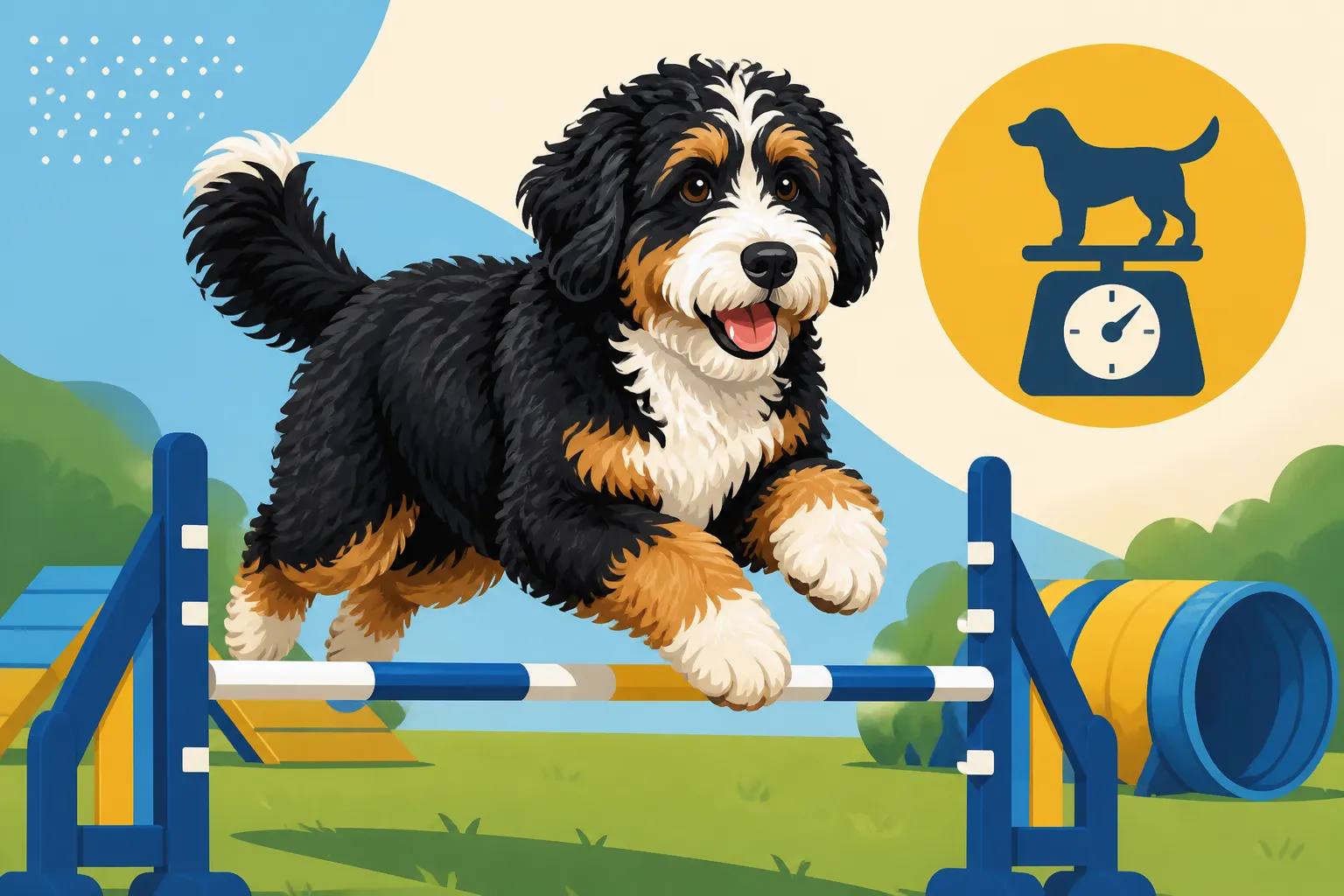
Whether a Bernedoodle Can Do Agility at Ninety Pounds
It’s a common scenario: you’re watching an agility competition, captivated by the blur of Border Collies and Shelties flying over jumps, weaving through poles, and zipping through tunnels. Then your gaze drifts to your beautiful, big Bernedoodle, perhaps comfortably napping at your feet, and a thought sparks – "Could my ninety-pound gentle giant do that?" It's a wonderful aspiration, but the reality for larger breeds, especially those with the Bernese Mountain Dog's genetic blueprint, involves some careful considerations and modifications. This guide will delve into whether a large Bernedoodle can indeed excel in agility, what adjustments are needed, and how to prioritize their health and happiness every step of the way.
Understanding the Bernedoodle's Build for Agility
When we talk about a Bernedoodle, especially a standard one weighing in at ninety pounds or more, we're discussing a magnificent blend of two distinct breeds: the sturdy, often slower-moving Bernese Mountain Dog and the athletic, intelligent Poodle. This unique combination gives us a dog that can be surprisingly agile, but also one that carries the predispositions of its larger parent. It's crucial to understand these physical traits to approach agility safely and effectively.
The Bernese Influence on Structure and Stride
The Bernese Mountain Dog is a large, powerful breed originally bred for drafting and guarding. Their build is substantial, with heavy bones, a deep chest, and a broad frame. This robust structure means they are not inherently designed for the quick, sharp turns, high jumps, or explosive bursts of speed often seen in traditional agility. Their natural gait is more deliberate, and their joints bear significant weight, making them more susceptible to orthopedic issues like hip and elbow dysplasia. When you have a Bernedoodle, particularly a standard size, that leans heavily into its Bernese lineage, these characteristics will be present. Trying to force a dog with this heavier build into high-impact, competitive agility without proper conditioning and modification can lead to strain, injury, and long-term joint damage. It's not about what they can't do, but what their bodies are best suited for and how we can adapt. You want to ensure you're Keeping a Ninety Pound Bernedoodle Off Its Joints as much as possible.
The Poodle's Contribution to Agility and Grace
On the flip side, we have the Poodle – a breed renowned for its intelligence, athleticism, and incredible agility. Poodles excel in dog sports, often floating over obstacles with an almost effortless grace. They have lighter bone structure, longer legs, and a natural spring in their step. Their keen problem-solving abilities and eagerness to please make them quick learners, a huge advantage in agility training. The Poodle's influence in a Bernedoodle can imbue them with a surprising amount of bounce, speed, and mental sharpness, which can make them enthusiastic participants in agility. However, even with the Poodle's genes in the mix, a ninety-pound Bernedoodle is still a large dog. While they might inherit the Poodle's drive, their sheer size and weight will always be a factor in how their body handles impact and repetitive movements. It’s a beautiful dance between power and grace, and finding that balance is key.
Hybrid Vigor and Physical Potential
The concept of hybrid vigor often suggests that crossbred dogs can be healthier or more robust than their purebred parents. While Bernedoodles often boast a wonderful blend of intelligence and a generally calmer disposition, it doesn't automatically negate the physical predispositions of the parent breeds, especially regarding their larger size. A Bernedoodle might exhibit remarkable athleticism and mental keenness for training, but their substantial frame means careful attention must always be paid to their developing and aging joints.
For a ninety-pound Bernedoodle, agility isn't about competing against the fastest border collies, but about engaging their minds and bodies in a fun, controlled way. Their potential lies in modified courses, lower jumps, and an emphasis on precision and problem-solving rather than raw speed. It's about tapping into that Poodle brain and Bernese desire to work, while always respecting the limits of their impressive Bernedoodle physique.
Tailoring Agility Training for a Larger Dog
You wouldn't ask a sumo wrestler to perform gymnastics, just as you wouldn't expect a large draft horse to jump hurdles like a thoroughbred. The same logic applies to your Bernedoodle. While their enthusiasm might be boundless, their physical structure demands a tailored approach to agility. This isn't about limiting their fun, but rather ensuring their longevity and comfort.
Emphasizing Low-Impact Activities
For a large Bernedoodle, the focus should always be on low-impact agility. This means modifying traditional obstacles and choosing activities that minimize stress on their joints, especially their hips and elbows. Instead of high jumps, think about broad jumps or tunnels. Weave poles are fantastic for mental engagement and body awareness without any jumping. Raised platforms for targeting exercises can build strength and proprioception (awareness of their body in space).
Consider this scenario: instead of a 24-inch A-frame, your Bernedoodle navigates a lower, wider ramp that allows for a gentler incline and descent. Or, rather than jumping over multiple hurdles, they practice controlled walk-overs, focusing on precision and foot placement. You can find excellent, adjustable agility equipment on platforms like Amazon, allowing you to gradually introduce elements and adapt them as your dog gains confidence and skill.
Slow and Steady Progression
Rushing into high-impact activities with a large breed can lead to serious injuries. A Bernedoodle, especially a standard one, is not fully mature until around two years old, sometimes even later. During this critical growth period, their bones and joints are still developing, making them incredibly vulnerable. It's vital to Growing a Standard Bernedoodle Slowly on Purpose with appropriate exercise. Agility training should begin with foundational exercises that build strength, coordination, and body awareness without any undue strain. This means starting with simple commands like "stay," "go," and directional cues, and introducing obstacles at a very low height or even flat on the ground.
Think about a young Bernedoodle puppy, maybe 8-12 months old. Instead of jumping, they might learn to walk over a broomstick laid flat on the ground, or practice going through a collapsed tunnel. The goal is to build muscle memory, confidence, and a strong understanding of the commands before any physical challenge is introduced. Consistency over intensity is the mantra here. Patience will pay dividends in their long-term health and enjoyment of the sport.
Modified Obstacles and Courses
Traditional agility courses are often designed with smaller, faster dogs in mind. For a ninety-pound Bernedoodle, modifications are not just helpful, they are essential. Jumps should be set at the lowest possible height, or even completely removed for certain sessions, focusing instead on weaves and tunnels. Contact obstacles like A-frames and dog walks should have lower heights and gentler slopes to reduce impact on descent.
Here's a table showing some common agility obstacles and how they can be modified for a larger Bernedoodle:
| Obstacle Type | Standard Agility (for smaller breeds) | Modified Agility (for 90lb Bernedoodle) | Benefits of Modification |
|---|---|---|---|
| Jumps (Hurdles) | Set at various heights, up to 26 inches | Set to lowest possible height (4-8 inches) or used as walk-overs | Reduces joint impact, encourages controlled movement |
| A-Frame/Dog Walk | Steep incline/decline, significant height | Lower height, gentler slope, wider planks if possible | Minimizes stress on hips, elbows, and spine during ascent/descent |
| Tunnels | Varying lengths and curves | Wider diameter tunnels, less severe curves | Accommodates larger body, less awkward navigation |
| Weave Poles | 6-12 poles, tight spacing | Fewer poles (6-8), slightly wider spacing initially | Focuses on body awareness and coordination; can increase poles as skill improves |
| Teeter-Totter | Standard height and pivot point | Lower to the ground, shorter length, slower pivot | Reduces fear of unstable surface, less impact on landing |
By focusing on these modifications, you create an environment where your Bernedoodle can still experience the joy and mental stimulation of agility without the associated risks that come with their size and potential joint vulnerabilities. It’s about adapting the sport to the dog, not forcing the dog into the sport. This also applies to everyday activities; consider if Whether Jumping Off Furniture Hurts a Bernedoodle in the long run.
Essential Considerations for Joint Health and Safety
The sheer joy of seeing your Bernedoodle engaged and happy is immense, but their long-term health must always be the priority. For a large breed like a ninety-pound Bernedoodle, joint health and overall safety are paramount when participating in any physical activity, especially one as dynamic as agility. Ignoring these aspects can lead to painful, expensive, and debilitating conditions later in life.
Pre-Training Health Clearances and Regular Vet Checks
Before you even think about introducing your Bernedoodle to agility obstacles, a thorough veterinary check-up is absolutely non-negotiable. This isn't just a routine visit; it's a specific assessment of their orthopedic health. Your vet can perform evaluations for common large-breed issues such as hip and elbow dysplasia, which can be inherited from the Bernese side. You'll want to be particularly vigilant for signs of Loose Hips in a Growing Standard Bernedoodle or Elbow Dysplasia in a Growing Bernedoodle. Many responsible breeders will provide health clearances for the parents, but a vet assessment for your individual dog is still crucial.
Beyond the initial check, regular veterinary visits are essential to monitor their joint health as they age and continue training. Early detection of any discomfort or changes in gait can allow for intervention before problems become severe. A vet can also advise on appropriate conditioning exercises, weight management (critical for joint health), and whether specific supplements might be beneficial. Remember, an ounce of prevention is worth a pound of cure, especially when it comes to the complex mechanics of large-dog joints.
Proper Warm-ups and Cool-downs
Just like human athletes, dogs need to properly warm up their muscles before exercise and cool down afterward. Skipping these crucial steps significantly increases the risk of injury, especially for a large dog whose muscles and ligaments are under more strain. A proper warm-up for a Bernedoodle entering agility training might include 5-10 minutes of brisk walking or trotting, followed by some gentle stretches. Think about slow, controlled movements like leg lifts, gentle trunk twists (encouraging them to look at a treat by their hip), and paw targets.
After an agility session, a cool-down is equally important. This involves another 5-10 minutes of slow walking to bring their heart rate down and allow their muscles to gradually relax. You can follow this with a gentle massage, paying attention to major muscle groups in their legs and back. This helps to prevent stiffness, soreness, and can even improve flexibility over time. It’s all about respecting their body and preparing it for and recovering it from activity.
Supportive Surfaces and Environments
The surface your Bernedoodle trains on makes a huge difference in joint impact. Hard, unforgiving surfaces like concrete or asphalt are absolute no-gos for agility training, as they offer no shock absorption and can be very harsh on joints. Even prolonged walking on these surfaces should be limited. Instead, seek out softer, more forgiving ground. Grass, rubber matting (often found in dedicated dog training facilities), or even packed dirt are much better options.
When training outdoors, be mindful of uneven terrain, hidden holes, or slippery spots that could cause a misstep or fall. A controlled environment, whether it's a fenced backyard or a proper training facility, ensures your Bernedoodle can focus on the tasks without distractions or hazards. If you’re training at home, consider investing in some rubber stall mats from a farm supply store for a dedicated, joint-friendly training area. Ensuring they have proper footing is important both during exercise and at home; consider Flooring That Suits a Heavy Bernedoodle.
Nutrition, Weight Management, and Supplements
Maintaining an ideal weight is perhaps the single most important thing you can do for your Bernedoodle's joint health, regardless of whether they do agility or not. Every extra pound puts additional stress on their joints, accelerating wear and tear. Work with your vet to determine the ideal weight for your individual Bernedoodle and feed a high-quality, large-breed appropriate diet.
When it comes to supplements, many Bernedoodle owners explore options for joint support. Glucosamine, chondroitin, and Omega-3 fatty acids are popular choices, often found in formulations designed for large breeds. While these supplements aren't a magic bullet and results can vary, they may help support cartilage health and reduce inflammation. Discuss with your veterinarian if Whether a Bernedoodle Needs Joint Supplements From Young and which specific products might be beneficial for your ninety-pound companion. Some great options are available through retailers like Amazon, but always consult with your vet first to ensure they are appropriate for your dog's specific needs.
Benefits Beyond Competition for a Large Bernedoodle
While the image of a Bernedoodle soaring over a jump might be the initial thought, the true value of agility for a large breed like a ninety-pound Bernedoodle often lies far beyond competitive ribbons. For these dogs, agility becomes a powerful tool for holistic development, strengthening their bond with you, and promoting a balanced, happy life.
Mental Stimulation and Engagement
Bernedoodles are incredibly intelligent dogs, inheriting keen problem-solving skills from their Poodle side and a desire to work from their Bernese heritage. Without adequate mental stimulation, this intelligence can manifest in undesirable behaviors, like destructive chewing, excessive barking, or general restlessness. Agility training provides a fantastic outlet for their clever minds. Each obstacle is a puzzle to solve: where to go, how to position their body, when to speed up or slow down, all while responding to your cues.
Imagine teaching your Bernedoodle to weave through poles. It's not just a physical act; it requires focus, memory, and responsiveness. Or consider the challenge of a tunnel: entering, navigating the curve, and bursting out the other side. Each successful completion builds confidence and satisfaction for your dog. This mental workout can be just as tiring, if not more so, than a long physical walk, leaving your Bernedoodle happily exhausted and content. If you find your Bernedoodle can be Whether a Bernedoodle Is Stubborn or Just Slow in picking up new commands, these engaging activities can be particularly beneficial. Online training programs like those offered by BAXTER & Bella can also provide structured guidance and support for this kind of mental engagement from home.
Building Confidence and Reducing Shyness
Many Bernedoodles, particularly those with a stronger Bernese influence, can be a bit reserved or even shy around new people or situations. This isn't necessarily a bad thing, but it can sometimes hinder their enjoyment of new experiences. Agility, especially in a supportive, positive reinforcement environment, can be a fantastic confidence builder. Successfully navigating an obstacle, even a modified one, gives your dog a sense of accomplishment.
Picture a timid Bernedoodle who initially hesitates to walk through a tunnel. With gentle encouragement, positive reinforcement, and repeated successful attempts, they learn that it's safe and even fun. Over time, this builds their self-assurance, translating into more confidence in other aspects of their life. They learn to trust their handler and themselves, making them more resilient and outgoing. This can be especially helpful if you find yourself Building Confidence in a Timid Bernedoodle. The focus on teamwork and positive experiences strengthens the bond between you and your dog, creating a confident, well-adjusted companion.
Controlled Exercise and Physical Conditioning
While avoiding high-impact activities, controlled agility provides excellent physical conditioning for a large Bernedoodle. It helps to build core strength, improve balance, and enhance coordination – all crucial for supporting their heavy frame. The varied movements, from walking over low obstacles to curving through tunnels, engage different muscle groups than a typical walk. This can lead to better muscle tone, improved stamina, and overall physical well-being.
For instance, practicing figure-eights around cones helps with body control and turning radius, while walking slowly on a low balance beam (even a 2×4 laid flat) strengthens their core and improves proprioception. These activities, when done safely and with appropriate modifications, contribute to a Bernedoodle's overall fitness without putting undue strain on their joints. It’s a way to keep them active and engaged long past puppyhood, ensuring they have healthy, functional bodies for as long as possible. Remember to always tailor exercise to their age and physical development, as The Exercise a Bernedoodle Puppy Should Not Do can be very different from an adult dog's needs.
Strengthening the Human-Canine Bond
Perhaps one of the most significant, yet often overlooked, benefits of agility training is the profound strengthening of the bond between you and your Bernedoodle. Agility is a team sport. It requires clear communication, mutual trust, and an understanding of each other's cues. As you guide your dog through a course, celebrate their successes, and patiently work through challenges, that connection deepens.
Your Bernedoodle learns to pay attention to your body language and verbal commands, and you learn to read their subtle signals of excitement, confusion, or hesitation. It's a dance of cooperation and understanding that fosters a truly special relationship. The shared experience, the joy of working together towards a common goal, creates lasting memories and a partnership built on trust and respect. Whether you're aiming for competitive glory or simply enjoying backyard fun, agility is a powerful way to connect with your magnificent Bernedoodle.
Disclaimer
This article is for general informational purposes only and does not constitute professional advice. Laws, prices and regulations vary by location and change over time. Consult a qualified professional for guidance on your specific situation.